
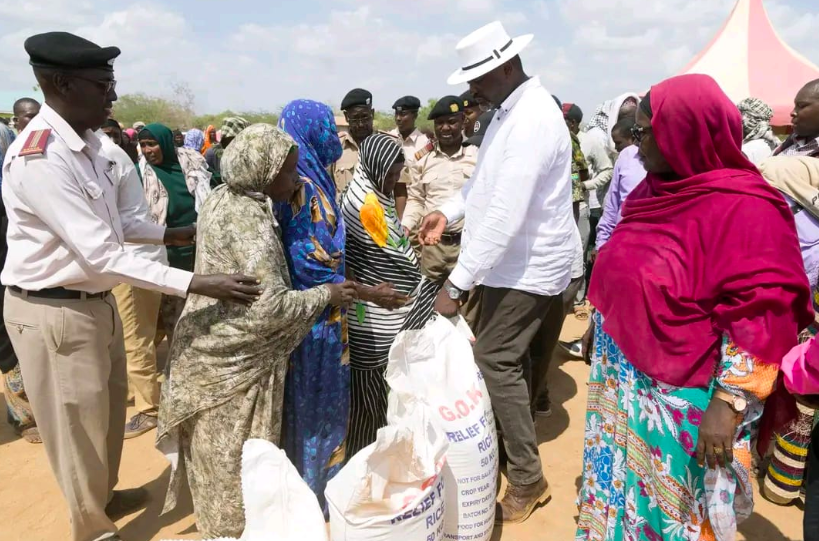
Public Service, Human Capital Development and Special Programmes: CS Geoffrey Ruku leads a relief food distribution exercise at Morokani village, Tana North sub-county. / STEPHEN ASTARIKO.
Food insecurity in Kenya will remain extremely high and could worsen in the coming months, a new report warns.
The report by the Food Security
and Nutrition Working Group for East and Central Africa says 6.39 million Kenyans are classified as stressed. Another 3.12 million people are in crisis while 586,306 others are in emergency phases.
A total of 3.7 million Kenyans are experiencing crisis or
worse conditions according to the February 26 report.
Refugee populations are severely affected, with 429,500 people in Dadaab, Kakuma, and Kalobeyei camps
in IPC Phase 3 or higher, including 186,500 in emergency.
The report attributes the
deteriorating situation to below-average rainfall during the October–December
2025 rain season which was erratic and poorly distributed.
Drought, isolated
intense storms, pest infestations, and livestock diseases have compounded
agricultural and pastoral losses.
The resulting poor harvests, high
food prices, and declining purchasing power have forced households to adopt
negative coping mechanisms such as skipping meals, borrowing, and selling
productive assets.
Malnutrition levels are also rising with 810,871 children affected
by acute malnutrition and another 202,230 suffering severe acute malnutrition. Some 44,907 children require treatment in refugee camps.
Mandera, Turkana South, and North
Horr are classified as extremely critical, while Laisamis is
projected to deteriorate.
The report highlights a widening gap
in response capacity due to declining funding, changing donor priorities and
rising needs.
“Urgent needs increasingly exceed
available support. This calls for stronger coordination, targeted
interventions, and improved data collection to enable evidence-based resource
allocation,” the report says.
Key risk factors to monitor include
March–May rainfall performance, crop pests and livestock diseases, household
food stocks, staple food prices, market functionality, and humanitarian
assistance for refugees.
The report notes that the UN Office
for the Coordination of Humanitarian Affairs has provided Sh900
million for drought response in seven priority counties of Turkana, Mandera,
Wajir, Garissa, Tana River, Samburu and Marsabit.
Human-wildlife conflicts have also
emerged as a serious threat, destroying crops, predating livestock and
disrupting essential services.
The report warns that without timely
intervention, the ongoing food insecurity and malnutrition crisis will deepen,
leaving millions at risk of hunger and famine.
