Latest News – From Aardvark to Zol: How documenting language has helped South Africa understand itself
[CREDIT: Ntomb’Zekhethelo Ncanana]
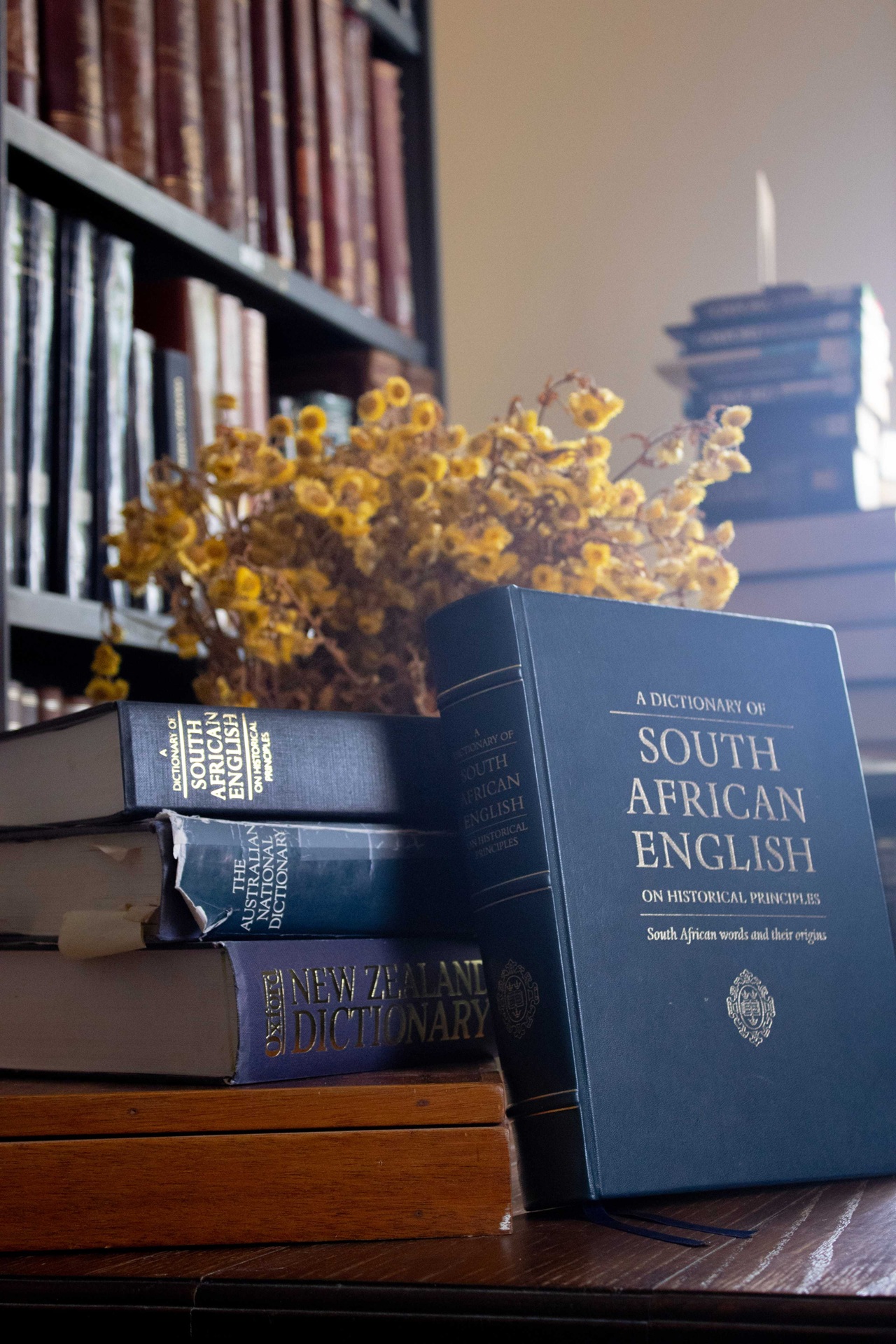
Exactly thirty years ago, in the early days of South Africa’s democracy, a remarkable book arrived on library desks across the country. Produced by the Dictionary Unit for South African English (DSAE) at Rhodes University and published by Oxford University Press, A Dictionary of South African English on Historical Principles was imposing in size and scholarly precision, yet it carried an unexpected emotional charge. At a moment when the nation was beginning to narrate itself anew, this dictionary offered a quietly powerful mirror: a record of how South Africans had spoken, written and imagined their world across more than three centuries.
The dictionary did not present South African English as a tidy list of meanings. Instead, it traced words from their earliest known appearance in written sources, drawing on evidence from newspapers, travellers’ journals, court transcripts, literature and everyday documents. This “historical principles” approach demanded forensic rigour. Each word’s story had to be proven through dated quotations that showed how meanings shifted over time. What emerged was not just a reference work but a biography of a people.
“Even ordinary words such as mealie surface at pivotal moments in history,” says Executive Director of the DSAE, Tim van Niekerk. “A 1900 citation records Winston Churchill describing the need to “buy mealies” during the South African War. Nearly a century later, a 1990 citation captures Nelson Mandela, newly released from prison, reflecting on mealie fields he had once known as villages. Across time, a single word gathers layers of meaning. The dictionary is filled with such contrasts, revealing history through language.”
The origin story
That story began almost three decades before publication, in 1968, when Professor Bill Branford launched a pilot project at Rhodes University. At the time, South African English was widely dismissed as quirky or marginal. Yet more than 3,500 local words were already in circulation without a full scholarly record. Professor Branford and his early team recognised the need for something more ambitious: a dictionary that took South African English seriously as a distinct, fully developed variety shaped by encounter, conflict and creativity.
Compiling that record in a pre-digital world required extraordinary stamina. Researchers collected citations on paper slips that filled filing cabinets and cardboard boxes. Some entries spanned centuries. The final published dictionary entry of the word kraal, for example, had 156 cited quotations spanning over 262 years. Other entries captured the linguistic machinery of apartheid: Group Areas, pass law, bantustan. Documented chronologically, these became an unflinching record of how language had been used to legislate, justify and resist oppression in South Africa.
“Every word was treated with forensic care,” says van Niekerk. “It was more than a dictionary; it was a historical record of a country finding its voice.”
When the dictionary finally appeared in 1996, the Truth and Reconciliation Commission was underway. South Africans were listening, often for the first time, to testimonies that laid bare the country’s fractured past. The dictionary, in its own way, became part of that reckoning. It documented the euphemisms that shielded cruelty, the slurs that shaped policy, and the rallying cries that fuelled resistance. It also illuminated the vast web of linguistic borrowing that had long defined South African English: words from Khoi and San languages (e.g. dagga, kanna), Dutch and Afrikaans (e.g. veld, kloof), Bantu languages (e.g. ubuntu, indaba), Malay (e.g. sosatie, sjambok), Portuguese (e.g. brinjal, chokka) and others. Its pages reminded readers that South African English had never belonged to a single group. It was a collective creation, woven through moments of exchange, peaceful, painful and everything in between.
Building a record of a country’s voice
Today, the DSAE, still housed at Rhodes University, continues this work in the digital era. The original citation slips, painstakingly organised decades ago, now underpin a dynamic online platform that tracks emerging terms and evolving usage.
Contemporary lexicographers work in a multilingual, digitised environment shaped by social media, youth culture and rapid urban change.
“Our predecessors designed and built a lexical dataset before the term ‘database’ was widely used,” says Bridgitte Le Du, Senior Editor at DSAE. “At the time, it was written as ‘data base’. We still rely on much the same structure today to track new words, shifting meanings and modern usage electronically.”
Above all, the DSAE’s work is an act of cultural care. It honours the voices that came before, preserves the injustices encoded in language so they cannot be forgotten, and celebrates the creativity with which communities continue to shape South African English today.
As Le Du reflects, “Words show us where we have been, but they also show us what kind of society we are becoming. That is why the work still matters.”
Thirty years on, A Dictionary of South African English on Historical Principles remains what it was always destined to be: a national archive, a scholarly triumph and a living testament to the power of language to connect, illuminate and, at times, to heal.