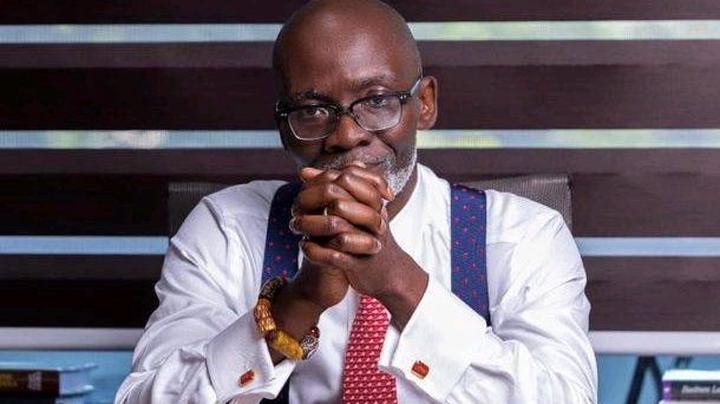
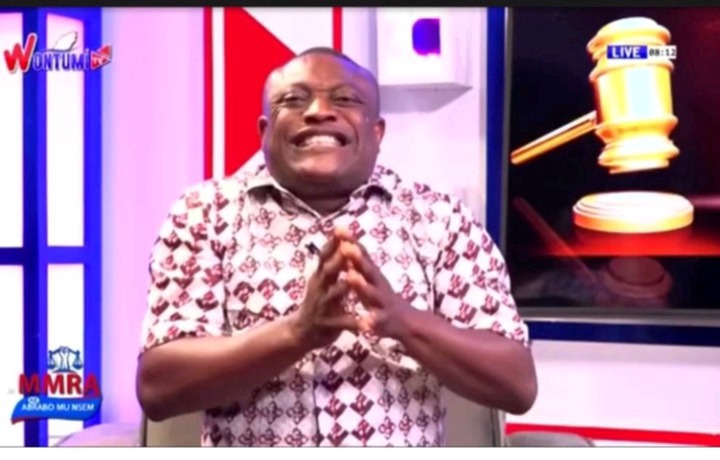
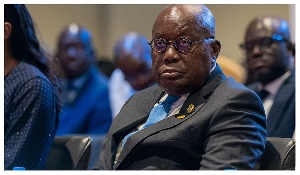
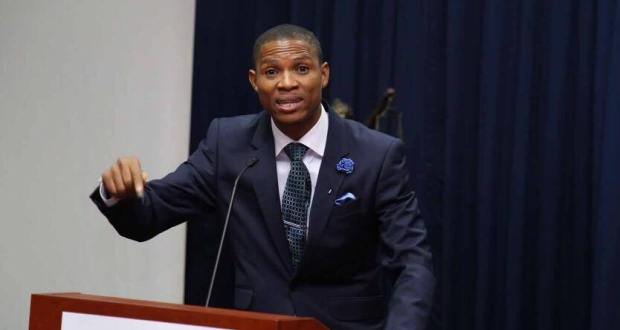
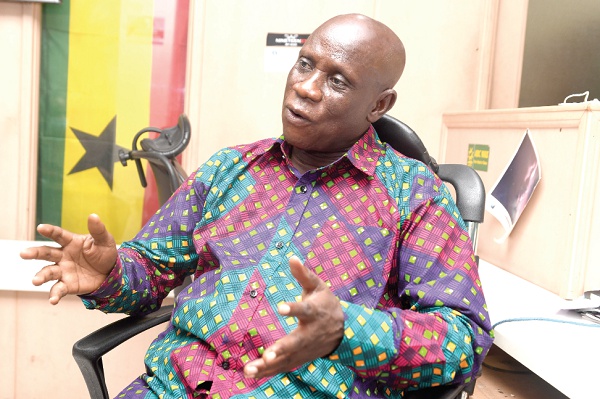
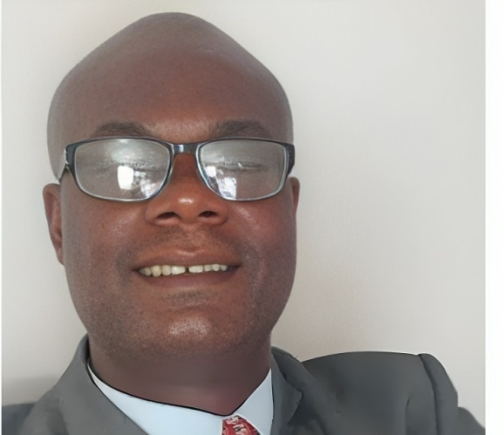
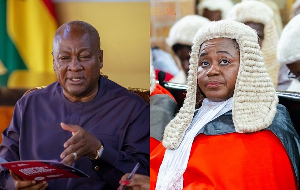
Lawyer Maurice Ampaw, a respected legal expert and advocate for human rights, has harshly criticized Gabby Otchere-Darko, a key figure in the New Patriotic Party (NPP), for treating him with apparent disdain. Ampaw said he spent three uninterrupted hours at Gabby’s office, hoping to hold a discussion on critical issues affecting the party, only to be completely ignored.
During his appearance on Mmra Ne Abrabo Mu Nsem on Wontumi TV, Ampaw recounted his experience, expressing shock that someone he once admired could disregard him in such a manner. Despite the noble cause he intended to discuss, Gabby reportedly paid no attention to his visit.“I’ve never had anything against Gabby. I admire him. But imagine sitting in someone’s office for three full hours, and they pretend you’re not there. That was my experience,” Ampaw revealed.
He further claimed that Gabby’s arrogant attitude is part of the problem within the NPP and could be driving supporters away. He warned party members not to let Gabby’s behavior discourage them from contributing meaningfully to the party’s future.
“Gabby Otchere-Darko is a hindrance. Don’t emulate him. Are people praising him for showing disrespect to someone like me? Win or lose, we’re not defending that attitude anymore,” Ampaw declared.
He used the opportunity to call for unity within the NPP, urging members to rise above petty conflicts and disloyalty if they want to prevent the party from losing leadership to John Mahama.
Ampaw’s sentiments add to a growing number of voices raising concerns about Gabby Otchere-Darko’s character and interpersonal relations, which many say are often cold and dismissive.
Though widely acknowledged for his exceptional legal skills and deep-rooted political influence, Gabby’s critics argue that his personal approach may be alienating people who genuinely care about the party’s growth.
Ghanaian media personality and political commentator, Okatakyie Afrifa, has stirred up social media with a fiery outburst aimed at Malik Basintale, the Chief Executive Officer of the Youth Employment Agency (YEA). In a bold and confrontational tone, Afrifa claimed that he used to provide food for Basintale in the past, suggesting that the YEA boss has forgotten his humble beginnings.
In a widely circulated video, Okatakyie Afrifa did not mince words as he addressed Malik Basintale, saying: “I used to buy food for you, gyae gyimii no!” — a statement which translates loosely to “stop the foolishness.” His remarks were laced with both disappointment and frustration, hinting at a strained personal history between the two.
Afrifa went on to allege that Basintale, who now occupies a high-ranking position within the Akufo-Addo-led administration, has become arrogant and ungrateful. He accused him of speaking ill of people who once supported him, including himself. The broadcast personality questioned Basintale’s loyalty and values, painting him as someone who has abandoned those who helped him rise to prominence.
The video has since triggered a wave of reactions online, with some supporting Afrifa for “reminding” public officials of their roots, while others felt the public nature of the rant was unnecessary and unprofessional.
This public fallout comes at a time when political tensions in Ghana are already high, and such personal attacks are increasingly drawing attention from both citizens and political watchers.
As of now, Malik Basintale has not issued a public response to the allegations and verbal jabs. However, many Ghanaians are closely watching the situation, anticipating whether the YEA boss will react or ignore the storm altogether.
A cloud of sorrow has fallen over the Ghanaian entertainment and youth culture community following the tragic discovery of the lifeless body of popular Jama leader, Agyei Baffour Emmanuel, popularly known as Atom De Moral Spirit. He was reportedly found dead in a bush after being declared missing for several days.
Atom, a well-known figure among Ghanaian students and youth groups, gained nationwide attention for his unmatched energy and charisma while leading Jama sessions — a traditional style of rhythmic chanting and drumming. He rose to online fame after a viral video showed him at the center of a vibrant school gathering, leading fellow students in high-spirited chants and dance routines that left social media users in awe.
Loved by many for his liveliness and spirited personality, Atom became a symbol of joy and excitement during public events, school programs, and communal youth gatherings. His unique ability to electrify crowds made him a beloved figure, especially among schoolchildren and the younger generation who looked up to him for inspiration.
Tragically, Atom went missing a few days ago, prompting concern among his friends, family, and followers. Search efforts were launched after his unexplained disappearance. Unfortunately, those hopes were dashed when his body was discovered in a bush under unclear circumstances.
Photos circulating online show mourners gathered at the site where his remains were found, with many still in disbelief over the untimely passing of a young man who brought life wherever he went.
Authorities are yet to release full details surrounding the cause of death, but investigations are reportedly underway.
Tributes have since flooded social media platforms, with fans, friends, and fellow Jama lovers expressing heartbreak over his sudden demise. Atom De Moral Spirit is being remembered not just as a performer, but as a source of joy who brought people together through culture, rhythm, and energy.
Artificial intelligence (AI) is no longer considered science fiction. It is already evident in the way we live, work and connect, with personalised internet ads, voice assistants, chatbots, facial recognition systems, and even financial advice tools.
Artificial intelligence is gaining traction in Ghana’s banking, retail, agricultural, education and customer service industries. However, as technology improves, many experts are beginning to wonder whether AI will replace their skills.
If you’re a banker, teacher, call centre agent, content producer, marketer or even an entrepreneur, you’ve seen AI systems complete certain things faster and more efficiently than humans. This generates alarm, and rightly so.
The good news is that AI has not come to replace, but rather to enhance and improve human activities. Educational platforms in Ghana deploy AI tutors to help students.
This means that artificial intelligence isn’t optional. It’s a must-have tool for individuals and businesses who want to stay current and competitive.
Here are some compelling reasons why increasing your AI skills is important, especially in Ghana’s changing job market:
Automation is accelerating quickly
AI is automating routine and repetitive tasks across all industries. Many important occupations are being redefined, such as data entry, scheduling, inventory management, and email responses.
In Ghana’s financial business, for example, AI-powered chatbots now respond to consumer issues in seconds, whereas human personnel used to. This does not mean that all jobs will disappear.
This indicates that the nature of labour is shifting. The genuine value is now found in tasks that require judgement, creativity, emotional intelligence, strategic thinking, and other skills that machines cannot fully replicate.
To remain relevant, let AI handle the mundane while you focus on the important. To accomplish this, you must first understand how AI works, what it is capable of, and how to use it.
New job roles are emerging
While artificial intelligence will eliminate certain jobs, it will also generate new ones, like AI trainers, data analysts, prompt engineers, machine learning specialists, AI ethicists, and others.
Even in traditional areas such as farming and education, there are job opportunities for people who can interpret AI data, create digital learning tools, or manage tech-assisted operations. Ghanaian youth who learn AI will be better prepared for these high-demand, high-value jobs.
If you work in marketing, human resources, education, sales or logistics, understanding AI solutions such as ChatGPT, Canva AI, Midjourney, Microsoft Copilot, or Salesforce Einstein can be a huge advantage.
Businesses want AI-savvy employees
Employers in 2025 will look for more than just qualifications. They want people who can think, adapt and create, especially with digital tools. A CV titled “AI Integration Experience,” “Prompt Engineering,” or “Data Analysis Using AI Tools” will stand out.
In Ghana, SMEs, fintech firms, and even government agencies are investing in artificial intelligence to improve service delivery and reduce costs.
If you can show that you understand AI tools and how to use them to improve efficiency or decision-making, you will improve your employability and promotion prospects.
Entrepreneurs can use AI to scale faster
If you own a small business in Ghana, AI could be your most valuable competitive advantage. ChatGPT, Grammarly, Canva AI, and Lumen5 allow you to automate customer answers, generate marketing material, analyse customer data, design business proposals, and create social media videos.
You no longer need to hire a large workforce to run a modern firm; all you need are the correct AI tools and expertise. This levelled the playing field for Ghanaian entrepreneurs with low funds.
AI makes you more productive and creative
Many professionals are concerned that AI would limit human inventiveness. But the contrary is true.
AI can help you generate ideas, overcome creative bottlenecks, and quickly test business models.
If you’re a writer, designer, musician or public speaker in Ghana, AI technologies can help you draft content faster, edit and enhance your work, create images or music, and suggest improvements and alternatives. Consider AI to be a smart assistant that accelerates, sharpens and innovates your performance.
Conclusion: Adapt or be left behind
Those who embrace artificial intelligence will succeed in 2025 and beyond. Those who resist will struggle. The future belongs to people who are adaptive, curious and eager to learn new abilities.
Whether you’re a student in Accra, a tailor in Takoradi, a corporate executive in Kumasi, or a farmer in Tamale, AI can help you, but only if you take the first step towards learning and growth.
So, is AI replacing your skills? Maybe. But only the outdated ones. The true question is whether you are improving yourself to stay relevant.
Dr Andrews Ayiku is a Lecturer/SME Industry Coach and Coordinator (MBA Impact Entrepreneurship and Innovation) at University of Professional Studies Accra [email protected] IG: andy_ayiku @AndrewsAyiku F: Andyayiku
Chelsea have an astonishing number of attackers on the books ahead of the 2025-26 season
Chelsea’s acquisition of forwards continues unabated. Since the takeover by the Clearlake Capital consortium in the summer of 2022 they have permanently signed 19 wingers, strikers and attacking midfielders. In the coming days that number should grow to a round 20, Borussia Dortmund’s Jamie Gittens expected to follow Joao Pedro, who on Wednesday signed from Brighton and Hove Albion in a $69 million deal, arriving to feature in the closing stages of the Club World Cup.
The Office of former President Nana Addo Dankwa Akufo-Addo has dismissed media reports alleging that he attempted to influence the New Patriotic Party’s (NPP) decision on its early primaries and sought to postpone the upcoming July 19 National Delegates Conference.
In a statement issued on July 14, 2025, the former President described the reports as “completely false.”
According to the statement, Akufo-Addo, who is currently outside the country, has not submitted any petition or made any request to the party regarding the primaries or the conference.
“For the avoidance of doubt, we wish to state emphatically that these reports are completely false. President Akufo-Addo, who has been out of the jurisdiction for some time now, has not made any such requests on the party, either by a petition or any other means, and he does not have any such intentions,” the statement read.
The former President’s office further suggested that the publications were being driven by individuals with ulterior motives that had nothing to do with strengthening the party.
“Clearly, those behind these publications have an agenda of their own, which has nothing to do with improving the fortunes of the New Patriotic Party (NPP),” it added.
The NPP National Delegates Conference is scheduled for July 19, 2025, as part of preparations for the party’s campaign ahead of the 2028 general elections.
AM/KA
GhanaWeb Special: The gold market that fuels galamsey
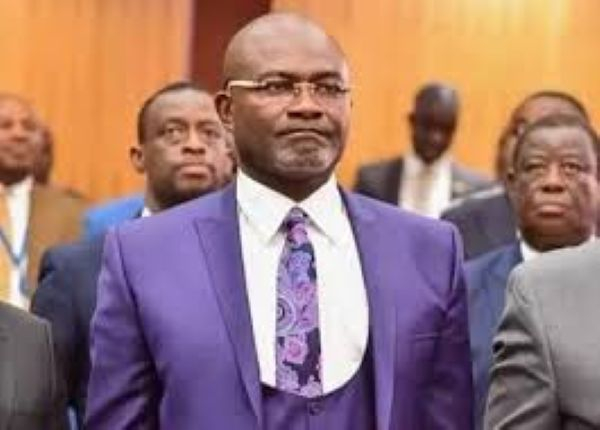
New Patriotic Party (NPP) flagbearer hopeful, Kennedy Agyapong
New Patriotic Party (NPP) flagbearer hopeful, Kennedy Agyapong, has stated that if he were the President of Ghana, several police officers who witnessed the violence that marred the Ablekuma North election would have been dismissed.
According to the former Assin Central Member of Parliament, nobody will be above the law under his leadership, and regardless of a person’s status, whether a police officer or a party member, anyone who breaks the law will face justice.
Speaking to the media in a video shared on social media regarding the Ablekuma North elections, Kennedy Agyapong emphasised, “Nobody is above the law. And trust me, if I were the president, I would have fired many of the police officers who were there.
“I would have arrested those who were captured on camera to serve as a deterrent. You can’t take anybody’s life, and you can’t beat anybody.
“We are all one people, and I will ensure peace and fairness. What we are seeing now would not be tolerated under my leadership,” he said.
The election, which saw the National Democratic Congress (NDC) parliamentary candidate for Ablekuma North, Ewurabena Aubynn, elected as the Member of Parliament-elect for the constituency, was marred by violence.
Former Minister of Fisheries and Aquaculture, Mavis Hawa Koomson, was assaulted along with other party members during the chaos.
The rerun, held on Friday, July 11, 2025, followed months of controversy over the initial parliamentary results declared in December 2024, after rioting at the collation center forced the suspension of vote counting from 19 polling stations.
Hon. Kennedy Agyapong clashes with NDC Alhaji Asorka at the ongoing rerun elections in Ablekuma North.
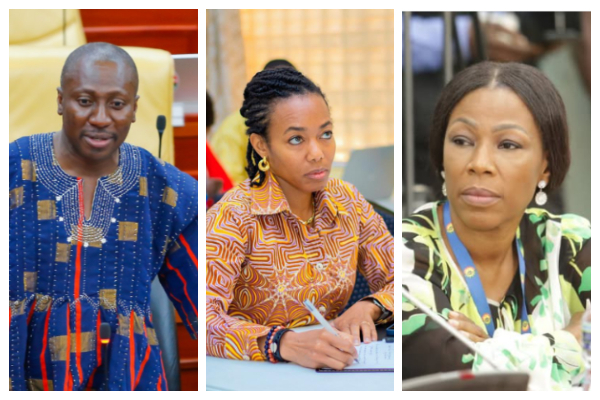
A photo collage of Afenyo Markin, Dr Zanetor Agyeman-Rawlings and Professor Grace Ayensu-Danquah
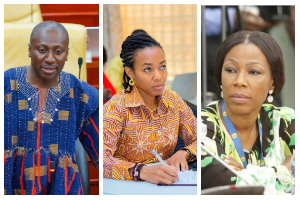
The Minority Leader of Parliament, Alexander Afenyo-Markin, on July 14, 2025, caused a stir in Parliament following comments he made about the Member of Parliament for Essikadu-Ketan, Professor Grace Ayensu-Danquah.
The Effutu MP, while making a submission, ordered Prof Ayensu to sit down, insisting she was out of order.
A visibly agitated Afenyo-Markin scolded the MP, arguing that as a new entrant in Parliament, she ought to conduct herself properly and not interrupt when a leader was speaking.
Afenyo-Markin further jabbed Prof Ayensu, questioning why she had been given a ministerial appointment in the ruling National Democratic Congress (NDC) government when senior party figures, such as Dr Zanetor Agyeman-Rawlings the Member of Parliament for Klottey Korle, had not been considered.
“My colleague, your name is not even on the list yet. We have only heard rumors that you will be facing the Appointments Committee, and this is what you choose to be doing?
“You came to meet Dr. Zanetor here, and for some strange reason, it appears your name is being considered when even party stalwarts like Helen Ntoso are still waiting. And yet you want to be raising points of order while your leader is speaking?”Afenyo-Markin said.
Prof Ayensu, who is also the Deputy Minister of Health-designate, did not take kindly to the comments.
She described Afenyo-Markin’s remarks as offensive and discriminatory against women in Parliament.
Responding to the Speaker, she said, “Mr. Speaker, there are only 14% of women in this House, and some of these statements are very discouraging. I was simply standing up, waiting to catch your eye, when I was attacked for no reason.
“Mr. Speaker, it makes it very difficult for women to speak when we face veiled threats and passive-aggressive behavior. I respectfully request that part of the statement be expunged from the records because I was offended by it, having done nothing to deserve such treatment.”
Prof Ayensu emphasised that she had not provoked Afenyo-Markin in any way and urged Parliament to encourage a more inclusive and respectful environment for female MPs.
AM/KA
GhanaWeb Special: The gold market that fuels galamsey
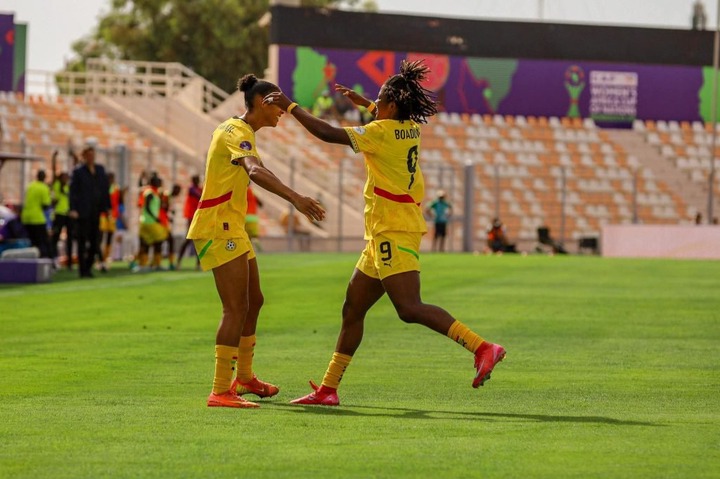
Ghana’s Black Queens face a must-win clash against Tanzania today in what has become a do-or-die encounter in the group stage of the 2024 Women’s Africa Cup of Nations (WAFCON).
Following a 2-0 defeat in their opening match against defending champions South Africa and a hard-fought 1-1 draw with Mali, the Queens find themselves with just a single point after two games.
Anything less than a victory against Tanzania at the Berkane Municipal Stadium on Monday will almost certainly end their hopes of advancing to the quarterfinals.
Despite the pressure, there are reasons for optimism. The team has shown flashes of quality, particularly in attack, where Doris Boaduwaa and Chantelle Hlorhkah have proven dangerous.
Alice Kusi and Grace Asantewaa bring experience and composure in midfield, while coach Kim Bjorkegren has demonstrated tactical flexibility with his substitutions.
Tanzania, who are also fighting for survival in the tournament, won’t be an easy opponent.
They possess speed, grit, and the hunger of a team with everything to gain. However, Ghana will take confidence from past encounters and their superior quality on paper.
This match is about more than just three points – it’s about pride, redemption, and the chance to keep their WAFCON dreams alive.
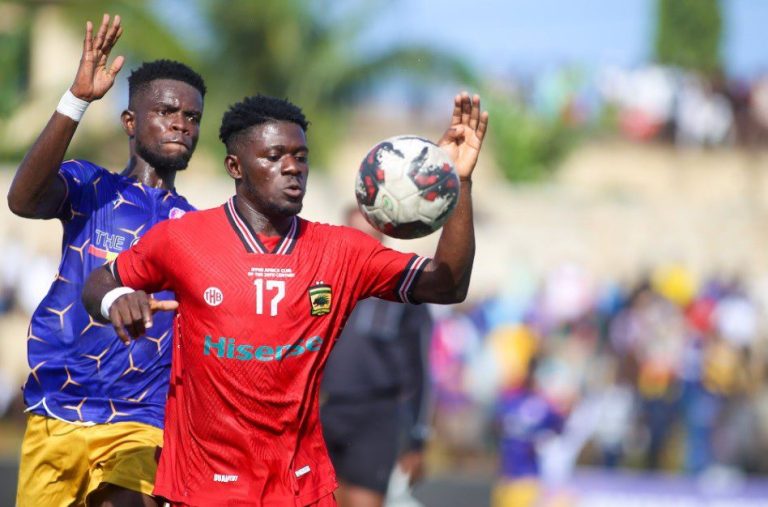
Asante Kotoko are considering a review of their centralised player accommodation policy after serious allegations surfaced from former captain Justice Blay.
In a recent interview, Blay alleged that some players, while in camp, have engaged in misconduct, including alcoholism and “snatching” teammates’ girlfriendsâclaims that have since sparked heated debate among fans and stakeholders.
Reacting to the issue, Kotoko’s Communications Director, Sarfo Duku, said the initial decision to house players together was meant to improve convenience and team cohesion. However, the club is now reassessing the move in light of the disturbing revelations.
“The idea of bringing these boys together⦠is to ensure that they have some convenience,” Duku told Luv FM. “The struggle of players having to move from their destinations to come for training, traffic issues, transportationâwe thought bringing them closer to the training facilities would give them comfort.”
He revealed the policy was endorsed by Otumfuo Osei Tutu II, the club’s life patron, with the goal of providing players with a stable and focused environment.
However, Duku admitted that if the arrangement proves to be more damaging than beneficial, Kotoko will not hesitate to make changes.
“It is an initiative that was endorsed by the King himself⦠but if upon second thought, we realise that it will rather go against the club, we will take another look at it,” he said.
The club is expected to evaluate the current setup before the new season begins.
Michael Donyinah Mensah, Executive Director of the Centre for Public Opinion and Awareness
Michael Donyinah Mensah, Executive Director of the Centre for Public Opinion and Awareness, (CenPOA) a non-partisan and non-governmental civil society organisation dedicated to promoting civic engagement and participation in public administration, has expressed the opinion that the violent incidents that marred the Ablekuma North constituency will tarnish John Dramani Mahama’s presidency if the government does not take swift action to bring perpetrators to book.
The policy analyst stated that the country did not learn any lessons from the Ayawaso West Wuogon by-election violent incidents.
He lamented that what happened has shown that democracy is not growing and is a threat to the stability of the people in the country.
He explained that from what has happened, it has become evident that without violence and hooliganism, the country cannot organise an election properly.
“It appears without violence and hooliganism; we cannot organise elections and declare winners. This is most unfortunate and shows we are still far from realising the full potential and benefits of our democracy.
“We should have learnt lessons from the Ayawaso West Wuogon crisis, but from what happened on July 11, 2025, it is sad and disgusting, especially when we have passed a law to deal with electoral violence and vigilantism and hooliganism. This clearly shows that we are not moving forward,” he said on Frontline on Rainbow Radio 87.5FM.
Michael Donyina Mensah also condemned the justification by some people, saying, “Whereas some people have claimed that ‘tit-for-tat’ is not a sin, it is actually a grave sin because if you did something wrong and I condemned it, I have no business doing the same thing and justifying it.”
“The NDC made political capital out of the Ayawaso West Wuogon crisis and lambasted former President Akufo-Addo for failing to act, so after winning office, if a similar thing had occurred under your watch, then I can confidently say Ghanaian politicians are hypocrites.
“This will be a trial and test case for President John Dramani Mahama because if he fails to act on this matter to show Ghanaians that he is acting differently from what they expected Nana Akufo-Addo to do when the Ayawaso West Wuogon incident occurred, it will be a blemish on his presidency.”
Michael Donyina Mensah said although the Vice President Prof Naana Jane Opoku-Agyemang’s condemnation is good and reflects the position of the government, immediate action ought to be taken against those engaged in the act.
“Verbal condemnation is not enough. It must move beyond that, and action must be taken against those who engaged in the lawlessness. We need to see action taken against those who caused the commotion on the day of the election.”
Hearts of Oak right-back Michael Ampadu is set to part ways with the club after failing to reach an agreement on a contract extension, sources close to the player have confirmed.
The defender has been a regular in the Hearts of Oak setup since joining from Legon Cities and was a key part of the team during the last Ghana Premier League campaign. Despite consistent performances, talks between the club and the player over a new deal have hit a deadlock, with no official agreement in place as of now.
Ampadu’s contract has expired, and with the Phobians yet to table a new improved offer, the player is now expected to leave the club as a free agent in the coming days. His departure will mark the end of a notable spell with the former league champions.
Several clubs in the Ghana Premier League and outside are reportedly showing interest in the versatile full-back, who is now free to negotiate terms elsewhere.
His experience, work rate, and defensive awareness make him an attractive option for clubs looking to strengthen their backline ahead of the 2025/26 season.
Hearts of Oak, under new head coach Mas-Ud Didi Dramani, are expected to undergo a major squad reshuffle as they prepare for the upcoming campaign and Ampadu’s imminent exit appears to be part of the changes.
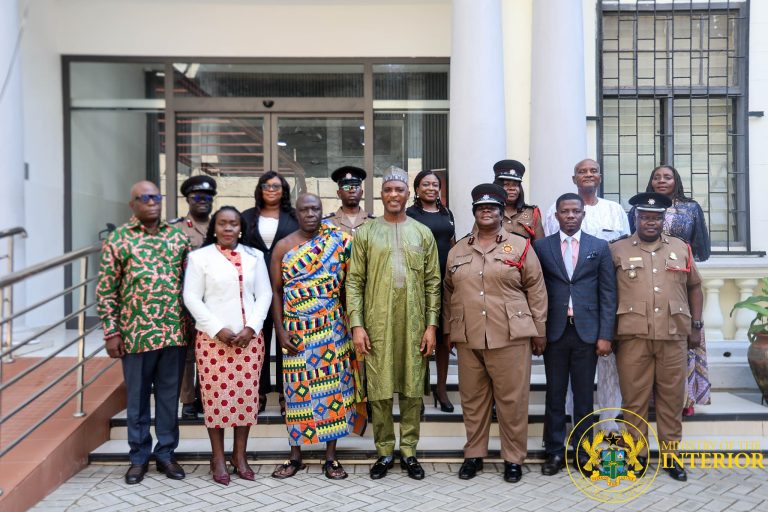
The Minister for the Interior, Alhaji Mohammed Muntaka Mubarak, has inaugurated the newly constituted Governing Council of the Ghana National Fire Service (GNFS) in Accra, with a strong call for a comprehensive review of the Fire Service Act, 1997 (Act 537).
Speaking at the ceremony, Muntaka underscored the need to align the Service’s legal framework with current realities, international standards, and emerging global threats.
He noted that the GNFS’s mandate has expanded significantly over the years and now includes multi-hazard emergency response, rescue operations, fire prevention, public education, hazardous material handling, and disaster mitigation.
The Minister urged the Council to take the lead in initiating reforms that reflect the evolving role of the Service.
He assured the Council of the Ministry’s unwavering support in working towards the modernisation and effective resourcing of the GNFS, guided by sound policy and ethical leadership.
“I congratulate all members of the Council on your appointment and trust that you will discharge your duties with integrity, professionalism, and dedication,” Muntaka said.
The newly appointed Chairman of the Council, Nana Ofori Ahenkan II, also reiterated the Council’s commitment to promoting transparency and accountability in the administration of the Fire Service.
He emphasised the Council’s responsibility in shaping a forward-looking and effective GNFS capable of fulfilling its vital national mandate.
Ghana’s proposed $70 billion Petroleum Hub development faces mounting criticism for potentially conflicting with national climate commitments.
Energy governance experts question the project’s alignment with Ghana’s Paris Agreement obligations and Nationally Determined Contributions (NDCs), which prioritize renewable energy transition.
The Natural Resource Governance Institute (NRGI) contends the investment risks locking Ghana into fossil fuel dependency as global markets shift. Country Manager Denis Gyeyir emphasized in The High Street Journal that such projects now carry significant financial disadvantages, noting investors demand high-risk premiums for fossil fuel ventures. “Financing costs escalate due to sector uncertainty,” he stated, highlighting potential debt burdens.
Project economics remain contentious. The hub’s $70 billion price tag nears Ghana’s 2024 GDP of $76 billion, requiring substantial borrowing. Critics argue equivalent investment could deploy nationwide solar farms, wind parks, and grid modernization addressing energy poverty faster while creating jobs. The infrastructure would also necessitate additional upstream oil exploration, increasing environmental impacts.
Timing concerns persist. Ghana’s energy transition framework targets renewable expansion, yet the petroleum hub’s multi-decade timeline could outlast peak fossil fuel demand. Gyeyir warned this might strand assets, stating such projects “deepen fossil fuel involvement counter to global trends.”
The Mahama administration has not publicly reconciled the hub with Ghana’s climate goals. With schools and hospitals underfunded, critics deem the project a misplaced priority. Renewable alternatives offer lower long-term costs and climate compliance, though officials maintain petroleum investments could fund green transitions.
UBA Ghana has had its Long-Term Issuer Default Rating (IDR) affirmed at ‘B-’ with a stable outlook by Fitch Ratings in its latest report released on 10 July 2025.
The rating is underpinned by UBA Ghana’s standalone creditworthiness and the potential support from its parent company, UBA Plc, which is headquartered in Nigeria.
Fitch also upgraded UBA Ghana’s Viability Rating (VR) to ‘b-’, reflecting improved creditworthiness following the sovereign upgrade of Ghana.
The update follows Ghana’s Long-Term Foreign-Currency IDR being raised to ‘B-’ in June 2025, after the country successfully restructured most of its Eurobond debt.
There various Key Drivers of the Rating including: Strong Profitability and Capital Strength: UBA Ghana has consistently recorded high operating returns on risk-weighted assets, averaging 4.5% from 2021 to 2024. The bank maintains large capital buffers, with a tangible leverage ratio of 12.7% and a CET1 ratio of 14.1% as of March 2025.
High Sovereign Exposure but Well Capitalised: While UBA Ghana holds significant investments in government securities (over 290% of equity), Fitch notes the bank’s strong capital position mitigates potential risks. Liquidity also remains robust, with customer deposits accounting for 93% of non-equity funding.
Improved Loan Quality: Impaired loans fell to 12.5% by the end of 2024 from 24.7% the previous year, thanks to strategic write-offs and recoveries. The bank’s prudent lending approach means loans constitute only 9% of total assets.
Group Support Outlook: Fitch notes UBA Ghana’s strategic importance within the UBA Group, with the parent company’s Long-Term IDR upgraded to ‘B’ in April 2025 following Nigeria’s sovereign rating uplift. UBA Ghana’s Shareholder Support Rating (SSR) remains at ‘b-’, a notch below its parent, reflecting its size within the group.
Commenting on the rating, Managing Director/CEO of UBA Ghana, Uzoechina Molokwu, stated: “We are encouraged by this affirmation from Fitch, which reinforces the confidence in our business fundamentals, prudent risk management, and the continued support from our parent group. We remain committed to delivering exceptional value to our customers, shareholders, and stakeholders across Ghana.”
UBA Ghana is well-positioned for future growth, with plans to expand lending to high-quality corporate and SME clients while continuing to manage sovereign and credit risks prudently.
DISCLAIMER: The Views, Comments, Opinions, Contributions and Statements made by Readers and Contributors on this platform do not necessarily represent the views or policy of Multimedia Group Limited.
DISCLAIMER: The Views, Comments, Opinions, Contributions and Statements made by Readers and Contributors on this platform do not necessarily represent the views or policy of Multimedia Group Limited.
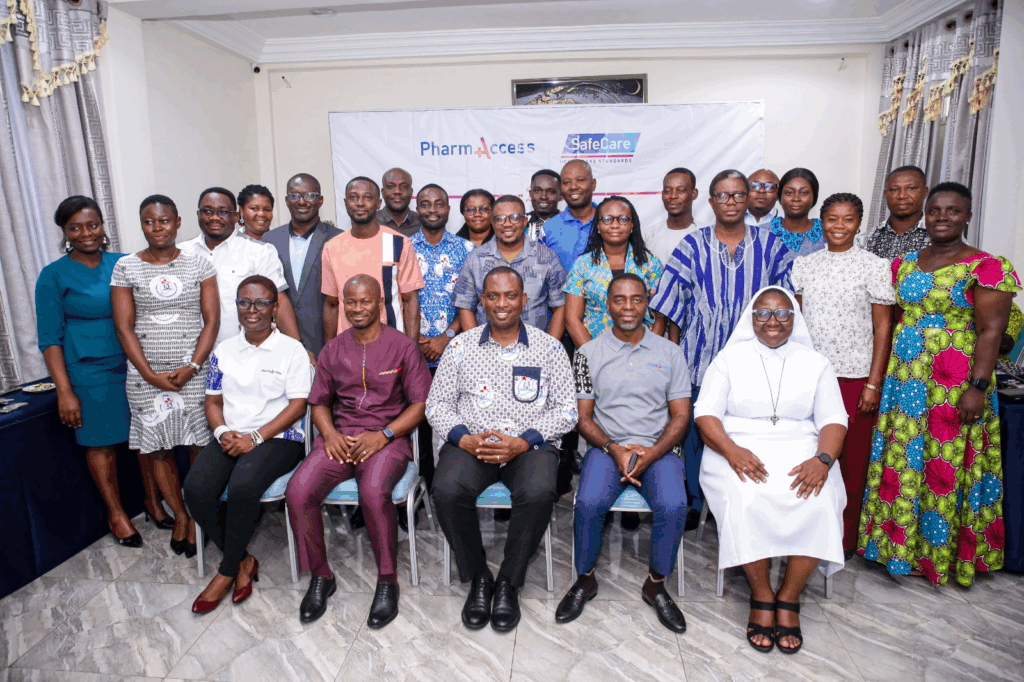
At a glance, the transformation might seem modest: a Cleaner, more conscious of disinfection routines, a Nurse adhering to protocols for wound dressing, or a medical officer being more attentive to patient interactions and documentation. But beneath these subtle changes lies a quiet revolution, SafeCare, which is impacting Ghana’s healthcare system—one facility, one worker, one patient at a time.
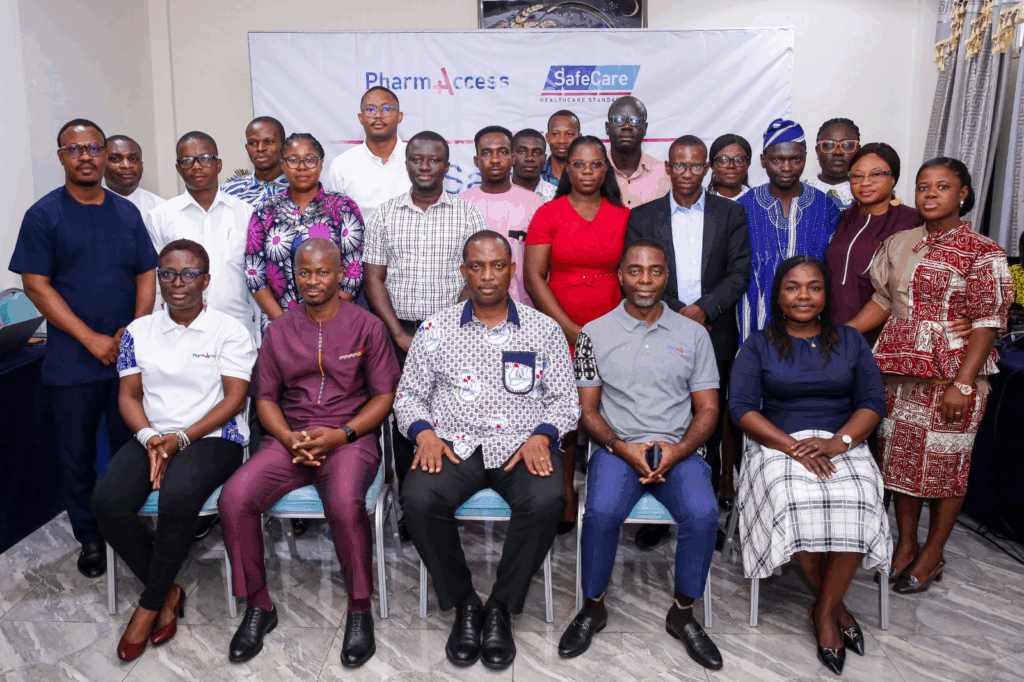
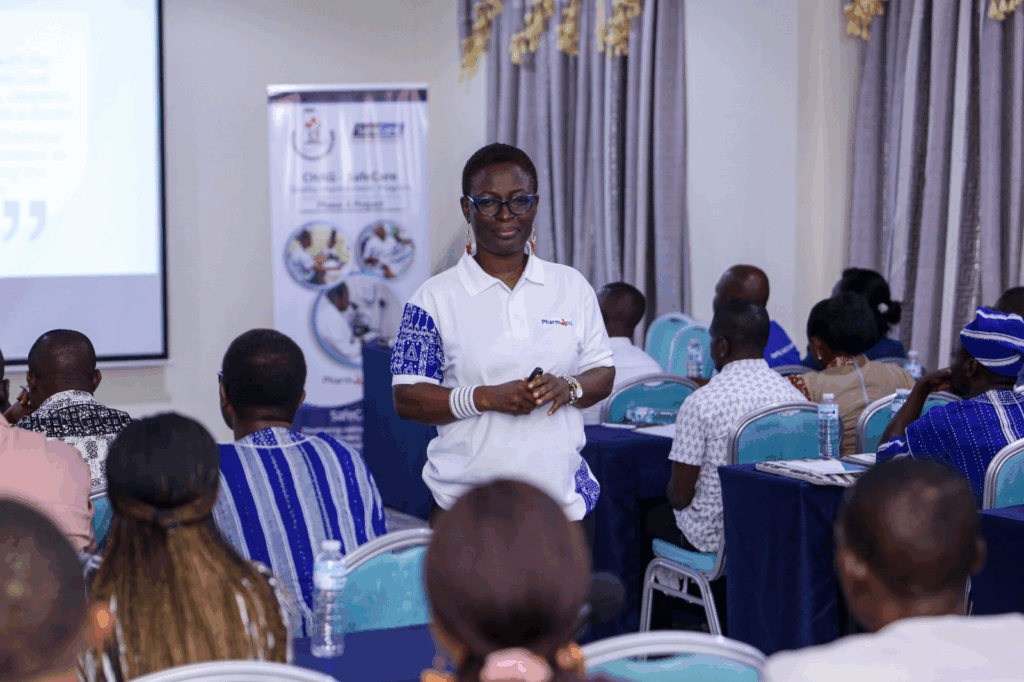
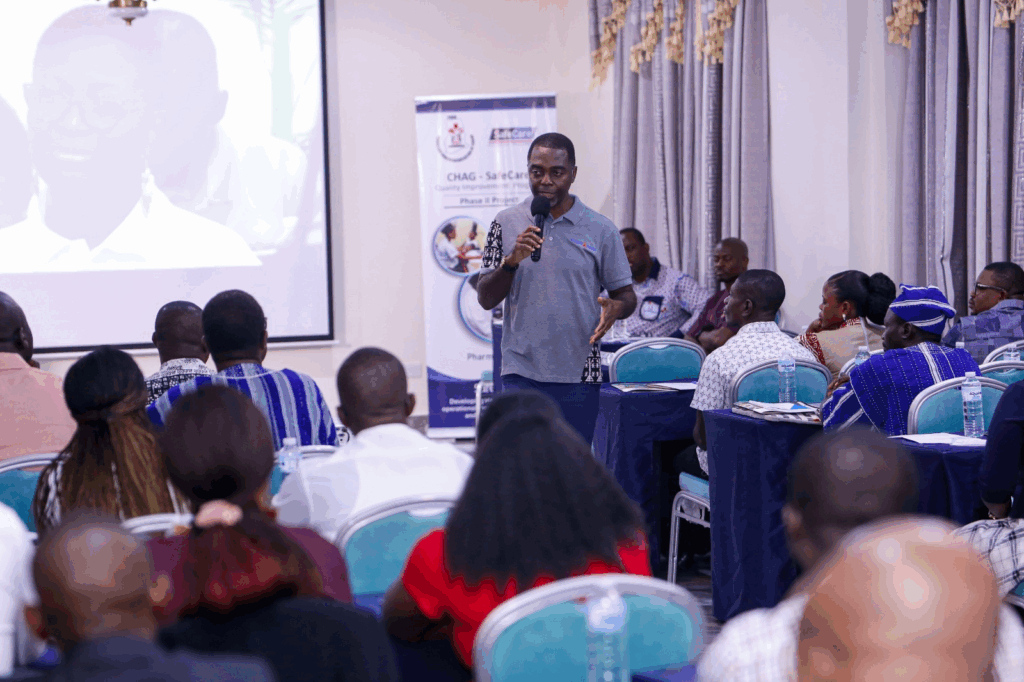
According to the internationally certified SafeCare assessors, who recently participated in the SafeCare Assessor Refresher Training in Koforidua under the theme “Consistency, Integrity, and Excellence: Elevating SafeCare Assessment Process for Facilities’ QI”, it may be the best hope yet for improving the quality of healthcare in Ghana.
Silently and gradually, SafeCare is helping to shape quality in healthcare delivery in Ghana. SafeCare was introduced to Ghana in 2011, but took off on a larger scale through the strategic partnership with Christian Health Association of Ghana (CHAG) and PharmAccess in 2019.
Through the partnership, selected healthcare professionals are trained to become Internationally Certified SafeCare assessors, utilising the SafeCare standards to assess CHAG member facilities and supporting them through an improvement initiative using the digitally enabled quality improvement approach.
Healthcare facilities networks using the SafeCare programme get their facilities introduced to a system for measuring, improving and benchmarking quality using ISQuaEEA-accredited standards. The SafeCare standards are categorised into 13 service elements (covering both clinical and non-clinical areas) with focus areas including Accident & Emergency Care, HIV, TB & Malaria, Infection Prevention, Mother & Child, Life & Fire Safety, Customer Care, Business Performance, Staff & Training, Stock Management, and Clinical Management.
Since its introduction in Ghana, healthcare organisations and networks such as CHAG, private healthcare partners and now Ghana Health Service (GHS), are using the SafeCare system to progress in improving trajectories from low quality to high quality. —demonstrating that systemic improvement is possible even with limited resources.
“SafeCare has the key to unlock remedies to the quality challenges in our health sector,” said Dr. Jennifer Salman, a paediatrician at Sunyani Municipal Hospital. “It’s more than guidelines and SOPs. It’s a way of thinking that transforms everyone in the healthcare facility—from the cleaner to the medical director.”
Training the Change Agents
The Assessor Refresher Training Programme, organised by PharmAccess, aimed to empower individuals to become agents of change. Participants included doctors, nurses, pharmacists, hospital administrators, quality officers, all trained to use the SafeCare standards and improvement methodology to support healthcare facilities with the provision of safer, efficient and more compassionate care.
“As a nurse, I used to think quality improvement was just about bedside care,” said Severa Kyeremaa, a pediatric nurse specialist from the CHAG network and a SafeCare certified assessor. “But SafeCare helped me understand that even cleaners and orderlies contribute to patient outcomes.” “Now I walk into a facility with confidence, knowing I have the tools to help close quality gaps.” For many, the training was an eye-opener. It pushed health professionals out of their silos, encouraging them to engage with broader aspects of service delivery— From governance, management, procurement & resource management, care coordination to data systems and waste management.
“SafeCare takes you beyond your area of specialisation,” said Benjamin Amoa-Menyah, another SafeCare-certified assessor and a specialist ENT nurse, from the CHAG network. “You start thinking about laboratory, pharmacy processes, documentation—things that seemed outside your role before. It sharpens your practice.”
A Proven Model, A Growing Movement
The success story with CHAG is proof of concept. Since 2019, SafeCare has helped the faith-based facilities adopt and integrate a culture of continuous improvement. Under the guidance of the CHAG Director for Quality, Dr. Abraham Baidoo and with the support of dedicated professionals at the newly set up Quality Hub, CHAG has embedded the SafeCare approach as a major strategic direction to support effective and efficient service delivery among member facilities.
“We have institutionalised SafeCare within CHAG, and the results are evident,” said Dr. Baidoo. “Our facilities are safer, better managed, and more accountable. It is no surprise that Ghana Health Service has adopted the same model. We are proud to share what we’ve learned.”
The Ghana Health Service began a small-scale rollout of the SafeCare Programme in the Savannah and Bono East regions in 2022. In one year, several facilities recorded significant quality gains. Subsequently, after expansion into one hundred other healthcare facilities in ten additional regions, four of the facilities have obtained a SafeCare Level 4 quality rating in 2024. —a leap that would have seemed impossible without the programs’ structured guidance powered by digital innovation. The Ghana Health Service is looking to scale the SafeCare system to all healthcare facilities of the Service using a local ownership approach.
“We have moved from fragmented quality initiatives to a system-wide framework,” explained Joyce Amponsah, who works with the Quality Assurance Department at the Ghana Health Service Institutional Care Division. “SafeCare has made it possible to track real progress, not just intentions.”
Restoring Trust, Raising the Bar
With healthcare organisations becoming more sensitive to medico-legal issues and striving to gain public trust, the SafeCare system is helping facilities to restore confidence of patients, communities and healthcare professionals.
“SafeCare is not just a checklist,” said Bonifacia Benefo-Agyei, Country Director for SafeCare Ghana. “It is a culture of integrity. Our assessors are trained not just to evaluate, but to inspire change.”
“When patients know that every step of their care is being guided by internationally recognised standards, it creates trust,” added Dr. Maxwell Antwi, Country Director of PharmAccess Ghana. “Our goal is for every Ghanaian to feel safe seeking care here, not to feel they must go abroad for better service.”
The growing SafeCare movement is also aligned with Ghana’s national commitment to Universal Health Coverage (UHC)—not just coverage in numbers, but care that is safe, equitable, and effective.
What’s Next: Building for the Long Term
The Certified Assessors will continue to work across Private, CHAG and GHS networks of facilities to evaluate quality performance, support improvements, and track facilities’ progress through SafeCare’s digital assessment tools. But the work doesn’t stop there. SafeCare’s ultimate promise lies in its sustainability—training teams who can train others, embedding standards into daily operations, and changing mindsets from the inside out.
SafeCare has transformed my approach to work,” said Dr. Salman. “I now view quality not merely as a target to achieve, but as a responsibility to maintain.” This sentiment resonates with the experiences of nearly every health worker who has adopted the SafeCare model. For them, it is not just about improving scores; it is about elevating standards. And in doing so, fostering hope.
DISCLAIMER: The Views, Comments, Opinions, Contributions and Statements made by Readers and Contributors on this platform do not necessarily represent the views or policy of Multimedia Group Limited.
Tags:
DISCLAIMER: The Views, Comments, Opinions, Contributions and Statements made by Readers and Contributors on this platform do not necessarily represent the views or policy of Multimedia Group Limited.
Improved reserves will influence BoG FX policy adjustments
The Bank of Ghana (BoG) is expected to reduce its dominant role in the country’s foreign exchange (FX) market in a strategic pivot toward a more flexible exchange rate regime, according to recent policy disclosures.
This move comes on the back of strong cedi appreciation and an overperformance in rebuilding international reserves – developments the central bank and International Monetary Fund (IMF) say support a transition toward more market-determined currency pricing.
The BoG has discontinued its bilateral adjudications and now conducts all FX interventions exclusively through transparent auctions. In a further step, the central bank is developing an internal FX intervention policy framework that will guide the scope, instruments and governance of its operations in the FX market.
The framework, which is expected to be adopted by the BoG board by end-September 2025, will codify the central bank’s discretion under a constraint approach to currency interventions.
The IMF, in its recent programme assessment, welcomed these reforms and called for formalisation of the FX intervention framework. It urged the BoG to deepen the interbank FX market and reduce its footprint to allow the exchange rate to respond more freely to market dynamics.
Greater transparency and predictability, the IMF argued, would enhance investor confidence and align Ghana’s monetary architecture with international best practice.
“Replacing bilateral adjudications with a transparent auction-based FX system represents an important improvement to transparency of the BoG’s FX operations,” the Fund noted.
“Looking ahead, deepening the interbank FX market by reducing BoG’s footprint and allowing for greater exchange rate flexibility should be a priority,” it added.
By April 2025 reserves had grown to about US$10.7billion, covering more than three months of import needs. The cedi has recorded strong gains in recent weeks, buoyed by improved FX inflows, a strengthened reserve position and tightening monetary policy.
According to market data from Databank, last week the cedi appreciated by 6.36 percent week-on-week against the US dollar to close at a mid-rate of GH¢11.80/$ – representing a cumulative gain of 31.57 percent year-to-date.
Similar gains were recorded against the British pound and euro, with the local currency appreciating 23.79 percent and 19.26 percent respectively.
The currency’s recent performance reflects a confluence of factors which include larger-than-expected cocoa receipts, a strong pipeline of inflows from the Domestic Gold Purchase Programme (DGPP) and consistent overshooting of Net International Reserve (NIR) targets under the IMF-supported programme.
The BoG’s FX interventions have also been more active in recent months, though authorities say such operations are increasingly rules-based and guided by auction outcomes rather than discretionary pricing.
“We are ahead of schedule on rebuilding official international reserves. Despite debt service commitments in a post-debt restructuring environment, we have consistently overperformed NIR targets since beginning the programme… This overperformance occurred in the context of a significant increase in BoG FX interventions,” the BoG stated in ensuing remarks.
The monetary authority said it remains committed to enhancing exchange rate flexibility, modernising FX operations and improving the governance of its interventions.
It has fully exited sell buy-back operations and earlier swap arrangements with commercial banks. Domestic gold purchases are now conducted strictly at market prices and the central bank is actively managing portfolio risks associated with gold’s share in total reserves.
While the IMF acknowledged benefits of the Domestic Gold Purchase Programme (DGPP) in boosting reserve buffers, it cautioned that the central bank must closely monitor associated liquidity and valuation risks. It also highlighted the importance of ensuring that reserve accumulation strategies are consistent with long-term portfolio stability.
In a broader policy shift, BoG has committed to eliminating multiple currency practices (MCPs) and ensuring a unified FX market. A more robust reference rate computation method, adopted in September 2024, has been in place for six months and is reported to have improved transparency and accuracy in the FX rate-setting process.
The broader macroeconomic framework appears to be stabilising, though risks remain. Inflation remains above BoG’s medium-term target of 8 ±2 percent and monetary policy remains tight. The BoG increased its policy rate by 100 basis points to 28 percent in March 2025, citing persistent non-food inflation pressures and elevated inflation expectations.
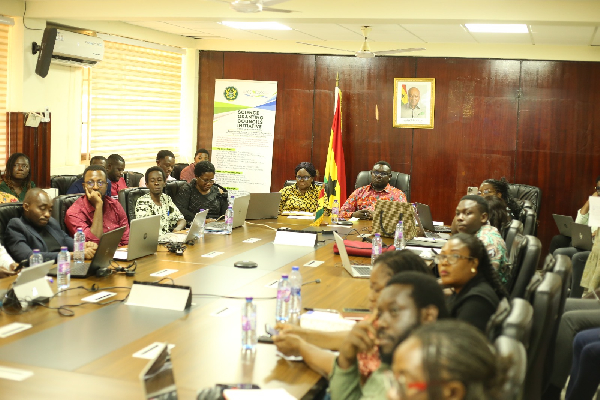
The workshop features expert facilitators from Meta’s Public Policy team
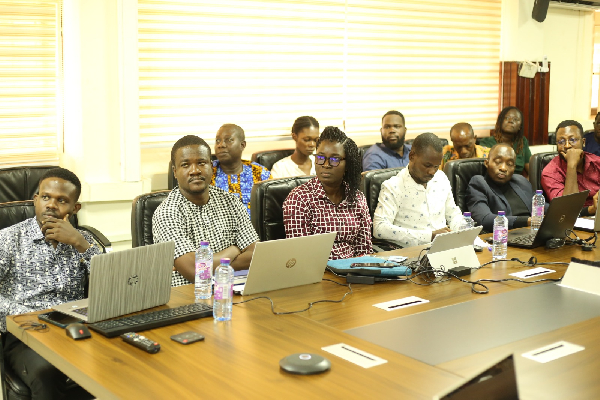
The Ministry of Tourism, Culture, and Creative Arts has commenced a two-day digital skills training workshop in collaboration with Meta, the parent company of Facebook, Instagram, and WhatsApp.
Running from July 14 to 15 in Accra, the workshop is designed to equip officials from the Ministry and its thirteen (13) implementing agencies with practical tools to harness Meta platforms for tourism promotion, cultural storytelling, and the growth of creative enterprises.
Delivering the welcome address, Vitus O Langmagne, Director of Human Resources at the Ministry, described the partnership as timely and strategic in aligning Ghana’s tourism, culture, and creative industries with global digital trends.
He urged participants to fully engage with the training and apply the knowledge gained to enhance both their professional output and personal development.
The training is spearheaded by Mabel Cudjoe, Director of Research, Statistics, and Information Management at the Ministry. She emphasized the importance of building internal capacity to meet the demands of an evolving digital environment.
According to her, participants will receive in-depth training on optimizing both organic and paid tools across Meta’s platforms – Facebook, Instagram, and WhatsApp.
“Modules include content creation, community engagement, audience targeting, campaign performance analytics, and the use of WhatsApp Business and API solutions to improve customer interaction,” Cudjoe noted.
“Participants will also be introduced to Meta Support Pro and the Self-Guide Portal to access ongoing technical and operational assistance.”
The workshop features expert facilitators from Meta’s Public Policy team, including Sade Dada, Head of Public Policy for Anglophone West Africa; Judith Mongala, Ahmad Shehada, and Burak Karagol, Partner Managers for Government and Social Impact; and Victoria Oloni, Public Policy Manager for Anglophone West Africa.
It will also include a special address by Kojo Boakye, Meta’s Vice President for Public Policy in Africa, the Middle East, and Türkiye.
GA
GhanaWeb Special: The gold market that fuels galamsey
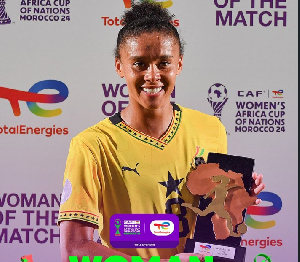
Ghana forward Chantelle Boye-Hlorkah was named Most Valuable Player (MVP) on Monday night after the Black Queens’ dominant 4-1 victory against Tanzania in the 2024 CAF Women’s Africa Cup of Nations (WAFCON).
After her outstanding performance and goal in the big win, she earned the Woman of the Match award.
Chantelle Boye-Hlorkah has been one of the best-performing players of the Black Queens since the start of the 2024 WAFCON in Morocco.
Following Ghana’s 4-1 win against Tanzania on Monday, the Black Queens booked their place in the quarter-finals, where they will be facing off with their counterparts from Algeria. That showdown will happen on Saturday, July 19.
More will be expected of Chantelle Boye-Hlorkah in the knockout stage of the tournament.
The Member of Parliament for Madina, Francis Xavier Sosu, has disclosed that two suspects have been arrested over the alleged defilement of a 14-year-old girl by 18 men in Madina, Accra.
According to the MP, the victim was discovered to be pregnant following the assault.
In a statement on the floor of Parliament on Monday, July 14, Xavier Sosu expressed outrage over the incident and vowed to pursue justice for the victim, pledging to ensure that all perpetrators are held accountable.
“My checks with the Madina DOVVSU divisional commander confirm that the victim is 14 years old and lives in Madina. The girl was discovered pregnant by her parents. Upon questioning, the girl said she had had sexual intercourse with 18 men on different occasions.
“Two suspects have been apprehended, cautioned, and detained to assist the police investigation. Efforts are underway to get the remaining suspects arrested, since the condition is a matter of defilement,” He stated.
DRIP equipment being used for galamsey – Afenyo-Markin alleges
…..
Explore the world of impactful news with CitiNewsroom on WhatsApp!
Click on the link to join the Citi Newsroom channel for curated, meaningful stories tailored just for YOU: https://whatsapp.com/channel/0029VaCYzPRAYlUPudDDe53x
No spam, just the stories that truly matter! #StayInformed #CitiNewsroom #CNRDigital
Asante Gold Corporation has successfully secured $173 million through a private placement to support its mining operations in Ghana, particularly at the Bibiani and Chirano mines, and to settle outstanding debts.
Asante Gold Corporation has completed its previously announced bought deal private placement, raising gross proceeds of $173 million.
The funding was done through the issuance of $163.3 million subscription receipts, each priced at $1.06.
The offer was fully subscribed, including the full exercise of the underwriters’ option.
Each subscription receipt will convert into one common share of Asante Gold once escrow conditions are met.
These include securing a comprehensive financing package valued at no less than US$275 million. Until then, the proceeds will be held in escrow.
Commission
The placement was led by BMO Capital Markets as co-lead underwriter and sole bookrunner. Clarus Securities Inc. and Jett Capital Advisors LLC also participated in the underwriting syndicate.
The underwriters earned a cash commission of 5.5 per cent on the gross proceeds, excluding amounts raised from specific investors listed by the company’s leadership, commonly referred to as “president’s list investors”.
Conditions, strategy
The release of the escrow funds is conditional upon the completion of a larger financing arrangement, which includes a US$150 million senior debt facility, a US$125 million subordinated debt facility and a US$50 million gold stream agreement.
This package aims to provide Asante Gold with the capital needed to progress its projects and settle short-term financial obligations.
Appian Capital Advisory Ltd. is expected to contribute US$175 million, including a CA$10 million equity investment at the same share price as the private placement.
Rand Merchant Bank, part of FirstRand Bank Limited, is committing US$170 million in the form of debt, hedging, underwriting and guarantees.
Should the escrow conditions not be fulfilled by December 31, 2025, or if Asante indicates it will not go ahead with the plan, the funds will be returned to investors along with any interest earned.
Gold agreement
As part of its broader financial restructuring, Asante is also working to resolve its obligations to Kinross Gold Corporation.
The company has proposed a cash payment of around US$53 million and the issuance of shares, which will increase Kinross’ stake in Asante to 9.9 per cent.
In addition to this equity arrangement, Kinross will receive a convertible debenture and a deferred note to settle the remaining balance.
These steps are expected to strengthen Asante’s balance sheet and streamline its capital structure ahead of further investment and development.
Previous placement
Following the success of the current offering and the new financing arrangements, Asante has cancelled the third tranche—amounting to US$40 million—of its earlier US$100 million non-brokered private placement.
This move reflects the company’s decision to shift towards more structured and institutionally backed financing sources.
Ghana operations
Operationally, the company is advancing its work at the Bibiani and Chirano gold mines in Ghana.
It is also progressing technical studies at the Kubi Gold Project.
The funds raised through this placement, along with the expected financing package, will be used to further develop these projects, repay short-term debts and support general working capital needs.
Asante Gold’s decision to secure long-term capital comes as it seeks to solidify its position in Ghana’s gold mining sector, with a focus on enhancing production and sustaining growth through strategic partnerships and financial restructuring.
A 32-year-old filmmaker who recorded and circulated a video threatening to kill any police officer he encountered has been remanded by the Dansoman Circuit Court.
The accused, Israel Agbo Forson, pleaded not guilty to the charge of threat of death.
Chief Inspector Christopher Wonder, prosecuting, told the court that on June 18, 2025, a National Police Patrol Team stopped an Uber vehicle near Wisconsin University, with Forson as a passenger.
The team requested to search the vehicle and Forson’s luggage.
While the driver complied, Forson objected and demanded that officers wear gloves before conducting the search, leading to a verbal exchange during which he recorded the incident.
Both parties agreed to proceed to the Taifa Police Station, where the search was conducted in the presence of the District Commander. Forson was subsequently granted police enquiry bail.
The prosecution said that shortly after his release, Forson recorded another video in which he threatened to kill any police officer who crossed his path and shared it on social media.
On June 23, 2025, police intelligence identified Forson as the individual in the video.
He was arrested, and a search of his residence yielded no incriminating evidence.
The case has been adjourned, and Forson remains in custody pending further proceedings.
The Ghana Coalition Against Galamsey has called on the government to intensify its crackdown on key actors behind illegal mining, urging swift investigations and prosecutions to dismantle the networks fuelling the practice.
The Coalition specifically demanded action against two National Democratic Congress (NDC) constituency chairpersons from Axim and Dunkwa, who have been accused of involvement in illegal mining activities.
Although the Presidency has acknowledged receipt of the Coalition’s petition, the group says it is yet to receive an official response.
Speaking to Citi News on Monday, July 14, 2025, the Convener of the Coalition, Dr. Ken Ashigbey, emphasised the need to go after the masterminds of galamsey, describing them as central to the crisis.
“It is important that we deal with the kingpins involved in this. The president himself said in October 2024 that if we are to deal with this mess, it should be the kingpins. He even spoke of offering rewards for identifying those involved in illegal gold trade,” Dr. Ashigbey stated.
“We have named specific individuals. Now, we need to see decisive action taken against them—both in terms of the mining operations and the broader illegal trade.”
The Coalition also pressed the government for updates on ongoing investigations into Akonta Mining, a company previously flagged for engaging in illegal activities within protected forest reserves.
“What has happened with the Akonta Mining case? We know one of the directors has been arrested, but what about the rest? And what’s the status of Heritage Imperial—the same company that was given a prospecting license and still went on to destroy parts of forest reserves?” he queried.
Ablekuma North rerun was rigged with fear and intimidation – Ahiagbah
The Ghana Health Service (GHS) has announced plans to extend operating hours at Community-based Health Planning and Services (CHPS) compounds and polyclinics to 24 hours, in alignment with the government’s 24-hour economic policy.
Director-General of the GHS, Dr. Samuel Kaba Akoriyea, revealed that the initiative aims to ensure round-the-clock access to healthcare services nationwide.
He added that necessary security measures will be put in place to support the expanded operations at health facilities.
Speaking at a press conference in Accra on Monday, July 14, 2025, Dr. Akoriyea explained that the decision is both strategic and timely, designed to respond to the growing health needs of Ghanaians and support the broader economic agenda.
“The reason is to align with the 24-Hour Economy Model. The other reason is to take advantage of this opportunity to improve our services. Currently, many CHPS facilities do not run 24-hour operations, and at night, people often struggle to access care,” he said.
The announcement comes just weeks after the government outlined plans to expand healthcare infrastructure nationwide. On June 20, the government revealed an ambitious initiative to construct approximately 600 new CHPS compounds across all districts by the end of 2025.
Minister of State in Charge of Government Communications, Felix Kwakye Ofosu, stated that each district is expected to build at least two CHPS compounds this year as part of efforts to boost access to primary healthcare.
“Each district is required to construct two new CHPS compounds this year. That amounts to about 600 CHPS compounds in 2025 alone. If we sustain this momentum, we could exceed 2,000 CHPS compounds over the next four years,” he noted.
The combined efforts are expected to significantly enhance healthcare delivery in underserved communities and ensure that healthcare services remain accessible to all Ghanaians, regardless of the time of day.
Govt targets construction of 600 CHPS compounds by end of 2025
The meeting centered on partnerships aimed at unlocking the agricultural enclaves across the country
The Millennium Development Authority (MiDA) is set to collaborate with the International Finance Corporation (IFC) to transform Ghana’s agricultural sector through a major boost in agribusiness investment and development.
This was disclosed during a working visit by Kyle Kelhofer, IFC Senior Manager for Ghana, Liberia, and Sierra Leone, to the Chief Executive Officer of MiDA, Alexander Kofi-Mensah Mould.
The meeting centered on strategic partnerships aimed at unlocking the potential of key agricultural enclaves across the country.
Briefing the IFC official, Mould highlighted MiDA’s ongoing efforts in developing three major agricultural economic enclaves located in Kasunya, Oti, and the Afram Plains.
These areas collectively span nearly 50,000 acres of arable land earmarked for large-scale agribusiness development.
According to Mould, MiDA is currently constructing critical infrastructure in these enclaves, including irrigation systems, electricity supply, road networks, and housing for anchor farmers.
Once development is complete, the lands will be leased to private developers for commercial farming activities.
However, Mould emphasized the need for robust feasibility studies to ensure the viability and cost-effectiveness of the planned infrastructure investments.
“To attract the necessary funding, we need comprehensive feasibility studies, especially regarding land use and infrastructure costs, including irrigation,” he said.
He also mentioned that he had been traveling across the country to profile anchor farmers, understand their challenges, and gather insights to help shape policies that support President John Mahama’s administration in making informed decisions on agricultural enclave development.
Highlighting government priorities, Mould reiterated the administration’s commitment to reducing the national import bill and achieving food self-sufficiency through targeted investments in agriculture.
Mould, who is also a former Executive Director at Standard Chartered Bank responsible for Wholesale Banking, stated that he is collaborating with government policymakers to provide targeted subsidies for farmers.
These subsidies focus on farm infrastructure development and agronomic inputs and tools—particularly machinery for land clearing and development, as well as irrigation equipment.
In response, Kelhofer pledged IFC’s support in undertaking detailed feasibility assessments for the three agricultural enclaves.
He also assured MiDA of IFC’s willingness to mobilize potential foreign direct investors for the project, drawing parallels with a similar initiative the IFC successfully implemented in Sierra Leone.
The partnership marks a significant step toward transforming Ghana’s agricultural landscape and positioning the country as a key player in regional food production and agribusiness.
AM/KA
GhanaWeb Special: The gold market that fuels galamsey
The Ministry of Defence, as part of ongoing efforts to restore discipline and accountability within Ghana’s security framework, has withdrawn military protection for all civilians not legally entitled to such services, including public officials, former ministers, and businesspersons.
Defence Minister Dr. Edward Omane Boamah announced in a post on his official Facebook page on Tuesday, July 15, describing the move as part of the government’s broader Reset agenda aimed at promoting transparency and responsible governance.
“As part of our Reset agenda to restore discipline and accountability, we’ve withdrawn military protection for civilians (including public officials, former ministers, businessmen, and women, among others) who are not entitled to it,” he stated.
The Minister emphasized that this decision is intended to end the abuse of military personnel for private gain, a practice he described as inconsistent with the professional obligations of the armed forces.
“This decision aims to STOP the misuse of military personnel for personal gain,” he wrote.
Dr. Omane Boamah also warned that any military personnel found engaging in unauthorized guard or escort duties would face severe consequences.
“Therefore, military personnel found providing unauthorized guard duties, and any other unauthorized duties will face far-reaching consequences,” he cautioned.
Calling for collective responsibility, the Defence Minister urged citizens to support the initiative in order to ensure a more disciplined and just use of state security resources.
“Let’s work together to promote a more disciplined and responsible use of our military resources. We’re committed to transparency and accountability. Let’s build a more responsible and just society together,” he concluded.
The move is seen as part of President John Mahama’s broader strategy to reset governance structures and reduce the politicization and misuse of state institutions.
Did you know you can invest in agriculture right from the comfort of your home using just your mobile phone? That’s the innovative model being championed by Ghana-based agri-tech firm Grow For Me. The firm is leveraging digital tools to make it possible for anyone to participate in farming without ever getting their hands dirty, while simultaneously empowering farmers to scale up their productivity and earnings.
Grow For Me operates a web-based crowdfunding platform that allows individuals to invest in crop production and, in turn, share in the profits from sales at harvest. At the same time, the platform enables farmers to sell their produce at competitive rates, ensuring they remain motivated and financially secure to continue farming. This dual strategy has revolutionised agricultural finance in Ghana and is rapidly gaining traction.
In 2023, the firm partnered with MTN Ghana to launch a mobile-accessible version of its platform. The goal was to transform commodity financing, aggregation, and trading into a streamlined, digital experience accessible to both investors and farmers. The platform, now also available through other networks, enables investors and funders to support the purchase of essential farm inputs like quality seeds and fertilizer, as well as finance the aggregation and trading of commodities. In order to deepen transparency, investors receive monthly updates on the performance of farms or trades, while buyers and off-takers, including processing companies, exporters, and retailers, easily access quality agricultural commodities through the platform.
This digital marketplace benefits both sides. Farmers gain financial backing from individuals who believe in their potential, and sponsors earn a return when the crops are sold through the Ghana Commodity Exchange or certified off-takers. The system is helping businesses raise the funds they need to expand and innovate by connecting them directly with supportive investors, opening new doors for growth and prosperity in Ghana’s agricultural space.
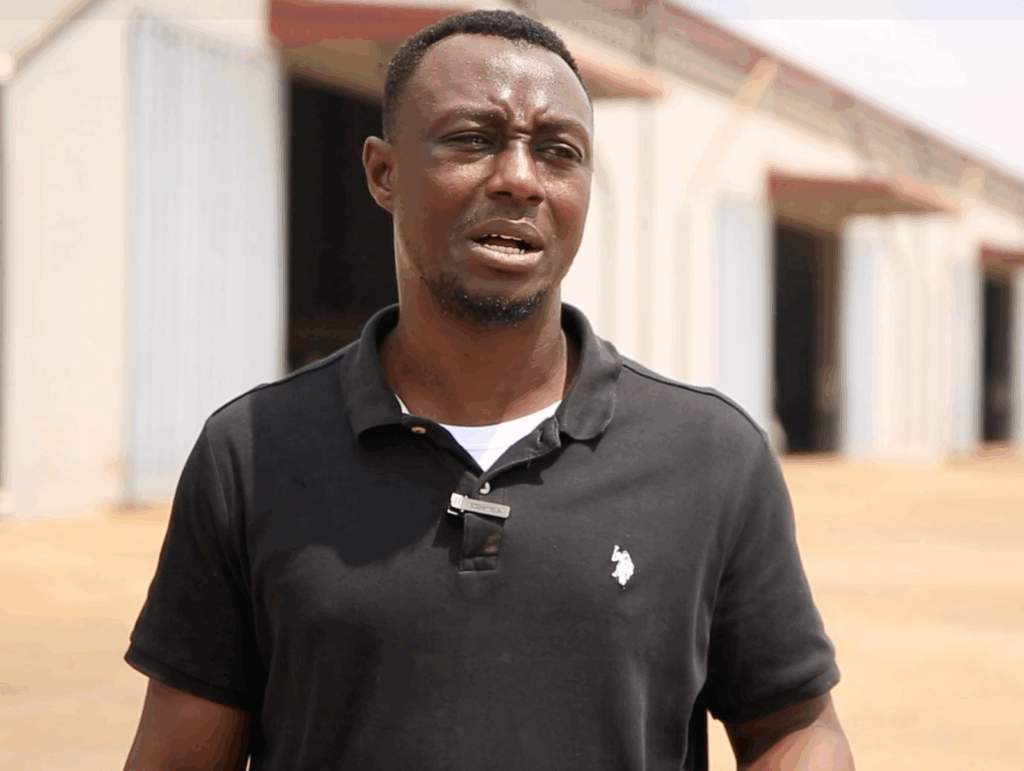
Nana Prempeh, CEO of Grow For Me
Accessing Grow For Me’s services is simple. On MTN Ghana, users dial *170#, then select Option 5 for Financial Services, Option 4 for Pensions and Investment, and finally Option 3 for Grow For Me. This opens a menu of six services: “I want to Fund/Invest,” “Check my updates,” “I want to Buy,” “I want to Sell,” “I am a Farmer,” and “Training.” Choosing “I want to Buy” presents a list of available commodities such as cocoa / shea nuts, cashew, rice, soybean, and maize. After selecting a crop, the system prompts users to input how many units they want to purchase, shows the cost per unit, and provides the expected range of interest rates.
For instance, for the second quarter (Q2) of 2025, one unit of maize was priced at 1,050 Cedis, with expected returns ranging between 5.43% and 12.86%. After entering the number of units, the platform displays the investment duration (April 1 to September 30, 2025 in this case), and the anticipated payout date, which for Q2 was December 23, 2025. The platform connects investors with a trusted network of experienced farmers growing high-demand crops, ensuring that funded crops are cultivated, harvested, and sold to a ready market, allowing investors to reap rewards at harvest without ever stepping onto a farm.
On the flip side, the platform also supports farmers who want to sell their commodities. After dialing into the Grow For Me service and selecting “I am a Farmer,” users are guided through a process that allows them to sell their harvests, request farm services, or access training. After selecting the commodity and their location, the system shows a list of nearby warehouses, current prices, and available working capital. Farmers can either deliver the crops themselves or arrange for a trained aggregator to pick them up. Payments are made either in cash or through mobile money.
According to CEO Nana Prempeh, much of the company’s focus now is on building robust financial systems that support the platform’s growth and accessibility. “What we are spending more time on is our financial services offering. We are working a lot on that because it is scalable, it’s accessible, it doesn’t require a lot of boots on the ground,” he said.
Grow For Me is playing a vital role in transforming Africa’s food systems by integrating capital, technology, trade, regulation, and policy. It offers a unified platform where individuals and businesses can invest in crop production, support commodity aggregation, and provide off-takers with reliable access to traceable produce. The firm’s work supports the United Nations Sustainable Development Goals, particularly SDG 1 (No Poverty) and SDG 2 (Zero Hunger), by creating opportunities for farmers in rural communities that are often hit hardest by labor shortages and the effects of urban migration. The firm equips farmers to increase their income, build resilience, and break free from cycles of poverty.
Since its inception, Grow For Me has made impressive strides. The firm reports on it’s website that it has traded over $1.1 million worth of commodities, raised $152,000 for input financing, impacted 19,000 farmers, cultivated 3,500 acres of land, and raised $450,000 in working capital.
Much of this success, Nana Prempeh emphasizes, is due to the company’s strategic partnerships. “Through AGRA, we’ve been able to reach out to thousands of farmers. We’ve been able to provide them with a ready market where they can move their produce from farm to market. And we are happy that we can work with our partners from Goldcoin to ensure there is no post-harvest loss. And thanks to AGRA for making that possible,” he noted.
Grow For Me says it is helping rewrite the narrative of African agriculture, one mobile phone at a time, by turning farming into a smart, digital, and scalable investment for the future.
DISCLAIMER: The Views, Comments, Opinions, Contributions and Statements made by Readers and Contributors on this platform do not necessarily represent the views or policy of Multimedia Group Limited.
DISCLAIMER: The Views, Comments, Opinions, Contributions and Statements made by Readers and Contributors on this platform do not necessarily represent the views or policy of Multimedia Group Limited.
Former NPP Deputy General Secretary, Nana Obiri Boahen
Former Deputy General Secretary of the New Patriotic Party (NPP), Nana Obiri Boahen, has launched a blistering critique of the erstwhile Akufo-Addo government and the party for disbanding its affiliated vigilante groups — Delta Force and Invisible Force — describing the move as politically naive and detrimental to the party’s grassroots strength.
His comments follow a violent incident during the Ablekuma North parliamentary rerun on July 11, 2025, in which former Fisheries and Aquaculture Minister, Mavis Hawa Koomson, and the NPP’s Deputy National Organiser, Chris Lloyd Nii Kwei Asamoah, were physically assaulted by thugs allegedly affiliated with the opposition National Democratic Congress (NDC).
In an interview, Obiri Boahen expressed dismay over what he termed as the NPP’s failure to safeguard its loyalists, arguing that the party turned its back on the very forces that helped secure its 2016 electoral victory.
“As for the NDC, you can’t match them. What happened at Ablekuma North is just a dress rehearsal for the Akwatia by-election. I know the NDC,” he said.
He blamed the NPP’s leadership for neglecting its grassroots operatives and abandoning groups that provided essential protection when the party was in opposition.
“The Invisible Force and Delta Force were the ones that helped us secure power in 2016. Not even the police or military could give us the protection they did. These boys gave us the much-needed shield,” Obiri Boahen declared.
He criticised the party’s support for the 2019 Vigilantism and Related Offences Act, which outlawed political militia groups, saying it weakened the NPP’s on-the-ground defenses against rival aggression.
“It did not make sense when the NPP introduced a law to disband vigilante groups. I questioned that decision and asked why the NPP was behaving like children. Does the NPP have more strength than the NDC?” he asked.
He further revealed that had the groups remained intact, they would have made him their patron due to his supportive relationship with them.
“A time came, if the government had not disbanded Delta Force and Invisible Force, they would have made me their patron because I related to them, recognised them, and addressed their concerns,” he noted.
Lawyer Nana Obiri Boahen, a former Deputy General Secretary of the NPP on disband of the NPP Vigilante boys and Akwatia by-election. Something to PONDER NDC 👂. pic.twitter.com/Pt8heG55g4
The inauguration of all three boards, marks a renewed push by the Ministry
The Minister of Trade, Agribusiness and Industry, Elizabeth Ofosu-Adjare, on Wednesday, July 9, 2025, inaugurated three key governing boards under her Ministry, the Ghana Investment Promotion Centre (GIPC), the Ghana Standards Authority (GSA), and the Ghana Export-Import Bank (Exim Bank), to strengthen Ghana’s investment, industrialization, and export agenda.
The first to be inaugurated was the 10-member governing board of the Ghana Investment Promotion Centre, chaired by former Minister of State, Akwasi Oppong-Fosu.
Other members include Dr Zakaria Mumuni, Dr Audrey Smock Amoah, Deputy Minister for Trade, Agribusiness and Industry Sampson Ahi, Deputy Finance Minister Thomas Nyarko Ampem, CEO of GIPC Simon Madjie, Dr Reuben Owusu Gyamfi, CEO of the Ghana Association of Banks John Awuah, Major Christine Naa Adoley Oko (Rtd), and President of the Greater Accra Markets Association Mercy Afrowa Needjan.
Addressing the Board, the minister emphasised the critical role of GIPC in attracting foreign direct investment (FDI) to propel job creation and economic transformation.
She announced plans for a review of the GIPC Act to make it more robust and responsive to global investment dynamics.
“I am confident that you know the mandate of the board for which you have been called to serve – primarily to bring foreign direct investment into Ghana. We are looking at your law again to make it more robust, more effective, and to help you achieve your mandate,” Ofosu-Adjare stated.
Chairperson of the Board, Akwasi Oppong-Fosu, pledged the Board’s commitment to supporting the minister in realizing the President’s vision of a transformed Ghanaian economy through strategic investment promotion.
The minister later inaugurated the governing board of the Ghana Standards Authority (GSA), chaired by Hudu Mogtari.
The 12-member board comprises Appiah Kusi Adomako, Michael Agbeko Kwadjo Seneyah, Roderick Kwabena Daddey-Agyei, Dramani Bukari, Samuel Akrofi, Prof Nana Ama Browne Klutse, Dr Humphrey Ayim-Darke, Prof Ransford Edward Van Gyamfo, Prof Charles Tortoe, Jane Dede Senam Tachie-Menson, and Rodaline Zumale Adama.
Ofosu-Adjare charged the board to prioritize quality assurance and standard harmonization, particularly under the African Continental Free Trade Area (AfCFTA), to enhance Ghana’s competitiveness on the continental market.
“We need to do a lot of standard harmonization because once we harmonize our standards with other countries it makes trading easier under AfCFTA,” she noted.
Chairperson Hudu Mogtari assured the minister of the board’s dedication to safeguarding consumer interests and supporting industrial development through enhanced standardization and regulatory enforcement.
Completing the day’s series of inaugurations, the minister also swore in the newly constituted board of the Ghana Exim Bank, with Dr Joseph Nyarkotei Dorh as Chairperson.
Other members include Samuel Danquah Arkhurt, Deputy Minister Sampson Ahi (MP), Matilda Asante-Aseidu, Francis Kojo Kwarteng Arthur, Stephen Abbas Miezan, Adamu Robert Akati, Millicent Samira Lardi Glawu, and Sylvester Adinam Mensah.
In his remarks, Dr Joseph Nyarkotei Dorh expressed gratitude to the minister for the opportunity to serve and outlined the board’s strategic focus in line with Ghana Exim Bank’s mandate and the President’s vision for a 24-hour economy.
He indicated that the board would concentrate on five key areas: strengthening the agriculture–agribusiness value chain, boosting food production for national security, promoting import substitution and export diversification, and accelerating garment and apparel exports.
Dr Dorh further emphasized the board’s targeted commitment to increasing rice production and expanding the poultry industry. “We shall avoid the temptation of spreading thin to make the necessary impact and become more relevant in the broader objectives of Ghana Exim Bank. Minister, count on us to deliver on the objectives of the bank,” he assured.
The inauguration of all three boards, marks a renewed push by the Ministry to deepen investor confidence, ensure product and service quality, and strengthen export capacity in line with Ghana’s industrial transformation agenda.
GA
GhanaWeb Special: The gold market that fuels galamsey
Musician Emmanuel Kwamina Amonoo, popularly known as Quamina MP
Musician Emmanuel Kwamina Amonoo, popularly known as Quamina MP is of the opinion that ladies easily fall in love with guys who speak Fante.
According to the Mankessim-born singer, Fante-speaking people are naturally funny, and ladies love guys who make them laugh and smile all the time.
He remarked while speaking in an interview on property fm and monitored by MyNewsGh.com that “Normally, when I engage in a conversation with my boys, they all get excited and start laughing because the Fante language is unique”.
“It’s true that speaking the Fante language makes a lot of girls admire you and probably fall in love with you,” he said.
Adding that “when the ladies hear you speak Fante, it sounds nice to them, and they want to even follow you home. Most ladies want to date a guy who will make them laugh or smile, and we, the Fante guys, are known for that.”
Talented Ghanaian striker Francis Antwi Boasiako has made a significant move in his football career, signing with Serbian Super Liga side Javor Ivanjica, GHANAsoccernet.com can confirm
The 20-year-old joins the top-flight team on a free transfer after an impressive season with Radnicki Sremska Mitrovica in Serbia’s second division.
Boasiako began his football journey with lower-tier Ghanaian outfit Benab FC, where he built a reputation as a prolific goal scorer, netting over 50 goals before heading to Europe.
His debut season at Radnicki saw him adapt well to Serbian football, registering three goals and one assist in 23 games – a performance that earned the attention of Javor’s scouting department.
“Francis Antwi stood out last season,” a statement from Javor’s official website read. “He showed great promise in his first professional campaign, and we are confident in his growth.”
Reacting to the transfer, Boasiako expressed his excitement: “This is a major milestone in my journey. I’m truly thankful and ready to give my all.”
Javor, newly promoted to the Serbian top division, views Boasiako as a vital addition to their squad.
With his speed, flair, and strong desire to develop, the young Ghanaian is expected to play a pivotal role in helping the club establish itself in the league.
The opposition New Patriotic Party (NPP) has announced that it will proceed with its National Delegates Conference as scheduled on Saturday, July 19, 2025, despite calls from within the party to postpone the event.
Following a petition urging a change of date to allow more time to address pressing internal issues, the party’s National Executive Committee (NEC) and National Council have dismissed the request, citing extensive preparations and firm commitments already made.
Chairman of the Conference Planning Committee, Joseph Osei-Owusu, confirmed the decision at a media briefing after the Council meeting.
“There was a petition that the date for the conference should be changed. Our NEC, after considering it, decided that we should continue. Given the preparation and commitments that we have made, the conference will proceed as announced,” he said.
The upcoming conference is expected to be a pivotal moment for the party, with major constitutional reforms on the agenda. Delegates will deliberate on proposed amendments arising from the Prof. Mike Oquaye Committee report and a longstanding proposal from the party’s 2019 Delegates Conference in Kumasi.
Although the 2019 reform was approved in principle, it has not been formally adopted until now. The party leadership sees this conference as an opportunity to complete that process.
At a press briefing ahead of the event, NPP Director of Communications, Richard Ahiagbah, emphasised that the constitutional reforms are aimed at strengthening the party’s internal structures and preparing it for future electoral victories, particularly the 2028 general elections.
“That report, which has a package of amendments—and proposals resulting from the Mike Oquaye Committee and other submissions by party members—is part of the bundle that this conference will consider,” Ahiagbah explained.
This year’s conference will be held under the theme “Rebuilding Together With Our Values,” reflecting the party’s focus on unity, renewal, and long-term strategic planning.
NPP to consider Constitutional Amendments at July 19 Delegates Conference
Opposition New Patriotic Party (NPP) communications director Richard Ahiagbah has alleged security manipulation by the ruling National Democratic Congress (NDC) during the recent Ablekuma North parliamentary rerun.
Speaking to media, Ahiagbah claimed state security was deliberately sidelined in favor of NDC-aligned operatives.
“The state was supposed to provide security, but they demobilized official agencies and deployed their own personnel,” Ahiagbah stated. He asserted the NDC created an unsafe environment for opposition voters through intimidation tactics designed to influence the outcome.
“They know they lost but engineered this rerun under fabricated security,” he added, alleging NDC operatives discouraged non-partisan voters and opposition supporters through visible coercion. Ahiagbah further questioned law enforcement’s response, asking, “Why haven’t they arrested anybody?” regarding the alleged incidents.
The accusations center on the July 14 by-election, though no formal evidence of misconduct has been presented publicly. The NDC administration under President Mahama has not yet responded to the claims.
Member of Parliament (MP) for Suaman Dadieso Constituency, Frederick Addy
The Minister of Health, Kwabena Mintah Akandoh has given a vivid update to the Member of Parliament (MP) for Suaman Dadieso Constituency, Frederick Addy, about the steps being put in place to post trained but unemployed health professionals in his constituency.
During a Parliamentary session on Friday, July 11, 2025, the minister addressed the pressing issue raised by the MP about the measures being implemented to tackle the challenges faced by 30,000 trained health workers who have remained unemployed despite the critical staff shortage in health facilities nationwide.
Akandoh explained that there are health professionals who meet the employment criteria but are still awaiting recruitment.
“Currently, the number of health workers demanding employment is substantial and far above the 30,000 as quoted; please permit me provide some details of health professionals currently eligible for employment but yet to be recruited.
“We have the 2021 batch with the total of 15,947, the 2022 batch with the total of 17,176 and the 2023 batch with the total of 15,755; this gives us the total of 48,878 unemployed nurses,” he asserted.
According to him, approximately 15,000 nurses were given financial clearance and employed in December 2024 and their payroll process is ongoing.
However, approximately 8,000 of them have been placed on payroll while others are yet to have a hologram and some yet to have their clearance renewed because some of them expired.
He highlighted that a category of 21,570 health professionals, specifically allied health professionals have not had financial clearance for several years, dating back to 2019.
He noted that, a total of 1,621 unemployed pharmacists has also not received any financial clearance since 2019.
Akandoh also mentioned that efforts are currently underway to begin the recruitment process of over 900 medical doctors who are presently not working.
The minister guaranteed that collaboration between the Finance and Health Ministries would facilitate the swift recruitment of health professionals, effectively doubling numbers in the health institutions.
“The problem is therefore enormous, but we’re committed to finding solutions to it; the Ministry is actively engaging the relevant stakeholders including the Ministry of Finance to ensure that the recruitment of professionals is done as soon as possible to beef up the numbers at various health institutions to promote quality of care for all people living in Ghana,” he assured.
AM/KA
GhanaWeb Special: The gold market that fuels galamsey
Former President Nana Addo Dankwa Akufo-Addo has strongly denied claims that he attempted to reverse the New Patriotic Party’s (NPP) decision to hold early primaries or to postpone the upcoming National Delegates Conference scheduled for July 19.
This follows media reports suggesting that the former President sought to overturn the party’s stance on early primaries and delay the conference.
In a statement issued on Monday, July 14, the Office of the Former President dismissed the allegations as “completely false.”
“President Akufo-Addo, who has been out of the jurisdiction for some time now, has not made any such requests to the party—either through a petition or by any other means—and has no intention of doing so,” the statement read.
It further added, “Clearly, those behind these publications have an agenda of their own, which has nothing to do with improving the fortunes of the New Patriotic Party (NPP).”
The New Patriotic Party (NPP) on Monday, July 14, announced that its upcoming Annual Delegates Conference, scheduled for Saturday, July 19, will deliberate on key constitutional reforms, including recommendations from the Prof. Mike Oquaye Committee report and an outstanding proposal from the party’s 2019 Delegates Conference in Kumasi.
Though the 2019 reform received approval at the time, it has yet to be formally presented for consideration until now.
…..
Explore the world of impactful news with CitiNewsroom on WhatsApp!
Click on the link to join the Citi Newsroom channel for curated, meaningful stories tailored just for YOU: https://whatsapp.com/channel/0029VaCYzPRAYlUPudDDe53x
No spam, just the stories that truly matter! #StayInformed #CitiNewsroom #CNRDigital
According to new research by a top market and economic research agency and consultancy in Ghana, SumsureIQ, Ghana’s Fast Moving Consumer Goods (FMCG) sector showed signs of recovery at the end of 2024 compared to 2023 from a difficult economic landscape characterised by fairly high and sticky but gradually reducing inflation levels amid cost-of-living crises.
In this mid-year research review, the findings confirm the continuous but cautious recovery of the FMCG sector in Ghana as of the first half of 2025.
Over the years, SumsureIQ research findings have been published as part of the SumsureIQ’s Quarterly Brand/Category Performance Tracking Index. In this latest research, SumsureIQ investigates the FMCG sector in Ghana to find out how it is performing as at mid-year of 2025.
The research findings show that as at the end of June 2025 (i.e. from January to June 2025), FMCG volume sales and consumption grew by about 12.5 per cent compared to the same 2024.
This increase was mainly driven by the consumption of Food products which accounted for about 75.4 per cent of the increase.
Followed by Non-Alcoholic Beverage with about 15.7 per cent of the increase, then Non-Food with 6.5 per cent of the increase and Alcoholic Beverage with just 2.4 per cent of the increase.
In terms of value (the amount of money spent), FMCG consumption increased by about 42.8 per cent (in Ghana Cedi terms) as at the end of June 2025 compared to 2024.
The main driver of this increase was also Food consumption with about 59.0 per cent of the increase, followed by , “surprisingly”, Alcoholic Beverage with about 15.3 per cent of the increase.
Then, Non-Alcoholic Beverage with 15.0 per cent and Non-Food with 10.7 per cent of the increase.
Inflation
These results are further collaborating evidence with previous SumsureIQ research results, that, the average living standard of the Ghanaian consumer which declined in 2024 compared to 2023 is now recovering during in the first six months of 2025.
Furthermore, these results indicate that, although, the levels of inflation are dropping sharply compared to the levels in 2024, they are still relatively high.
Moreover, the impact is not transmitting quickly enough down to the final consumer on average. Thus, the impact of inflation on the cost-of-living pressures, is easing but not quick enough in the first half of 2025.
However, according to SumsureIQ, the research findings may suggest that, there has been a significant expansion or improvement in the volume and value of the level of consumption in the first 6 months of 2025 compared to the same period in 2024.
This improvement is good news and a relief for many Ghanaian consumers. This is because, it shows potential turning point in the average living standard deterioration in the country which have been induced by relatively high levels of inflation and the accompanying cost-of-living crisis and compounded with the struggling Ghanaian Cedi (GHS) against other foreign currencies.
However, in the past 4-5 months, the Ghanaian Cedi has been performing well against a basket of international currencies and therefore, boosting the standard of living improvement process.
Value for money
According to Dr Erasmus L Owusu, the Founder and CEO of SumsureIQ, “consumers are purchasing progressively, more quantities in the medium to high pack sizes items range because, these pack-sizes range tend to have lower average price per standard base weight and hence, affordable”. Furthermore, “consumers see these pack sizes as better value for money propositions”.
He is of the view that, this shift suggests that, while the levels of inflation are going down, the consequential cost-of-living crises is also abating, hence, leading to some improvements in the average standard of living of the Ghanaian consumer.
This is buttressed by the most recent rate of inflation in June 2025 which is now is running at about13.7 per cent (Ghana Statistical Service) and gradually decreasing with minimal fluctuation.
What is more, with the recent appreciation of the Ghana Cedi, consumers will be making more calculated purchasing decisions”.
Furthermore, he points out that, “the latest SumsureIQ research findings harmonise the potential of Ghana’s FMCG markets recovering within the recovery of the Ghanaian economy as a whole and of course, the removal of the E-Levy may boost domestic consumption, especially, FMCGs.
However, these recent domestic changes and improvements, remains cautious, tenuous and are susceptible to global economic shocks like the recent global trade wars as a result of the array of tariffs imposed on imports by the USA could be destabilising factors for the fragile recovery”.
Data Collection
SumsureIQ (www.sumsureiq.com) is a full market and economic research agency and consultancy with Head office in Ghana.
SumsureIQ has collected about 120,000 lines of data every month since January 2022 on over 70 categories and segments of Fast-Moving Consumer Goods (FMCG) in Food, Non-Food, Alcoholic and Non-Alcoholic Beverages across all the 16 administrative regions and 10 channels/store-types including Modern Trade and Petrol Marts in Ghana.
SumsureIQ uses robust mathematical, statistical and econometric methodologies to estimate the market sizes of every category/manufacturer/brand.
SumsureIQ also uses the collected data to estimate a myriad of analytical KPIs. This amount of data shows that SumsureIQ has the complete view of the FMCG retail market structure, volume of consumption pattern and consumer behaviour in Ghana.
New Patriotic Party (NPP) flagbearer hopeful, Kennedy Agyapong
New Patriotic Party (NPP) flagbearer hopeful, Kennedy Agyapong, has stated that if he were the President of Ghana, several police officers who witnessed the violence that marred the Ablekuma North election would have been dismissed.
According to the former Assin Central Member of Parliament, nobody will be above the law under his leadership, and regardless of a person’s status, whether a police officer or a party member, anyone who breaks the law will face justice.
Speaking to the media in a video shared on social media regarding the Ablekuma North elections, Kennedy Agyapong emphasised, “Nobody is above the law. And trust me, if I were the president, I would have fired many of the police officers who were there.
“I would have arrested those who were captured on camera to serve as a deterrent. You can’t take anybody’s life, and you can’t beat anybody.
“We are all one people, and I will ensure peace and fairness. What we are seeing now would not be tolerated under my leadership,” he said.
The election, which saw the National Democratic Congress (NDC) parliamentary candidate for Ablekuma North, Ewurabena Aubynn, elected as the Member of Parliament-elect for the constituency, was marred by violence.
Former Minister of Fisheries and Aquaculture, Mavis Hawa Koomson, was assaulted along with other party members during the chaos.
The rerun, held on Friday, July 11, 2025, followed months of controversy over the initial parliamentary results declared in December 2024, after rioting at the collation center forced the suspension of vote counting from 19 polling stations.
Hon. Kennedy Agyapong clashes with NDC Alhaji Asorka at the ongoing rerun elections in Ablekuma North.
Cee of Mentor fame has disclosed that she has left her marriage after several years.
Unlike other gospel ministers who have said in the past that they left their husbands after hearing the voice of the Lord, Cee indicated that she left because there were things that she could no longer endure.
“I was married to a pastor, but I left because of certain issues and circumstances that I could not stand. He is aware of those issues. God did not tell me to leave my husband; I left because I could no longer take certain things,” she said.
On why gospel musicians prefer to marry men of God, she explained that it is mostly because they believe these men of God understand their calling and will help their ministry; hence, the decision to marry men of God.
She indicated that prior to getting married, she never wanted to marry a pastor, so she rejected a number of them, only to end up with one.
Governance think tank, the Africa Policy Lens, says it has been vindicated by recent revelation by the International Monetary Fund (IMF) that the Bank of Ghana pumped in dollars to support recent stability of the cedi.
The IMF, in its latest review of Ghana’s programme, revealed that the Bank of Ghana released a whopping $1.4 billion forex support to sustain Ghana’s currency against the US dollars.
Following the IMF’s confirmation, the Africa Policy Lens (APL) has revisited a report it issued in May this year which attributed the cedi upsurge to a deliberate forex support by the Bank of Ghana.
The Africa Policy Lens indicated in a statement that its May 2025 analysis that the government was deliberately boosting the forex market with the US dollar was widely criticised but “however, the IMF has now corroborated what our analysis clearly pointed out in May and this has vindicated us”.
In its May 2025 report, the APL, while commending the incumbent government for the cedi gains against the dollar, disclosed that the gains had been made possible due to an accumulated gold by the Central Bank, making it possible for the bank to pump more dollars into the forex market.
“Ghana’s currency, the cedi, has surged to become one of the world’s best-performing currencies in 2025, appreciating by over 20% against the US dollar year-to-date. This remarkable turnaround follows a turbulent 2024 when the cedi lost nearly a quarter of its value, contributing to high inflation and economic instability.
“As of mid-May 2025, the cedi trades at the retail around GH¢13.5 to the US dollar – a 17% gain since January 1. Inflation has also eased (down to about 21% in April 2025 from much higher levels), reflecting reduced import costs as the currency strengthens. The Africa Policy Lens (APL) commends this progress in macroeconomic stability.
“However, we note that the foundations of this appreciation and the sustainability of these gains merit close scrutiny and prudent policy action,” the Africa Policy Lens report read.
Role of Gold Reserves and Forex Interventions
In the report, the Africa Policy Lens observed that a key factor in the cedi’s stabilisation was Ghana’s strategic use of gold reserves and direct market interventions.
“The Bank of Ghana (BoG) aggressively accumulated gold through its Domestic Gold Purchase Programme (DGPP) (popularly “Gold-for-reserve” and now the Gold Board initiative) during 2023-2024. Official data show gold reserves climbed from 8.78 tonnes in May 2023 to 30.53 tonnes by December 2024 – an increase of ~21.8 tonnes in 20 months, averaging about 1.1 tonnes added per month (see Figure 1).
“This bolstered Ghana’s foreign exchange buffer significantly. By contrast, from January to April 2025, gold reserves edged up only from 30.53 to 31.37 tonnes – a rise of just 0.84 tonnes in four months (about 0.21 tonnes per month).”
“The sharp slowdown in gold accumulation suggests that authorities may have tapped into these gold reserves or at least paused new purchases, possibly to inject U.S. dollars into the market and meet forex demand. In effect, Ghana appears to be leveraging its gold stockpile to support the cedi, a tactic that boosts dollar liquidity and calms depreciation pressure in the short term.”
The report also made claims about the millions of dollars the Bank of Ghana had injected into the forex market to cushion the cedi.
It said; “Indeed, the central bank’s direct forex market interventions have been massive. In April 2025 alone, BoG injected $490 million into the foreign exchange market to ease dollar shortages and strengthen the Cedi.”
“Reports further indicate sizable interventions in other months – for example, about $264 million was injected in March 2025 as part of the stabilization strategy. Cumulatively, nearly $1 billion is estimated to have been supplied to the forex market by the government and central bank between January and May 2025.”
While acknowledging the positive impact of the cedi appreciation, the APL noted that these gains could be sustained through sound economic management, therefore urged the government to learn from the 2017/2019 situation when the cedi was similarly strong.
“The lesson for today is clear: sustainable exchange rate stability comes from sound economic management rather than one-off measures. The current administration can draw on this historical parallel by continuing structural adjustments initiated under the IMF program (e.g. fiscal consolidation, prudent debt management, and rebuilding of foreign reserves) to ensure the cedi’s strength is lasting.
“Just as the stability of the cedi contributed to a decline in debt ratios around 2017, maintaining that stability through robust policies now will reinforce Ghana’s economic resilience going forward. APL urges policymakers to view the 2017–2019 period not as an anomaly, but as a benchmark to surpass – through deeper reforms that address the root causes of cedi volatility.”
Black Queens forward Chantelle Boye-Hlorkah has expressed delight after Ghana progressed to the quarter-final of the Women’s Africa Cup of Nations following a thumping victory over Tanzania in their final Group C game.
Boye-Hlorkah sealed victory for Ghana after an exquisite finish as the Black Queens sealed a 4-1 win on Monday evening July 14, 2025, to set up a last eight clash against North Africans Algeria.
Ghana opened the scoring early in the game through Princella Adubea but Tanzania levelled before half time through Stumai Abdallah. But the Black Queens were too strong in the second half with Alice Kusi and Evelyn Badu registering their names on the score sheet.
“I am proud, I am so proud of the girls like they have my back out there today. I try to lead, as everyone I am a character, I am very vocal on the pitch and I try to push the team as much as I can,” she said after the game.
“Today, we went all out, we conceded a goal which I take full responsibility for but then as I look around all the girls were coming me up. I told the girls we are not going to win the game if we don’t play as a team and that is what we did.
“I am so proud the girls, I am so proud of Ghana, and I am proud of the fans.”
Ghana will face Algeria on Saturday in the quarter-final of the competition.
According to new research by a top market and economic research agency and consultancy in Ghana, SumsureIQ, Ghana’s Fast Moving Consumer Goods (FMCG) sector showed signs of recovery at the end of 2024 compared to 2023 from a difficult economic landscape characterised by fairly high and sticky but gradually reducing inflation levels amid cost-of-living crises.
In this mid-year research review, the findings confirm the continuous but cautious recovery of the FMCG sector in Ghana as of the first half of 2025.
Over the years, SumsureIQ research findings have been published as part of the SumsureIQ’s Quarterly Brand/Category Performance Tracking Index. In this latest research, SumsureIQ investigates the FMCG sector in Ghana to find out how it is performing as at mid-year of 2025.
The research findings show that as at the end of June 2025 (i.e. from January to June 2025), FMCG volume sales and consumption grew by about 12.5 per cent compared to the same 2024.
This increase was mainly driven by the consumption of Food products which accounted for about 75.4 per cent of the increase.
Followed by Non-Alcoholic Beverage with about 15.7 per cent of the increase, then Non-Food with 6.5 per cent of the increase and Alcoholic Beverage with just 2.4 per cent of the increase.
In terms of value (the amount of money spent), FMCG consumption increased by about 42.8 per cent (in Ghana Cedi terms) as at the end of June 2025 compared to 2024.
The main driver of this increase was also Food consumption with about 59.0 per cent of the increase, followed by , “surprisingly”, Alcoholic Beverage with about 15.3 per cent of the increase.
Then, Non-Alcoholic Beverage with 15.0 per cent and Non-Food with 10.7 per cent of the increase.
Inflation
These results are further collaborating evidence with previous SumsureIQ research results, that, the average living standard of the Ghanaian consumer which declined in 2024 compared to 2023 is now recovering during in the first six months of 2025.
Furthermore, these results indicate that, although, the levels of inflation are dropping sharply compared to the levels in 2024, they are still relatively high.
Moreover, the impact is not transmitting quickly enough down to the final consumer on average. Thus, the impact of inflation on the cost-of-living pressures, is easing but not quick enough in the first half of 2025.
However, according to SumsureIQ, the research findings may suggest that, there has been a significant expansion or improvement in the volume and value of the level of consumption in the first 6 months of 2025 compared to the same period in 2024.
This improvement is good news and a relief for many Ghanaian consumers. This is because, it shows potential turning point in the average living standard deterioration in the country which have been induced by relatively high levels of inflation and the accompanying cost-of-living crisis and compounded with the struggling Ghanaian Cedi (GHS) against other foreign currencies.
However, in the past 4-5 months, the Ghanaian Cedi has been performing well against a basket of international currencies and therefore, boosting the standard of living improvement process.
Value for money
According to Dr Erasmus L Owusu, the Founder and CEO of SumsureIQ, “consumers are purchasing progressively, more quantities in the medium to high pack sizes items range because, these pack-sizes range tend to have lower average price per standard base weight and hence, affordable”. Furthermore, “consumers see these pack sizes as better value for money propositions”.
He is of the view that, this shift suggests that, while the levels of inflation are going down, the consequential cost-of-living crises is also abating, hence, leading to some improvements in the average standard of living of the Ghanaian consumer.
This is buttressed by the most recent rate of inflation in June 2025 which is now is running at about13.7 per cent (Ghana Statistical Service) and gradually decreasing with minimal fluctuation.
What is more, with the recent appreciation of the Ghana Cedi, consumers will be making more calculated purchasing decisions”.
Furthermore, he points out that, “the latest SumsureIQ research findings harmonise the potential of Ghana’s FMCG markets recovering within the recovery of the Ghanaian economy as a whole and of course, the removal of the E-Levy may boost domestic consumption, especially, FMCGs.
However, these recent domestic changes and improvements, remains cautious, tenuous and are susceptible to global economic shocks like the recent global trade wars as a result of the array of tariffs imposed on imports by the USA could be destabilising factors for the fragile recovery”.
Data Collection
SumsureIQ (www.sumsureiq.com) is a full market and economic research agency and consultancy with Head office in Ghana.
SumsureIQ has collected about 120,000 lines of data every month since January 2022 on over 70 categories and segments of Fast-Moving Consumer Goods (FMCG) in Food, Non-Food, Alcoholic and Non-Alcoholic Beverages across all the 16 administrative regions and 10 channels/store-types including Modern Trade and Petrol Marts in Ghana.
SumsureIQ uses robust mathematical, statistical and econometric methodologies to estimate the market sizes of every category/manufacturer/brand.
SumsureIQ also uses the collected data to estimate a myriad of analytical KPIs. This amount of data shows that SumsureIQ has the complete view of the FMCG retail market structure, volume of consumption pattern and consumer behaviour in Ghana.
President Mahama (L) and suspended Chief Justice Torkornoo
Suspended Chief Justice of Ghana, Gertrude Torkornoo, has sued the government of Ghana at the Community Court of Justice of the Economic Community of West African States (ECOWAS).
Justice Torkornoo sued the government over her suspension and the ongoing hearing on three petitions for her removal.
The embattled Chief Justice asked the Community Court for a number of reliefs, including the revocation of her suspension and a stop to the ongoing hearing on the three petitions for her removal, which were submitted to President John Dramani Mahama.
However, the relief that has caught the eye of the public the most is the demand for $10 million in compensation.
Justice Torkornoo, in her application, is demanding the $10 million compensation because her suspension and the ongoing process on the petitions have violated her human rights and caused damage to her reputation and that of her family.
The demand for the compensation, which was her ninth relief, was captured as: “an award of USD 10 million as compensation for moral and reputational damages suffered by the Applicant as a result of her illegal suspension and unfair investigation.”
She contended that her suspension by President John Dramani Mahama “exposed her to public ridicule and odium, locally and internationally, and that the said act constitutes a violation of her human right to dignity guaranteed by Article 5 of the African Charter on Human and Peoples’ Rights.”
Justice Torkornoo, according to a report by gbcghanaonline.com, accused President John Dramani Mahama of failing to specify the claims in the petitions for her removal upon which he relied to suspend her.
“Fairness implies that the President, in making the prima facie determination with the Council of State, must specify the particular charges in respect of which a prima facie case is deemed to have been established and the reasons for the same.
“The President’s letter failed to do this. It simply stated that a prima facie case has been found against the Applicant without more. To date, the Applicant does not know the reasons for the President stating that a prima facie case has been established against her,” part of her application reads.
She added, “Yet a committee has been formed and is working. The President’s purported prima facie determination was no determination at all, as it failed to meet the standard of a judicious and objective assessment and, as such, was arbitrary and capricious.”
BAI/AE
Meanwhile, you can watch GhanaWeb TV’s exclusive interview with Arathejay below:
You can also watch the latest news in Twi on GhanaWeb TV below:
US President Donald Trump has announced the US will send “top-of-the-line weapons” to Ukraine via NATO countries, while also threatening Russia with severe tariffs if a deal to end the war is not reached within 50 days.
“We want to make sure Ukraine can do what it wants to do,” Trump said following a meeting with NATO chief Mark Rutte in Washington.
Rutte confirmed the US had decided to “massively supply Ukraine with what is necessary through NATO” and that the Europeans would foot the bill.
European countries will send Kyiv their own Patriot air defence systems – which Ukraine relies on to repel Russia’s deadly air strikes, and replacements will then be issued by the US, Trump said.
Neither Rutte nor Trump elaborated on the weaponry that will be sent to Kyiv but Rutte said the deal included “missiles and ammunition”.
However, the president did say “top-of-the-line-weapons” worth billions of dollars would be “quickly distributed to the battlefield” in order to support Ukraine.
“If I was Vladimir Putin today… I would reconsider whether I should not take negotiations about Ukraine more seriously,” Rutte said, as Trump nodded.
Ukrainian President Volodymyr Zelensky said on X that he spoke with Trump after his meeting with Rutte, and thanked him for his “willingness to support Ukraine and to continue working together to stop the killings and establish a lasting and just peace”.
“We discussed the necessary means and solutions with the President to provide better protection for people from Russian attacks and to strengthen our positions. We are ready to work as productively as possible to achieve peace,” he said.
On the tariffs front, Trump said that the US would impose 100% secondary tariffs targeting Russia’s remaining trade partners if a peace deal with Ukraine was not reached within 50 days.
This would see any country that trades with Russia face the tax if they want to sell their products to the US.
For example, if India keeps buying oil from Russia, US companies that purchase Indian goods would have to pay a 100% import tax, or tariff, when the products reach American shores.
This would make the goods so expensive that US businesses would likely choose to buy them cheaper from elsewhere, resulting in lost revenue for India.
The intention is also to hobble Russia’s economy. Theoretically, if Moscow was unable to generate money by selling oil to other nations it would also have less money to finance its war in Ukraine.
Given that oil and gas account for almost a third of Moscow’s state revenue and more than 60% of its exports, 100% tariffs could make something of a dent Russia’s finances.
Still, the Moscow Stock Exchange Index rose sharply following the announcement, likely as investors were expecting Trump – who last week teased a “major statement” on Russia – to pledge even harsher measures.
Although detail about both the tariffs and the NATO weapons deal was scant, Monday was the first time Trump pledged new military equipment for Ukraine since returning to the White House.
The briefing was also notable for the tone struck by US president, whose rhetoric on Vladimir Putin has become increasingly harsh.
Not for the first time, Trump implied Kyiv bore some responsibility for Russia’s decision to launch its full-scale invasion of Ukraine in February 2022.
But he mostly appeared frustrated at the lack of progress in ending a conflict which he once seemed to believe could be easily solvable.
Asked about his relationship with Putin, Trump said that the two speak “a lot about getting this thing done” but voiced his displeasure at the fact that “very nice phone calls” with the Russian president are often followed by devastating air strikes on Ukraine – which have been growing in intensity and frequency.
“After that happens three or four times you say: the talk doesn’t mean anything,” Trump said.
“I don’t want to call him an assassin but he’s a tough guy. It’s been proven over the years, he fooled a lot of people – Clinton, Bush, Obama, Biden,” he added. “He didn’t fool me. At a certain point talk doesn’t talk, it’s got to be action.”
Two rounds of ceasefire talks between Russia and Ukraine took place earlier this year but no other meetings have so far been scheduled – something Moscow has blamed on Kyiv.
Ukraine’s President Zelensky is currently hosting US envoy Keith Kellogg in Kyiv and earlier on Monday hailed a “productive meeting” – saying he was “grateful” to Trump for his support.
The Kremlin did not immediately comment on the announcement – but commentary trickling in from Moscow appeared to indicate a measure of relief.
Pro-Kremlin pundit and former Putin aide Sergei Markov called the tariffs announcement “a bluff” that indicated Trump had “given up on trying to achieve peace in Ukraine”.
Senator Konstantin Kosachev argued that “if this is all Trump had to say about Ukraine today, then so far it’s been much ado about nothing”.
In 50 days, a lot could change “both on the battlefield and in the moods of the powers that be in the US and Nato,” Kosachev wrote.
Trump’s decision led to praise from critics, including from within the rival Democratic Party.
The decision to send Patriot missiles to Ukraine, “made possible through the meaningful investments of our European partners, will save countless Ukrainian lives from Putin’s horrific assault,” said Democratic Senator Jeanne Shaheen, the top Democrat on the powerful Senate Foreign Relations Committee.
She called the measure “positive, but overdue” and said that the US needs to provide “a sustained flow of security assistance to Ukraine over the long term” in order convince Putin to end the war.
Denys Podilchuk, a 39-year-old Ukrainian dentist from Kyiv, praised European leaders for helping to persuade Trump.
“I am pleased that finally European politicians, with their patience and convictions, have slightly swayed him (Trump) to our side, because from the very beginning it was clear that he did not really want to help us,” he told Reuters.
New Patriotic Party (NPP) flagbearer hopeful, Kennedy Agyapong
New Patriotic Party (NPP) flagbearer hopeful, Kennedy Agyapong, has stated that if he were the President of Ghana, several police officers who witnessed the violence that marred the Ablekuma North election would have been dismissed.
According to the former Assin Central Member of Parliament, nobody will be above the law under his leadership, and regardless of a person’s status, whether a police officer or a party member, anyone who breaks the law will face justice.
Speaking to the media in a video shared on social media regarding the Ablekuma North elections, Kennedy Agyapong emphasised, “Nobody is above the law. And trust me, if I were the president, I would have fired many of the police officers who were there.
“I would have arrested those who were captured on camera to serve as a deterrent. You can’t take anybody’s life, and you can’t beat anybody.
“We are all one people, and I will ensure peace and fairness. What we are seeing now would not be tolerated under my leadership,” he said.
The election, which saw the National Democratic Congress (NDC) parliamentary candidate for Ablekuma North, Ewurabena Aubynn, elected as the Member of Parliament-elect for the constituency, was marred by violence.
Former Minister of Fisheries and Aquaculture, Mavis Hawa Koomson, was assaulted along with other party members during the chaos.
The rerun, held on Friday, July 11, 2025, followed months of controversy over the initial parliamentary results declared in December 2024, after rioting at the collation center forced the suspension of vote counting from 19 polling stations.
Hon. Kennedy Agyapong clashes with NDC Alhaji Asorka at the ongoing rerun elections in Ablekuma North.
play videoYoung Rob heats up Accra in ‘Cali Girl’ music video
Young Rob tears through the streets of Accra with his ride-or-die in full Bonnie and Clyde mode in the new visuals for ‘Cali Girl.’ Shot and produced by yours truly, Joe Aggrey, the result is an explosive thrill ride that snatches your attention from start to finish.
With summer just around the corner, Young Rob isn’t slowing down—he has his foot on the gas.
Thanks to slick cinematography and fast-paced action, ‘Cali Girl’ comes to life in spectacular fashion, full of passion, chaos, and high-stakes drama—enough to keep anyone on the edge of their seat.
Far from a typical love story, the visuals follow Young Rob and his partner-in-crime as they pull off a bold heist.
Sirens wail and tires screech as Accra’s vibrant backdrop flashes by, with the duo evading the cops in a climactic chase.
There’s a sense of gritty realism that keeps you locked in, threading a fine line between action and romance.
‘Cali Girl’ dropped in May, transporting listeners to the sun-soaked coasts of California ahead of the summer wave.
The track features Philadelphia’s Lonzo Starr—who is absent from the video—and delivers a seasonal banger with endless replay value for the summer faithful.
The Abuakwa Divisional Police Command has arrested a 31-year-old man for allegedly stealing prepaid meters from customers.
The suspect was initially apprehended by residents of Abuakwa Agogo Newsite on Monday, July 7, 2025 and handed over to the police to help in further investigation.
Mr George Amoah, Ashanti West Regional Manager of the Electricity Company of Ghana (ECG), who made this known, said the suspect, a resident at Sepaase in the Atwima Nwabiagya South Municipality, moved from one place to another to steal meters.
He noted that in some instances, the suspect replaced the stolen meters with fake post-paid meters and installed the stolen meters for customers, which enabled customers to consume electricity for free.
This, he said, negatively affected the revenue collection of the ECG as the free consumption of power was on the blind side of the company.
Additionally, the victims of stolen meters faced the inconvenience of filing police complaints and making payments for the replacement of the meters at the ECG.
“Lately, a lot of customers have thronged our offices to report stolen meters, which was an inconvenience to our cherished customers as they had to go through the stress of obtaining a police report and later paying the cost of meter replacement before getting their stolen meters replaced,” said Mr Amoah.
Due to the increase in the stealing of prepaid meters, he said the ECG intensified public education to create awareness, and that initiative had yielded good results.
Again, the company was collaborating with the security services to clamp down on such illegal activities, which brought huge losses to the company and citizens.
Mr Amoah commended residents for their extreme vigilance and arrest of the suspect, as the menace of meter thievery was soaring in the region.
He urged citizens to continue to help the company to prevent illegal activities such as illegal power connections, meter thievery, transformer vandalism and others against the ECG.
DISCLAIMER: The Views, Comments, Opinions, Contributions and Statements made by Readers and Contributors on this platform do not necessarily represent the views or policy of Multimedia Group Limited.
DISCLAIMER: The Views, Comments, Opinions, Contributions and Statements made by Readers and Contributors on this platform do not necessarily represent the views or policy of Multimedia Group Limited.
A man in California has been arrested after police say he staged a “macabre teddy bear” made to look as if it were constructed from human flesh at a petrol station.
Hector Corona Villanueva, 23, is accused of planting false evidence and causing an emergency by leaving the bizarre creation at an AMPM service station on Sunday afternoon in the city of Victorville.
The bear’s discovery led to a police investigation and a coroner’s examination of the item, while the petrol station was closed as a sense of unease spread in the community.
On Monday, the sheriff’s office ruled the bear wasn’t made of any human body parts and dubbed the toy a “prank”.
Mr Villanueva was identified and arrested on Monday. It is unclear whether he has hired a lawyer who can speak on his behalf.
The gruesome discovery in Victorville, 80 miles (130km) northeast of Los Angeles, had locals worried about a possible serial killer on the loose.
The item was found around midday on Sunday at the filling station on Bear Valley Road when a witness called police to report that “a teddy bear made of what looked like human flesh was left in front of the business”.
A video posted online shows police responding to the scene as a glove-clad official from the coroner’s office examines the object and places it into an evidence bag.
A statement from the San Bernardino County Sheriff’s office on Monday did not mention a potential motive, and said the “investigation into who left the teddy bear at the business is continuing”.
“Incidents such as this take up valuable emergency resources and put the public at risk, possibly delaying response time to legitimate calls for service,” the statement said.
“We would like to thank those that reported information that was helpful during the investigation of this case.”
South Carolina artist Robert Kelly has taken credit for creating the object, telling US media that he recently sold the figure to a buyer in Victorville.
“Our work is pretty easily recognisable, and people were sending the articles (about the petrol station) left and right. I looked, and sure enough it was the bear I sent out last week,” Mr Kelly told People magazine.
“Every artist wants credit [for] their work, so I said ‘I made that’, and haven’t been able to catch up with messages since.”
In a post to Facebook on Sunday, Mr Kelly denied having any knowledge of what the buyer intended to do with the bear.
“No I did not have any knowledge of the [buyer’s] intentions nor was I involved in a prank on the other side of the nation from me,” he wrote.
Mr Kelly, who sells his work through a shop on the website Etsy, specialises in horror creations for Halloween displays and films.
Other items are also made to resemble construction from human body parts, similar to the bear.
DISCLAIMER: The Views, Comments, Opinions, Contributions and Statements made by Readers and Contributors on this platform do not necessarily represent the views or policy of Multimedia Group Limited.
DISCLAIMER: The Views, Comments, Opinions, Contributions and Statements made by Readers and Contributors on this platform do not necessarily represent the views or policy of Multimedia Group Limited.