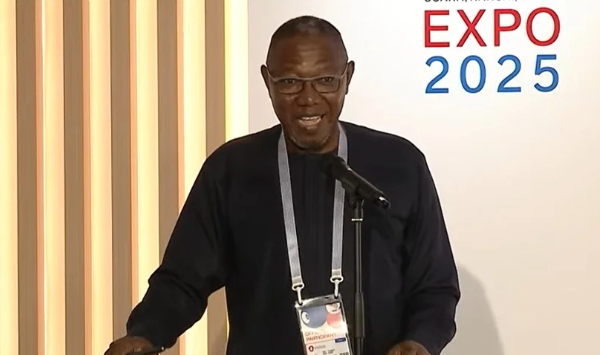
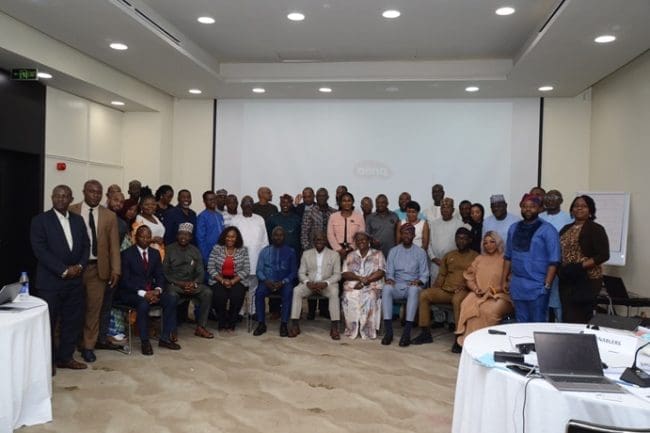
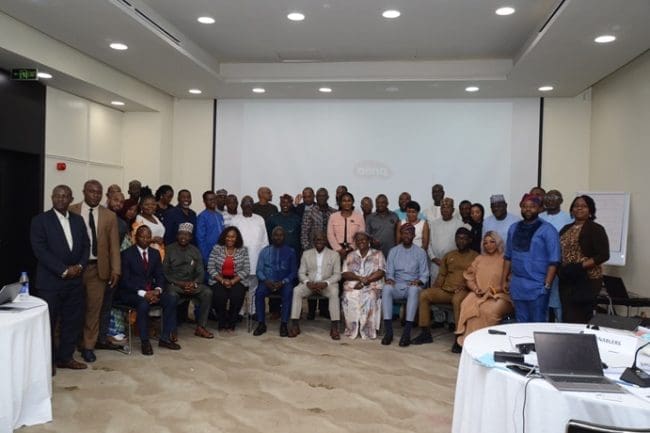
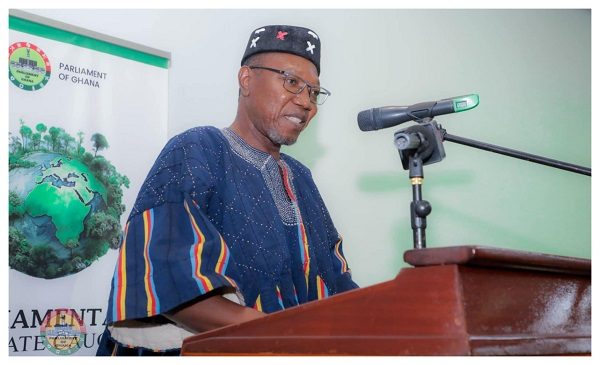
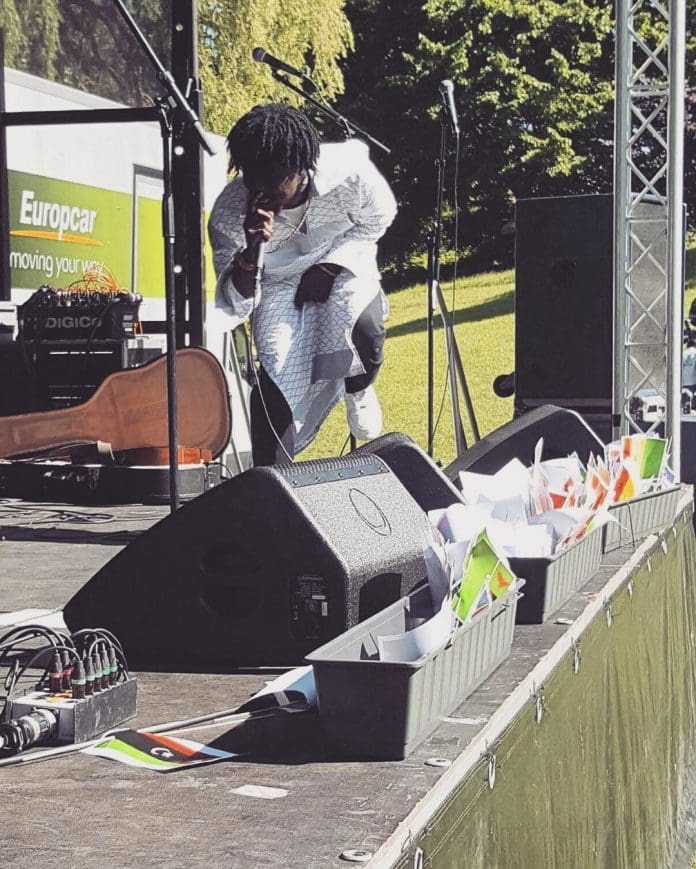
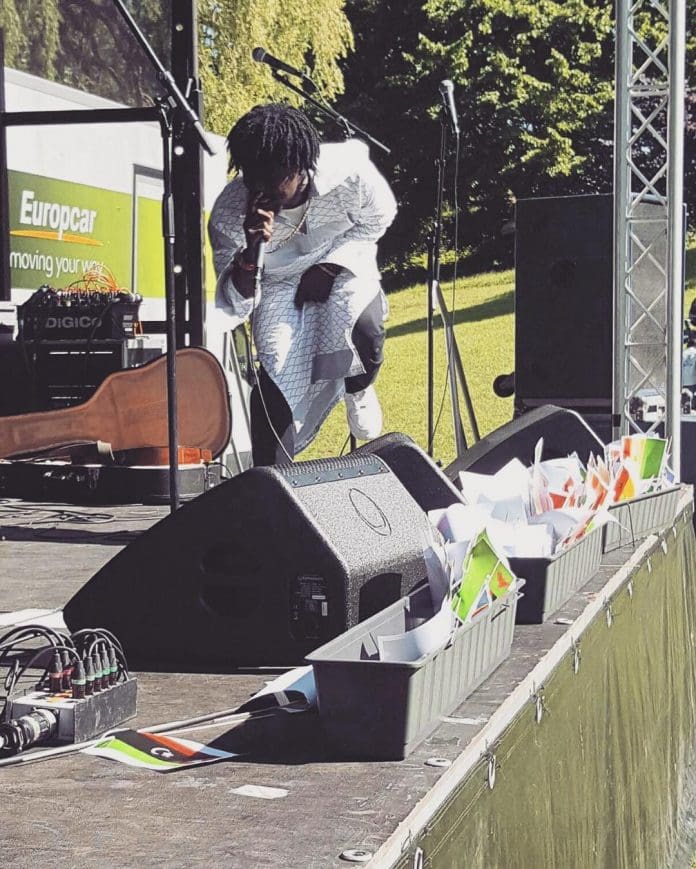
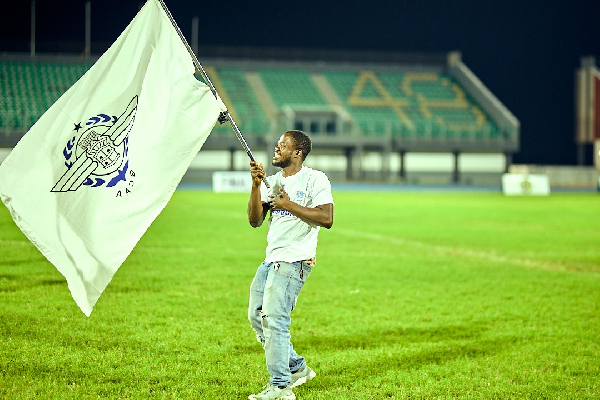
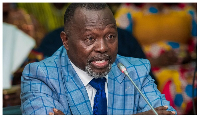
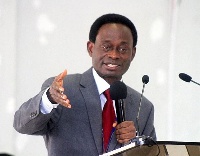
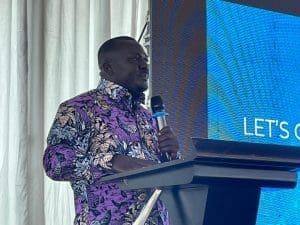
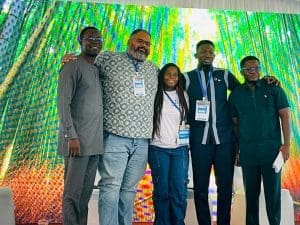
Babacar Dioh, representative of the Thiaroye 44 Movement, speaks during the Dakar roundtable on reparations. The movement brings together descendants of Senegalese tirailleurs and advocates for historical justice.
Senegalese civil society groups have intensified calls for France to address its colonial legacy through reparations and revised bilateral agreements.
At a Dakar roundtable hosted by advocacy coalitions including the Association of Descendants of Senegalese Soldiers and Front for Withdrawal of French Military Bases (GASSI), speakers demanded tangible restitution for historical injustices.
Held at African Memorial Square, the event featured Babacar Dioh of the Thiaroye 44 Movement, representing descendants of Senegalese World War II soldiers massacred by French forces. Souleymane Jules Diallo of JIF’AFRIK joined calls to dismantle “neocolonial frameworks,” citing enduring ecological and financial harm from trade and military pacts favoring French interests.
“The time for symbolic gestures is over,” stated Dioh, announcing formal reparations claims. Advocates contend current agreements perpetuate economic dependence, pointing to France’s control over Senegal’s currency until 2023 and ongoing military presence.
The gathering positions Dakar as a hub for pan-African redress efforts, amplifying continental demands for accountability. Speakers urged cancellation of exploitative resource contracts and withdrawal of French troops from West Africa.
This mobilization follows Senegal’s 2023 repeal of military treaties with France and aligns with broader African advocacy for historical justice. Activists seek structural transformation beyond financial compensation.
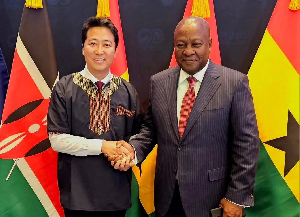
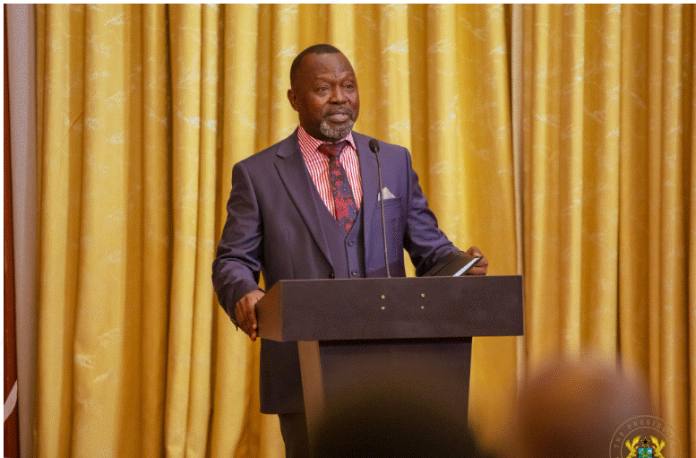
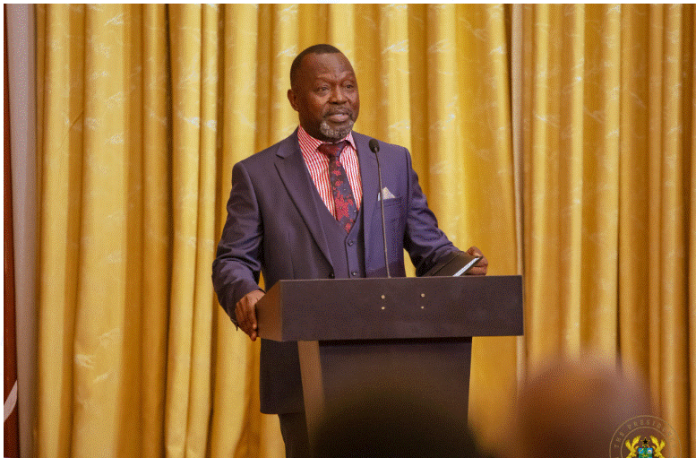
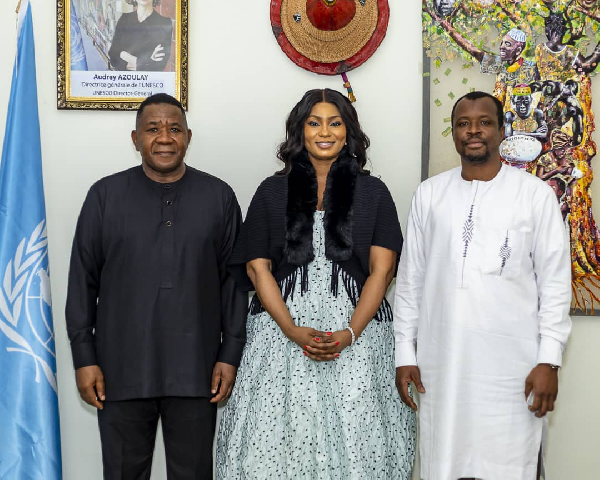
Kojo Choi’s (L) appointment by John Mahama (R) has sparked a lot of conversations
Kojo Choi the newly appointed Ghana’s Ambassador-designate to South Korea is a new face to many Ghanaians, despite operating a number of businesses in the country for years.
His appointment was announced on July 21, 2025, through a statement signed by the Executive Secretary of President John Dramani Mahama, Dr Callistus Mahama.
His inclusion on the ambassadorial list sparked public debate, with some questioning his Ghanaian identity and whether he truly deserved the role whiles arguing that equally qualified Ghanaian-born candidates were available for consideration.
While the appointment drew criticism from certain quarters, many others including those familiar with Choi’s long-standing presence in Ghana rallied in support, pointing out that he has lived in the country since childhood and has consistently demonstrated his commitment to national development.
Amid the debates, one question strongly stood out – who is Kojo Choi?
According to multiple sources including Choi’s social media, Kojo Choi (born Choi Seung-Up) was born in 1978 in Chuncheon, South Korea, to South Korean parents.
He is now a naturalised Ghanaian citizen and has lived in Ghana for more than 33 years.
He is married to Elizabeth Choi and has six children. Together with his wife, he co-founded One Heart Africa Academy, a Christian school located in East Legon.
Choi completed his early education in South Korea until the age of 14, when his father, Reverend Missionary John Choi, relocated the family to Ghana for missionary work.
Early Life and Education in Ghana
Kojo Choi attended SOS Hermann Gmeiner International College in Tema from 1994 to 1999.
He also graduated from the University of Ghana, Legon with a degree in Business Administration in 2002 after enrolling in 1999.
Career and Business Ventures
Over the years, Kojo Choi has established himself as a vital figure within both Ghanaian and Korean communities, serving as a cultural and business bridge between the two nations.
Professionally, he brings over two decades of experience spanning telecommunications, fintech, marketing communications, and business consulting across Ghana and the broader West African region.
Choi is the founder and CEO of PaySwitch Limited, Ghana’s only third-party processor for Visa, MasterCard, and UnionPay, which he launched in 2015.
He has also provided consultancy services to the Korean Embassy and various multinational firms.
Beyond the business sphere, Choi is deeply committed to promoting African art.
He founded Art Africa with the mission of empowering African artists and positioning Ghana as a center for contemporary art.
In 2022, he established the Art Africa Gallery in Osu, Accra, and spearheaded the Colour Cure Exhibition to support breast cancer care at Korle Bu Teaching Hospital.
In the diplomatic realm, he served as Deputy Head of Mission for Ghana during the 2018 Winter Olympics in PyeongChang.
Additionally, Choi is the driving force behind NanaTel Limited, an MTN Ghana-authorised distributor involved in mobile money management and customer care services in Ghana’s Eastern and Volta Regions.
To affirm these details, Kojo Choi also shared a post on his Facebook wall, personally confirming them to Ghanaians.
“33 years ago, I was just 14. Since then, I’ve witnessed every Ghanaian election under the 1992 Constitution. We shocked the world-not with chaos, but with peaceful, democratic transitions. Today, Ghana is a beacon of democracy in Africa. I could have left to the USA or to Korea at some point in life, but I chose to stay-not chase so-called greener pastures abroad,” he wrote.
“I naturalised as a Ghanaian, and I’ve never looked back. As I near my Golden Jubilee (though I still have 2 more years to cover), I look back with gratitude. The journey has been a blessing. I’m proud to be called Ghanaian. As Osagyefo Dr. Kwame Nkrumah said, ‘I am not African because I was born in Africa but because Africa was born in me.’ I feel that deeply. Ghana may not be my birthplace, but it is my true home. May the good Lord continue to bless us and our mother land Ghana,” he added.
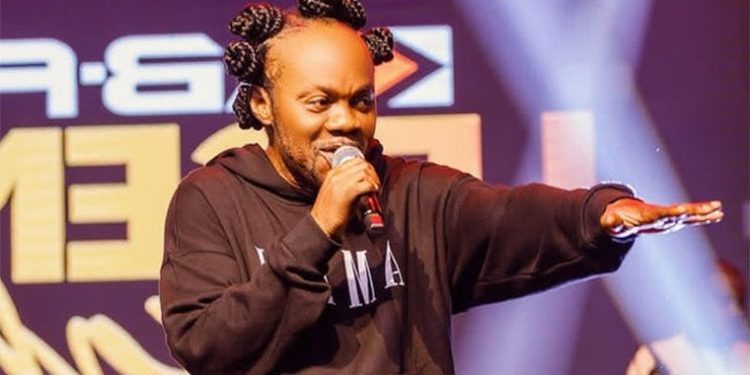
The Ghanaian music fraternity and fans across the globe have been hit with heartbreaking news of legendary Highlife musician Daddy Lumba’s death.
The celebrated icon passed away on July 26, 2025, at the age of 60, after battling health issues in recent years, as confirmed by family.
His demise marks the end of a golden chapter in Ghana’s music history.
Born Charles Kwadwo Fosu, Daddy Lumba was more than just a singer; he was a cultural force, a lyrical genius, and a trailblazer who revolutionised Highlife music and gave it an everlasting modern twist.
Here are 10 interesting things you should know about the iconic Daddy Lumba and the remarkable legacy he leaves behind:
1. Early start in music at just 16
Daddy Lumba’s music journey began in secondary school, where he formed his first band called Lumba Brothers with his friends. He was only 16 years old when he started laying the foundation for what would become an iconic career.
2. Germany was his launchpad
After moving to Germany in 1983, Daddy Lumba teamed up with his friend Ernest Nana Acheampong. Their collaboration produced the first Lumba Brothers album, ‘Yɛɛyɛ Aka Akwantuo Mu’ in 1989 — a major success that officially launched his career.
3. Released over 30 albums
Lumba wasn’t just a passing trend — he was a music machine. Over the span of four decades, he released more than 30 albums, each delivering classic hits and unforgettable anthems that resonated across generations.
4. A master of reinvention
Daddy Lumba was known for constantly reinventing his sound. Whether fusing traditional Highlife with modern instruments or exploring controversial themes, he always stayed ahead of the curve, keeping fans hooked with every release.
5. Award-winning career
His musical brilliance earned him numerous accolades, including Ghana Music Awards, National Honours, and Lifetime Achievement Awards. His song ‘Aben Wo Ha’ remains one of the most iconic and controversial Highlife hits of all time.
6. His music spoke boldly and honestly
Lumba was never afraid to speak his mind. His lyrics often explored themes of love, betrayal, social injustice, and personal struggles, delivered with raw honesty and unmatched flair.
7. He inspired generations of musicians
Many of today’s biggest Ghanaian acts, from Ofori Amponsah to Kwabena Kwabena, cite Daddy Lumba as a major influence. His fearless artistry and unique sound set a new standard in Ghana’s music industry.
8. He survived personal struggles and health battles
Behind the scenes, Lumba endured a series of health challenges that occasionally kept him away from the spotlight. Despite the odds, he always found his way back to the studio and stage, proving his resilience and undying passion for music.
9. Founder of DL Music Production
He wasn’t just a singer; he was also a producer and entrepreneur. Through his label DL Music Production, he supported and mentored other artistes, including the likes of Ofori Amponsah and Kofi Nti.
10. His death marks the end of a golden era
The Yentie Obiaa icon’s death is more than just a loss to music; it’s a national heartbreak. Known for his electrifying stage presence, smooth voice, and iconic fashion sense, his absence will leave a deep void in the entertainment industry.
DISCLAIMER: The Views, Comments, Opinions, Contributions and Statements made by Readers and Contributors on this platform do not necessarily represent the views or policy of Multimedia Group Limited.
DISCLAIMER: The Views, Comments, Opinions, Contributions and Statements made by Readers and Contributors on this platform do not necessarily represent the views or policy of Multimedia Group Limited.
Former Accra Lions right back Remember Adomako is on the verge of completing a move to Aduana FC, GHANASoccernet.com can exclusively report.
The defender is scheduled to undergo a mandatory medical examination on Tuesday, after which he will be unveiled as Aduana’s newest signing ahead of the 2025/26 Ghana Premier League season.
Adomako has already agreed to a three-year contract with the Dormaa-based club, sealing personal terms earlier this week. The deal marks an important addition to Aduana FC’s defensive setup as they reinforce their squad for both league and FA Cup campaigns.
The youngster has spent his entire career with Accra Lions, where he became known for his pace, overlapping runs, and consistent work rate on the right flank. His performances attracted interest from several GPL clubs, but Aduana moved swiftly to secure his signature.
This move is seen as part of Aduana’s broader strategy to rebuild key positions following the departures of several players this transfer window.
Baidoo has stated that his decision to contest is response to calls by grassroot
Legal practitioner, Bernard Bediako Baidoo Esq, has officially picked nomination form to contest in the National Democratic Congress parliamentary primaries ahead of the Akwatia by-election scheduled on September 2, 2025.
He picked the nomination form on Monday, July 28, becoming the third aspirant to pick forms, joining former MP Henry Boakye Yiadom and Erasmus Koney Ali, popularly known as Asanka, who picked their forms earlier through their representatives.
Speaking to media, Bernard Bediako Baidoo Esq said his decision to contest is response to calls by grassroot of the party and the electorates in Akwatia.
“Don’t forget that I’m a lawyer but I’m also the constituency secretary. And so I have been down there, they have worked with me, I’ve worked with them, they know my capabilities, they know everything about me. And so when calls like this come, it’s a call to service. And I’ve taken that in good faith”. Said Bernard Bediako Baidoo Esq.
He added, “So I am prepared to take the mantle, take it up from where we left off and then help the president and the government reset the constituency, which is Akwatia constituency. So, if you ask me, I mean it’s a simple reason of a call to service”.
Responding to critics why he is contesting his client Henry Boakye Yiadom in 2024 election petition against the late MP Ernest Yaw Kumi, he said the primaries presents fresh opportunity for any eligible party member to contest.
“To answer your question directly, like I said before, you understand that I’m not just a lawyer, I am also a constituency secretary.
“And so, the law staff is there, the law that is there and then the partisan hat is also there. And so, I’m done with the legal aspect. I did it for him as an honourable Okoyo and then the party.
“I did that for him because the decision was taken at the very top for me to do the case. We are done because we had other things to do” Bediako Baidoo Esq stated.
He added “As I’ve always said, we had other things to take the deceased Ernest Kumi on. There were a few things we wanted to, but God knows best. And so, once he’s no more, you cannot push further. It’s unfortunate. And so, once it’s like that, everything about 2024, it’s over. We start afresh and it is, I am of the view that a fresh face would do”.
Lawyer Bernard Bediako Baidoo is of the view that the division within the NDC in Akwatia requires a new face who will unify the party.
“We have a peculiar problem in Akwetia within the ranks of the NDC, cracks. And you would bear me witness that our results in 2024, irrespective of what we thought or what our view were, was more of a skirt and blouse against the parliamentary candidate.”
He said, “Anytime Akwatia is united, I mean, we win the seat. And so, our prayer is that we get a fresh face who would come and unite both factions. You are here, you know, and most of you hear in the news, you hear of Asanka faction, Okoyo faction, whichever faction. Sometimes it’s sad”
The Deputy Eastern Regional Secretary of the NDC, Kwaku Boateng, assured of a peaceful and transparent internal election ahead of the by-election.
He said the party is poised to win the seat.
The party’s election is scheduled for August 4, ahead of the by-election on September 2nd.
The Electoral Commission will open nominations from August 5 to August 7.
The Driver and Vehicle Licensing Authority (DVLA) has announced a major shift in its vehicle registration process at Ghana’s ports of entry, with the full rollout of digital sticker Drive from Port (DP) numbers set to begin on August 1, 2025.
According to the DVLA, the move follows a successful pilot programme at the Tema and Takoradi Ports and will phase out the issuance of aluminium DP plates at the ports.
From the effective date, only digital DP stickers will be issued to imported vehicles at the point of entry.
The initiative is aimed at enhancing the security, efficiency, and accountability of the DVLA’s services, while also aligning with global best practices in vehicle registration.
As part of the new system, the DVLA has partnered with the State Insurance Company (SIC) to ensure that all vehicles issued with the digital DP stickers receive valid insurance cover before leaving the ports.
“This transition is not only a move towards innovation but also a measure to ensure road safety and compliance with Ghana’s vehicle insurance laws,” the statement noted.
The DVLA, in a statement, is urging the public to cooperate fully with the new arrangements and has provided a dedicated helpline — 0302746760 — for further enquiries.
The digital rollout marks another milestone in the DVLA’s efforts to modernise its operations and deliver seamless services to the Ghanaian public
Everton have made an offer for Bayern Munich’s teenage defender Adam Aznou, but still need up to six more signings before the transfer window closes, manager David Moyes says.
The injury-related absences of central defensive duo James Tarkowski and Jarrod Branthwaite hurt Everton badly at the MetLife Stadium on Saturday as they conceded three second-half goals in a 3-0 loss to Bournemouth.
It only reinforced a view Moyes expressed at an event in New York on Friday when he said he needed “nine or 10” new signings.
Asked to clarify his comments following the Bournemouth defeat, which followed on from last week’s loss to Championship side Blackburn Rovers, Moyes said he felt justified in his assessment.
“Well, we’ve signed three, so if you take that off, we’re still in need of maybe five or six players,” he said. “That’s what we have to try and do.
“I’ve never had one of these times. In the past, I have had to sign a lot of players, but I’ve never had to do so many in one window.”
The Toffees have signed goalkeeper Mark Travers, made midfielder Carlos Alcaraz’s loan move permanent and French striker Thierno Barry for £27m.
But they have lost five senior players, including striker Dominic Calvert-Lewin and Mali midfielder Abdoulaye Doucoure, after their contracts expired.
Branthwaite is among four members of Moyes’ squad to sign new contracts this summer.
“We’re trying really hard behind the scenes to get things done,” he said.
Aznou, a Moroccan international, joined Bayern’s academy as a 16-year-old after leaving Barcelona, the city of his birth.
The left-back has made four appearances for Bayern and spent the second half of last season on loan at Spanish side Real Valladolid.
Moyes confirmed an offer has been made but has cautioned against believing the 19-year-old will have a seismic impact on his squad.
“We have made an offer,” said Moyes.
“Whether it’s accepted and whether it’s all done… but he’s a young player. It’s someone we see as having a good future and good potential.”
DISCLAIMER: The Views, Comments, Opinions, Contributions and Statements made by Readers and Contributors on this platform do not necessarily represent the views or policy of Multimedia Group Limited.
DISCLAIMER: The Views, Comments, Opinions, Contributions and Statements made by Readers and Contributors on this platform do not necessarily represent the views or policy of Multimedia Group Limited.
U.S. President Donald Trump prays with a group, during the White House Faith Office Luncheon at the White House in Washington, D.C.
Federal employees may discuss and promote their religious beliefs in the workplace, the Trump administration said on Monday, citing religious freedoms protected by the U.S. Constitution.
Agency employees may seek to “persuade others of the correctness of their own religious views” in the office, wrote Scott Kupor, director of the Office of Personnel Management, the U.S. government’s human resources agency.
Supervisors can attempt to recruit their employees to their religion, so long as the efforts aren’t “harassing in nature,” according to Kupor’s statement. Agencies can’t discipline their employees for declining to talk to their coworkers about their religious views.
The statement represents the latest effort of the six-month-old Republican Trump administration to expand the role of religion in the federal workplace.
Courts have long held that employers cannot suppress all religious expression in the workplace, but can lawfully curb conduct that is disruptive or imposes an undue hardship as long as it applies equally to members of any religion.
The U.S. Constitution’s First Amendment protects individuals’ rights to practice their religion while preventing the government from favoring one religion or another or religion in general.
OPM in mid-July said agency workers can get permission to work from home or adjust their hours to accommodate religious prayers, after previously demanding that workers report to offices fulltime.
The new statement cites President Donald Trump’s February executive order calling on agencies to eliminate the “anti-Christian weaponization of government.”
That order directs cabinet secretaries to identify federal actions hostile to Christians. Trump has embraced the conservative Christian world view and promoted policies that speak to concerns that their religious liberty is under attack.
Federal employees can also set up prayer groups in the workplace, so long as they don’t meet during work hours, Kupor’s statement said.
The memo references Title VII of the Civil Rights Act of 1964, a law that prohibits workplace discrimination based on a person’s religion or religious practices.
Kupor in the memo said that means the law requires employers to allow workers to proselytize, organize prayer groups on non-working time, and display religious icons.
The U.S. Equal Employment Opportunity Commission, which enforces Title VII, has said that proselytizing in the workplace can amount to unlawful religious harassment if it is unwelcome and is so severe or pervasive that it creates a hostile or abusive work environment.
“A consensual conversation about religious views, even if quite spirited, does not constitute harassment if it is not unwelcome,” the agency said in a 2008 guidance document.
Kupor’s memo is not legally binding, and any court that reviews it could disagree about the scope of Title VII’s protections. But the memo could be difficult to challenge directly in court, as judges in many past cases have said they lack the power to review internal agency documents.
DISCLAIMER: The Views, Comments, Opinions, Contributions and Statements made by Readers and Contributors on this platform do not necessarily represent the views or policy of Multimedia Group Limited.
DISCLAIMER: The Views, Comments, Opinions, Contributions and Statements made by Readers and Contributors on this platform do not necessarily represent the views or policy of Multimedia Group Limited.
Minister of Government Communications, Felix Kwakye Ofosu
The Minister of Government Communications, Felix Kwakye Ofosu, has announced that a total of 97,421 students has so far been reimbursed under the government’s flagship “No Fees Stress” initiative.
The minister, in a statement on his Facebook wall, highlighted the government’s commitment to ensuring equitable access to education by removing financial barriers for students.
Kwakye Ofosu emphasised that the reimbursements were part of broader efforts to ease the burden of school-related expenses on families across the country.
He added that the initiative targets students who initially paid fees upfront due to delays in government disbursements.
“The ‘No Fees Stress’ programme is a testament to our promise of making education truly accessible.
“As of today, 97,421 students have received reimbursements, and we are working to ensure that all eligible students benefit fully from the initiative,” he stated.
The minister further assured that the process is being streamlined to improve efficiency and transparency, with new digital platforms being deployed to fast-track future disbursements.
The “No Fees Stress” policy was introduced as part of the government’s education relief strategy aimed at cushioning students and parents from the high cost of tertiary education.
It forms a key component of the administration’s broader agenda to promote inclusive and quality education nationwide.
The Bretuo family of Kwahu Twenduase, The Adulai and Dossey Families, The Anim Families Of Obo Kwahu, The Osabutey Families of Big Ada, Aunty Afua, Madam Beatrice Nyakoa, The Ammah and Ankrah Families, Gordon A Anson, George Bediako USA, Apostle Martha Anim, The Church Council/ Pastorate/ Congregation of Ebenezer Pentecostal Family Ministry Int’l., The Good Shepherd Fellowship Of Churches, Associate/Partner Churches Ghana, Europe, UAE and the Americas, announce with deep sorrow the passing of their beloved
Bishop Dr. Ezekiel Goodman Kofi Anim, PhD, FCMA
Funeral Arrangements
Wake Keeping: Friday, 1st August from 7 pm till 11 pm at Ebenezer Pentecostal Family Ministry International, Pigfarm, Accra.
File Passing: 2nd August 2025. 5:00am till 7:30am.
Burial Service: Saturday 2nd August from 8:00am at The Swag Park. Kotobabi, Accra.
Internment: Private burial.
Thanksgiving Service: Sunday, 3rd August. 8:30 am at Ebenezer Pentecostal Family Ministry International, Pigfarm. Accra.
Reception: Sunday 3rd August at Ebenezer Pentecostal Family Ministry International. Pigfarm. Accra from 1 pm.
Dress Code: Saturday: Black | Sunday: Black and White.
Chief Mourners: Gordon A. Anson, Prof. Emeritus Korley, Mr Acolatse. Emmanuel Quarshie, Joseph Nii Ammah, Godson Amenyah, Mrs Elizabeth Adu Mensah, Brothers and Sisters, George Bediako USA, Aunty Afua, Madam Beatrice Nyakoa, Janet Serwaa, Ohio USA, United Peace Federation (UN), One Way One Job Bible College, The Church Council/Pastorate/Congregation of Ebenezer Pentecostal Family Ministry Int’l (EPFMI) Ebenezer Academy and The Good Shepherd Fellowship Of Churches.
SONS IN-LAW: Pastor Daniel Bredu, Pastor Anthony Naalon, Min Ebenezer Harry Fiscian.
NEPHEWS & NIECES: Joel Ezekiel Anim, Salome Sewor, Gloria Ama Kwakyewaa Anim, Christine Anim, Kingsley Anim, Gloria Sewor, Jemimah Sowah, Theophilus Nii Ayei Ammah, Pearl Nii Mc’hubert Sowah, Nii Ayei James Sowah, Chanteelle Kom, Amos Djedji, Adelaide Anim Anson, Ivanna Anim Anson, Brianna Anim Anson, Lordina Anim Anson, Emmanuel Edem Quarshie, Emmanuella Eyram Quarshie, Eugenia Etornam Quarshie, Nana Yaw Kye Akuffo, Jenovival Obenewah Asiamah, Darren Yeboah Asiamah, Nana Abena Marfoa Asiamah, Janet Atwiwah Anim, Vivian Ewuradoma Annan-Foster Darko, Christiana Dugbartey, Philip Kwabi Dugbartey.
ALL FRIENDS AND SYMPATHIZERS ARE CORDIALLY INVITED
DISCLAIMER: The Views, Comments, Opinions, Contributions and Statements made by Readers and Contributors on this platform do not necessarily represent the views or policy of Multimedia Group Limited.
DISCLAIMER: The Views, Comments, Opinions, Contributions and Statements made by Readers and Contributors on this platform do not necessarily represent the views or policy of Multimedia Group Limited.
President Kurt Edwin Simeon-Okraku has expressed immense pride in the Black Queens’ historic Bronze medal win at the 2024 Women’s Africa Cup of Nations, emphasizing the importance of continued investment in women’s football. Following Ghana’s third-place triumph, the 2nd Vice CAF President highlighted the impact of the GFA’s strategic initiatives, including the DNA Women’s Football Strategy.
“From the moment we developed the strategy, launched the talent identification program, established the Academy in the North, invested in the Women’s Premier League, and boosted TV coverage, we knew we were on the right path,” he said. “Thank God for the Bronze. Our investment in women’s football is yielding results, and we’re confident about our collective future.”
President Simeon-Okraku praised the Black Queens for their resilience and determination, acknowledging that their achievement signals greater potential for Ghanaian women’s football.
“We need to let the team enjoy this moment. Although they didn’t win the ultimate trophy, their achievement speaks volumes about the huge potential in our women’s game,” he stated.
Looking ahead, he emphasized the need for sustained investment, expanded talent identification programs, and a structured pathway for player development from the U-15 level to the senior national team.
“With the right investment, more talent identification programs, and a natural progression of players, we’ll reach our desired destination,” he affirmed. “The talent in them is unbelievable.”
The Black Queens’ bronze medal marks Ghana’s first WAFCON podium finish in over two decades, reigniting hopes for a new era of dominance in African women’s football.
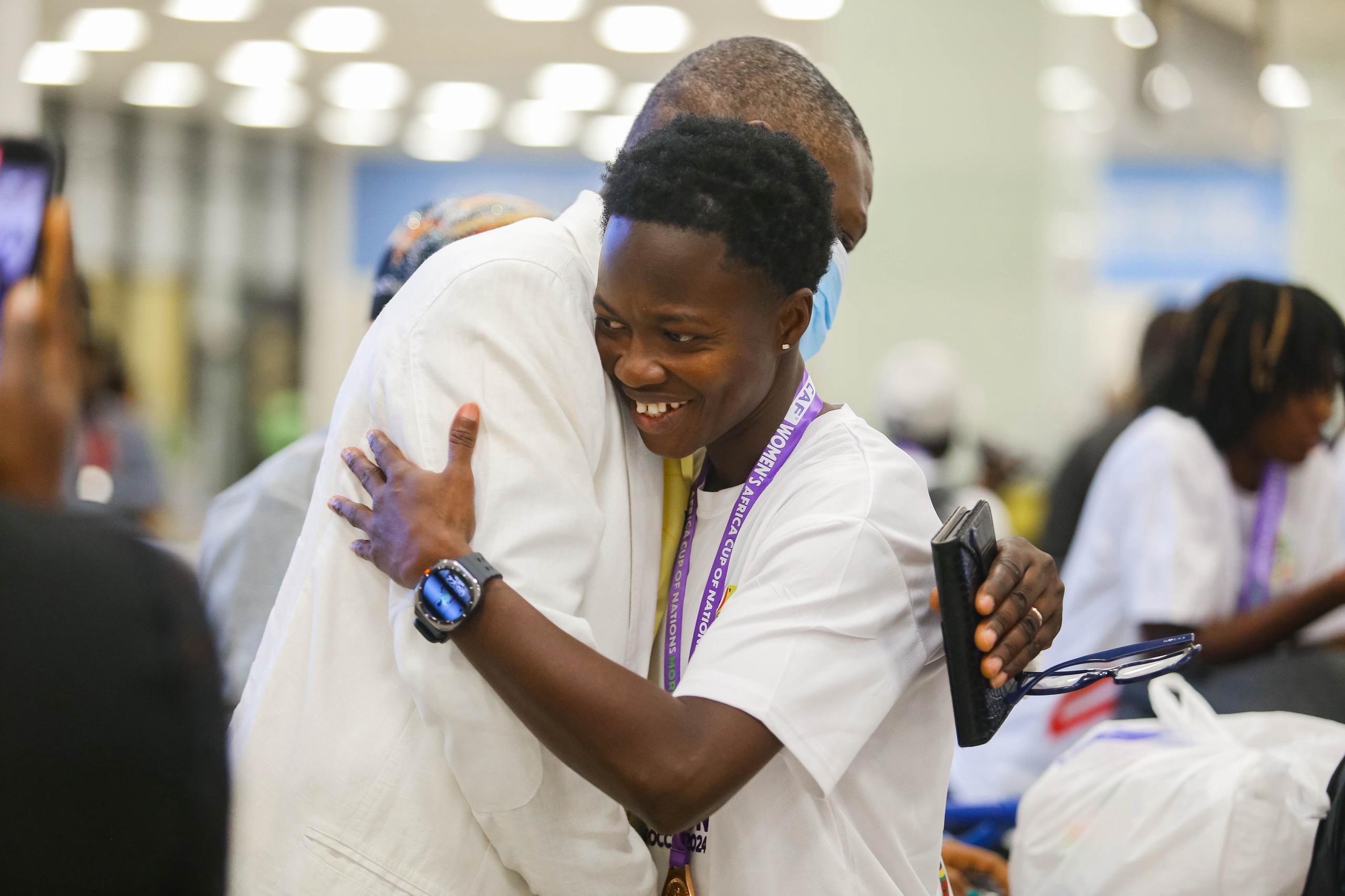
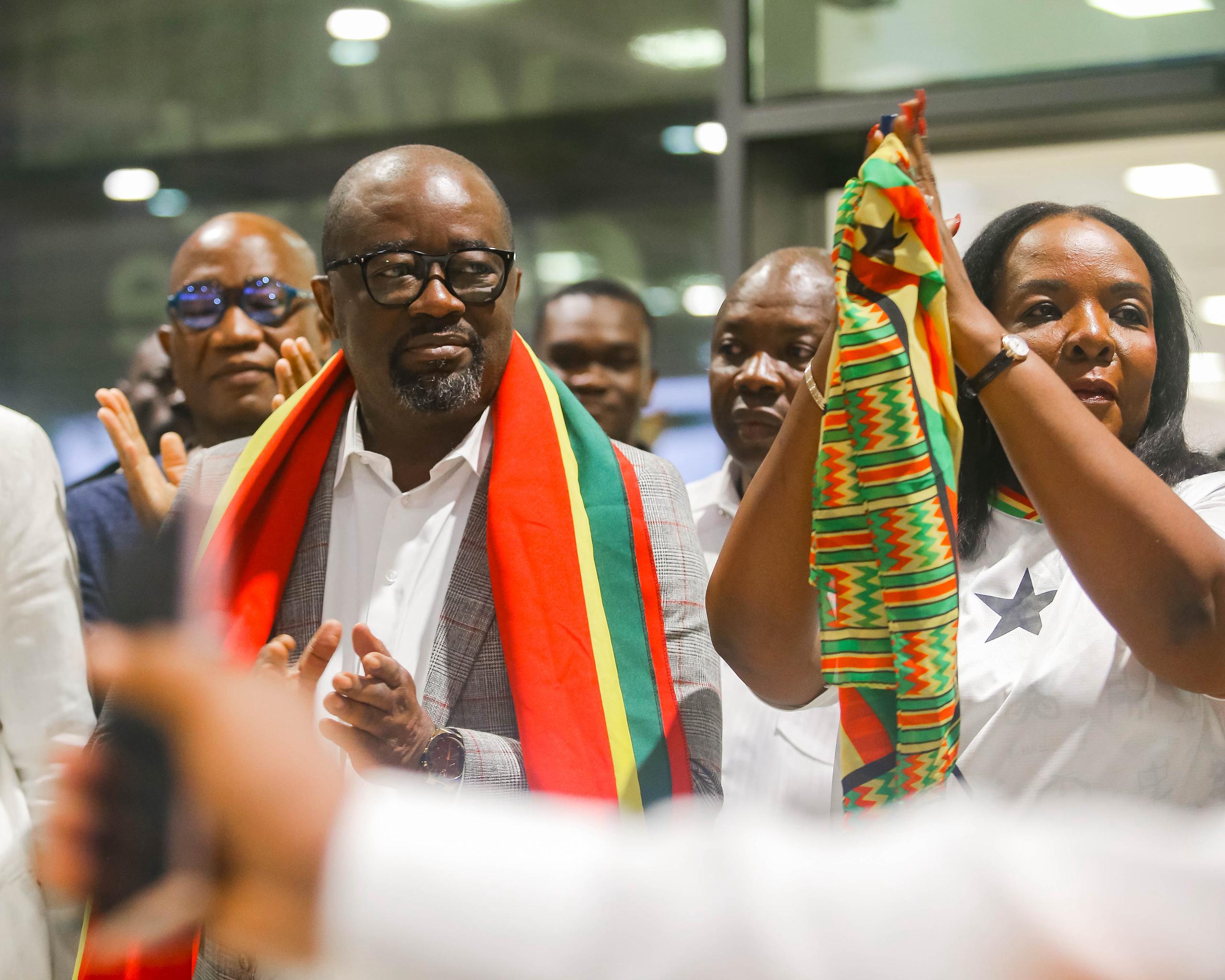
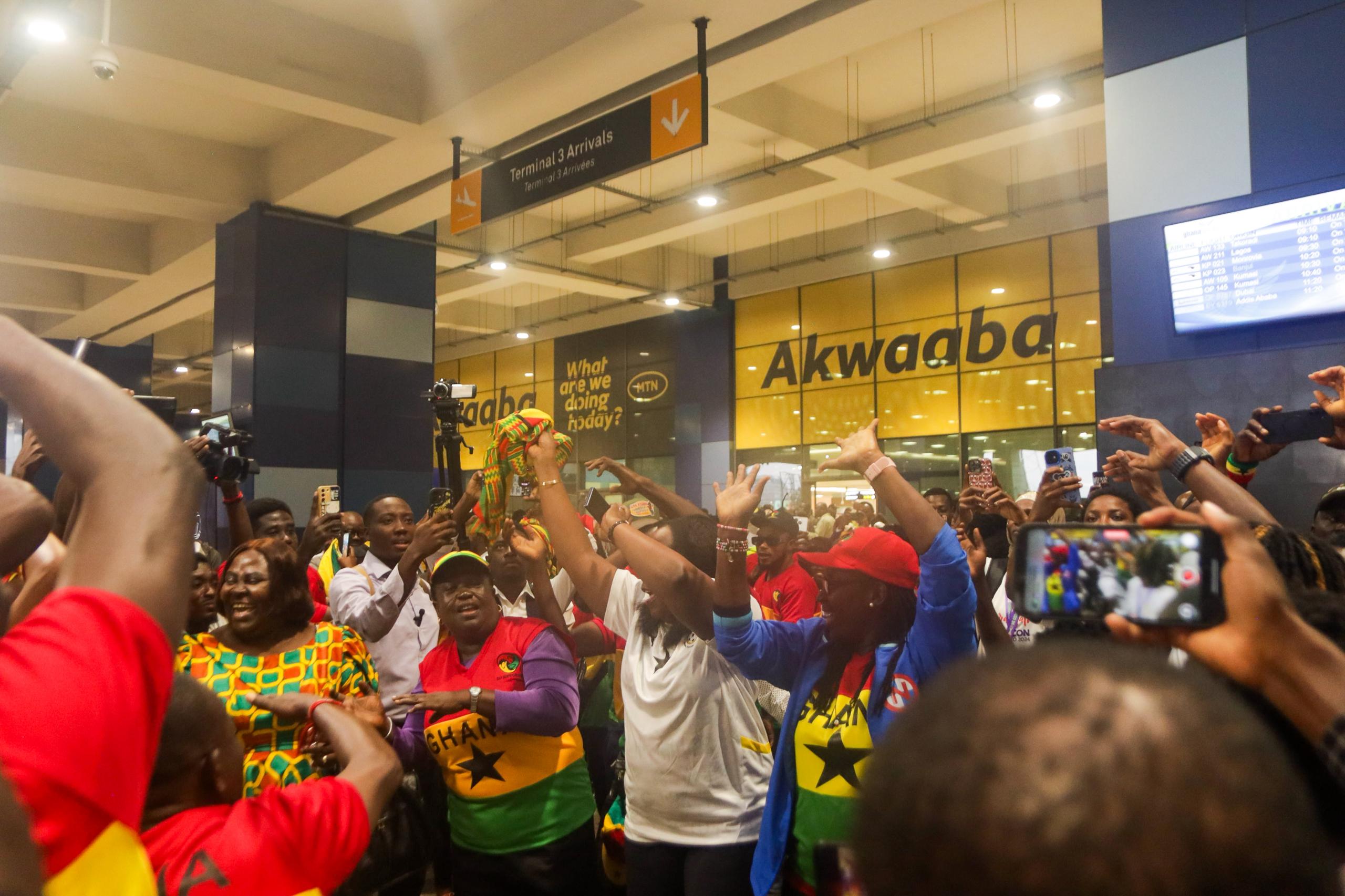
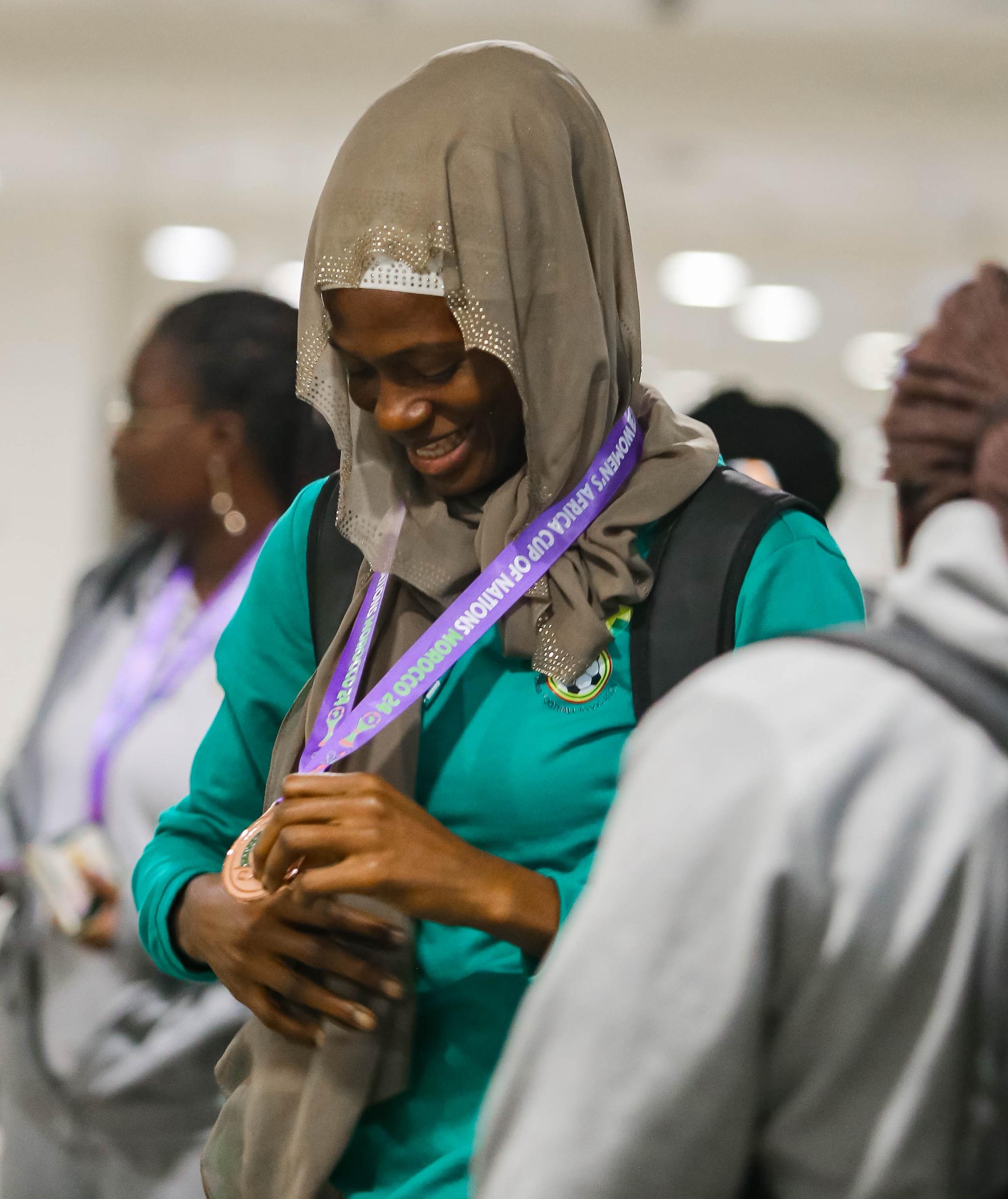
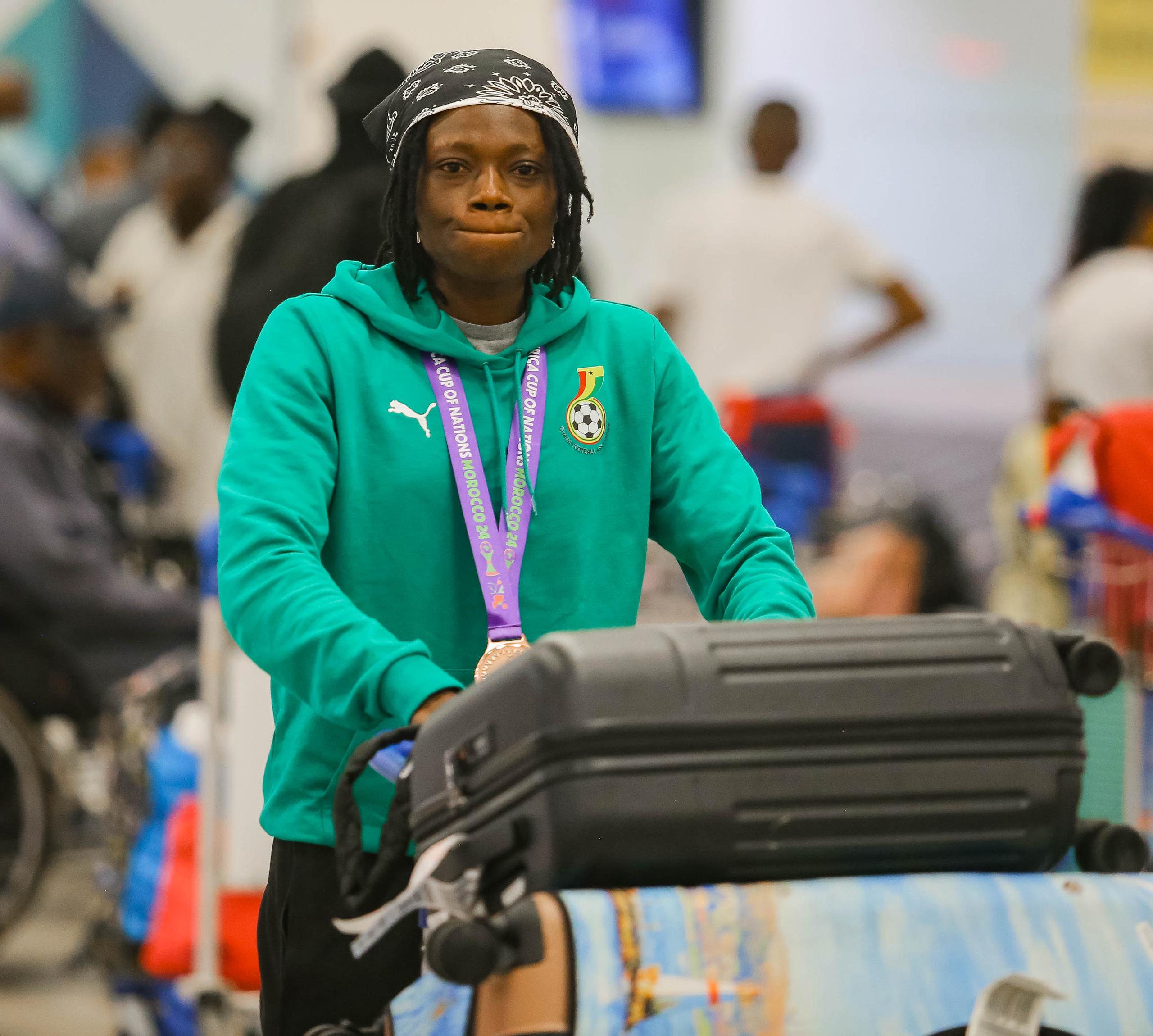
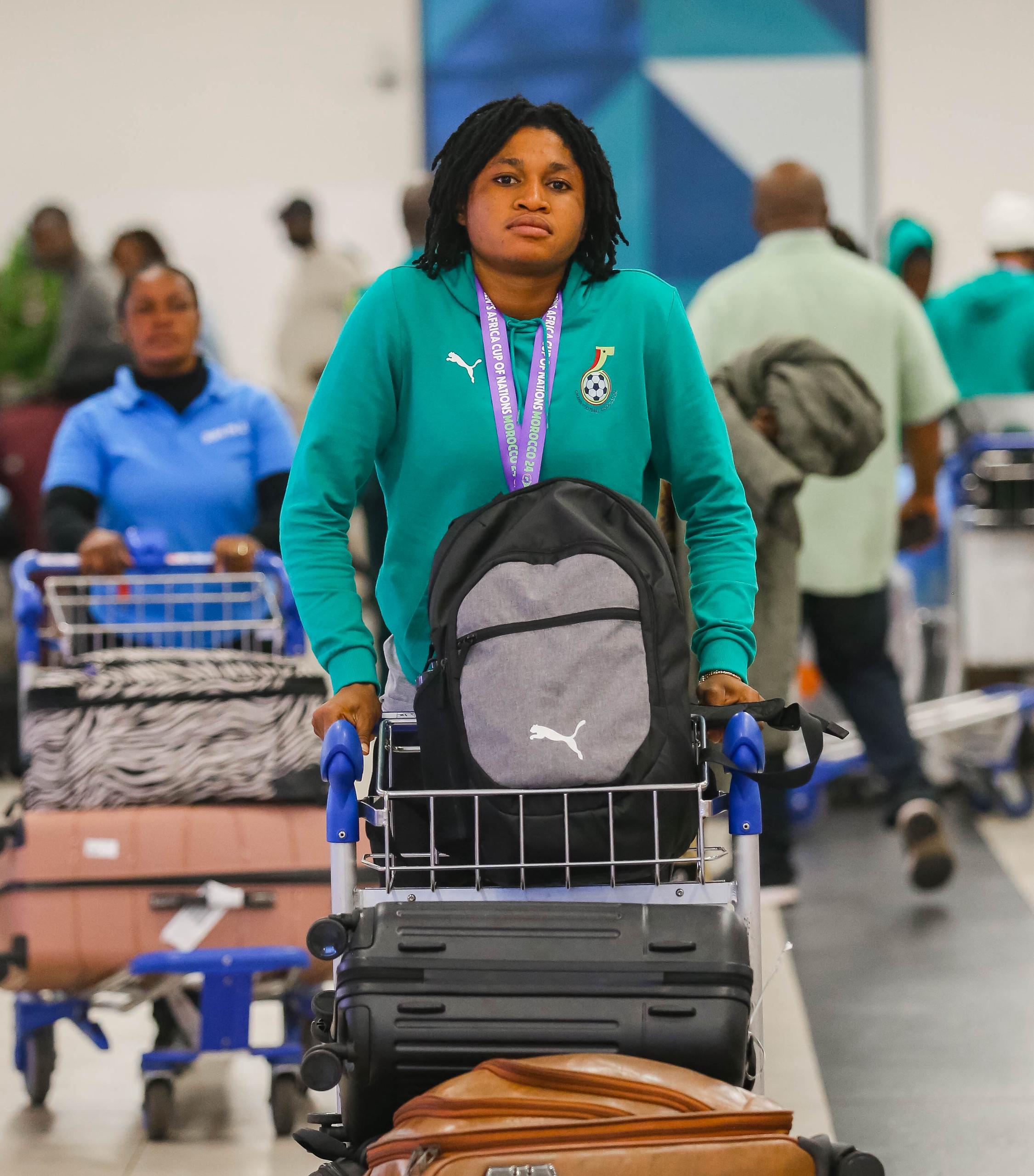
The Black Queens returned home to a warm and emotional welcome in Accra after securing the Bronze medal at the 2024 TotalEnergies Women’s Africa Cup of Nations (WAFCON) in Morocco. Upon arrival at Kotoka International Airport, the team was greeted with thunderous applause, chants, waving flags, and traditional drumming by fans and officials. The players, dressed in team colors and proudly displaying their bronze medals, were visibly moved by the outpouring of love and support.
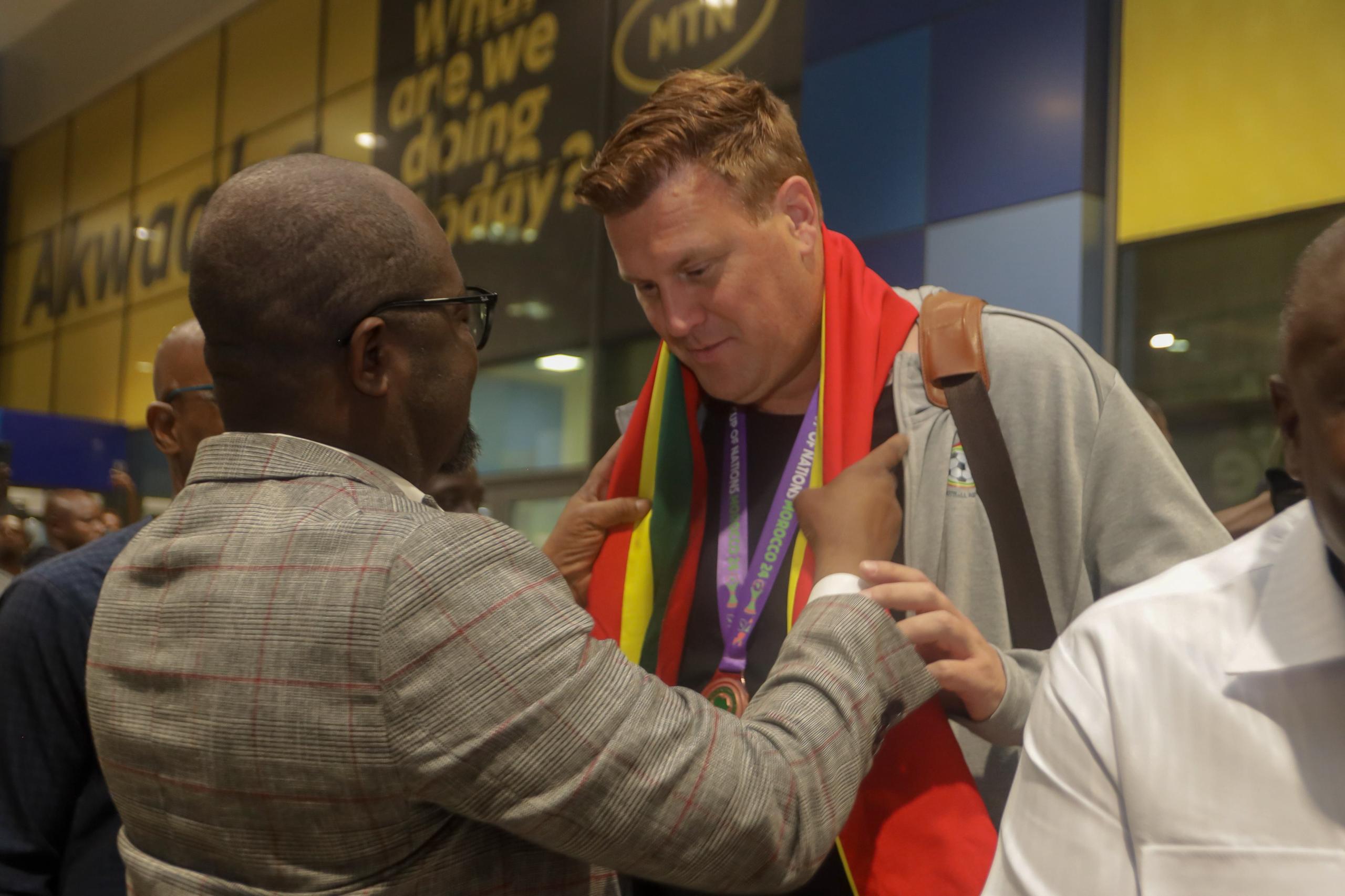
The team was received by prominent officials, including CAF 2nd Vice President and GFA President Kurt Okraku, Minister for Sports and Recreation Hon. Kofi Iddie Adams, GFA Vice President Mark Addo, and other GFA executives. Captain Portia Boakye led the team, lifting the medal high to the cheers of the crowd, symbolizing the team’s hard-fought journey.
The Technical staff, led by head coach Kim Lars Björkegren, and GFA representatives joined in the celebrations. The GFA and Ministry of Sports and Recreation have praised the team’s efforts, with plans underway for an official ceremony to honor their performance and inspire future investments in Women’s football.
The Bronze medal marks a significant milestone, reflecting years of hard work, structured reforms, and renewed focus on women’s football in Ghana. It’s a testament to the team’s dedication and progress.
Accra, July 28, GNA – Absa Bank Ghana has reaffirmed commitment to supporting young entrepreneurs with the launch of its Future Fuelled Youth Festival.
The event held at the British Council in Accravcoincided with the visit of Mr. Sydney Mbhele, Absa Group Chief Marketing and Corporate Affairs Officer.
It formed part of the bank’s broader youth empowerment agenda which aims to support innovation, entrepreneurship, and financial literacy.
The festival brought together students, startups, and key players in Ghana’s entrepreneurship ecosystem for a day of practical learning, engagement, and inspiration.
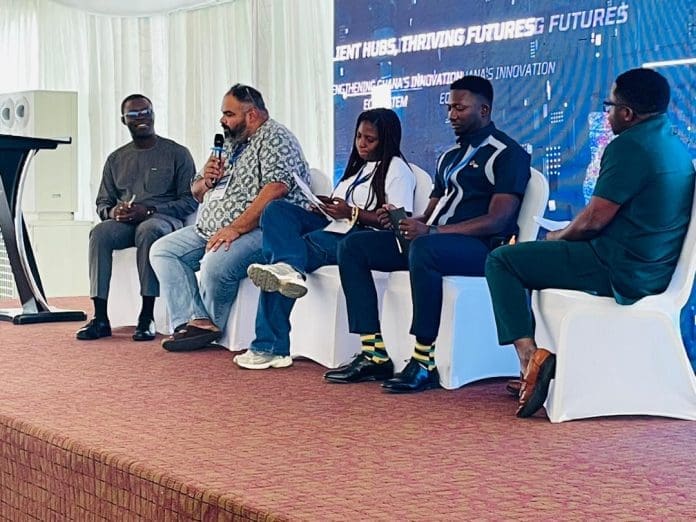
Activities included an innovation showcase of emerging Ghanaian brands, and a panel discussion focused on navigating the entrepreneurial journey from idea to impact.
Speaking at the event, Mr. Mbhele highlighted Absa’s people-first approach to banking.
“We do not just open accounts; we invest in people. When we say ‘Your Story Matters’, we mean it. Because in every entrepreneur, we see an agent of change, a builder of ideas, and a storyteller shaping the future,” he said.
Nana Essilfuah Tamakloe, Director of Marketing and Corporate Affairs at Absa Ghana, emphasised commitment to youth development.
“We are very committed to supporting the dreams and ideas of young entrepreneurs. That support goes beyond finance. It starts with capacity building, skills development, and advisory support to help them thrive,” she said.
The panel discussion, Moderated by Berla Mundi, offered practical guidance on building sustainable businesses. Speakers stressed the importance of market research, developing a minimum viable product (MVP), and learning from failure.
They encouraged participants to test ideas on the local market, rather than replicate foreign models, and to embrace continuous learning, mentorship, and flexibility in adapting business models.
Elselund Ewudzie-Sampson, a female entrepreneur, shared her journey from delivering groceries from home to building a logistics-backed foodstuff brand called Big Samps Market.
She recounted receiving a GHS 200,000 grant from Absa Ghana, which became a turning point in her journey.
“That grant changed everything. It allowed me to rebrand, hire new staff, and restructure the business for scale. Absa Bank’s support helped me move from survival to growth,” she said.
The Future Fuelled Youth Festival is part of Absa Bank’s ongoing contribution to financial literacy and entrepreneurship. It provides a space for young founders and ecosystem players to connect, share insights, and access resources to drive self-employment and long-term business success.
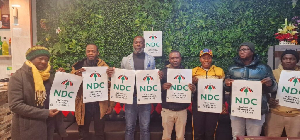
NDC Spain branch has raised concerns over the recent surge in violent crimes
The Spain Branch of the National Democratic Congress (NDC) has raised concerns over the recent surge in violent crimes and general insecurity in Ghana, urging swift and decisive action from the relevant authorities to restore peace and public confidence in the state.
Speaking in an exclusive interview on July 28, 2025, the Secretary of the branch, Hanson Dartey, expressed worry over what he described as “a disturbing breakdown in law and order”, citing recent incidents of targeted shootings, kidnappings, and the general fear that has gripped many communities across the country.
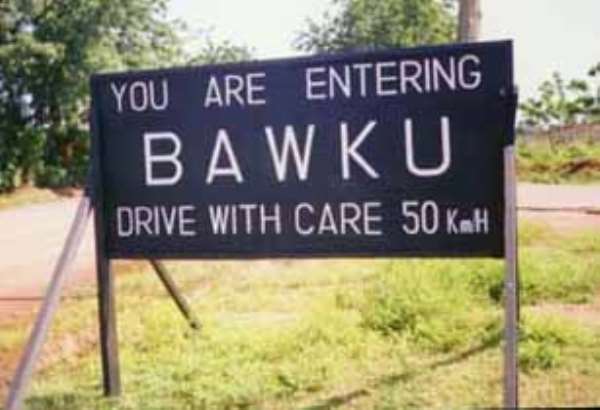
Dartey referenced the tragic killing of a Kusasi chief and his close friend in Kumasi, as well as the heart-wrenching shooting of high school students in Bawku, as clear indicators that “the country is facing an escalating security crisis.”
According to him, the recurrence of such deadly attacks points to a system struggling to contain criminal activities and protect innocent lives.
He emphasised that while crime exists in every society, the failure to act swiftly and decisively only emboldens perpetrators.
He therefore called on the Inspector General of Police (IGP) to take urgent steps to strengthen intelligence operations, boost police visibility, and coordinate efforts to dismantle organized criminal networks.
“It is the expectation of every citizen that the Ghana Police Service will rise to the occasion and protect lives and property.
“The time has come for the IGP to marshal his men with renewed dedication and professionalism,” Dartey remarked.
He also urged President John Mahama, in consultation with the Minister of the Interior, to roll out strategic measures to curb the rising tide of violence.
According to Dartey, ensuring national security must remain a top priority of the government, especially at a time when citizens are increasingly disillusioned by the state’s apparent inability to guarantee their safety.
“We believe that the President must act now, before the situation deteriorates further. This is not a matter of politics but of human lives,” he stated.
While urging state authorities to act, Dartey appealed to Ghanaians to be more mindful of their security and to seek peaceful approaches to conflict resolution.
He warned that retaliatory violence only compounds the nation’s challenges and leads to needless loss of life.
“The NDC Spain Branch calls on all Ghanaians, irrespective of political affiliation, to uphold peace and work together in safeguarding the future of our country. The safety of our families and communities must not be compromised.”
AM/SEA
GhanaWeb Special: The gold market that fuels galamsey
Attorney General Dr. Dominic Ayine has disclosed GH¢80 million remains unaccounted for from a GH¢189 million transfer to a Bank of Ghana account linked to the National Service Authority (NSA).
During Monday’s Government Accountability Series, Ayine confirmed prosecutors paused planned charges last week after uncovering new financial irregularities.
“We stumbled upon further evidence of malfeasance involving the account holding GH¢189 million,” Ayine stated. Forensic tracking revealed the GH¢80 million discrepancy, intensifying scrutiny of public fund management. Investigators also identified two cheques bearing former NSA Director-General Osei Assibey Antwi’s details, used to withdraw nearly GH¢2 million from the account.
The Attorney General emphasized the delay aims to ensure a comprehensive probe: “We halted charges to await evidence from the Bank of Ghana, Ministry of Finance, and Controller and Accountant-General.” The expanded investigation raises critical questions about internal controls and auditing at the NSA, testing public trust in President Mahama’s anti-corruption agenda.
Ghana’s Deputy Minister of Education, Dr Clement Abas Apaak, has reiterated Ghana’s commitment to inclusive and future-oriented education.
He made the remarks during a special session organized by a Designated International Organization (DINO) under the theme: “Advancing STEM, TVET and Remote Learning to Achieve SDGs – Goal 4 in Ghana.”
Dr Apaak stressed the government’s prioritization of Science, Technology, Engineering, and Mathematics (STEM) and Technical and Vocational Education and Training (TVET), describing them as key drivers of innovation, economic growth, and national development.
“Our government, the NDC government, recognizes that STEM and TVET are essential to driving innovation, fostering economic growth, and addressing the complex challenges of the 24th century,” he stated.
He outlined Ghana’s education reform agenda, anchored on a SMART Curriculum that aims to introduce coding, digital literacy, and STEM from the basic level.
“We are initiating what we call the SMART curriculum, and this is to integrate seamlessly STEM, coding, digital literacy into the basic school system.
“This, we believe, would ensure that from the very early age, students are exposed to technical and vocational concepts, sparking their interest and preparing them for future pathways,” he said.
At the secondary level, Ghana is embedding STEM into vocational skills, agriculture, civic education, design thinking, and life skills to create a holistic education system that merges theory with practical skills needed for employment and entrepreneurship.
Dr Apaak highlighted ICT infrastructure as central to the country’s educational transformation.
“We are promoting digital literacy at the basic levels by providing computer facilities installed in digitized learning environments and upgrading ICT laboratories. We are also promoting solar energy as a primary energy source for school facilities.”
He noted that the government is collaborating with the private sector and digital experts to modernize ICT labs, train teachers, build new facilities for underserved areas, and support learners with disabilities.
To bridge the digital divide, ICT centers are being built in marginalized communities to offer shared access to computers, the internet, and online resources.
“We aim to enhance the availability of digital learning resources for schools and to provide universal Internet access to facilitate digital teaching and learning,” he added.
Dr Apaak also referenced several e-learning platforms under the Ministry of Education and its digital education unit, CENDLOS. These include I-Campus Ghana, Ghana Learning Passport, Minicraft Education Edition, Global Teacher Campus, and Emui TV.
He noted that these solutions address limited connectivity, platform interoperability, and accessibility for learners with disabilities.
He cited various STEM-related initiatives such as the construction of STEM senior high schools, Girls in STEM programs, National Science and Maths Week, and the Robotics Olympia as efforts to bridge gender gaps and promote innovation and excellence.
“In the area of educational technology in Ghana, we stand at a remarkable intersection of technology and education. We see EdTech as a strategic enabler to teach everyone, to help everyone, to harness, and to take advantage of remote systems to promote education,” he emphasised.
Flagship programmes like One Tech, One Teacher, One Laptop, the Smart Schools Project, and the national Learning Management System are all part of the country’s digital shift.
On TVET, Dr Apaak explained that the government is aligning vocational education with smart technologies, artificial intelligence, and automation—positioning TVET as a first-choice path for learners.
“We are doing this because in Ghana there is a perception that suggests that TVET education is reserved for persons who are less intelligent or less academically inclined. Through this approach, we are targeting and promoting strategies that would ensure that TVET becomes a first option.”
Smart classrooms, virtual laboratories, digital assessment tools, and improved internet infrastructure are being rolled out in TVET institutions, with instructor training at the core of the implementation strategy.
On sustainability, Dr Apaak said the Ministry, through the Ghana TVET Service (GTVET), is integrating green principles into education to support climate action and green job preparedness. Initiatives include the Green Schools Project, recycling systems, water and energy conservation, climate-smart agriculture, renewable energy, and green construction education.
“Ghana’s commitment to advancing STEM, TVET and remote learning is an integral part of our effort to achieving SDG and to build a prosperous, equitable and sustainable future.
“We are dedicated to fostering innovation, leveraging technology and forging a strong partnership to transform our educational system with a particular focus on strengthening TVET to meet the demands of the 21st-century economy,” he said.
He closed with gratitude to the organizers of EXPO 2025 for the opportunity to share Ghana’s progress.
“As the Deputy Minister for Ghana’s Education Ministry, I extend my deepest appreciation to Expo2025 here in Osaka for hosting this vital DINO to Ghana that continues to champion quality education, empower our youth and shape the world where every individual has an opportunity to thrive. Once again, thank you for your attention.”
Joining Dr Apaak at the event were Prof Ernest Kofi Davis of the Ghana Education Service, Engr Dr Eric Kofi Adzrolo of the Commission for TVET (CTVET), and Dr Diyawu Mumin of the Centre for National Distance Learning and Open Schooling (CENDLOS).
Also present was Ms. Nakajima Sachiko, Thematic Project Lead for “Empowering Lives” at EXPO 2025.
NIGERIA’S SUPER Falcons mounted a remarkable second-half comeback to defeat hosts Morocco 3-2 in Rabat, securing a record-extending 10th Women’s Africa Cup of Nations (WAFCON) crown.
The Atlas Lionesses appeared destined for their first continental title after storming to a 2-0 lead at halftime. Captain Ghizlane Chebbak opened the scoring with a sublime curling strike, before Sanaa Mssoudy’s scuffed effort doubled the advantage at the packed 21,000-capacity Olympic Stadium.
But the second half belonged to the resilient Super Falcons. Esther Okoronkwo began the turnaround in the 64th minute, calmly converting from the penalty spot after Nouhaila Benzina handled Folamide Ijamilusi’s cross. Just seven minutes later, Okoronkwo drove into the box and set up Ijamilusi to slot home the equaliser.
With the clock winding down, Okoronkwo again proved decisive, delivering a precise pass for substitute Jennifer Echegini, who sealed the victory with two minutes remaining. The dramatic finish silenced the Moroccan crowd as Nigeria’s players collapsed in joy at the final whistle, celebrating one of the most memorable comebacks in WAFCON history.
Billed as “Mission X,” Nigeria’s campaign achieved its ultimate goal — reclaiming the title last won in 2018 and maintaining their flawless record in WAFCON finals. The triumph also earned the Super Falcons $1 million in prize money, double the reward from the previous edition, as they became the first team to lift the redesigned WAFCON trophy.
ECOWAS is conducting its second phase of Medium-Term Expenditure Framework (MTEF) training for regional focal points, running from July 21–25 in Lagos.
Co-organized by the Budget, Strategic Planning, and Human Resources directorates, the workshop aims to strengthen officials’ skills in aligning public spending with ECOWAS Vision 2050 goals.
Director of Budget and Treasury Mr. Molokwu Azikiwe emphasized the MTEF’s role in driving citizen-focused resource allocation: “This framework enhances dialogue to improve public resource utilization.” Representing Vice President Damtien Tchintchibidja, Strategic Planning Director Mr. Musa Gbogboto stressed the need for institutional alignment: “Understanding MTEF links directorates’ activities to Vision 2050 and community projects.”
The GIZ-supported program concludes Phase 2 this week, with Phase 3 commencing immediately to train additional personnel. The initiative reinforces ECOWAS’ commitment to standardized fiscal governance and strategic resource management across member states.
On 22nd July 2025, the Attorney General of Ghana (AG) announced that he had reached an agreement with the main owners of Unibank, a big local bank that was previously collapsed (“resolved”) by the Bank of Ghana (BoG).
Unibank’s majority shareholders (“owners”) had been under prosecution commenced by the previous government for financial crimes. The AG also seems to suggest that parallel civil proceedings to recover lost funds shall be terminated.
The main owner of Unibank, being the former finance minister from the same ruling party as the Attorney General, the announcement was naturally greeted with intense cynicism. If anything at all, the criminal action could have been maintained to apply pressure even as a negotiated settlement was being pursued. Why then drop the state’s leverage?
The terms of the settlement – the Unibank actors would need to pay back 60% of their estimated liability – have also proven controversial.
Today, the AG provided additional details. As a governance analyst, I am a huge supporter of public disclosures that shed light on the government’s actions. So, I am happy that I don’t need to scurry around trying to find leaks to do my public interest work.
I have reviewed the AG’s arguments very carefully. I have also gone back to my notes on the Unibank affair. On balance, I am deeply dissatisfied with the AG’s analysis of the public finance element of the situation.
I give some credit to his legal reasoning regarding the probability of recovery if the cases were to continue. Especially in light of the strange decision by the Court of Appeal to acquit in the Beige case (I am yet to read the judgment). However, the public still deserves total honesty and rigour from its AG in a case involving such large amounts. Claiming “pragmatism” is not enough.
Unibank was one of Ghana’s largest banks. Between 2013 and 2016, its assets grew from just about GHS GHS 825 million to GHS 2.88 billion. Its depositor accounts numbered over 400,000 by July 2017. It won many prestigious local awards.
Unfortunately, when the World Bank and IMF pushed Ghana to evaluate the quality of bank assets in 2015, it was discovered that many of Unibank’s assets were “impaired” on prudential grounds. Its capital adequacy ratio thus dropped significantly below the legal minimum of 10%. Shareholders were then asked to inject more funds, which they did to an extent.
A new government came into office in early 2017. The Bank of Ghana (BoG) changed leadership. The new bosses introduced stricter scrutiny of the banks. Over a period of more than a year, multiple audits ensued, during which it became clearer and clearer that the bank was bankrupt.
On 1st August 2018, its license was yanked.
A long-running debate continues as to whether the government should have found a way other than resolution (“collapsing”). At the time, however, the advice received was quite clear that the bank posed systemic risks for the whole financial sector.
A receiver was thus appointed to manage the residue of assets and liabilities as the least unpalatable option.
Hence began the saga.
The AG’s position is that the GHS 5.7 billion in direct exposure (the financial loss the government previously believed Unibank’s owners should be responsible for) has been revised upon closer examination to GHS 3.3 billion. Of this amount, GHS 800 million shall be paid back by Unibank through forfeiture of landed properties while GHS 1.2 billion is recovered from Unibank’s debtors.
The financial logic of the entire deal is TOTALLY MISCONCEIVED. The suggested amounts are puny, and whatever money can be recovered from any debtors was done a while back without making a dent in the liability.
It is instructive that two important players have been quiet thus far: the Bank of Ghana, a major creditor of Unibank, and the Receiver, who by law is required to safeguard the fiduciary interests of the defunct Unibank. WE MUST HEAR FROM THEM.
Now, let me explain why the AG’s analysis is seriously porous.
A. The claim that the “fictitious entries” entered in Unibank’s books do not amount to liability on their own confuses the issues. I do not accept that this is an honest assessment of the situation. The fictitious entries masked the fact that monies borrowed from the public (depositors) and creditors (BoG and other banks) could not be properly accounted for. The liability arose from the inability to balance liabilities with proper entries of assets.
B. On 31st July 2018, a day before the license revocation, the main shareholder of Unibank wrote an important letter which captures the liability “acceptable” to him and other shareholders. That number represents the minimum floor as one would assume that the shareholders will maximise their interests in any negotiation.
The losses to the country emanating from the Unibank saga exceed even the GHS 5.7 billion the previous government was pursuing.
Let’s delve into these matters.
In the July 31st, 2018 letter, Unibank’s owners admitted direct liability of GHS 4.9 billion. See the extract from the letter attached. If so, how does the liability now get revised to GHS 3.3 billion? In fact, at that time, Unibank said it was willing for its assets to be liquidated for injection into the bank at a forced sale value of GHS 3.52 billion ($730 million).
The Bank of Ghana alone was owed over GHS 2.8 billion. However, Unibank insisted that it had offsetting claims amounting to ~GHS 600 million. Even if this was accepted, it only brought the net liability down to ~GHS 2.2 billion. The just announced settlement of ~$160 million does not even cover this amount owed BoG. In KPMG’s own analysis, the exposure to BoG exceeded GHS 3.25 billion ($677 million).
By May 2018, KPMG-validated liabilities of Unibank amounted to nearly GHS 9.2 billion. That is to say $2 billion made up of customer deposits, BoG liquidity support, and corporate borrowings, among others. Whilst Unibank owners have repeatedly argued that they were also owed a lot of money by the government, through contractors, their own claims amounted to less than $200 million.
Now, here is the key issue. The basic equation of finance is that liabilities must be offset by shareholder funds and assets, which, in the case of banks, means good LOANS. Thus, if we assume that the government’s debt (DDEP notwithstanding) is prudent lending and therefore a good asset, we must account for roughly $1.8 billion more of WHERE THE UNIBANK MONEY WENT.
We know from KPMG’s extensive work, that nearly $400 million that Unibank loaned to companies belonging to Unibank’s owners never came back.
Of nearly $600 million loaned out to other companies, between half and 75% was deemed unrecoverable by KPMG.
As every reader can see, there is a big CAPITAL HOLE. Nearly $1.8 billion large. First, there is the ~$800 million of deposits by ordinary Ghanaians and companies that went to Unibank. Then over $400 million of BoG money. Plus, another $600 million was borrowed from various other banks and lenders.
The government’s settlement of $80 million in cash and $120 million in as yet undisclosed properties (even using BoG exchange rates) is thus nowhere near accounting for the liability.
It is important to remember that the government assumed most of that liability. First, by way of covering for the deposits through the setup of CBG, a state-owned bank. And, second, by way of BoG absorbing the losses in its liquidity support. So far, the country has not been told whether the other debts accumulated by Unibank have been cleared or not. But those debts are losses too.
Even the liability that the former owners of Unibank themselves admit they are responsible for, over $1 billion, has not been covered in this “settlement”. As of May 2018, KPMG’s view of the gap of money unaccounted for was $1.5 billion.
Thus, if we use market exchange rates, the government has “recovered” $160 million of a liability that may well exceed $1.5 billion (the receiver and BoG should update the nation). That is barely 10.6% of the total LOSSES TO GHANA’s welfare! Even that $160 million is suspect because, from the AG’s explanations, about $100 million of that amount is likely to be debt owed to contractors by the same government. It is important to re-emphasise that the deal cut by the government is only 21% of what Unibank’s owners themselves admitted was their liability to the bank on July 31st, 2025.
In any serious country, the press conference of the AG today would be the BEGINNING not the end of the national debate about how Ghana tackles national financial losses involving the rich and powerful in society.
The question is: is Ghana a serious country? Or a katanomic society? Judge for yourself.
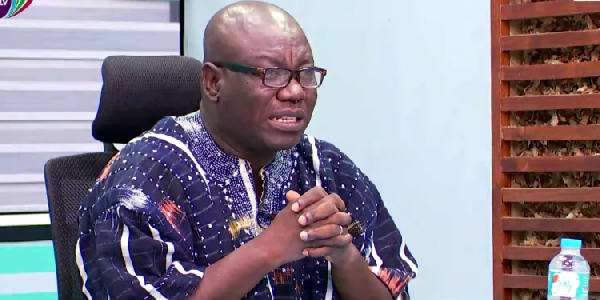
Former Deputy Attorney General, Alfred Tuah-Yeboah, has criticised justifications made by the current Attorney General, Dr. Dominic Ayine, to enter a nolle prosequi, a formal notice to discontinue prosecution, in the case involving Dr. Kwabena Duffuor and seven others.
Dr. Ayine had explained that the decision was informed by progress in asset recovery and the legal complexities surrounding the case.
However, in an exclusive interview on the Channel One Newsroom on Monday, July 28, Tuah-Yeboah challenged the logic behind halting prosecution based on the recovery of 60% of the alleged funds.
Tuah-Yeboah argued that the Attorney General’s explanation raises more questions than answers.
According to him, the idea that recovering 60% of the amount justifies discontinuing prosecution is flawed.
“The moment you give the explanation, then people will also begin to query the explanation. If he had entered nolle prosequi simplicita without explanations, that one we wouldn’t even know that he would be coming back with new charges. If the Attorney General says 60% is what he thinks is the proper threshold when it comes to financial matters, then I beg to differ.
“I mean, 60% on the face of it, you may think it is something big, but what about the 40%? Who pays for the 40% especially in this particular case, where the amount involved is 5.7 billion? But we are now told that about GHS2.1 billion was something that was falsified. So I even have a question there. Who falsified it? Because the receiver was appointed by the Bank of Ghana,” he stated.
AG justifies Duffuor case withdrawal, breaks down GH¢2bn recovery plan
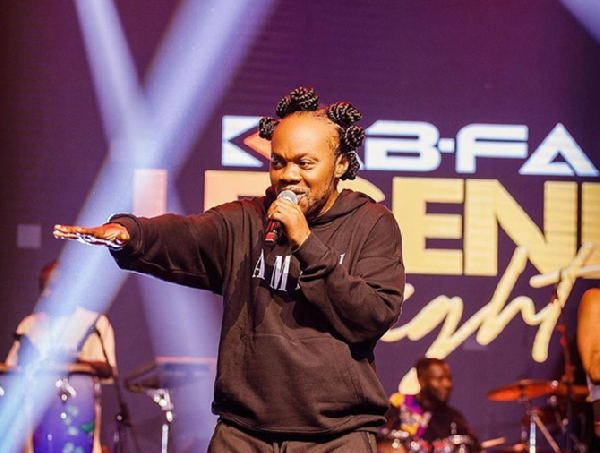
The late Ghanaian Highlife legend, Daddy Lumba, died at 60
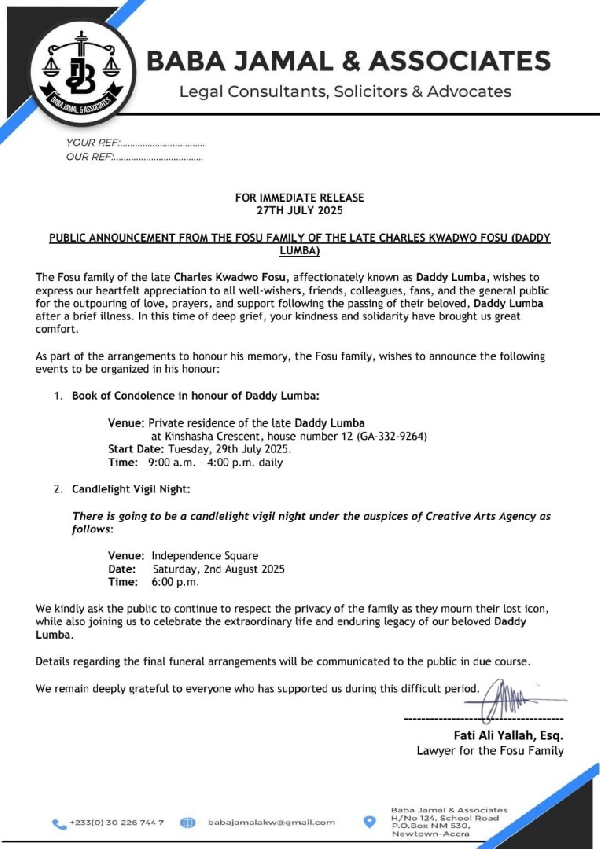
The family of the late Ghanaian Highlife legend, Charles Kwadwo Fosu, popularly known as Daddy Lumba, has announced plans to open a book of condolence in his memory beginning July 29, 2025. This follows the passing of the music legend on July 26 after a short illness.
In a statement released on July 27 by the family’s legal representatives, Baba Jamal & Associates, the Fosu family expressed appreciation for the overwhelming support they have received since the news of Daddy Lumba’s death was made public.
The statement described the love, prayers, and messages from fans, friends, industry colleagues, and the general public as a great source of comfort in this difficult time.
“The Fosu family of the late Charles Kwadwo Fosu, affectionately known as Daddy Lumba, wishes to express our heartfelt appreciation to all well-wishers, friends, colleagues, fans, and the general public for the outpouring of love, prayers, and support following the passing of their beloved, Daddy Lumba after a brief illness,” the statement read.
According to the statement, to give the public an opportunity to pay their respects, a book of condolence will be opened at Daddy Lumba’s private residence located at House Number 12, Kinshasha Crescent, GA-332-9264.
The signing will begin on July 29, and will run daily from 9:00AM to 4:00PM.
The statement noted that the condolence book is part of a series of events being planned to honour the memory and legacy of the man who shaped Ghana’s music landscape for almost four decades.
In addition to the condolence book, the family, in collaboration with the Creative Arts Agency, has also announced a national candlelight vigil in honour of the late music legend.
The vigil will take place on August 2, 2025, at the Independence Square in Accra, from 6:00PM to 10:00PM.
Simultaneous ceremonies are expected to be held in countries where he had a huge following and personal connections, including Germany, the United Kingdom, the United States, and the Netherlands.
The family’s legal representatives also urged the public to be respectful of their privacy as they grieve, even as they welcome all to participate in celebrating the life of one of Ghana’s greatest musical icons.
“We kindly ask the public to continue to respect the privacy of the family as they mourn their lost icon, while also joining us to celebrate the extraordinary life and enduring legacy of our beloved Daddy Lumba,” the statement added.
Watch the mood at Daddy Lumba’s residence after news of his shocking demise
GHANA’S BLACK Queens proudly ascended the podium at the 2024 TotalEnergies Women’s Africa Cup of Nations (WAFCON), claiming bronze after a determined 4:3 penalty shootout victory over defending champions South Africa in the third-place playoff.
The win signaled the Queens’ first return to the WAFCON podium in years, reaffirming their position as one of Africa’s most formidable women’s football teams.
The achievement highlights the steady resurgence of women’s football in Ghana, buoyed by initiatives like the GFA’s Women’s Football Strategy and the Football4Girls programme, both designed to expand opportunities and elevate the women’s game nationwide.
In a ceremony filled with emotion and pride, the players, draped in Ghana’s colors, received their medals to roaring applause from supporters and officials. Their spirited campaign — marked by grit and determination — has rekindled optimism for the future of women’s football in the country.
While bronze may not have been the ultimate prize, the Black Queens’ podium finish underscores a new chapter for Ghanaian women’s football, one filled with renewed ambition and belief that greater triumphs lie ahead.
The Ghana Investment Promotion Centre (GIPC) has facilitated 2,000 new jobs by brokering a partnership between investor Weave Ghana Limited and the Youth Employment Agency (YEA).
The agreement resolves a critical recruitment challenge identified by GIPC’s Aftercare and Investor Grievance Division during routine engagement with the company.
GIPC CEO Mr. Simon Madjie spearheaded high-level negotiations culminating in a Memorandum of Understanding (MoU). Under the terms, YEA will recruit and train 2,000 individuals to support Weave Ghana’s operations. YEA CEO Mr. Malik Basintale affirmed the alignment with the agency’s mandate: “We are open to anything that has to do with securing jobs for the young people.” He further announced plans to launch an “Employment Bureau” connecting job seekers with opportunities.
Weave Ghana’s Head of HR and Administration, Ms. Rose Morrison, described the collaboration as “timely and impactful,” addressing both operational hurdles and national employment goals. Madjie emphasized the strategic value of investor aftercare: “This outcome underscores our commitment to supporting businesses beyond initial establishment to promote growth and job creation.” He revealed ongoing reviews of the GIPC Act to establish a formal Investor Grievance Mechanism, enhancing dispute resolution.
The intervention reflects Ghana’s intensified focus on job creation under President Mahama’s administration, leveraging public-private partnerships to tackle youth unemployment.
Ghanaian rapper and music producer Kwame Ametepee Tsikata, known professionally as M.anifest, has stated that the legacy of the late highlife icon, Charles Kwadwo Fosu, popularly known as Daddy Lumba, will remain deeply embedded in the world of music.
Speaking on Channel One TV’s The Point of View with Bernard Avle on Monday, July 28, M.anifest paid tribute to the legendary musician, highlighting the lasting impact of his art.
He noted that Daddy Lumba was not only a prolific hitmaker but also a gifted lyricist whose music will continue to inspire generations.
“His music will live on. He has made great music; he’s the rare case where the legend and the mystic and the actual output of the music meet, and then it works. He was a hit maker, but he had the lyricism. I think posterity will be kind to him, and we are all grateful for what he contributed. His DNA will not leave us anytime soon,” he remarked.
Daddy Lumba passed away at The Bank Hospital at Cantonments, Accra, on July 28, 2025. His death has sparked widespread tributes from fans, colleagues, and music lovers across the globe.
Daddy Lumba, widely considered one of the most influential figures in Ghana’s music scene, enjoyed a career spanning more than three decades. Known for his distinctive voice, compelling lyrics, and timeless hits, he released over 30 albums and captivated generations with classics such as Aben Wo Ha, Theresa, Yentie Obiaa, and Playboy.
Born on September 29, 1964, Lumba’s musical journey began in the 1980s and took off with the release of his debut album Yɛɛyɛ Aka Akwantuo Mu, in collaboration with Nana Acheampong as the Lumba Brothers. His solo career soared thereafter, earning him numerous accolades and a loyal fan base both locally and abroad.
Daddy Lumba’s legacy is etched in the cultural and musical identity of Ghana, having inspired countless artistes and left a mark on the country’s highlife genre.
15 feared dead in Kumasi–Accra highway crash
…..
Explore the world of impactful news with CitiNewsroom on WhatsApp!
Click on the link to join the Citi Newsroom channel for curated, meaningful stories tailored just for YOU: https://whatsapp.com/channel/0029VaCYzPRAYlUPudDDe53x
No spam, just the stories that truly matter! #StayInformed #CitiNewsroom #CNRDigital
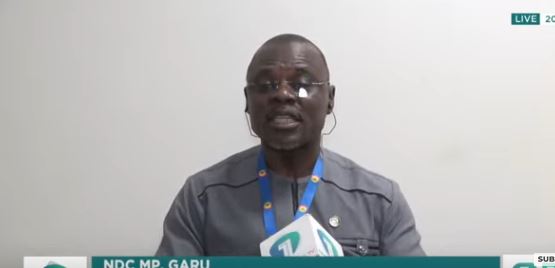
Member of Parliament for Garu, Dr. Thomas Winsum Anabah, has called on the government to implement targeted and intelligence-led strategies to disarm residents of Bawku to curb the persistent violence in the area.
His concerns come in the wake of rising insecurity in parts of the country. Public discourse has linked these incidents, including the fatal shooting of two students from Nalerigu Senior High School, to a spillover of the Bawku conflict.
In an exclusive interview on Channel One Newsroom on Monday, July 28, Dr. Anabah stressed that disarming the population must be a central focus of the government’s intervention.
According to him, even military personnel deployed to the area are stunned by the calibre of weapons being used, with some reportedly encountering arms they had never seen before.
He called on the government to move beyond surface-level interventions and adopt intelligence-driven operations involving neutral and credible actors.
“We need to enforce security there; ransacking, searching, confiscating weapons and dealing with those who are possessing weapons. That way, everyone will become disarmed. If it is left with clubs and knives, that one is different.
“But with these sophisticated weapons that you hear, the military even reports to us that they wield weapons that some of them have not even seen before.
“It raises the question of how they got it in and who is facilitating it. That is why some of us believe that the whole of Bawku has become an enterprise for those who deal in those things. It is up to the government to use serious intelligence, very neutral people who love peace, to really research into the issue and use intelligence to get all those who are backing some of these things to bring an end to it,” he stated.
Nayiri Palace slams gov’t over Nalerigu curfew, demands apology
The Nigerian Air Force has killed several high-value commanders of the Islamic State West Africa Province (ISWAP) in precision airstrikes conducted around the Lake Chad region.
According to an official statement released Monday by Air Force Spokesperson Ehimen Ejodame, the operation specifically targeted Arina Woje, a known terrorist sanctuary in the Southern Tumbuns area of Borno State.
The strikes followed confirmed intelligence, surveillance, and reconnaissance (ISR) indicating the return of ISWAP elements to the area after recent internal clashes.
Military intelligence revealed significant activity, including movement of fighters, reactivation of structures, and potential command centers concealed under dense foliage.
Preliminary battle damage assessments confirmed the destruction of key structures housing ISWAP leaders, fighters, and logistics facilities.
While the exact number of casualties was not disclosed, the military stated the operation successfully disrupted the group’s operational planning and resupply efforts in the region.
ISWAP, alongside its ally Boko Haram, continues its campaign to establish an Islamist state in northeast Nigeria, with attacks extending across the Lake Chad Basin.
Ghanaian Afrobeats star, Camidoh, has opened up about how he battled with depression and anxiety at a point in his music career.
Speaking on United Showbiz on July 26, 2025, Camidoh described some turbulences he went through, including a fallout with collaborators in Ghana over rumors he didn’t even understand and a loss of communication with external teams.
“It was due to rumors about me that they had heard. For me, I don’t even know what I had done, but people took offence and spread rumors about me.
“And even the external team I was working with, I stopped getting feedback after a while. We could write them emails, but no response,” he said.
He added that the stress plunged him into depression and poor health.
“So, all that stress got me sick, and I went through depression,” he said.
The turning point came when he met an elderly woman who, after exchanging contacts, began sending him motivational texts and voice notes.
“One day, she sent me a voice note which touched me deeply. She told me how it seemed like nothing was working out for me But I shouldn’t give up,” he added.
He added that he was so touched that he sampled her message in a track on his upcoming album, even quoting her words in the album’s cover artwork.
Camidoh said he personally invited her to his artwork unveiling party, but tragically, she passed away two days before the event.
“I was devastated. Because she was my source of inspiration during the days I was going through anxiety and depression,” he shared.
Despite the loss, he says he continues to carry her messages in his heart and in his works.
Dr Clement Abas Apaak, Deputy Minister of Education
Ghana is reforming its education curriculum to meet current global trends and drive economic growth, Deputy Minister of Education, Dr Clement Abas Apaak, has told participants at Japan Expo 2025.
Delivering remarks at the exhibition, the deputy minister revealed that the government is building a strong foundation on which Technical, Vocational Education and Training (TVET), as well as Science, Technology, Engineering and Mathematics (STEM), would flourish.
He observed that the government’s commitment was rooted in Sustainable Development Goal 4, which is focused on ensuring inclusive and equitable quality education and promoting lifelong learning opportunities for all.
“Our government, the NDC government, recognizes that STEM and TVET are essential to driving innovation, fostering economic growth, and addressing the complex challenges of the 24th century,” Dr Apaak said on Friday July 25, 2025.
He continued: “Our agenda is built on several key pillars, with a strong emphasis on transforming TVET to meet the demands of the rapidly evolving global economy.
“Within this context, we are strategically transforming and reforming our curriculum. We are initiating what we call the SMART curriculum, and this is to integrate seamlessly STEM, coding, and digital literacy into the basic school system.”
Dr Apaak said the study of STEM programmes at the basic level will enable learners to acquaint themselves with key concepts of the field during their formative years.
He noted that a transformation of the curriculum will reap benefits beyond academics, equipping students with employable and entrepreneurial skills.
Discussing investments made in TVET, the deputy minister said the government wanted to make the programme a key learning alternative for Ghanaian students and not area reserved for academically weak learners.
He explained that it was why the administration had facilitated the integration of AI tools to align vocational learning with the changing demands of industries.
Itemizing a number of interventions, he mentioned initiatives such as One Tech, One Teacher, One Laptop Initiative, Smart Schools Project, I-Campus Ghana, and the Learning Management System, all of which are part of strategic efforts to transform TVET in Ghana.
Dr Apaak further highlighted ongoing plans to expand Information Communication and Technology (ICT) infrastructure in order that it can be leveraged for quality STEM education.
The Member of Parliament for Bolga Central, Isaac Adongo, has declared his lack of confidence in the system used by the Auditor-General in auditing government accounts.
According to him, the current audit system does not offer assurance that discrepancies will be addressed.
He noted that, instead, the Auditor-General’s system pretends to be working.
Adongo said if the system does not prosecute persons found guilty of wrongdoing, it is fundamentally flawed.
His comments come on the back of the recent Auditor-General’s Report on government accounts.
The report showed overstatements and understatements of the government’s finances alongside various leakages in the public sector, amounting to over GH¢17.4 billion.
“I’ve never had confidence in the kind of system we are operating. We are basically pretending to be exercising assurance, but the system that we are operating itself doesn’t lend itself to proper assurance,” Adongo was quoted by myjoyonline.com to have said.
He bemoaned the inability of the Public Accounts Committee of Parliament to prosecute culprits, calling them toothless.
“The Parliament of Ghana is toothless when the auditor reports to it and simply engages in talk shows without prosecutorial powers. They don’t have those powers, and Parliament is the employer of the auditor. So, yes, there’s independence of the auditor away from the executive, but to what end? That is where the problem is,” he added.
Adongo also noted that the audit goes through a process where irregularities are flagged by auditors, then agencies are given opportunities to explain.
They are also given an “exit conference” and a formal “management letter” indicating unresolved issues.
The Bolga MP noted that the process only leads to mere directives to “go and implement these recommendations so that you don’t see any more. You go and you go and sleep”.
He added that the internal auditors are often HND holders, who are expected to police sophisticated financial controllers, lawyers, and engineers, often in situations where they are poorly remunerated.
“At the end of the day, they are not able to do anything. The following year, it is repeated on a large scale,” he said.
Member of Parliament for Agotime-Ziope, Charles Akwasi Agbeve, has rejected accusations that non-Ghanaians, particularly Togolese nationals, are transported into Ghana to register and vote during national elections.
Addressing the issue on Citi Eyewitness News, Mr. Agbeve described the claims as unfounded and misleading, explaining that the Agotime traditional area is a transnational community that stretches across the Ghana-Togo border.
He emphasised that despite residing across the border, many individuals in Togo have blood relations in Ghana, which accounts for their frequent interactions and presence in the country.
According to the MP, if there were indeed deliberate efforts to bus in people from Togo to register and vote, the system would be overwhelmed by the sheer number involved.
“I want someone to point to me and give me evidence, any of those people over there who are not Ghanaian. There are 47 Agotime States, only 17 are in Ghana. The rest are all in Togo.
“They all have a relationship here. In fact, if you go to Togo, there are two constituencies over there called Agotime South and Agotime North. That is how big Agotime is. So, if we are really bringing people to register in Ghana, can they contain it? They cannot,” he said.
Duffour case: Rescind decision or face us in court – Minority to Ayine
The sudden passing of Ghanaian highlife legend Daddy Lumba on Saturday, July 26, has catalysed an unprecedented surge in his music’s popularity on Apple Music Ghana. This phenomenon is far more than a fleeting moment of grief. It is a profound cultural impact of an artiste whose work captivated and resonated deeply with generations of Ghanaians for nearly four decades. The data paints a vivid picture of a nation united in mourning and deep appreciation.
An Unprecedented Chart Domination
Just days following his death, Daddy Lumba’s songs have saturated the Apple Music Ghana Top Songs chart. “Makra Mo” notably commands the highly coveted No. 1 spot, a poignant symbol of the renewed emotional connection Ghanaians feel to his music.
This isn’t just a peak; it’s a profound, organic response. Other classic hits, including “Ankwanoma” at No. 5, “Sika” at No. 6, “Se Sumye Kasa A” at No. 13, “Mpempem Do Me” at No. 15, “Mensei Da Harry (Remix)” at No. 17, and “Biribi Gyegye Wo” at No. 18, demonstrate a widespread embrace of his extensive catalogue.
In total, a staggering 30 of his songs now occupy positions within the Top 100, an unprecedented feat for any Ghanaian artiste on an African Apple Music chart. This overwhelming presence on the charts highlights the immediate and deeply felt public response to his demise, showing how his melodies continue to provide comfort and a collective memory.
The Power of Posthumous Popularity
The powerful dynamic of an artiste’s death leading to increased music sales is recognised globally, from the likes of Michael Jackson to Whitney Houston. However, Daddy Lumba’s case in Ghana presents a particularly compelling and unique example of cultural resonance. The sheer volume of songs re-entering and dominating the charts signifies more than just casual listening; it suggests a deliberate act of remembrance, a national tribute from a grieving nation and its diaspora.
Fans are not just listening; they are revisiting his work, finding solace and connection in his timeless melodies and poignant lyrics that often spoke directly to the Ghanaian experience, from the struggles of “Yee Ye Aka Akwantuom” reflecting immigrant life to the timeless advice in “Sika.”
This outpouring of support demonstrates the enduring power of music to unite people across continents in times of shared sorrow. His legacy extends beyond simple entertainment, evolving into a cherished cultural heritage that bridges geographical divides for Ghanaians living abroad.
Further solidifying his global appeal, his 2008 song “Mpempem Do Me” was notably featured on King Charles III’s Commonwealth Day Playlist in March 2025.
This placed him on a curated list alongside international titans like Beyoncé and Bob Marley, powerfully demonstrating his profound artistry that transcended national borders. Ghanaian President John Dramani Mahama eloquently stated, “Lumba’s unmatched musical genius provided the soundtrack to our lives,” adding that while “the beats to his memorable songs may have died down, his enduring legacy will echo through the ages.”
A Cultural Icon’s Lasting Imprint
Daddy Lumba was more than a musician; he was a foundational cultural institution in Ghana. His music often reflected societal nuances, exploring themes of love, heartbreak, and everyday life, making him relatable across generations. This current chart domination is a powerful affirmation of that deep-seated connection. It solidifies his status as arguably Ghana’s most influential musician.
A Nation’s Vigil: August 2nd and Beyond
The national sentiment extends beyond streaming numbers. The Creative Arts Agency (CAA), in collaboration with his family, has announced a National Candlelight Vigil in his honor set for Saturday, August 2, 2025, at Independence Square in Accra, from 6:00 PM to 10:00 PM. This event is part of a wider global tribute, with simultaneous vigils planned in key diaspora cities across Germany, the United Kingdom, the United States, and the Netherlands. This coordinated international effort underscores the profound impact Daddy Lumba had on the Ghanaian identity worldwide. As the CAA stated, “Your presence will not only honor the legacy of an icon but also unite us in celebrating the power of music, culture, and community.”
This emotional resonance is now translating into tangible data on streaming platforms. It proves that authentic artistry fosters lasting emotional bonds, which manifest with striking intensity during moments of loss.
This emotional resonance is now translating into tangible data on streaming platforms and organized national and international tributes. It proves that authentic artistry cultivates lasting emotional bonds, which manifest with striking intensity during moments of loss.
The widespread resurgence in his music consumption undeniably highlights the indelible mark he left on the Ghanaian music landscape and on the hearts of its people.
His passing, as former President Nana Akufo-Addo noted, saw even political rivals “find common ground in sorrow,” a true testament to his unifying power. The collective embrace of Daddy Lumba’s music in this period of national mourning is a powerful reminder that some legacies are not diminished by death, but rather illuminated, continuing to inspire and unite.
DISCLAIMER: The Views, Comments, Opinions, Contributions and Statements made by Readers and Contributors on this platform do not necessarily represent the views or policy of Multimedia Group Limited.
DISCLAIMER: The Views, Comments, Opinions, Contributions and Statements made by Readers and Contributors on this platform do not necessarily represent the views or policy of Multimedia Group Limited.
The 17th Pan African Festival (PANAFEST) seminar concluded in Tamale with prominent voices demanding reparations for Africans and their descendants impacted by the transatlantic slave trade.
Held under the theme ‘Let us speak of reparations: Pan-Africanist artistic activism’, the event focused specifically on ‘Narratives of Resistance to Slavery in Northern Ghana’, attracting students, researchers, diaspora communities, and tourism stakeholders.
Professor Felix Y.T. Longi, Senior Research Fellow at the University for Development Studies (UDS), stated reparations are essential to address systemic inequities stemming directly from slavery and colonialism. He argued reparations extend beyond financial compensation, representing a crucial step towards healing, reconciliation, and building a fairer society. “Reparations acknowledge the deep harm caused by slavery and its enduring impact on Black communities. They are a form of justice and a step toward correcting injustices of the past,” Prof. Longi stated, emphasizing their role in restoring dignity.
Meanwhile, Ekow Sampson, Deputy CEO of Operations at the Ghana Tourism Authority (GTA), highlighted the critical need to elevate resistance narratives from Northern Ghana. He noted these stories are often overlooked compared to the focus on coastal slave forts and castles. Sampson cited the bravery of communities in Nalerigu, Mamprugu, and Dagbon who actively resisted slave raids and constructed defensive settlements. “Northern Ghana holds powerful stories of courage and resistance that must be told with pride and authenticity. These stories are critical to our national history,” he said.
Sampson reaffirmed the GTA’s commitment to supporting PANAFEST and Emancipation Day as vital platforms for diaspora education, healing, and reconnection. He detailed ongoing efforts to document and develop heritage resistance sites across the Northern Region to boost domestic and international tourism. The Authority called on traditional leaders, academics, communities, and the diaspora to collaborate in preserving these narratives and locations. “By investing in research, education and storytelling, we preserve not just monuments but also memory – for future generations to understand our past and appreciate our progress,” Sampson concluded.
Ghana Premier league side Dreams FC have strengthened their technical team with the appointment of trainer Hanson Parker ahead of 2025/26 league season.
As reported earlier by your trusted hub, Ghanasportspage.com that the Still Believe outfit were on the negotiation table with the Ghanaian gaffer, finally deal between both parties has ended and it ended successfully leading to his appointment.
The club offered him a long-term contract with documents signed this afternoon.
Hanson joined the 2023/24 CAF Confederation Cup semi finalist after leaving Division One League side Golden Kicks FC, where he led the team to the 2024/25 MTN FA Cup final but suffered defeat to Kumasi Asante Kotoko SC.
Hanson Parker is handed the position of first assistant coach to Winfred Dormon who was confirmed head coach having spend several stints as assistant coach at the Dreams FC.
With the experience of Hanson Parker, he is expected to improve Dreams FC technical team as they aim to secure Africa slot next season.
Ghana Premier league side Dreams FC have strengthened their technical team with the appointment of trainer Hanson Parker ahead of 2025/26 league season.
As reported earlier by your trusted hub, Ghanasportspage.com that the Still Believe outfit were on the negotiation table with the Ghanaian gaffer, finally deal between both parties has ended and it ended successfully leading to his appointment.
The club offered him a long-term contract with documents signed this afternoon.
Hanson joined the 2023/24 CAF Confederation Cup semi finalist after leaving Division One League side Golden Kicks FC, where he led the team to the 2024/25 MTN FA Cup final but suffered defeat to Kumasi Asante Kotoko SC.
Hanson Parker is handed the position of first assistant coach to Winfred Dormon who was confirmed head coach having spend several stints as assistant coach at the Dreams FC.
With the experience of Hanson Parker, he is expected to improve Dreams FC technical team as they aim to secure Africa slot next season.
Ghana Civil Aviation Authority won the maiden edition of the Corporate League
History was made under the floodlights at the University of Ghana Stadium on Friday, July 25, 2025, as the Ghana Civil Aviation Authority (GCAA) edged past Union Ghana in a heart-stopping penalty shootout to win the inaugural University of Ghana Corporate Football League.
It was a final packed with passion, pressure, and pure drama.
GCAA looked set for glory when they grabbed a lead in the second half by Joojo Bossman, sparking wild celebrations from their bench and fans.
But Union Ghana, known for their fighting spirit, refused to back down. With time ticking away, their talisman Emmanuel Arthur stepped up once again delivering a brilliant assist to David Annan in stoppage time to level the score and force penalties.
In the moment that mattered most, GCAA’s goalkeeper Tsawodzi Ruben rose to the occasion, pulling off two sensational saves that sent the GCAA camp into jubilation as they clinched the shootout 4–2.
GCAA’s Prince Aboagye was named Most Valuable Player of the final, thanks to his tireless work and commanding presence on the pitch.
Meanwhile, Union’s Emmanuel Arthur may have missed out on the main trophy, but his impact was undeniable, finishing as the league’s top scorer with nine goals, and providing that crucial assist in the final.
From start to finish, the maiden edition of the UG Corporate Football League 2025, spearheaded by the Ghana Football Association (GFA), has delivered unforgettable moments and it couldn’t have ended on a more dramatic note.
With this win, GCAA not only take home the trophy but also cement their place in the 2025 University of Ghana Corporate Football League.
The league is brought to you by University of Ghana Sports and Wellness Directorate and RITE Sports Services in collaboration with the GFA to promote corporate football.
SB/VPO
Meanwhile, watch as football fans question FIFA’s move to scrap penalty rebound rule
Former Director of the Ghana School of Law, Kwaku Ansa Asare, has endorsed the proposed replacement of the School’s current admissions system with a national bar examination, describing the move as both timely and commendable.
Speaking on Citi FM’s Eyewitness News on Monday, July 28, Ansa Asare praised the Attorney-General and Minister for Justice, Dr. Dominic Ayine, for initiating the reform and encouraged him to ensure its full implementation.
“This is a good step that Dominic Ayine has taken. I am praying and hoping it will materialise because, oftentimes, Attorney-Generals over the years have made such political statements without actually implementing them. So, if he has the boldness to implement it, it will be so much better for the nation,” he said.
Dr. Ayine announced the proposal during the Government Accountability Series in Accra.
The new policy—part of a broader legal education reform bill expected to be submitted to Cabinet in August—aims to decentralise legal training and broaden access to the legal profession.
Under the proposed system, LLB graduates from accredited institutions would undergo a one-year Bar Practice Programme at their respective schools. Upon completion, candidates would sit for a unified national bar examination. Those who pass would be called to the bar, bypassing the current restrictive admissions system operated by the Ghana School of Law.
The move has been widely welcomed by legal education advocates, who have long criticised the centralized “Makola” admissions structure as overly exclusive and lacking transparency.
Gov’t to replace Ghana School of Law admissions with National Bar Exam
Accra, July 18, GNA – Dr Dominic Akurutinga Ayine, the Minister of Justice and Attorney-General on Monday reiterated that he wants “to jail persons who have looted state resources.”
“Finally, make no mistake about my intentions. I want to jail persons who have looted state resources but at the same time, I am pragmatic enough to know that it is not in every instance that that is possible,” Dr Ayine stated on Monday at the Government Accountability Series press conference at the Presidency, in Accra.
The discussions focused on strengthening collaboration for the benefit of Ghana
Ghana’s Permanent Delegate to UNESCO, Meredith Naakai Lamptey-Addy, together with the Secretary-General of the Ghana Commission for UNESCO, Dr. Osman Damba Tahidu, held a strategic engagement with Edmond Moukala, UNESCO Country Director in Accra.
The meeting served as an official introduction of the newly appointed Permanent Delegate to the staff of the UNESCO Accra Office and provided a platform to discuss key priorities aligned with UNESCO’s mandate.
The discussions focused on strengthening collaboration to ensure Ghana derives maximum benefit from UNESCO’s programmes in education, science, culture, and communication.
The parties reviewed ongoing projects within the Accra Office and examined strategies for enhancing coordination, implementing necessary reforms, and fostering more effective engagement with all UNESCO stakeholders in Ghana.
Attention was also given to addressing programmatic challenges and identifying ways to amplify Ghana’s presence and influence within UNESCO’s global framework.
The parties reaffirmed their commitment to working closely together and with relevant partners to ensure that UNESCO’s impact in Ghana is visible, relevant, and transformative at all levels.
The IGP and his team engaged key stakeholders and reinforced ongoing security efforts
The Inspector-General of Police (IGP), Christian Tetteh Yohuno and some members of the Police Management Board (POMAB) on July 25-26, 2025, held separate engagements with community leaders at Asawase in the Ashanti Region and Tulaku in the Greater Accra Region to calm tension and enhance local security.
At Asawase, the IGP and his team engaged key stakeholders and reinforced ongoing security efforts.
Upon a review of the current security situation, the IGP directed the establishment of a base for the Formed Police Unit (FPU) in the area to ensure a robust police presence and improve response time.
Also, additional strategic police checkpoints have been mounted at both entry and exit routes to Asawase to further improve security of the locality.
The IGP also used the opportunity to interact with personnel deployed for operational duties and thanked them for their invaluable service to the country.
He assured them that their welfare and wellbeing is paramount to the police administration and urged them to be vigilant, enforce the security arrangements outlined by the Regional Security Council and make Asawase uncomfortable for criminals.
Similarly, at Tulaku in Accra, some POMAB members met with leaders of the Kusasi and Mamprusi communities, as well as the Cattle Dealers Association, to discuss recent concerns and reaffirm the Police Service’s commitment to peaceful coexistence and cooperation.
The Accra Regional Commander as well as Divisional and District Commanders are holding similar engagements with community leaders and youth groups to foster peace, protect lives, and work closely with community leaders to ensure security, law and order.
GhanaWeb Special: The gold market that fuels galamsey
2025/2026 cocoa season expected to start on August 7, 2025.
The government is expected to announce a new producer price for cocoa before August 7, 2025.
This comes on the back of the technical committee on producer price completing its work for the government’s consideration.
The new 2025/2026 crop season is expected to start on August 7, 2025.
However, the Minister of Finance, Dr Cassiel Ato Forson is expected to announce the new producer price in the coming days.
The producer price is currently pegged at GH¢3,100 per kilogramme per bag and GH¢49,600 per tone.
President John Mahama, earlier this month, announced his administration’s commitment to ensuring that cocoa farmers in Ghana receive at least 70% of the world market price for cocoa.
This is aimed at restoring dignity and fairness to the backbone of Ghana’s agricultural economy.
Market watchers anticipate a possible upward adjustment in line with prevailing global cocoa prices which have surged in recent months.
SP/AME
How Virtual Reality is enhancing business and customer experience
Hajia Samira Bawumia in a pose with some of the visiting students
The former Second Lady of Ghana, Hajia Samira Bawumia, has launched an award scheme for senior high school (SHS) students in the country, starting with students in the Tano North Constituency of the Ahafo Region.
The initiative, which is championed under the Samira Empowerment and Humanitarian Project (SEHP), is designed to promote academic excellence, discipline, and leadership among students in the area.
The scheme will recognise top-performing students annually while encouraging others to strive for excellence.
The former Second Lady announced the package when the Tano North Member of Parliament, Dr. Gideon Boako led a delegation of about 80 students and teachers from Bomaa and Serwaa Kesse Girls’ SHS from the Tano North Constituency to her office on Thursday, July 24, in Accra. Speaking to the students, Hajia Samira Bawumia said, “Education remains the most powerful tool we can use to change the future of our children and our nation.
“This award scheme is my way of encouraging our young people to believe in themselves and to work hard to achieve their dreams.”
The Tano North Constituency is represented in Parliament by Dr. Gideon Boako, who also serves as the Deputy Ranking Member on the Finance Committee.
He joined the event and expressed his appreciation to Hajia Samira Bawumia for her commitment to the development of the constituency.
“This initiative by the former Second Lady is not just an award; it is a statement that our children, regardless of where they come from, deserve the best support and recognition,” Dr. Boako said.
The scheme will cover awards for Best Performing Student in Science, Arts, and Business, as well as prizes for leadership, innovation, and community service.
Recipients will receive certificates, educational materials, and access to mentorship opportunities.
According to organisers, the selection process will be done in collaboration with school authorities to ensure transparency and merit.
Parents, teachers, and traditional leaders present at the event commended the former Second Lady for her continued advocacy for quality education.
The headmistress of Serwaa Kesse Girls’ SHS remarked, “This award scheme will greatly motivate our students. It shows them that hard work is noticed and appreciated.”
Stakeholders believe the initiative will inspire healthy competition and raise academic standards across schools in the constituency.
The Municipal Chief Executive (MCE) of Bawku, Isaac Azonaba, has acknowledged the significant disruptions caused by the newly imposed curfew in the municipality but stressed that the measure is a necessary step toward restoring peace and stability in the area.
The government, through the Ministry of the Interior, announced a revised curfew from 2:00 p.m. to 6:00 a.m. in Bawku and its environs, effective Sunday, July 27, 2025, following recommendations from the Upper East Regional Security Council (REGSEC) amid escalating tensions.
Speaking on the impact of the directive in an interview on Citi Eyewitness News on Monday July 28, Mr. Azonaba admitted that while the curfew is having far-reaching consequences on daily life and economic activity, it is an important sacrifice for long-term peace.
“The curfew is in place at the moment, but not only businesspeople — our farmers who are also in their planting season — are affected,” he stated. “Bawku is a business town, and the curfew being put at 2:00 pm is really giving us a challenge.”
He described the situation as “worrisome,” noting that the early curfew has cut short trading hours, restricted market activities, and hindered farming efforts during a critical period for agriculture in the region.
However, Mr. Azonaba emphasized that peace must take precedence over short-term inconvenience.
“It is a security measure, and you know when there is peace and calmness, businesses can move well, farming can be done well,” he said.
The Interior Ministry’s statement, signed by Minister Muntaka Mohammed-Mubarak, underscored the government’s appeal for calm and restraint, urging all residents to use non-violent means to address grievances.
A total ban on carrying arms and offensive weapons remain in force, with violators facing arrest and prosecution.
Bawku, a historically volatile area, has seen recurring tensions and ethnic conflict over the years. The current curfew forms part of broader government efforts to stabilize the municipality, protect lives, and create an atmosphere conducive to peacebuilding and economic recovery.
Read also
Duffour case: Rescind decision or face us in court – Minority to Ayine
It was a weekend of redemption, but not the kind many expected. While the dust was still settling on the heartbreak left by the men, it was the women who stepped forward, bold, brilliant, and victorious, to restore pride to two football-obsessed nations.
In England and Nigeria, the wounds of recent men’s football failures still sting. England’s men had stumbled yet again in a major final, losing the UEFA Euro 2024 title to Spain after Gareth Southgate’s side faded on the big stage in Berlin.
Nigeria’s Super Eagles, for all their flair and promise, watched the 2023 AFCON title slip from their grasp in a bruising final defeat to Cote d’Ivoire in 2024.
Then, just months later, the women teams of these countries rewrote the scripts.
On Saturday, July 26, 2025, the Super Falcons of Nigeria staged a rousing second-half comeback in Rabat, stunning hosts Morocco 3-2 to reclaim their place atop African football.
It was their 10th WAFCON crown, a bold reminder that when African women’s football is written, the first and last pages almost always belong to Nigeria.
Barely 24 hours later in Basel, England’s Lionesses marched out under the weight of expectation and years of pressure. And they didn’t blink.
A tense, tactical final against world champions Spain ended with the Lionesses crowned champions of Europe once more, a second UEFA Women’s Euro title, but perhaps more importantly, a reaffirmation that the golden generation wasn’t just hype.
Two stories, two nations, one theme: where the men fell short, the women soared.
Different paths, same burden
For both countries, men’s football commands the spotlight. Stadiums sell out. Media cycles revolve around transfer sagas, managers’ press conferences, and missed penalties that become national talking points.
In contrast, the women have had to build their legacies in the shadows, fighting for airtime, investments, and respect. Yet in those struggles, they’ve forged something purer; something tougher.
The Super Falcons’ journey hasn’t been smooth. In recent years, they’ve battled not just opponents on the pitch, but the very system meant to support them.
Bonus rows. Pay disputes. A federation often slow to back them. Yet, they’ve endured and won; again.
In Switzerland, England’s women arrived with scars, emotional ones from their failed World Cup charge in 2023 and the growing murmurs that the post-2022 magic had faded.
But on Sunday, July 27, 2025, they quieted all of that with disciplined football, smart substitutions, and a steely belief forged in the crucible of pressure.
The role reversal
There’s a poetic irony here.
For decades, it was the men expected to deliver, to win tournaments, lift nations. The women were afterthoughts. Now, the women are becoming the standard bearers.
When England’s men walked off the pitch in Berlin, heads hung and dreams dashed, the conversation turned familiar: “We played well”.
But it was a tale of near-misses and what-ifs.
But when the Lionesses walked off the pitch in Basel, it was with medals, smiles, and history rewritten.
When Nigeria’s Super Eagles lost the AFCON final in Abidjan, it reopened old wounds, questions about mentality, finishing, and tactical nous.
But the Super Falcons’ triumph in Rabat brought healing, a reminder that Nigerian football still has world-class winners wearing the green and white.
Not just a win; a statement
These weren’t just tournament victories. They were national exclamations.
For young girls in Lagos and Leeds, Abuja and Birmingham, this weekend wasn’t just about football; it was about visibility, possibility, and validation.
That women’s sport matters. That women can carry the weight of expectations and deliver.
More than that, these victories offered a lesson to the men’s teams: talent alone is not enough. There must be resilience, unity, and a willingness to leave egos at the door and fight for the crest.
Where next?
As both nations bask in the glory of their women’s teams, the question must be asked: Will they be supported like the men?
Will the Super Falcons now be given the same logistical and financial backing the Eagles enjoy? Will England’s FA double down on grassroots development for girls, not just capitalise on a moment?
Because if this weekend has taught us anything, it’s that the women aren’t just filling in the gaps, they’re leading the charge.
FKA/AE
Watch the mood at Daddy Lumba’s residence after news of his shocking demise
Former President John Agyekum Kufuor has paid glowing tribute to iconic Ghanaian highlife musician Daddy Lumba, describing his passing as a devastating loss to the nation and the world of music.
In a heartfelt statement issued on Monday, July 28, following news of the artiste’s death on July 26, Mr. Kufuor said he was shocked by the announcement, noting that he had not heard of any prior illness.
“The news of the passing away, this past weekend, of one of the foremost Ghanaian highlife artists ever, Daddy Lumba, hit me like a thunderbolt,” the former President said. “I never heard of his illness, which makes it all the more shocking.”
Describing the late Charles Kwadwo Fosu, popularly known as Daddy Lumba, as “an iconic and highly-talented musician of our time,” Mr. Kufuor recalled how the artist’s distinct voice and compelling lyrics won over music lovers both in Ghana and beyond.
“Truly, his lyrics were thrilling, transcendental, and enjoyable. I count myself as one of his favourite devotees,” he stated.
The former President also remembered fondly attending Lumba’s “Night of the Legends” concerts, some of which he was personally invited to by the late musician.
“As we mourn his untimely death, may we be consoled that he was a precious gift of Our Creator to us all to enjoy while he was with us here on earth. We celebrate his achievements and remarkable life,” Mr. Kufuor added.
He extended his condolences to Daddy Lumba’s widow, children, and extended family, and wished them strength in these difficult times.
“May The Almighty God give him a befitting rest in His bosom. Adieu Charles Kwadwo Fosu (Daddy Lumba). Damirifa Due, Daddy Lumba eee!!!”
NPP endorses Kwame Asumadu as candidate for Akwatia by-election
…..
Explore the world of impactful news with CitiNewsroom on WhatsApp!
Click on the link to join the Citi Newsroom channel for curated, meaningful stories tailored just for YOU: https://whatsapp.com/channel/0029VaCYzPRAYlUPudDDe53x
No spam, just the stories that truly matter! #StayInformed #CitiNewsroom #CNRDigital
The Asantehene, Otumfuo Osei Tutu II on Monday handed over a prime land at Adum in Kumasi to the Ghana School of Law for a construction of a campus Kumasi.
The 1.12-acre land situated in Adum and located behind the ministries area, is to enable the building of permanent legal education facility for the Ghana School of Law with the objective to expand legal education in the country.
That plan to allocate the Adum land to the Ghana School of Law had been initiated in 2003 as the GSL is currently has a permanent campus only at Makola in Accra.
The Kumasi campus will be the second one to be constructed in the country.
The initiative builds upon the foundation laid in 2010 when through the efforts of Asantehene, the Kumasi campus of the Ghana School of Law was established which is currently located at the campus of the Kwame Nkrumah University of Science and Technology (KNUST).
When completed, the new campus will have lecture halls, staff offices, moot court, hostel accommodation, banking facility, law firms, legal shops for all regalia for lawyers, a clinic, among others.
Legal education In a speech delivered on his behalf by the Paramount Chief of the Sampa Traditional Area, Nana Samgba Gyafla II, at the official handing over of the site TODAY July 28, 2025, Otumfuo Osei Tutu II, said legal education is deeply cherished in the Ashanti region with the former British legal jurisdiction established in the 1930s, decades after its introduction in the Gold Coast colony in the 1850s. Even before then, he indicated that Asante royals and natives practiced law within the colony and said Asanteman continues to produce legal minds making Kumasi a beacon for legal excellence in the nation. He touted the legal prowess of a number of Justices of the courts from the region, including Justice Henry Kwasi Prempeh, Johnson Boateng Siriboe, Dickson Kwame Afreh including the former Chief Justice Kwasi Anin-Yeboah who presided over the law with forensic precision and intellectual depth.
Legal education demand The Asantehene said population growth has rising demand for legal education which recognised as a key route to social mobility and professional advancement, saying “this therefore called for an urgent need for a permanent well-equipped professional legal facility in Kumasi”. “With the support key individuals and personalities, I decided to donate this parcel of land to support the flourishing future of legal education in the region and the northern part of Ghana thereby ensuring equitable access to professional legal training” he said. He used the occasion to invite all Ghanaians, including corporate entities to support such a worthy cause, and stated “it is my wish that construction will commence in earnest to ensure the realisation of this noble objective”. Next generation The Acting Chief Justice, Justice Paul Baffoe-Bonnie, said for decades, the Kumasi campus has served as a branch of the Ghana School of Law at the KNUST and stated that the handing over of the land would culminate in the building of a modern campus to enhance legal education. He said “this campus will provide the next generation of lawyers with greater opportunities for practical while keeping them close to the courts where justice is administered” and added that it is a milestone not only for Kumasi but for Ghana as whole. He added that the campus would ensure that professional legal remains accessible and relevant across the country and stated that the facility would not only be brick and mortar but would represent collective aspirations for a Ghana governed by the rule of law. While calling on all stakeholders including faculty, bar, the bench, public and private sector partners to work together for the full realisation of the project, he said the campus would be a place where future lawyers would be imbibed with the values of integrity, service and community leadership. Further, he lauded the Asantehene for his contributions to the development of the legal profession and said “Otumfuo’s unflinching support to the growth of legal fraternity has been immense”. Legal training The Director of the Ghana Law School, Nana Barima Yaw Kodie Oppong, said even after people had successfully completed the LLB programme at KNUST, they were compelled to move to Accra for professional law programmes. Indeed, he said professional legal training became so much attached to Makola that it became an abomination for anyone for anyone to claim to have become a lawyer without having gone through the Ghana School of Law, Makola. To address it, he said approval was secured in 2010 leading to the establishment of the Kumasi campus at KNUST, saying “this year is the 15th anniversary of the realisation of this noble objective”. Nana Oppong, who is also the Director of Legal Education, commended successive and progressive-minded chairpersons of the General Legal Council for their efforts towards the execution of the project. In a welcome address, the Ashanti Regional Minister, Dr Frank Amoakohene, said with the donation of the land, Otumfuo has laid a solid foundation for the nurturing legal professionals to uphold the rule of law, champion fairness to contribute to Ghana’s socio-economic advancement.
Private legal practitioner, Kwesi Botchway Jnr, has responded to the Attorney-General Dr Dominic Ayine’s claims against former Director-General of the National Signals Bureau (NSB), Kwabena Adu-Boahene, stating he believes the Attorney-General was “misbriefed.”
In a statement titled “Setting the Records Straight: Was Kwabena Adu-Boahene a Staff of the National Signals Bureau in 2007 and Subsequently its Director in 2017? Did he steal funds from a state BNC to his private BNC, as claimed by the Attorney-General? Did the Attorney-General Lie?”, the lawyer dismantled what he calls a false foundation underpinning the criminal case being prosecuted by the state.
According to Botchway, the Attorney-General’s assertion that Adu-Boahene had served as a staff member of the National Signals Bureau (NSB) in 2007 and became its director in 2017 is “a complete lie and a deliberate attempt to misinform and mislead the public.”
He clarified that “the National Signals Bureau, an agency of the National Security Council, was established on 29th December 2020 by the National Signals Bureau Act, 2020 (Act 1040).”
According to him, before this legal framework was enacted, Adu-Boahene worked under the National Security Coordinator’s Office as part of the Bureau of National Communications (BNC), an internal unit that evolved from the Central Technical Laboratory and Workshop (CTL/W), later renamed the Government Communications Headquarters (GCHQ).
He emphasised, “As at 2007, National Signals Bureau did not exist! It also did not exist in 2017 for Adu-Boahene to be its director. Per the AG’s claim, it means Adu-Boahene was a Director of a ghost agency not recognised by law.”
He stated that the actual timeline reveals that Adu-Boahene was employed at the National Security Council Secretariat in 2007, became a director there in 2017, and assumed the role of NSB Director-General in 2021, following its legal establishment.
The private legal practitioner also took issue with the Attorney-General’s suggestion that Adu-Boahene misappropriated funds from a “State BNC Account” to a “Private BNC” account between February and September 2020.
He stated, “There is no account operated by the National Security known as ‘State BNC’. This does not exist!!”
Instead, what the Attorney-General referred to as the “State BNC” account was in fact the “Coordinator’s Account, NSC,” operated at Fidelity Bank, which had a cheque book alias labelled “The Director BNC.”
According to Botchway, this was not a dedicated account for the BNC, but rather an operational account controlled by the National Security Coordinator and co-signed by Adu-Boahene under his administrative direction.
“The account did not belong to the Bureau of National Communications,” he explained.
“But rather belonged to the National Security Coordinator. Kwabena Adu-Boahene was only a co-signatory to the account… he could not, on his own volition and unilaterally, access funds without the signature and clearance of the National Security Coordinator.”
He added that the AG and EOCO may have confused the use of the alias ‘Director BNC’ with an official account name and further criticised the AG for failing to distinguish between internal operational practice and formal state account structures.
He added that this so-called “State BNC” account was not sanctioned by the Controller and Accountant General or the Finance Minister, nor was it operated through the Bank of Ghana, thus disqualifying it from being classified as a legitimate state account.
The lawyer also addressed claims by the AG that Adu-Boahene diverted state funds into a personal company, labelled “Private BNC.”
According to the lawyer, this was a Special Purpose Vehicle (SPV) that was legally registered as BNC Communications Bureau Limited, with authorisation from the National Security to carry out classified and sensitive operations, such as fallout management from the 2016 NSO transaction, water security, and cyber operations.
He explained, “This SPV was a legal entity created to isolate the National Security and to achieve specific objectives… for example, the purchase of cybersecurity equipment from ISC Holdings in Israel.”
Lawyer Botchway insisted that the use of SPVs was not new, and that the National Security apparatus “has operated and continues to operate SPVs for special operational purposes.”
There was, he said, no evidence to suggest that Adu-Boahene personally benefited from the SPV or the transfers in question.
Challenging the AG’s narrative, Lawyer Botchway argued that all transactions between the Coordinator’s Account and the private BNC were operational and state-sanctioned, not personal or fraudulent.
“All funds from the National Security Coordinator’s account inaccurately and disingenuously referred to as State BNC account by the AG to the private BNC were for operational purposes and were never used for the personal benefits of Adu-Boahene,” he said in the statement.
He also questioned the plausibility of the AG’s accusation that over $7 million was misappropriated without detection, stating, “It is unreasonable and does not make sense for over $7 million to go missing in an account operated by the National Security Coordinator without him or the President realising.”
Botchway added that “the Private BNC was not a criminal enterprise as described by the AG”.
He argued that the Attorney-General had either been “misled” or “did not understand the issues” at the time of his public address.
AM/SEA
GhanaWeb Special: The gold market that fuels galamsey
The Ghana Hubs Network has held its 2025 Annual Gathering of Hubs in Accra to strengthen collaboration and innovation across Ghana’s entrepreneurship landscape.
Held under the theme “Resilient Hubs, Thriving Futures: Strengthening Ghana’s Innovation Ecosystem,” the two-day event brought together hub leaders, entrepreneurs, development partners, and policymakers to explore ways to accelerate inclusive digital transformation and job creation.
Chairperson of the Ghana Hubs Network, Yaw Adu-Gyamfi
Chairperson of the Ghana Hubs Network, Yaw Adu-Gyamfi, highlighted the growing impact of hubs nationwide, noting that over 100 active hubs, including 80 under the Ghana Hubs Network, have trained 12,000 youth and women and supported more than 6,000 startups and small businesses.
In 2024 alone, the network mobilised 24 million dollars in funding support from partners such as the National Entrepreneurship and Innovation Programme, GIZ, Mastercard Foundation, and Ashesi University.
He stressed the need for a supportive policy environment and called for the swift passage of the Startup and Innovation Bill. He also urged academia, government, and the private sector to deepen their commitment to youth innovation and entrepreneurship.
A major highlight of the event was the launch of a Gender-Responsive Toolkit developed with GIZ and GFA Consulting Group to promote the inclusion of women and persons with disabilities in the innovation space.
Yaw Adu-Gyamfi emphasised that Ghana’s innovation future must be built beyond Accra and driven by young innovators and changemakers across all regions.
Deputy Chief Executive Officer Of The National Entrepreneurship And Innovation Programme Joan Selasie Ahiawordor
The Deputy Chief Executive Officer of the National Entrepreneurship and Innovation Programme, Joan Selasie Ahiawordor, reaffirmed NEIP’s commitment to strengthening innovation hubs across the country to accelerate youth entrepreneurship and inclusive economic growth.
Speaking on behalf of the NEIP CEO, she described the event as a vital platform where impact is created, ideas are shaped, and partnerships are built to drive the future of Ghana’s innovation ecosystem.
She noted that entrepreneurship is one of the most powerful tools to reduce unemployment, foster innovation, and drive inclusive growth. NEIP remains committed to three key focus areas: building the capacity of entrepreneurs through training and mentorship, improving access to funding and markets, and strengthening the broader entrepreneurship ecosystem through strategic partnerships.
Highlighting NEIP’s flagship initiatives, she mentioned the “Adwumawura Programme” a bold intervention aimed at creating at least 10,000 businesses annually, particularly targeting women, persons with disabilities, and underserved communities.
She explained that the Adwumawura Programme is not just about handing out capital, but about providing a full support system including business development services, mentorship, training, and market access to ensure sustainability.
Madam Ahiawordor emphasised that NEIP views innovation hubs not merely as external actors but as foundational partners in the entrepreneurship journey. Hubs are where many entrepreneurs take their first steps. You are the first responders and front-liners of building resilience, she said.
She also announced that NEIP is deepening collaboration with hubs through co-hosted incubator and accelerator programmes, direct financial and technical support, and two-way policy feedback systems.
To the gathered entrepreneurs and ecosystem players, she assured, NEIP is here for you—whether you are just starting or scaling. We believe in your potential and are investing in your future.
She concluded with a call for greater collaboration, urging all stakeholders to align efforts and deliver tangible results that will shape Ghana’s future through resilient innovation ecosystems.
GIZ Reaffirms Commitment to Ghana Hubs Network, Urges Stronger Collaboration for Digital Innovation
Emmanuel Mumuni, Programme Component Manager at GIZ, reaffirmed the German development agency’s strong commitment to the Ghana Hubs Network and emphasised the critical role of innovation hubs in advancing sustainable economic development.
Speaking at the Annual Gathering of Hubs in Accra, Mr Mumuni highlighted the steady progress of Ghana’s innovation ecosystem, noting GIZ’s long-standing support since the network’s inception.
Years ago, hubs weren’t even part of the mainstream conversation. Today, it’s hard to find any SME in Ghana that hasn’t interfaced with a hub whether through training, funding, capacity building, or mentorship, he said.
Mr Mumuni stressed that digital transformation is a key pillar of GIZ’s development agenda in Ghana, particularly in job creation, entrepreneurship, and improving the macroeconomic outlook. We believe digital innovation is a major driver of sustainable economic growth, he added.
He called on members of the Ghana Hubs Network to strengthen institutional capacity, align strategies, and speak with a unified voice to influence national policy, particularly in areas like cybersecurity, digital inclusion, and the pending Ghana Startup and Innovation Bill.
As development partners, we prefer working with structured, united groups. The Ghana Hubs Network presents a great opportunity to collaborate on bigger, aligned projects that can make real impact, he noted.
Mr Mumuni also praised the leadership of the Network, particularly its Executive Director, Yaw Adu-Gyamfi, and the board for their relentless push toward a larger vision. He urged all hubs to actively contribute, stressing that the success of the network depends on every member.
Florence Toffa Calls for Africa’s Active Participation in AI Development
The Director of Mobile Web Ghana, Florence Toffa, called on African countries to move beyond being passive consumers of emerging technologies and become active participants in the development and innovation of artificial intelligence.
Speaking during a panel discussion on private sector participation in the innovation ecosystem, she emphasised the importance of inclusive participation, training, and innovation in AI to avoid being left behind in the global digital transformation.
When new technologies arrive in Africa, we often sit back and observe while others take the lead, she said. But this time, as part of the responsible AI movement, we are determined to act differently. We must not remain mere consumers—we must become creators and innovators.
She highlighted the strides Ghana has made in this space, including the launch of the country’s national AI strategy. According to her, innovation hubs across the country play a vital role in ensuring communities are not excluded from the AI revolution.
There’s a lot we can do beyond using tools like ChatGPT to charge phones or watch television, she stated. We must train people to create, build labs, and develop locally relevant solutions using AI. Economic empowerment is coming through this industry, and we must claim our share.
She also shared her experience with international partners who have shown interest in helping local organisations access funding.
One CEO who visited us was impressed with how we run our training and projects. He told me, Florence, your biggest gap is not in execution but in sourcing funding. Let us help you. They even offered to write funding proposals for us in French without taking any commission.
Ms Toffa urged other hub leaders and entrepreneurs to be open to collaboration and accept support when needed. Sometimes, the biggest barrier is simply asking for help. If we identify our gaps and build strategic partnerships, we can overcome them.
She concluded by calling on innovation hubs to unite and drive inclusive digital transformation in Ghana and across the continent.
GFA Consulting Group Strengthens Innovation Ecosystem by Partnering with Local Hubs
Digital Innovation and Partnership Manager at GFA Consulting Group, Alhassan Muniru, emphasised the critical role local innovation hubs play in fostering grassroots development in Ghana’s startup ecosystem.
Mr Muniru explained that GFA Consulting Group, a Germany-based consulting firm, works extensively with development partners to implement impact-driven programs.
In Ghana, the organisation is currently partnering with over 15 hubs across the country, from Accra to Tamale, supporting young innovators and early-stage startups.
For us, the private sector is the engine of growth, he said. If we want to make a lasting impact at the grassroots level, we must work with the real actors on the ground hubs and young innovators.
He noted that access to funding remains a significant barrier for smaller organisations and startups. GFA helps bridge this gap by facilitating funding access through strategic partnerships and capacity-building initiatives.
Most small organisations don’t have direct access to funding, he explained. By working closely with them, we not only help channel resources where they are needed most but also contribute to strengthening their internal capacity and long-term sustainability.
He added that this collaborative approach benefits both GFA and its partners, as the exchange of knowledge and skills creates a multiplier effect that enhances the broader innovation ecosystem.
Private Sector’s Active Engagement Crucial to Startup Growth
Ashwin Ravichandran, Portfolio and Programs Advisor at MEST Africa, underscored the importance of genuine private sector involvement in strengthening Ghana’s innovation ecosystem, citing it as critical to the growth and success of local startups.
Mr Ravichandran highlighted notable collaborations with both international development partners such as GIZ, UNICEF, UNDP, and the Mastercard Foundation, as well as key private sector players including Absa Bank, Fidelity Bank, MTN, Telecel, and Vodafone.
We have enjoyed meaningful partnerships with various organisations, but the real game-changer is when the private sector does more than just fund initiatives—they engage directly and provide access to their internal resources and networks, he explained.
He recalled MTN Ghana’s earlier support for startup hackathons, noting how the presence and participation of MTN executives during those events significantly improved the company’s relationship with the startup community. Their involvement went beyond funding—it was strategic and intentional. That level of engagement changed how MTN was perceived in the ecosystem, he added.
Mr Ravichandran also cited MedPharma as a notable success story. The startup, which emerged from ecosystem support programs, is now set to launch a competitively priced health insurance scheme via MTN Mobile Money, offering innovative health solutions tailored for the Ghanaian market.
Further highlighting the impact of collaboration, he pointed to organisations such as the Kosmos Innovation Center, describing it as one of the more robust ecosystem hubs in Ghana. Kosmos Innovation Center has done a phenomenal job of not just connecting with hubs, but also building strong ties with universities across the country. That kind of stakeholder integration is what drives sustainable innovation, he said.
Serwaa Amihere says she would have honoured Lumba’s invitation if she knew he would die soon
A video of Ghanaian media personality, Serwaa Amihere, has gone viral on social media following the sudden demise of Ghana’s Highlife legend, Daddy Lumba.
In a video shared on social media on July 26, 2025, Serwaa Amihere, who confirmed the death of the musician on Lumba’s radio station, shared her last conversation with the singer.
Serwaa explained that her last conversation with the late musician was a week ago, when the late Lumba invited her home to a fufu date.
According to her, if she had known the “Makra Mo” singer would die sooner, she would have honored his invitation.
“This is my first time coming to Daddy Lumba’s station, and it’s just very unfortunate that I am coming here under these circumstances… I have received so many calls, but it is with deep regret and sorrow that we announce that the legend is gone.
“He asked me to come eat fufu at home. If I knew he wasn’t going to be here this weekend, I would have gone the same day,” she said.
Serwaa Amihere, who is a fan of the late musician, also disclosed that the two were planning to stage a concert on December 28, 2025, after their recent February 15 show.
“I spoke with Daddy Lumba this week and last week. He spoke with my dad as well. This year, in February, we had a show, and we were supposed to have the same show on December 28,” she added.
The late Lumba, before his sudden demise, contributed immensely to the Ghana music industry.
He had over 33 albums to his credit with hit songs such as “Akoma Da Akomas So,” “Poison,” “Dangerous,” “Gold Digger,” “Makra Mo,” and many uncountable classic songs.
Daddy Lumba died at the age of 60.
Watch the video below:
@233media1 #fry #viralvideos #fryyyyyyyyyyyyyyyyyyyyyyyyy #fryyyy #formypage #formypage ♬ original sound – +233 Media
JHM/AE
Watch the mood at Daddy Lumba’s residence after news of his shocking demise