Accra, Sept 26, GNA – President John Dramani Mahama has called for the removal of blockade on Cuba.
The United States embargo against Cuba is an embargo preventing US businesses and citizens from conducting trade or commerce with Cuban interests since 1960.
Speaking at the 80th Session of the United Nations General Assembly (UNGA80) in New York, President Mahama said: “As Dr Kwame Nkrumah, our nation’s founder, famously said, ‘we seek to be friends with all and enemies to none’.”
The President noted that the Cuban people shed their blood on African soil in the fight against apartheid.
He reiterated that Cuba had been and continues to be a faithful friend of Africa.
Touching on UN, the President said Ghana demands not only a reform of the Security Council, but also a reset of the global financial architecture, which was currently rigged against Africa.
“Africa must have a greater say in the world’s multilateral financial institutions,” he said.
The President said the very fact that he could stand at the UNGA and ask these things, and the fact that all nations could ostensibly gather there to address critical global issues, air grievances, and express
concerns—that was what makes the survival of the organisation so important.
“In every old city or village, you will find a town square, a courtyard, or a plaza that once served as a gathering place for the citizens and their leaders,” President Mahama said.
“Meetings and celebrations were held there, as were trials and elections. They were spaces that brought people together and held them as a community. Sadly, time and technology have eroded those spaces.”
President Mahama said in many ways, the United Nations was the proverbial town square of our modern global village.
“And it has never been more critical for us to protect this one space that brings and holds the world’s nations together as a community.”
He said the internet, social media platforms, and artificial intelligence offer them the illusion of connectivity, when in fact they reinforce isolation by using algorithms that ensure they do not receive new ideas and perspectives, but rather more of the same.
“We are served alternative facts and manipulated images, making it easier to disseminate disinformation and sow seeds of division,” he said.
“These are dangerous times. Our world is currently experiencing a rise in nationalism and economic instability.”
The President said there was a general breakdown of multilateralism; various acts of aggression had been committed against the sovereignty of others, and nations were attempting to circumvent the very safeguards put in place to prevent large-scale global conflict.
He said these conditions were all too like the ones that led to the League of Nations’ failure in fulfilling its mandate.
The Ghana Education Service (GES) has announced the opening of applications for the promotion of non-teaching staff of the service.
A letter signed by the Deputy Director General of GES, Prof. Smile Dzisi via a Facebook post, stated that the application is inviting qualified serving non-teaching staff for the consideration of the following positions:
For the Accounting Class, the various upper grade includes Chief Accountant II, Deputy Chief Accountant I and II as well as Principal Accountant.
For Internal Audit Class, the various upper grades includes Chief Internal Auditor II, Deputy Chief Internal Auditor I and II, and Principal Internal Auditor.
For the Non-Accounting Class, thus the Administrative class, available slots include Chief Administrative Officer II, Deputy Chief Administrative Officer I and II and Principal Administration Officer.
The Catering Class includes Chief Domestic Bursar, Deputy Chief Domestic Bursar and Principal Domestic Bursar.
Also, the Technical Class includes Chief Technical Officer, Deputy Chief Technical Officer and Principal Chief Technical Officer. For the Librarian Class, the various upper grades includes Chief Librarian, Deputy Chief Librarian and Principal Librarian.
The Supply Class slots include Chief Supply Officer, Deputy Chief Supply Officer and the Principal Supply Officer.
For the Laboratory Technician Class, slots are Chief Laboratory Technician, Deputy Chief Laboratory Technician and Principal Laboratory Technician.
The Secretarial Class slots are Principal Private Secretary, Senior Private Secretary and Private Secretary, and the Driver Class slots include Yard Foreman, Chief Driver and Principal Driver.
The GES mentioned that applicants who qualify for the various grades should have been promoted to any of the above mentioned grades before 2021, and should have been continuously at post since that date except for periods of approved absence, and must have satisfactory work history with good conduct in the service.
It stated that applicants with Master’s Degree and PhD Certificates who wish to apply should ensure that such certificates programmes should be approved on the GES course of study and should not be obtained before the previous promotion, noting that such certificates for promotion should have been obtained before 2022.
Applicants are expected to complete an online application form with a recent passport sized photograph, and upload only last promotion or appointment letter with all documents in PDF format, with the exception of passport sized photograph.
It stated that application forms should be uploaded on the GES website before October 10, 2025.
The National Chairman of the National Democratic Congress (NDC), Johnson Asiedu Nketiah, has sent a strong signal that the current wave of arrests related to alleged corruption and embezzlement is just the beginning of a broader campaign to hold former government officials accountable.
Addressing a durbar of chiefs and people in the Atewa East Constituency as part of the phase two of his Thank You Tour of the Eastern Region on Thursday September 25, he disclosed that several former government appointees will be arrested for their alleged roles in the misuse and misappropriation of public funds.
“As for the arrests, we have only just begun — we haven’t gotten far yet,” he stated. “Anyone who has taken advantage of the country’s resources or embezzled state funds must be held accountable.”
Mr. Nketiah further appealed to traditional authorities, the clergy, and Muslim leaders to support the government’s renewed effort to confront corruption and restore public trust in national leadership.
“We call on traditional leaders, imams, and clergy to support us, because we believe what we are doing will help heal Ghana and preserve what Dr. Bawumia himself admits was damaged, so that Ghana can remain strong,” he said.
Ghanaian Afrofusion star, Gyakie, has reached another career milestone as her latest project, ‘After Midnight’, takes centre stage on the world-famous Times Square billboard in New York City.
The feature comes through Spotify’s EQUAL initiative, a global programme dedicated to celebrating and amplifying the voices of female artistes around the world.
The Spotify EQUAL campaign has consistently spotlighted outstanding women in music, and Gyakie’s inclusion reflects her rising influence not only in Africa but also across the international music scene.
Since her breakout with ‘Forever’, Gyakie has built a reputation for blending soulful melodies with Afrobeats, R&B, and contemporary sounds. ‘After Midnight’ showcases her growth as an artiste, delivering a rich mix of storytelling, emotion, and rhythm that resonates with fans both locally and globally.
Gyakie’s appearance on the iconic Times Square billboard underscores the increasing global recognition of Ghanaian and African music. It also highlights the growing role of African female artistes in shaping today’s international sounds cape.
With ‘After Midnight’ now enjoying worldwide attention, fans and industry watchers alike are eager to see what’s next for Gyakie as she continues her ascent on the global stage.
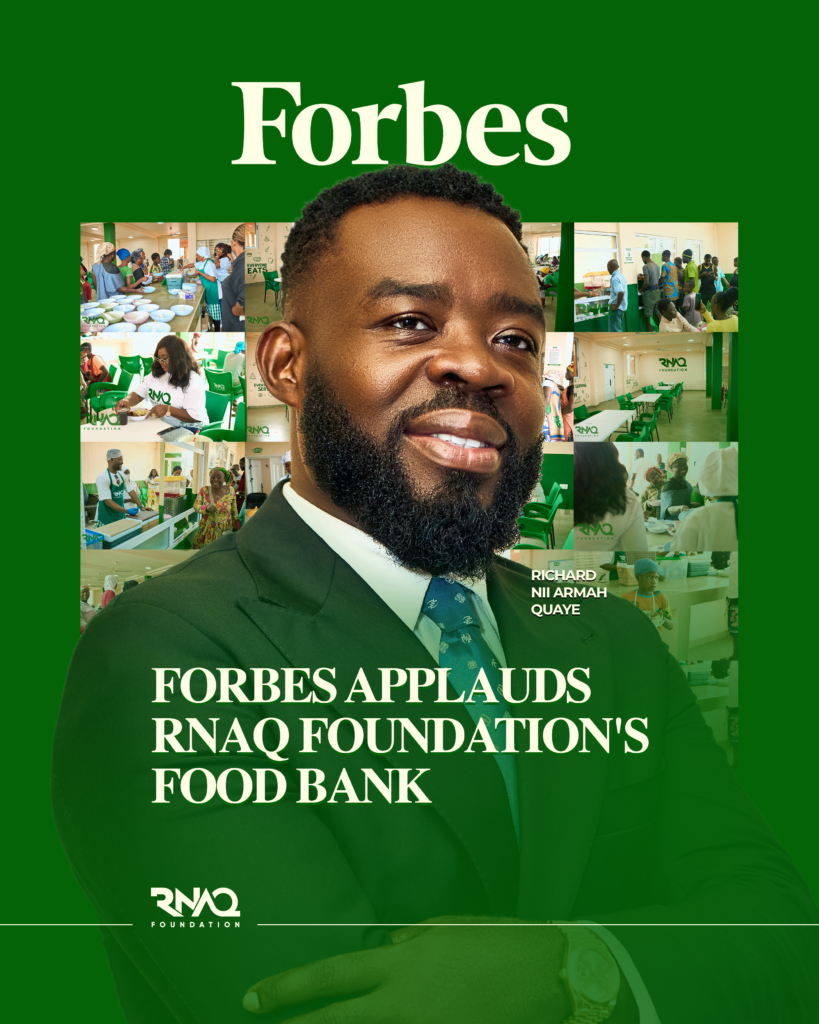
Ghanaian entrepreneur Richard Nii Armah Quaye is transforming Ghana into a business and cultural hub in West Africa by putting people at the center of his investments. From finance and food to healthcare and philanthropy, Mr Quaye’s ventures are proving that nation-building begins with empowering individuals.
Born into a humble background, Mr Quaye built his business empire with one guiding belief: success must have purpose.
“Your success has to impact the lives of so many people in your country. Until you successfully do that, then you are not truly successful,” he explained.
His journey began in 2009 with the launch of Bills Microcredit, a company that funds small and medium-sized enterprises (SMEs), the backbone of Ghana’s economy. Since then, it has disbursed over 7.5 billion Ghana cedis in loans to more than 300,000 businesses.
Today, it controls more than 70 per cent of lending funds in the market, making it Ghana’s largest non-banking financial institution. Mr Quaye’s motivation is simple: “80% of the citizens trade. If that segment is neglected, our economy will come crashing down.”
In 2019, he founded Quick Angels Limited, Ghana’s first institutionalised angel investor company, to provide equity funding to entrepreneurs who often struggle to access capital. The company has fueled growth across industries—culinary, healthcare, and creative arts.
Fast food chain Chickenman-Pizzaman, backed by Mr Quaye, now operates over 100 outlets, creating jobs for 2,000 young Ghanaians. Sankofa Natural Spices has taken local ingredients to U.S. grocery shelves, while Tigon Creative Studios is nurturing Ghana’s media talent, and Ridge Medical Center is expanding healthcare access.
Mr Quaye’s investments are driven by his belief that building businesses means building the nation.
“When you invest in an individual in the business space, you are investing in the nation,” he said.
To him, Ghanaian businesses must compete globally, and he is determined to rewrite the narrative that only foreign-backed firms succeed in Africa.
“There’s always a misconception that businesses in Africa, specifically in Ghana, cannot build national and global businesses… that is something I want to disrupt.”
In 2025, he expanded his vision of social impact with the launch of RNAQ Food Banks, a project deeply personal to him.
“I came from a very impoverished background. I know how it feels to be hungry. I’ve been hungry before,” he recalled.
Since August, the food banks have served over 17,000 people across five branches, providing free daily meals. For Mr Quaye, this is not charity but infrastructure to restore dignity, stability, and opportunity.
Beyond his businesses, Mr Quaye has become a vocal advocate for keeping wealth and investment within Ghana. Unlike many entrepreneurs who move their successes abroad, he reinvests in his homeland.
“Nation-building depends on all of us. If we’re going this way, we won’t build our country,” he said.
As he gradually transitions into the role of mentor, board member, and silent partner, Mr Quaye says his legacy lies in replication.
“I must create and replicate people like me so that they can also replicate themselves… and that’s how we build a country,” he said.
For him, true legacy is not measured in wealth but in the ripple effect of empowered Ghanaians shaping industries, feeding communities, and telling their own stories on the world stage.
DISCLAIMER: The Views, Comments, Opinions, Contributions and Statements made by Readers and Contributors on this platform do not necessarily represent the views or policy of Multimedia Group Limited.
DISCLAIMER: The Views, Comments, Opinions, Contributions and Statements made by Readers and Contributors on this platform do not necessarily represent the views or policy of Multimedia Group Limited.
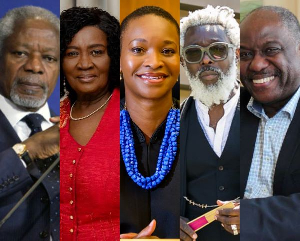
L-R: Kofi Annan, Opoku-Agyemang, Maame Ewusi-Mensah Frimpong, T-Michael and Peter Bossman
A good name, they say, is better than riches, and according to Martin Dugard, names tell stories and hold history within them.
This was evident during President John Dramani Mahama’s speech at the 80th session of the United Nations General Assembly (UNGA), where he made reference to influential Ghanaians who have made significant contributions and shaped history through their work and life’s contribution.
UN General Assembly: ‘The future of the world is Africa’ – Mahama declares
President Mahama, in his address, touched on several pressing global issues, calling for immediate action while referencing notable names to buttress his points.
While demanding the removal of the blockade imposed on Cuba, the president cited a statement from Ghana’s founding father and first President, Dr Kwame Nkrumah, which highlights the need to foster diplomatic ties with all countries.
“While I am making requests, I would like to call for the removal of the blockade on Cuba. As Dr Kwame Nkrumah, our nation’s founder, famously said, ‘We seek to be friends of all and enemies to none.’ The Cuban people shed their blood on African soil in the fight against apartheid. Indeed, Cuba has been, and continues to be, a faithful friend to Africa.
“You see, the very fact that I can stand here and ask these things, and the fact that all nations can ostensibly gather here to address critical global issues, air grievances, and express concerns—that is what makes the survival of this organisation so important,” he said.
President Mahama also spoke about migration and its effects, making reference to the Sudan crisis, which has forced 12 million people to migrate.
He highlighted how some immigrants, most notably Maame Ewusi-Mensah Frimpong, a judge on the US District Court for the Central District of California, Dr Kofi Annan and Dr Peter Bossman, a medical doctor, have risen above all odds to become successful individuals in various Western countries, contributing significantly to national development.
“When we speak of migrants, we speak of Maame Ewusi-Mensah Frimpong, a judge on the US District Court for the Central District of California. She is the first Black female judge on any of California’s four federal district courts. She was born in America to immigrant parents from Ghana.
“We speak of Peter Bossman, a medical doctor born in Ghana who moved to the town of Piran in Slovenia in the 1980s. He later became the first Black mayor of Piran, the first Black mayor in Slovenia, and in the whole of Eastern Europe,” he said.
“We speak of T-Michael, the iconic Ghanaian-Norwegian artist and designer, and the late Kofi Annan, former United Nations Secretary-General and Nobel Peace Prize recipient, who was born in Ghana but spent his adulthood in various places in America and Europe. These are people who have brought great distinction to the countries that they call home. Just as the migrants and the children of migrants before them did. These are not invaders or criminals,” Mahama added.
Prof Naana Jane Opoku-Agyemang was also featured in President Mahama’s speech, where in his closing remarks, he congratulated her on her milestone as the first female Vice President of Ghana.
Mahama expressed that her achievement has broken the glass ceiling and changed the narrative for young girls, who, through Prof Opoku-Agyemang’s example, he said, can now dream and believe they can achieve great things without hindrance.
Mahama’s UNGA 80 Address: Three bold statements that have won widespread plaudits
“I would also like to congratulate Her Excellency Naana Jane Opoku-Agyemang on being the first woman Vice President of Ghana. Now every Ghanaian girl knows the heights to which she can ascend,” the president said.
MAG/VPO
Watch more videos from the NPP’s recent demonstration directed at President Mahama
The Railway Workers Union of Ghana has suspended its planned strike and picketing, which was originally scheduled for September 30, 2025, after receiving a directive from the National Labour Commission (NLC).
In a statement dated September 24, 2025, the union confirmed that the NLC had responded to its earlier petition dated September 16, 2025, and instructed that the industrial action be suspended pending negotiations.
Railway Workers Union to strike over 12-month salary arrears
“The Commission has directed that we stay our intended action and appear for negotiations on September 30, 2025. We remain committed to this process and will honour the Commission’s directive in good faith,” the union said.
TUC issues strike warning over planned resumption of Tema-Mpakadan train service
It cautioned, however, “That it will resume its action on a new date if the negotiations fail to address their grievances”.
The workers had earlier threatened a nationwide strike and peaceful picketing over more than a year of unpaid salaries and entitlements, which they said had led to financial hardship, broken homes, health challenges, and the disruption of their children’s education.
Read the full statement below:
JKB/VPO
Watch more videos from the NPP’s recent demonstration directed at President Mahama
Fresh scandal has erupted around Lamine Yamal after influencer Fati Vázquez, who dated him when he was 17, alleged that the Barcelona prodigy operated under a bizarre system: a “calendar of girls.”
According to Vázquez, Yamal’s agent coordinated the schedule, ensuring he met different women on different days.
“Lamine’s agent organizes the days with the girls he goes out with. He has a calendar of girls,” she revealed.
Vázquez claims she only discovered this arrangement after posting photos with Yamal, when another girl messaged her to saying “Were you with Lamine? I left a day before you arrived.”
Lamine Yamal’s ex-girlfriend leaks private chats on social media
The revelation, she says, proved she wasn’t his only romantic interest and confirmed suspicions of a wider pattern.
The influencer described Yamal as poorly guided, arguing that his inner circle exploits his fame rather than steering him away from damaging behavior.
“I met his closest circle and, the way they guide him, I don’t think he’s being advised properly,” she said.
The allegations comes days after Yamal won his second consecutive Kopa Trophy as the world’s best U-21 player and is considered the future of Barcelona and Spain.
FKA/JE
Meanwhile, watch interviews with Bahubali’s twin sister and promoter below
Namibians were reminded that cemeteries are sacred spaces
Namibia’s authorities have warned people not to hold parties at cemeteries after a social gathering at a gravesite in the capital, Windhoek, sparked outrage last weekend.
According to City of Windhoek officials, the event at Gammams cemetery “showed seating arrangements, cooler boxes and alcohol” on full display.
One Windhoek resident who witnessed the party said it was “nothing short of disgraceful”.
In a Facebook post, she described the scene that met mourners entering the gravesite, saying “from the entrance all the way inside, car boots were open, people were drinking, and the cemetery resembled a shebeen rather than a place of rest”.
She also said the cemetery was left in a pitiful condition, with bottles and cans left lying around.
In a statement issued on Thursday, the City of Windhoek said this was “unacceptable”, adding that “it disrespects the dignity of the deceased [and] disturbs other grieving families”.
It also reminded residents that leaving litter or waste behind at the cemetery was a criminal offence and said there would be “strict monitoring and enforcement” to preserve burial sites.
“Cemeteries are sacred spaces reserved only for burials and remembrance of the deceased,” it said.
“Social gatherings, alcohol consumption, and littering within cemetery grounds are strictly prohibited.”
This is not the first time Gammams has made headlines. In 2021 a man was arrested after a video circulated showing him firing off shots during a funeral held there.
The same funeral also saw cars being spun in a parking area near the burial site, local news site The Namibian reported at the time.
According to a Ghpage news report on September 26, 2025, drama unfolded at Lawson FM when a young nurse known as Nana Yaa stormed the station with ‘Wee boys” to confront the host of a popular program, Lawson Afisem, and a young man identified as Desmond.
The chaos started after Desmond went live on the show, hosted by Maame Frimpomaa Korankye, popularly called MFK. On air, Desmond narrated how he met Nana Yaa on TikTok and later fell in love with her.
He said their relationship quickly developed into something serious. According to him, during the time they were together, he often visited Nana Yaa, and they shared intimate moments.
Desmond alleged that things turned sour when he lost his phone to Nana Yaa. He explained that despite several attempts to retrieve it, she refused to give it back.
Believing the issue was unfair, Desmond turned to Lawson Afisem to tell his side of the story publicly, hoping the platform could help him recover his phone.
However, his revelations did not sit well with Nana Yaa and her family. Feeling disrespected and humiliated, they decided to confront both Desmond and the radio team.
Reports indicate that Nana Yaa, her mother, and some supporters arrived at the station with anger, threatening to deal with Desmond and even warning MFK and her staff over the matter.
The situation became tense, with threats allegedly made against the host’s life. According to eyewitnesses, the nurse’s family made it clear they were not happy with how the issue was handled on air.
Police intervention later calmed the heated scene, and both Nana Yaa, her mother, and Desmond were taken into custody for questioning.
The incident has since sparked public debate on social media, with many people criticizing both sides. Some believe Desmond should not have gone public with private issues, while others argue that Nana Yaa and her family overreacted by storming a media house in such a manner.
The matter is now in the hands of the authorities, as the public waits to see how it will be resolved.
The National Democratic Congress (NDC) has announced that its Deputy General Secretary in charge of Operations, Mustapha Gbande, will temporarily oversee the day-to-day administration of the party.
This follows the departure of the General Secretary, Fiifi Fiavi Kwetey, who is leading a four-member delegation to attend the 2025 Labour Conference in the United Kingdom.
The delegation, which left Accra today, Friday, September 26, 2025, includes Deputy General Secretary Barbara Serwaah Asamoah, National Deputy Communications Officer Godwin Ako Gunn, and Deputy Director of International Relations, Dr. Karl Arhin. They are expected to return to Accra on Friday, October 3, 2025.
In a statement signed by the party’s Director of Communications, Kakra Essamuah, the NDC said the trip reflects its commitment to building stronger international partnerships with progressive parties worldwide.
According to the party, the engagement in the UK is part of its broader agenda to promote shared ideals of social justice, equality, and inclusive development.
With Fiifi Kwetey away on official assignment, Mustapha Gbande will steer the secretariat until his return.
Vintage fashion has been steadily gaining popularity, and one of the most versatile and timeless pieces in a woman’s wardrobe is the vintage shirt. From the charming designs of the 1920s to the bold patterns of the 1980s, vintage shirts offer a blend of classic elegance and modern style. These shirts are not only a nod to history but also a way to express individuality and creativity in everyday fashion.
The 1920s was a decade marked by bold changes in women’s fashion, with more freedom and comfort coming into play. Vintage button-up blouses from this era are typically made of soft fabrics like silk or cotton, with intricate lace detailing or pleats. These blouses often feature high collars or bow ties at the neck, creating a soft yet refined look. Pair them with a high-waisted skirt or tailored trousers to embrace the elegance of the Jazz Age while keeping it fresh for modern-day wear.
The 1940s were all about femininity and fun, and polka dot shirts quickly became a fashion staple during this period. Vintage polka dot shirts often feature a slim, tailored fit, with short sleeves and a neat button-up design. Whether in classic black-and-white or bold red-and-white, these shirts exude retro charm. They can be styled with pencil skirts or denim jeans for a versatile yet timeless look, perfect for everything from a day at the office to a weekend outing.
The 1950s were characterized by a feminine, polished aesthetic, and tie-front shirts became an iconic piece of this era’s fashion. Vintage tie-front shirts often come in soft cotton or linen and feature a cropped fit that ties at the waist, creating a flattering hourglass shape. These shirts are perfect for pairing with high-waisted jeans, skirts, or even shorts for a casual yet chic look. The playful tie-front design brings a fun, retro element to any outfit.
Vintage shirts for ladies are an essential piece that brings a sense of history, style, and individuality to any wardrobe. From the delicate blouses of the 1920s to the bold prints of the 1980s, there is a vintage shirt for every occasion and personal style. By incorporating these timeless pieces into your closet, you not only embrace the charm of past decades but also create fresh, fashionable looks that stand out in the modern world.
Telecel Ghana has hosted a three-day Artificial Intelligence (AI) workshop in Accra for small business owners as part of its SME Month celebration, themed “Connecting the Next Generation of Entrepreneurs.”
The programme brought together young entrepreneurs from diverse sectors including technology, agriculture, fashion, hospitality, and consulting, who were trained to harness AI for growth, efficiency, and competitiveness.
Sessions combined hands-on demonstrations with forward-looking discussions on the future of business in the age of AI.
Micah Akati, founder of MidBrew AI Agency and lead trainer for the workshop, guided participants through practical modules on using AI tools for market research, video creation, presentations, client pitches, continuous learning, and digital brand management.
“AI is critical for emerging businesses today. Every startup should view AI as a capable companion that helps make up for shortfalls in finance or labour. These young entrepreneurs are learning how AI saves time and resources while boosting productivity,” Akati said.
One of the participants, Godwin Okronipa, co-founder of Flywheel Technologies, said the sessions sharpened his perspectives on deploying AI within his year-old business.
“This workshop gave me clarity on new tools and functions to integrate into our solutions. I was most impressed with AI video tools that can enhance our client pitches as we scale and position ourselves in the digital solutions space,” he explained.
Telecel Ghana said the initiative reflects a strategic commitment to support young businesses to integrate AI into their operations at a time when advanced technology is reshaping industries worldwide.
“Our role is to give the next generation of entrepreneurs a head start by connecting them to tools that enable innovation and competitiveness. AI is no longer optional for SMEs; it is central to how they grow, stand out, and survive,” said Tawa Bolarin, Director of Enterprise Business at Telecel Ghana.
As part of SME Month, Telecel also launched three tailored connectivity products designed to help small businesses stay competitive in the digital economy.
These include the Boss Plan, an integrated voice, data, and social media bundle with a digital marketing campaign tool; One Business Mobile, a team-friendly package offering shareable data, calls, and SMS across all networks; and a revamped Your Business Online service, which provides unlimited web pages, business email addresses, and domain registration.
Beyond the workshop, Telecel has lined up several other activities this September, including the Connecting Hustles Podcast 2.0, which will feature candid conversations with young entrepreneurs on navigating challenges in business; Red Pop-Ups, live public showcases of creative skills; Telecel Business Runway, a knowledge-sharing event with expert insights and product showcases; and The Red Mixer, a networking session designed to link entrepreneurs with industry leaders for future partnerships.
Young entrepreneurs attend 3-day AI Workshop organised by Telecel Ghana as part of the telco’s 2025 SME Month activities.
On Friday, September 26, the Africa Media Bureau, in partnership with Channel One TV and Citi FM, organised the Broadcasting at the Crossroads forum at the Alisa Hotel in Accra.
The forum brought together key stakeholders, including policymakers, regulators, media practitioners, and former President John Agyekum Kufuor, to deliberate on the future of broadcasting in Ghana and across Africa.
Speakers addressed critical issues such as the sustainability of Ghana’s Digital Terrestrial Television (DTT) platform, the regulation of new and traditional media, and the need for Africa to reclaim its narrative through a stronger, pan-African media presence.
The event highlighted a collective commitment to safeguarding democracy, promoting responsible journalism, and leveraging technology for the growth and integration of the continent’s media landscape.
The Vice President of the Fertility Society of Ghana, Dr. Promise Sofogah, has revealed that local data findings of infertility in many couples show that about 70% of the problem is from men.
Speaking at Malm-Hesse Medical Negligence Conference dubbed, “Third Party Reproduction in Ghana: Surrogacy and Gamete Donation – Benefits, Challenges and Ethics,” he said, “We have realised from our local data that with a lot of couples who come seeking treatment for infertility, a little around 70% of the time, the problem is from the men.”
He explained that infertility is caused by some factors that do not only affect women but men as well, with some in both couples and a few with unexplained reasons.
“Infertility is caused by some factors that only affect women, if you have hundred couples with infertility, about 30 of them, the problem is from the woman, another 30 of them is exclusively from the man, another 30 is from both genders, with 10 of them unexplained thus (the problem cannot be found with medical checks),” he pointed out.
He explained that infertility is when a couple have stayed together for a maximum of 12 months trying to conceive, and a maximum of six months for a woman who is above the age of 35 years trying to conceive.
He indicated that, as a woman grows, the level and quality of her eggs reduces, noting that women are born with a set number of eggs and begin to lose them when they reach puberty stage, thus through menstruation, emphasising that the quality of eggs reduces after 35 years.
He said “the older a woman gets, it gets more difficult for (her) to conceive naturally.”
He added that some women delay child birth until their eggs are finished, while some may have eggs but are low in quality to produce normal babies, which result in the use of donor eggs.
He advised the public to put an end to harassing women when it comes to infertility, stressing that men also suffer from infertility.
He noted that regulations governing surrogacy should be implemented to avoid abuse of the system, since financial incentives have been identified as a motivating factor for surrogacy.
Senior Associate of ECAM Law Consult, Christian Lebrecht Malm-Hesse Esq, mentioned that for the past 30 years there have not been any regulation for surrogacy, emphasising that every year there are couples seeking to have babies through Assisted Reproductive Technology (ART).
He indicated that the space needs to be regulated to remove charlatans, and called for proper documentation to improve surrogacy in the country.
Mr. Malm-Hesse stressed that discrimination is high, therefore, the country should be clear on the stance of LGBTQ+ and whether it can also benefit from surrogacy, stating that the advanced countries are clear on their stance.
He added that there is the need to implement laws for third party reproduction, which includes the number of donations from donors, as well as the age requirements of donors, highlighting that the age requirements in common law is 21 years, and the donor should have a child.
He also pointed out that surrogacy cannot be commercialised.
The Ghana Railway Development Authority (GRDA) has stated that the threats by the Trades Union Congress (TUC) and the Railway Workers’ Union of the Ghana Railway Company Limited (GRCL) to resist the operationalisation of the Tema–Mpakadan Standard Gauge Railway Line were based on a deliberate mislinking of salary arrears at GRCL to the start of proof-of-revenue services on the line.
The Authority indicated that neither the TUC nor GRCL had engaged it or the Ministry of Transport before issuing their threats.
It maintained that attempts to conflate GRCL’s internal management failures with GRDA’s lawful mandate were misplaced and risked undermining a strategic national investment worth USD 447 million.
According to the Authority, the Railways Act, 2008 (Act 779) vests all railway assets in GRDA and empowers it to develop, administer and regulate the sector, including operationalising newly constructed lines and conducting proof-of-revenue services.
It stressed that the start of operations on the Tema–Mpakadan line fell squarely within its statutory remit and that no operator, including GRCL, had inalienable rights over any railway line in Ghana.
GRDA further explained that under the open-access model, multiple public or private operators could apply for operating licences and slots.
It disclosed that 17 entities had submitted applications but GRCL was not among them, adding that the company neither possessed the requisite rolling stock for standard gauge operations nor had trained staff for the line.
The Authority gave background that the 97.7-kilometre Tema–Mpakadan line, completed in December 2024 at a cost of USD 447 million, formed a vital multimodal corridor linking Tema Port to Buipe via the Volta Lake and to Burkina Faso through the Tema–Ouagadougou corridor.
It said that international standards required passenger service trials to test systems such as signalling, train control, traffic management, station facilities and maintenance depots before full commercial operations.
GRDA reported that it had successfully completed four days of test runs and that proof-of-revenue services would commence on October 1, 2025.
The Authority noted that the line was funded through a USD 447 million loan from the Indian EXIM Bank on-lent to GRDA by the Ministry of Finance, which it must service through revenues generated from operations.
It said that the open-access model had been adopted to ensure fairness, competition and sustainability, with train traffic to be centrally managed by GRDA.
GRDA pointed to what it called systemic inefficiencies within GRCL. It said that despite heavy government investments, the company had failed to sustain operations, diverted funds, procured defective materials and engaged in the illegal sale of parts of the network without the Authority’s consent.
It listed issues such as derailments on the Western Line, abandonment of materials, empty rehabilitated stores, staff on foreign payrolls producing no value and unauthorised disposal of locomotives and wagons.
The Authority described as false the claim that GRCL’s predicament was its responsibility and said the evidence showed a consistent pattern of mismanagement and unlawful actions by GRCL itself.
It expressed disappointment that the TUC had failed to engage GRDA and the Ministry before issuing threats and called on the union to demand accountability from GRCL’s management instead of shielding them.
GRDA also raised concerns about acts of vandalism against point machines and signalling equipment recorded after TUC’s public declaration of intent to resist government’s railway agenda.
It warned that the TUC and its affiliates would be held accountable for any sabotage, destruction or disruption of railway infrastructure during the period of their declared action.
The Authority assured the public that the Tema–Mpakadan line, a strategic national asset, would commence proof-of-revenue operations on October 1, 2025, in line with government directives and Act 779.
It reiterated its resolve to deliver safe, reliable and efficient services and to safeguard the nation’s investment for the benefit of all Ghanaians.
play videoMumuni Bawumia was the Northern Commissioner under Nkrumah’s government
Dozens of Ghanaians, led by the Regional Commissioners of the Northern and Upper Regions, converged at Kulungugu on August 1, 1963, to mark the first anniversary of the assassination attempt on Ghana’s first President, Osagyefo Dr Kwame Nkrumah.
A rare news report sighted by GhanaWeb details how the event, meant to commemorate Dr Nkrumah’s escape from his assassins and the tragic loss of lives, was observed at ground zero.
“High in the upper regions of our land, through the northern mist, another day breaks. But for Ghana, this morning is set apart from other mornings; this is Kulungugu Day. Led by the Regional Commissioners for the Northern and Upper Regions, Mr Bawumia and Mr Asunda, thousands of Ghanaians in cars, buses, lorries, bicycles, and on foot set out from Bawku on the road to the tiny village of Kulungugu; the scene a year ago of the outrageous bombing incident against Osagyefo Dr. Kwame Nkrumah and the peace-loving people of this land,” a voice in the report narrated.
Nkrumah wept by my bedside – Kulungugu bombing victim
The video shows the Northern Regional Commissioner, Mumuni Bawumia, father of former Vice President Dr Mahamudu Bawumia, and the Upper Regional Commissioner, Gabriel Asunda, riding in a convertible car and waving as they led a convoy to Kulungugu.
“It was decided that Kulungugu Day be observed every year as a day when the forces of neocolonialism were defeated by providence and justice, and a day of triumph for Osagyefo, his socialist pattern of life, and our stand for African unity,” the narrator said.
Samia reveals Nkrumah’s ‘sad’ confession after Kulungugu bombing
Chanting and singing songs of Nkrumah’s Convention People’s Party (CPP), Mumuni Bawumia and Gabriel Asunda led the followers to the site of the bombing.
Gathered around the site in their thousands, Ghanaians who traveled to Kulungugu witnessed a leader of the Kusasi tribe pour libation and offer prayers for peace at the site.
In his address to the gathering, Mumuni Bawumia spoke about those who died in the explosion and other bombing incidents and announced that a monument would be erected in their memory.
Gabriel Asunda, who was with Dr Nkrumah on the day of the bombing, also recounted the experience to the crowd.
The report also shows the large crowd that greeted Dr Kwame Nkrumah at Accra Airport following his survival of the assassination attempt.
Portions of the video show Commissioners Bawumia and Asunda dancing with the crowd, as well as similar celebrations in the national capital, Accra.
Watch the video below:
Martin Amidu breaks silence on removal of Gertrude Torkornoo
Two Companies to Fifteen Houses Allegations: Abronye DC details ordeal with police during arrest
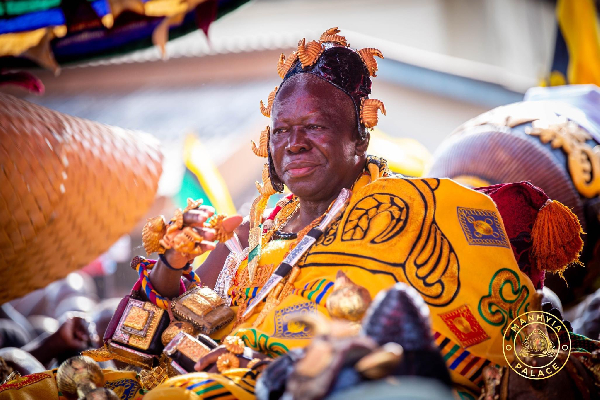
Confusion erupts after ‘Igbo king’ is allegedly denied handshake with Otumfuo at Manhyia
Rising Afrofusion sensation, Raevin, is set to heat the airwaves with the release of his highly anticipated new single, ‘Fever II’, featuring Ghanaian Afrobeats star Kelvyn Boy and fast-rising Afrofusion talent Kojo Blak.
The record, produced by globally acclaimed and Grammy-winning hitmaker Killbeatz, is a seamless fusion of vibrant rhythms, soulful melodies, and captivating storytelling.
‘Fever II’ delivers a bold sounds cape that embodies Raevin’s artistry, blending infectious Afrobeats grooves with modern pop sensibilities. Kojo Blak’s silky vocals and Kelvyn Boy’s refreshing energy perfectly complement Raevin’s signature style, creating a track poised to become a staple on playlists and dance floors across Africa and beyond.
Speaking on the collaboration, Raevin shared: “Fever II is more than just a song; it’s a cultural moment. Working with Kelvyn Boy, Kojo Blak, and Killbeatz allowed us to create something truly special.” With Killbeatz behind the boards—whose production credits include global hits with Ed Sheeran, Wizkid, King Promise, Burna Boy, Fuse ODG, and many others—‘Fever II’ carries the quality and international appeal to resonate with Gen Z, Millennials, and Afrobeats lovers worldwide.
The single follows the release of Raevin’s acclaimed debut EP, ‘Feelings of Raevin’, which showcased his versatility and cemented his place as one of Afrofusion’s most exciting new voices.
His artistry has also earned him recognition as an “Apple Up Next” Artist to Watch, solidifying his rise as one of the key voices shaping the new wave of African music. ‘Fever II’ officially dropped on all digital streaming platforms on September 19, 2025. Fans can expect a vibrant rollout, including exclusive performances, interactive social media activations, and visual content that captures the heart of the record.
The Ghana National Fire Service (GNFS) has retrieved a one-week-old baby boy from a toilet pit at Ali, a suburb of Suhum in the Eastern Region.
The incident, which occurred on Tuesday, September 23, 2025, witnessed the swift action of officers from the Suhum Municipal Fire Service to rescue the lifeless baby after responding to a distress call at 6:30 a.m.
The statement added that an 11-member crew led by ASTNO Danso Henry arrived at the scene, near Gateway Preparatory School at 6:44 a.m. and, after a careful rescue operation, sadly retrieved the lifeless body of the one-week-old baby boy from the toilet pit at about 7:00 a.m.
Preliminary findings, according to GNFS, suggest that the tragic act was allegedly committed by the baby’s mother, who fled the scene. The body has since been handed over to the police for further investigation.
Accra, Sept. 26, GNA- School Placement is absolutely free, the Ghana Education Service (GES) has said.
A statement issued and signed by Daniel Fenyi, Head of Public Relations, GES said parents, guardians or students should not pay money to any individual or group of persons for placement into any Senior High School or Technical and Vocational Education and Training (TVET) Institution.
“The GES categorically states that the school placement exercise is absolutely free of charge. At no point should any parent, guardian or student pay any money to any individual or group of persons for placement into any Senior High School or Technical and Vocational Educational and Training (TVET) institution.
According to GES, its Management’s attention has been drawn to trending reports on social media allegeding that some parents and guardians are being charged sums of money for placement of wards in Senior High Schools.
The statement said GES had established official and transparent processes for placement.
“Parents and guardians are advised to use only the Computerised School Selection and Placement System (CSSPS) portal, the Resolution Centres and the official GES communication channels for all placement -related concerns.”
We encourage anyone who is approached with demands for money in exchange for placement to report immediately to the Ghana Education Service or the nearest Police Station for swift action.”
GES said it remained committed to ensuring fairness, transparency, and equal opportunity for all qualified candidates.
“Placement into Senior High Schools is strictly merit-based and free of charge,” the statement added.
Treasury bills were undersubscribed in last week’s auction
The government is aiming to raise GH¢6.248.84 billion at its treasury bills auction on September 26, 2025.
This is expected from the 91, 182 and 365-day bills.
Last week, the government secured GH¢3.432.82 billion in its auction on Friday, September 22, 2025.
This was an oversubscription from the target of GH¢3.019 billion.
Data from the Bank of Ghana showed that investors tendered a total of GH¢3.445.95 billion across the 91-day, 182-day, and 364-day bills.
According to the results released by the central bank, out of the bids tendered, only GH¢13.13 million was not accepted.
T-bills: Government beats target with GH¢3.43 billion raised
Also, bids worth GH¢2.581.67 billion were tendered for the 91-day bills, but only GH¢2.576.67 billion were accepted.
Out of GH¢613.82 million submitted for the 182-day bills, only GH¢608.82 million were accepted.
The 364-day bill received bids worth GH¢250.46 million, but only GH¢247.33 million were accepted.
Interest rates for the 91-day bill were 10.45%, while the interest rate for the 182-day bill was 12.36%.
Additionally, the interest rate for the 364-day bill was 12.88%.
The Bank of Ghana said the GOG Securities Wholesale Auction is open only to Primary Dealers.
All Primary Dealers are obliged to act as market makers in GOG Securities.
“The investing public interested in purchasing or selling GOG securities may do so on the secondary market (Ghana Fixed Income Market) through depository participants (including Primary Dealers),” the BoG said.
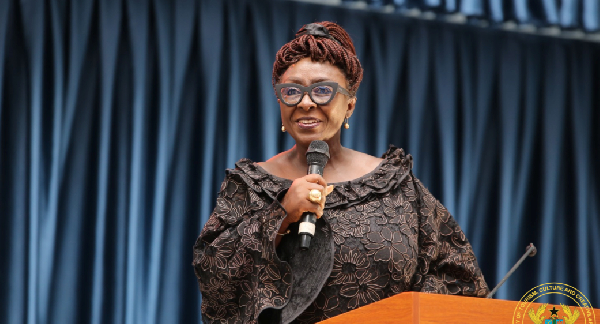
Ablah Dzifa Gomashie is the Minister of Tourism, Culture and Creative Arts
The Minister of Tourism, Culture and Creative Arts, Ablah Dzifa Gomashie, has called for an end to the longstanding ridicule of Ghana’s theatre industry.
She has described the practice as not only “shameful” but also “self-destructive.”
Speaking on September 23, 2025, at the opening of the six-day Ghana Theatre Festival, the veteran actress and minister, who has experienced both the triumphs and struggles of Ghana’s performing arts, emphasised that theatre is far more than just acting on stage.
Abla Dzifa Gomashie hints at quitting acting
She reflected on her days as a student at the University of Ghana, Legon, recalling how theatre students were mockingly labelled “Dondologists”, a dismissive term used to belittle their craft.
“It started way back when at the citadel of education, you called us Dondologists to ridicule who we are. Yet, in that same space, you celebrate colleagues worldwide while trampling on us. And that must stop, because you see, we only reflect who you are. If you mock us, you’re mocking yourselves,” she told the audience.
According to Dzifa Gomashie, this mindset is rooted in ignorance. She argued that those who belittle the art fail to recognise its true impact.
Fatal Helicopter Crash: ‘We are traumatised, but I believe it shall be well’ – Dzifa Gomashie
Far from being “mere pretence,” she described theatre as a rigorous discipline that builds character, sharpens intellect, and nurtures talent across a wide range of professions.
“There is a comedian who is a dentist by profession. There are lawyers and poets who thrive in this space. So why mock an industry that could employ you after studying law, architecture or any other field?” she asked.
Gomashie also brought to light the sector’s economic weight, disclosing that in 2024 the creative industry was Ghana’s fourth-highest foreign exchange earner.
She said this demonstrates that arts are not a frivolous pursuit, but rather a massive driver of national development.
The minister also assured stakeholders that the government is actively reviewing outdated cultural policies to better align with contemporary realities.
“Our success is not in the individual but in our collective ability to increase revenue and safeguard the fortunes of this industry. This festival allows us to reflect on how far we’ve come and to forge ahead together,” she said.
Charles Bissue is the Director of Operations for Kennedy Agyapong’s Campaign Team
The Director of Operations for Kennedy Agyapong’s Campaign Team, Charles Bissue, has stated that the New Patriotic Party’s (NPP) flagbearership is not an automatic entitlement for any former presidential candidate.
Speaking in an interview on Rainbow Radio on Thursday, September 25, 2025, Bissue insisted that the NPP’s internal democratic processes must be respected.
He argued that the party’s constitution does not grant automatic flagbearership to anyone, regardless of past contests.
Bissue explained that if the position of flagbearer were to be an automatic right, there would be no need to hold primaries.
I’m happy to be prosecuted under an NDC gov’t – Charles Bissue
According to him, opening up the contest is the only way to ensure fairness and strengthen the democratic tradition within the party.
“The 2026 flagbearership isn’t an automatic right for any former presidential candidate. Let’s allow due process to run,” he stressed.
Bissue further noted that competition in the primaries gives party members the opportunity to choose a leader who best represents their aspirations ahead of the national elections.
MRA/VPO
Watch more videos from the NPP’s recent demonstration directed at President Mahama
play videoAfrica’s total public debt has surged to $2.14 trillion in 2024
GhanaWeb Feature by Ernestina Serwaa Asante
Following the launch of the Pan-African “Black Paper” on debt earlier in 2025, many have been left wondering why it was named the Black Paper. Is the paper itself black, or is it simply a symbolic title?
Before delving deeper into this conversation, it is important to understand that the Black Paper offers a decolonial framework for discussing Africa’s debt and broader economic challenges.
Unlike the traditional white papers produced by institutions such as the International Monetary Fund and the World Bank, this Black Paper argues that Africa’s debt crisis stems from colonial exploitation and not merely poor governance.
Africa’s creditors must cancel the continent’s debts – ITUC-Africa
It challenges existing development finance models, viewing them as remnants of colonial systems, and proposes a new roadmap for Africa’s financial sovereignty.
The goal is to transform the continent from a debtor to a net creditor.
Developed under the Stop the Bleeding Campaign, the paper explores Illicit Financial Flows (IFFs), colonial legacies, and climate financing across Africa.
The continent loses billions of dollars annually through IFFs, and for Africa to achieve self-sufficiency, these loopholes must be sealed.
“So, it’s being called a Black Paper as opposed to the typical white paper because we are trying to assert ourselves as Africans. We want to own our narrative and our continent. That’s why it’s called a Black Paper,” Dr Eunice Offei explained to GhanaWeb’s Ernestina Serwaa Asante.
AFRODAD chair calls for restorative justice as Africa’s debt crisis deepens
Speaking on GhanaWeb TV’s BizTech, the researchers: Professor Godfred Bokpin, Dr Emmanuel Senanu, Dr Eunice Offei, and Dr Gabriel, emphasised that African leaders must pursue broader reforms to enhance the continent’s competitiveness on the global stage.
“We’re also making the point that if you look at what leaves the continent annually, compared to what we receive through borrowing, Foreign Direct Investment, portfolio flows, and aid — it’s minimal. What we lose through Illicit Financial Flows far outweighs what we gain,” Professor Godfred Bokpin said.
The paper also highlights how colonial powers continue to dominate negotiations involving African nations, a narrative, they said must be dismantled.
Furthermore, the researchers noted that although Africa contributes the least to global carbon emissions, it bears a disproportionate share of the climate crisis.
The climate finance directed to Africa often comes in the form of loans, adding to the already heavy debt burden faced by many African countries.
Data from the IMF and the World Bank shows that 22 African countries are currently in debt distress or at high risk of debt distress.
Multilateral lenders must support Africa’s debt restructuring efforts – Ato Forson
Four nations, namely Chad, Ethiopia, Ghana, and Zambia, have already defaulted, while seven countries now spend more on debt interest than on education, and 25 spend more on debt interest than on health, according to UNCTAD’s 2023 report.
On Africa’s total public debt, it has surged to $2.14 trillion in 2024, up from $1.8 trillion in 2022.
External debt servicing is also projected at $88.7 billion in 2025, nearly matching the previous year’s figure of $89.4 billion.
Meanwhile, watch the latest edition of BizTech below:
UDS are through to the final of the World University Games
The University for Development Studies (UDS) of Ghana has qualified for the finals of the World University Games after beating Spain’s University of Granada in the semi-finals on Friday, September 26, 2025.
After 90 minutes of end-to-end football, neither side could find a breakthrough, with the game locked at 0-0 and destined for a penalty shootout.
Granada blinked first, missing their opening spot-kick to hand UDS the early advantage.
But the Ghanaians faltered on their fourth attempt, dragging the contest into sudden death.
LIVESTREAMING: University of Developments Studies vs University of Granada
With pressure mounting to the limit, UDS’s goalkeeper emerged the hero, pulling off a decisive save that sealed a dramatic 5-4 shootout victory.
The win sends UDS into the final of the prestigious competition, etching their name into the history books and igniting wild celebrations from the Ghanaian camp.
FKA/JE
Meanwhile, watch interviews with Bahubali’s twin sister and promoter below
The Acting Director-General of the National Communications Authority (NCA), Rev. Ing. Edmund Yirenkyi Fianko, has pointed out constitutional limitations that restrict the Authority’s ability to regulate Ghana’s broadcasting sector effectively.
Speaking at the “Broadcasting at the Crossroads” forum organised by the Africa Media Bureau at the Alisa Hotel on Friday, September 26, 2025, Rev. Fianko explained that under existing laws, the NCA can only reject a broadcasting authorisation if there is no available frequency, provided all other requirements are met.
“Currently, the only constitutional construct that we have has placed some limitations on the NCA. The only reason we have to decline a broadcasting authorisation properly when the person has met all other requirements is the unavailability of a frequency,” he said.
He further noted that while the constitution indicates that a licence is not required to operate a mass media outlet, spectrum resources still require strict regulation.
“Unlike other sectors where we regulate, and where we can look at the economics of the market and other metrics, when it comes to broadcasting, until the law changes, we are very limited,” he added.
Rev. Fianko stressed the urgency of legal reforms to give the NCA broader regulatory powers, including the ability to assess market economics and enforce content standards in a broadcasting environment that is becoming increasingly complex with digital convergence.
Read more…
Gov’t can’t keep subsidising DTT operations alone – Sam George warns
Acting Chief Justice, Paul Baffoe-Bonnie, has advised the newly established Ghana Law Society to obtain formal recognition and licensing from the General Legal Council (GLC) as part of its efforts to operate as a professional body.
The Ghana Law Society has filed a suit at the Supreme Court challenging the Ghana Bar Association’s long-standing monopoly as the sole professional association for lawyers in Ghana.
Speaking at a meeting with members of the Ghana Law Society in Accra on Thursday, September 25, Justice Baffoe-Bonnie underscored the importance of adhering to proper legal procedures.
“To us, it means you must have a certificate from the General Legal Council. So, when in your speech you say that you are going to make a representation to the General Legal Council for recognition and licensing, it will be in the right direction. Because all that we are interested in at the General Legal Council is that you will possess our license,” he stated.
The Supreme Court case, if successful, has the potential to reshape Ghana’s legal profession by allowing for the establishment of multiple professional associations.
Two individuals have been sentenced to three months’ imprisonment with hard labour for illegally dumping refuse at the Accra Post Office area.
The convicts Albert Okai and Amoako Darko, were sentenced to serve their jail term at the Nsawam Medium Security Prison when they failed to pay a fine of 50 penalty units (GH¢600) each
A third accused, Michael Osei, however, pleaded not guilty and has been remanded into custody for one week, with his case set to continue in court.
The Mayor of Accra, Hon. Michael Kpakpo Allotey speaking after the judgement, stated that the convictions are part of the Assembly’s ongoing efforts to clamp down on indiscriminate refuse dumping in the city.
He stressed that the case serves as a clear warning about the consequences awaiting offenders who flout the Assembly’s sanitation by-laws, emphasising that strict enforcement is crucial to safeguard public health and maintain a clean environment.
American R&B sensation, Sisqó, has arrived in Accra before his headline performance at the Rhythm & Brunch 2nd Anniversary Celebration set for Saturday, September 27, at the Polo Club.
The award-winning singer, famous worldwide for timeless hits such as “Thong Song” and “Incomplete”, touched down on Thursday, sparking excitement among fans eager to see him perform live. His presence marks another high point in Ghana’s rapidly growing entertainment landscape.
Organisers of Rhythm & Brunch say this year’s anniversary will deliver more than just music. Guests can expect the full Rhythm & Brunch experience — a fusion of great food, good vibes, and unforgettable performances that have made the brand one of Accra’s favourite weekend hangouts.
All roads now lead to the Polo Club on Saturday, where fans will get the chance to relive the magic of Sisqó’s R&B classics while celebrating a homegrown event that continues to put Accra on the cultural map.
The operation also led to a recovery of $70,000 in Ghana
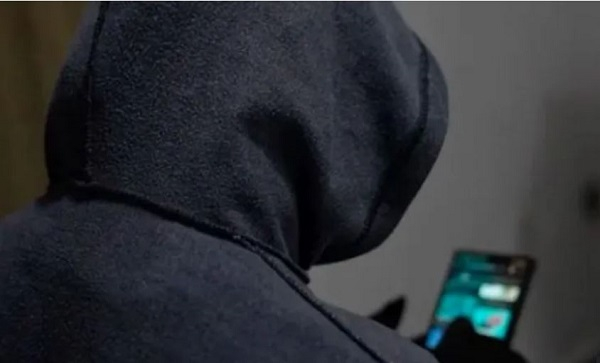
A BBC report published on Friday, September 26, 2025, has detailed a sting operation carried out by the International Criminal Police Organization (Interpol) across various African countries to crack down on cyber scammers.
According to the report, the operation led to the arrest of 260 suspects across 14 countries, including Ghana, during the crackdown conducted between July and August 2025.
In Ghana, the operation resulted in the arrest of 68 suspects, with authorities seizing 835 devices and identifying 108 victims.
INTERPOL Red Alert: Ken Ofori-Atta, associates to face global scrutiny – Security expert predicts
During the Ghana operations, investigators recovered $70,000 of an estimated $450,000 lost by victims through romance scams and sextortion.
The scammers in Ghana extracted payments using various schemes, including fake courier and customs shipment fees, the report said.
The scammers also secretly recorded intimate videos during explicit chats and used them to blackmail their victims.
Other countries where the operation was conducted include Angola, Benin, Burkina Faso, The Gambia, Guinea, Cote d’Ivoire, Kenya, Nigeria, Rwanda, Senegal, South Africa, Uganda, and Zambia.
Ghanaian police officer places 3rd in Interpol hackathon
The operation, executed under the African Joint Operation Against Cybercrime project and funded by the UK, targeted criminal networks using social media and digital platforms to extort monies from victims.
In total, the investigation identified more than 1,400 victims across the 14 countries, with an estimated combined loss of $2.8 million (£2.1 million) suffered by the victims.
The crackdown, which led investigators to identify IP addresses, digital infrastructure, domains, and social media profiles linked to members of the scam syndicates, resulted in the seizure of USB drives, SIM cards, and forged documents.
Interpol stated that a total of 81 cybercrime groups were dismantled during the operation.
GA/AE
Martin Amidu breaks silence on removal of Gertrude Torkornoo
Two Companies to Fifteen Houses Allegations: Abronye DC details ordeal with police during arrest
Confusion erupts after ‘Igbo king’ is allegedly denied handshake with Otumfuo at Manhyia
Flash Back! A picture taken during a previous conference
HR Focus Africa, a subsidiary of L’AINE HR, has announced the return of the R Fous Africa Conference & Awards 2025, set for Friday, October 17, at the Accra International Conference Centre.
The event is expected to draw more than 1,000 HR professionals, business leaders, and policymakers both in-person and virtually from across the continent.
This year’s theme, “Equity, Innovation & Impact: Reimagining Work and Talent in Africa’s Emerging Future,” underscores Africa’s growing role in shaping the global future of work.
The 2024 edition attracted over 600 senior professionals, cementing the conference as a premier platform for dialogue on workplace transformation.
According to the organisers, the 2025 programme promises a rich blend of activities, including panel discussions with thought leaders, interactive workshops on emerging HR practices, and exhibitions showcasing the latest technologies and solutions for talent management.
The highlight of the gathering will be the HR Focus Africa Awards, which recognise excellence in diverse categories.
These include Sector Awards for Banking & Finance, Insurance, Hospitality, Healthcare, Manufacturing, and Oil & Gas; Function Awards covering Learning & Development, Employee Relations, and Performance Management; Personality Awards such as HR Manager of the Year and HR Rising Star of the Year; and Innovation Awards for organisations championing sustainability and flexible work.
Daniel Annan, Chairman of the Organising Committee, said the conference continues to push the boundaries of innovation.
“Every year, our focus is to create a platform for shared learning and people development. For thirteen years, we have remained committed to this mission, and we have no intention of stopping now,” he stated.
James Laar, Managing Director of L’AINE HR, added that the event has become a reference point for HR strategy and practice.
“The conversations and connections forged here continue to drive sustainable growth across Africa’s business ecosystem. This is an event the leadership of L’AINE HR is truly proud of,” he remarked.
The biennial event aims to accelerate knowledge transfer across African markets, foster collaboration, and raise professional standards.
He stated that for organisations, it also provides direct access to senior HR leaders, visibility across multiple channels, and association with Africa’s most prestigious HR platform.
The World Bank has dismissed the Akufo-Addo administration’s long-standing claim that Ghana’s 2022 economic collapse was driven by global shocks, stating instead that the crisis was fundamentally self-inflicted.
In its Policy Notes on Ghana, the Bank was unequivocal: “The deterioration of global conditions due to the COVID-19 pandemic and the Russian Federation’s invasion of Ukraine was not the cause of the 2022 macroeconomic crisis; rather, it merely exposed an economy already beset with deep structural vulnerabilities and precarious macroeconomic conditions.”
For years, government officials have attributed the severity of the downturn, marked by surging inflation, a free-falling currency, and eventual debt default, to external factors. The World Bank, however, argues that domestic policy failures were decisive.
It points to weak governance, fiscal indiscipline, and delayed reforms, observing that easy access to capital markets and expectations of natural resource windfalls fostered political short-termism, undermined accountability, and weakened the social contract.
The report highlights a recurring pattern of fiscal expansion followed by painful corrections, a cycle that has driven Ghana into 17 separate IMF programs over the past 68 years.
“Sudden macroeconomic stops and crises have led the country to request a record number of IMF programs, remaining under active IMF support for 40 out of its 68 years of history,” the Bank noted.
The human cost has been severe. The Bank estimates that the 2022 crisis and its aftermath pushed more than 800,000 Ghanaians into poverty, with income per capita stagnating around US$2,200 for a decade and poverty now affecting over one-quarter of the population.
Warnings were also issued about renewed fiscal excesses in the 2024 election year. The report cites unbudgeted spending commitments of approximately US$4.8 billion, about 5.7 per cent of GDP, much of it accumulated outside official financial management systems.
“Spending indiscipline poses a critical challenge to Ghana’s macro-fiscal stability… the absence of stringent expenditure controls frequently results in budget overruns and excessive borrowing, undermining efforts to maintain fiscal discipline and compromising long-term sustainability,” the Bank cautioned.
Beyond fiscal mismanagement, chronic inefficiencies in key sectors remain a drag. The energy sector continues to cost about 2 per cent of GDP annually, with arrears mounting despite repeated reform efforts.
Meanwhile, COCOBOD’s debt had ballooned to US$1.8 billion by 2024, with its interventions creating distortions that hurt farmer incentives and undermine overall industry performance.
The World Bank stresses that Ghana now faces a critical juncture. Temporary fixes will not suffice.
“There is an urgent need to signal a clear break from the past and a commitment to change… Success will ultimately be measured by the ability of the government to regain the trust of its citizens.”
Its policy prescriptions are uncompromising: restore fiscal discipline, expand the tax base, reform state-owned enterprises, and strengthen governance.
Without decisive action, the Bank warns, Ghana risks remaining locked in the destructive cycle of crisis and bailout that has defined much of its post-independence economic history.
The Greater Accra Regional Hospital (GARH) has started free prostate cancer clinical screening sessions for men to promote early detection, as part of activities marking Prostate Cancer Awareness Month.
The screening exercise, which was held on Friday, September 19, will also continue on Monday, September 29, 2025, at the hospital’s Outpatients Department.
In an interview with the media, Dr. Leslie Issa Adam-Zakaria, Acting Medical Director of the Greater Accra Regional Hospital, said given the increasing cases recorded, there was the need for the hospital to continuously create awareness about the disease.
“The challenge we face is that many of our patients are diagnosed too late when the disease has already spread beyond the prostate gland. At that point, it can no longer be cured, only managed. The goal is to detect the disease early through regular screening, when it can be treated effectively and cured,” he explained.
He reiterated the importance of dedicating September to prostate cancer awareness, saying it is an opportunity to encourage more men to get screened while ensuring that those affected are cured on time.
Dr. Adam-Zakaria, however, indicated that despite commitment by staff, the hospital lacks significant infrastructure and equipment that affect service delivery, pointing to essential diagnostic tools that are currently non-functional.
He added that the lack of functioning equipment forces patients to rely on expensive private facilities for diagnostic services, increasing both their financial burden and the pressure on the public healthcare system.
Dr. Foli Ashiagbor, urologist at the Greater Accra Regional Hospital, also emphasised that prostate cancer is among the most common cancers affecting men between the ages of 50 and 74, with approximately seventy percent of them diagnosed with prostate cancer.
He also raised concerns about late presentation, noting that preliminary data from the hospital indicates that sixty percent to seventy percent of prostate cancer patients are diagnosed at advanced stages and, therefore, urged people to report for early screening.
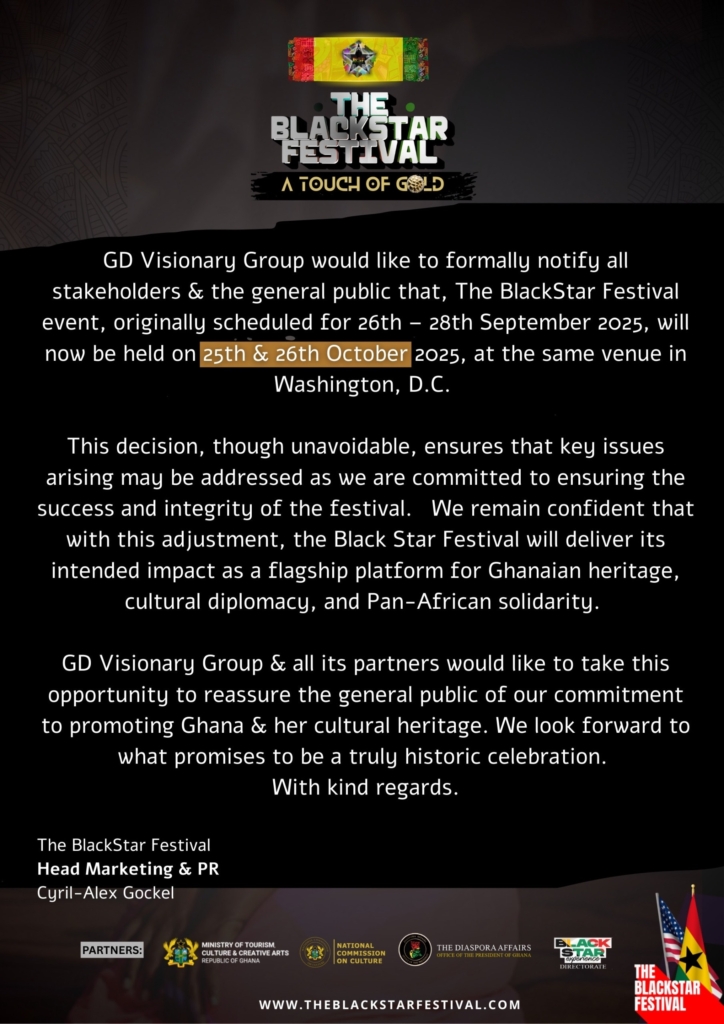
The organisers of the Black Star Festival have announced new dates for the event, shifting it from September to October 2025.
GD Visionary Group said the festival, originally scheduled for 26th to 28th September, will now be held on 25th and 26th October at the same venue in Washington D.C.
In a statement, the group explained that the postponement was necessary to address important matters that had arisen. It assured the public that the adjustment would allow the festival to meet its high standards of excellence and integrity.
According to the organisers, the new dates position the Black Star Festival to deliver its intended impact as a flagship platform for Ghanaian heritage, cultural diplomacy and Pan-African solidarity.
They also reaffirmed their commitment to promoting Ghana’s rich cultural identity and said preparations were underway to make the festival an unforgettable experience.
DISCLAIMER: The Views, Comments, Opinions, Contributions and Statements made by Readers and Contributors on this platform do not necessarily represent the views or policy of Multimedia Group Limited.
DISCLAIMER: The Views, Comments, Opinions, Contributions and Statements made by Readers and Contributors on this platform do not necessarily represent the views or policy of Multimedia Group Limited.
play videoKwaku Dawuro presents the morning political show on Movement TV
Kwaku Dawuro presents The Morning Political Show on the Wontumi morning show.
Seated with his guests, they discussed some of the most topical political subjects of the week.
Together with his guests, they provided in-depth analysis of political stories making headlines today.
With its blend of expert analysis and engaging discussions, the programme, hosted in the widely spoken local dialect, Twi, brings together well-experienced guests and professionals to share their perspectives on the nation’s most pertinent political and social matters.
When Ghanaian entrepreneur Richard Nii Armah Quaye founded Bills Micro Credit at the age of 24, he wasn’t trying to build a multi-million-cedi empire, he was simply responding to a need in his community. Now at 40, he says he’s investing in the nation.
“When I started Bills, I was just 24 years old, right after school,” he tells BET. “I didn’t even work after school. I just entered into the business world right away,” he recalls. “It was never the case that I thought from the beginning that Bills was going to be such a big company today, employing thousands of young people, but as I moved forward, I began to see things much clearer.”
That clarity would lead to the creation of RNAQ Holdings, the umbrella company for Bills Micro Credit and Quick Angels Limited, a venture capital firm. Collectively, Quaye’s companies have disbursed more than 1.7 billion cedis (roughly $135 million), supported over 300,000 clients, and created more than 4,000 jobs across West and East Africa. His approach to business is both ambitious and deeply personal.
“I came from one of the most deprived communities in our country,” he says. “If we run away with our talent, then we are not only letting ourselves down, we are letting everybody in our country down.”
Quaye’s entrepreneurial journey began modestly. After returning to Ghana from studying accounting and finance in the UK, he noticed neighbors coming to his door for small loans. “They were asking me to support them with small cash—$100, $200—and I saw an opportunity there,” he says. “[I thought],why don’t I set up a company that will be in the business of giving credit to these people?” He launched Quick Credit, lending out the little money he had on hand, one loan at a time.
Fifteen years later, what began as a one-man operation has grown into a financial ecosystem that not only provides credit to small business owners but also invests in promising Ghanaian entrepreneurs through Quick Angels Limited. The impact is tangible—businesses have expanded, jobs have been created, and entire communities have benefited.
But Quaye’s vision extends beyond profit. His Food Bank initiative, which I had the opportunity to visit during my reporting trip to Ghana, feeds hundreds of people each day—free of charge—while supporting local food vendors.
“Food was a luxury when I was growing up,” he says. “I have been having a crisis of my conscience because I have almost everything any human being could want, and I watch other people in my country struggling to even have one square meal.”
For Quaye, the Food Bank is about more than charity—it’s a strategy to reduce hunger-related crime and restore dignity. “We need to be each other’s keeper,” he said. “If you are in the position to help, you must help. Sometimes when people are hungry, they commit petty crimes, and before you realize it, they may have committed a crime that will affect you or somebody close to you.
The Case for Investing in Ghana
Ghana has become one of the most attractive destinations for African diaspora investment, and Quaye is adamant that now is the time for Black Americans to take part.
“Everywhere that you have an abundance of problems, you have an abundance of opportunities because business is about solving societal problems,” he explained. “The market is green and ready, and there are a lot of opportunities here. If I have been able to do it and done it as a young person, everybody can also come do the same and even do way more than I have done.
The Ghanaian government has made it easier for foreigners, particularly African Americans, to invest by reducing capital requirements and promoting policies like the “Year of Return” in 2019 and “Beyond the Return,” a 10-year-long initiative. Quaye sees this as a call to action. “If we care about the youth of Africa, then it’s not about donations or charity,” he said. “We should come and invest here and create businesses and jobs.”
Building Bridges for the Diaspora
While Quaye is investing in the business ecosystem, Atlanta native and Kumasi-based community builder Nzingha Samuel-Owusu is investing in infrastructure—social, cultural, and literal—for the diaspora. She is a serial social entrepreneur who has founded an ecosystem dedicated to intentional living development that aims to make repatriation sustainable for Black Americans.
“We’re bringing leaders of industry from the U.S. to Ghana, seeing what tools they need to properly establish themselves there, and how we can lessen the barriers of entry so that they can reestablish their business lines and still earn money,” she tells BET.
Nzingha also works to correct misconceptions about Ghana.
“The first myth is that everything is super cheap, and then people over-negotiate to the point where it becomes disrespectful,” she says. Another challenge: visitors who want the “Detty December” party experience but skip meaningful engagement with the culture. “I wish they could add a little bit more and make it a comma, not a period. Yes, party—and volunteer, invest, build relationships.”
Her next major undertaking is to purchase acres of land in Kumasi and build a community designed with “green zone” principles—health access, natural food systems, and cultural education—that offer diaspora families a more grounded, holistic life. “For African Americans, it is much more of a spiritual journey and choice than a financial one,” she said. “Your nervous system calms down, you breathe differently, and you connect at a different level.”
A Shared Vision for the Future
Both Quaye and Samuel-Owusu believe that business must serve as a tool for nation-building. For Quaye, that means continuing to invest in small business owners and committing 90% of his future wealth to his foundation. “When you invest in one Ghanaian and we create a business, that business will end up employing thousands of people,” he said. “When you invest in an individual, you are investing in the entire nation.”
Samuel-Owusu is focused on preparing the ground—literally—for the next wave of African American repatriates.
“We are now activating,” she said. “We’re bringing brilliant leaders of industry over there to see what they need to establish their roots in Ghana without having to split their time.”
Together, their efforts demonstrate that Ghana’s business ecosystem is evolving into something more ambitious: a blueprint for economic empowerment, cultural restoration, and freedom that transcends borders.
Asante Kotoko have announced their 23-man travelling squad for the crucial CAF Confederation Cup second leg clash against Kwara United in Abuja on Sunday, September 28.
Head coach Karim Zito has opted for a blend of experience and youth, with goalkeepers Aziz Haruna Dari and Mohammed Gamara making the cut.
The defensive unit is packed with options including Lord Amoah, Musa Hamzata, Joseph Amoah, Patrick Asiedu, Zackaria Fuseini, Ansu Henry, Samba O’Neil, and Joseph Ablorh, who will be tasked with providing solidity at the back.
In midfield, the Porcupine Warriors boast depth with Seth Kwadwo, Lord Hillary Adabo, Gyau Hubert, Antwi Emmanuel, Fuseini Walid Neymar, Amoh Philip, Listowel H. Hinne, and Amidu Peter all named. Their creativity and balance will be crucial against the Nigerians.
Up front, Donzo Morifing and in-form striker Albert Amoah—who scored twice in the first leg—will lead the attack as Kotoko aim to protect their 4-3 aggregate advantage from the Accra Sports Stadium.
The Reds face a tough test in Abuja, with Kwara United determined to overturn the deficit, but the squad selected shows Kotoko’s intent to fight for progression to the next stage of the competition.
play videoSarkodie (L) has said he and Shatta Wale (R) usually clash over the execution of their goals
Rapper Sarkodie has opened up on his complicated relationship with Shatta Wale, stating that their bond is rooted in a shared dream for the music industry, but their frequent clashes stem from how differently they choose to pursue it.
In a conversation with media personality NYDJ, Sarkodie explained that both he and Shatta Wale are driven by the same core ambitions: financial success and, above all, the growth of Ghana’s music industry.
The kind of money in music can rival real estate – Sarkodie
However, their disagreements arise from different methods of execution.
According to Sarkodie, Shatta Wale often disagrees with his approach, and vice versa.
He further described their bond as “beautiful and interesting,” shaped by years of misunderstanding but also by a realisation that their differences come down to execution rather than intent.
Sarkodie breaks silence on alleged NPP affiliation
“So myself and Shatta, we have a beautiful, interesting relationship. And it took us time to all understand that, we have different ideologies. But one thing that stands out is me and Shatta almost want the same thing every time. Shatta likes money a lot and so do I. We want the success of the industry. Yes, same thing. Free spirit, same with me. That’s how I am as a person. But we bump heads sometimes because of his execution.
“And same thing, my execution, he doesn’t like it. And you have a lot of people, I just feel like it’s human nature. People are born naturally different. As much as somebody is doing their things someway and because you wouldn’t do that, you think the person is wrong. That’s been our biggest problem over the years,” he stated.
He added, “But when you speak to people, you realize you guys all love the same thing, just that the routes to the place is where it’s a bit different. So we got to a point like, listen, my brother, you know, and I know the way you feel about me and how I feel about you. So we cannot let maybe if we don’t understand something that would be an issue. And Shatta gets these things like, and he knows who he really wants to rock with.”
JICA don cancel one exchange programme wit Nigeria and three oda African kontris
Japan International Cooperation Agency (Jica) don cancel one exchange programme wit African kontris, ova wetin dem cite as “misunderstandings and confusion” ova di programme.
Jica on Thursday, 25 September, tok say dem go scrap di “Jica Africa Hometown” initiative, wey dem design to foster cultural and social exchanges between four African kontris and Japan, afta tori begin spread say e go open di door to migrants.
Jica for statement on dia website wey dem take announce di withdrawal, tok say dem believe say na di term “hometown plus di fact say dem go designate Japanese local govments as hometowns lead to di misunderstanding and confusion within Japan”.
Wetin be Jica Africa Hometown Initiative
Na during di 9th Tokyo International Conference on African Development (TICAD 9) for August, JICA tok say dem bin announce di “JICA Africa Hometown” initiative.
Di aim of di initiative na to designate four municipalities for Japan as “JICA Africa Hometown” for four African kontris respectively, wit di goal of promoting exchanges between dem through various exchange programs.
Originally, under dis initiative, dem reason say dem go coordinate and implement exchange programs among di Japanese local govments, relevant African kontris, and JICA. Di agency add say dem go give more details later.
Di Nigeria Ministry of Information and National Orientation bin announce di informate on dia X handle on Friday 22 August. According to di statement wey bin cause confusion, dem say dis na efforts to deepen cultural diplomacy, promote economic growth and enhance workforce productivity
Dem bin say di Japanese govment go create special visa category for highly skilled, innovative, and talented young Nigerians wey wan go Kisarazu to live and work.
However, days later, di Japanese govment bin clear am say while di purpose of JICA Africa Hometown initiative na to promote cultural and developmental exchanges between selected African kontris and four Japanese cities, e no involve immigration benefits or special visas.
Di Japanese cities plus dia respective partner African nations na: Kisarazu for Chiba paired wit Nigeria; Nagai for Yamagata dey paired wit Tanzania; Sanjo for Niigata dey paired wit Ghana; and Imabari for Ehime dey paired wit Mozambique.
Why Japan scrap am?
Jica say di announcement don cause serious confusion for di kontri and e don place too much burden on di four municipalities.
E spark false claims for social media say African migrants go flood di participating cities wey include Kisarazu, Sanjo, Imabari, and Nagai. But di agency don clear am say di initiative no get plans to promote immigration.
“JICA take dis situation seriously. Afta consulting wit all parties involved, JICA don decide to withdraw di “JICA Africa Hometown” initiative,” di agency tok for di statement.
Di agency say dem go continue to support efforts to promote international exchanges despite di withdrawal of di initiative.
Diana Asamoah Ties the Knot in a Colourful Ceremony
News Hub Creator29min
Gospel musician and actress Diana Asamoah has once again captured public attention, this time with her surprise wedding. The celebrated entertainer walked down the aisle in a vibrant and colourful ceremony, leaving fans both stunned and excited. What makes the news even more intriguing is that the marriage comes after earlier speculations linking her to Opoku Bilson, popularly referred to as her “sugar boy.” Instead, Diana chose a different man, proving that love stories often take unexpected turns.
The wedding was nothing short of glamorous, with family, friends, and industry colleagues in attendance. Videos from the ceremony show Diana adorned in elegant attire, radiating joy as she exchanged vows with her new husband. The event was filled with music, dancing, and heartfelt moments that reflected her personality and strong faith. For many of her fans, it was a refreshing reminder that love can blossom in surprising ways.
Reactions on social media have been buzzing since the announcement. While some expressed shock at her decision to marry someone other than Opoku Bilson, others congratulated her for following her heart. Many fans praised her for keeping her personal life private until the big reveal, noting that the secrecy added to the excitement and glamour of the occasion.
This wedding marks a new chapter in Diana Asamoah’s life, both personally and publicly. As she embraces this fresh journey, her fans continue to shower her with love and best wishes. What did you think of this post? Kindly leave your feedback in the comments section below, and don’t forget to like, share, comment, and follow for more updates.
Bekwai (Ash), Sept. 26, GNA – Mr. Ralph Opoku Adusei, Member of Parliament (MP) for Bekwai, has pledged to ensure every child in the constituency benefits from the Free SHS programme.
He made the pledge at a ceremony where he presented school items to 100 prospective SHS students in the area.
The donation, which included 100 chop boxes, 100 student mattresses, and 100 trunks, was to support parents who struggle to meet the basic requirements of their wards admitted to SHS institutions.
Mr. Opoku Adusei said the intervention was meant to ease the financial burden on parents while motivating students to take advantage of the opportunity provided by the Free SHS policy.
Mrs. Leticia Obeng, Bekwai Municipal Director of Education, commended the MP for the support and urged parents to work closely with teachers to enhance quality education delivery.
Beneficiary parents and students expressed gratitude for the gesture, noting that it would inspire the students to study hard and excel in school.
SIX PEOPLE were injured and four others arrested following an alleged assault by officers from the Kokrobite District Police Headquarters on taxi drivers during a funeral wake-keeping.
The incident took place at the Kokrobite Goil Filling Station, where drivers were directing a hearse carrying the body of a colleague’s wife in an effort to ease traffic on the Kokrobite road.
According to reports, the police accused the taxi drivers of blocking the road with their vehicles, leading to a confrontation.
At least six individuals, including one passenger, sustained injuries during the altercation, while four drivers—among them the chairman of the Kokrobite Drivers Association—were taken into custody.
Some of the injured drivers expressed confusion over the officers’ actions, stating they were merely trying to manage traffic for the hearse. They alleged that police officers attacked them with sticks without provocation.
The drivers further claimed this was not an isolated incident, asserting that officers from the Kokrobite District Command have a history of assaulting them.
They noted that both drivers and commercial motorcyclists (Okada) often face harassment when they refuse to pay bribes to the officers.
In light of these events, the drivers are calling on the Inspector General of Police and the Minister for the Interior to take immediate action against the officers involved and their commander.
They warned that failure to address their concerns would compel them to “advise” themselves.
Meanwhile, reports indicate that the district station officer and his team also assaulted and drove away journalists who attempted to gather their side of the story.
–After vowing to Akufo-Addo to abandon presidential race
Former Vice President and 2024 Presidential candidate of the New Patriotic Party (NPP), Dr Mahamudu Bawumia, has refuted allegations that his Muslim identity or ethnic background, contributed to the party’s electoral loss, dismissing such claims as mere propaganda disconnected from factual analyses.
The Greater Accra Regional Hospital (GARH) has started free prostate cancer clinical screening sessions for men to promote early detection, as part of activities marking Prostate Cancer Awareness Month.
The screening exercise, which was held on Friday, September 19, will also continue on Monday, September 29, 2025, at the hospital’s Outpatients Department.
In an interview with the media, Dr. Leslie Issa Adam-Zakaria, Acting Medical Director of the Greater Accra Regional Hospital, said given the increasing cases recorded, there was the need for the hospital to continuously create awareness about the disease.
“The challenge we face is that many of our patients are diagnosed too late when the disease has already spread beyond the prostate gland. At that point, it can no longer be cured, only managed. The goal is to detect the disease early through regular screening, when it can be treated effectively and cured,” he explained.
He reiterated the importance of dedicating September to prostate cancer awareness, saying it is an opportunity to encourage more men to get screened while ensuring that those affected are cured on time.
Dr. Adam-Zakaria, however, indicated that despite commitment by staff, the hospital lacks significant infrastructure and equipment that affect service delivery, pointing to essential diagnostic tools that are currently non-functional.
He added that the lack of functioning equipment forces patients to rely on expensive private facilities for diagnostic services, increasing both their financial burden and the pressure on the public healthcare system.
Dr. Foli Ashiagbor, urologist at the Greater Accra Regional Hospital, also emphasised that prostate cancer is among the most common cancers affecting men between the ages of 50 and 74, with approximately seventy percent of them diagnosed with prostate cancer.
He also raised concerns about late presentation, noting that preliminary data from the hospital indicates that sixty percent to seventy percent of prostate cancer patients are diagnosed at advanced stages and, therefore, urged people to report for early screening.
Following the burial of the late Asantehemaa, Nana Konadu Yiadom III, on Thursday, September 18, 2025, the Asantehene, Otumfuo Osei Tutu II, is expected to choose her successor within two weeks.
In line with Asanteman traditions, the selection of the next Asantehemaa, would require the involvement of the paramount queen mother of Kokofu (Kokofuhemaa), and the Kenyasihemaa.
The two notable queen mothers play an important role in the selection of the next queen mother of the Ashanti Kingdom.
Fourteen (14) gallant women have occupied the stool of the Asantehemaa, a position that places them in a position that allows them to actively participate in the selection of the King of Asanteman, the Asantehene.
In fact, the Asantehene and the Asantehemaa are the custodians of the Golden Stool, although the former is the occupant of the stool.
Past queen mothers have historically assisted 16 great kings to rule the kingdom in their capacity as chief advisers; with some serving more than two kings.
However, this time around, it appears a new record would be set after the Asantehene successfully installs a new Asantehemaa.
A sculptures of the 16 kings of the Asante Kingdom
As the numbers suggest, some queen mothers have served more than two kings of Asanteman.
Similarly, history indicates that some kings have also served with more than two Asantehemaa as custodians of the Golden Stool.
However, the installation of a new Asantehemaa this year would break a record in the Asante Kingdom.
Historical records show that only two kings have had three queen mothers.
So, if the new Asantehemaa is successfully installed, the current Asantehene, Otumfuo Osei Tutu II, would be breaking this record.
From Kusi Amoa to Konadu Yiadom III: List of all Asantehemaas since the creation of the Asante Kingdom
Below is a history of Asante Kings and the Queen Mothers they served with:
1. Opemsuo Osei Tutu I (1670 to 1717):
Otumfuo Nana Osei Tutu, who was born Osei Kofi and is regarded as the founder of the Asante Empire, was the leader of Asanteman from 1670 to 1717.
His queen mother was Nana Nyaako Kusi Amoa. Nana Nyaako Kusi Amoa was the first queen mother of Asanteman.
She was queen mother in the 17th and 18th centuries and likely ruled from either 1695 or 1701 to 1722.
2. Nana Opoku Ware I (1720 to 1750):
Nana Opoku Ware I, the second King of the Asante Kingdom, reigned from 1720 to 1750.
His first queen mother was Nana Nyaako Kusi Amoa. His second queen mother was Nana Nketia Ntim Abamo, the second Asantehemaa, who was made queen mother in 1722 following the death of Kusi Amoa.
She reigned for 18 years, from 1722 to 1740.
3. Nana Kusi Obodum (1750 to 1764):
Nana Kusi Obodum was Asantehene from 1750 to 1764.
According to historical records, he was forced to abdicate.
His queen mother was Nana Nketia Ntim Abamo.
Inside the Four-Day Dote Yie: Highlights of Asantehemaa Nana Konadu Yiadom III’s funeral
4. Otumfuo Nana Osei Kwadwo Okoawia (1764 to 1777):
Otumfuo Nana Osei Kwadwo Okoawia was Asantehene from 1764 to 1777.
Nana Nketia Ntim Abamo also served as his first queen mother. His second queen mother was Nana Konadu Yaadom, who was Asantehemaa from 1768 to 1809, reigning for 41 years.
5. Nana Osei Kwame Panyin (1777 to 1803):
Nana Osei Kwame Panyin reigned as the king of Asanteman from 1777 to 1803. His queen mother was Nana Konadu Yaadom.
6. Nana Opoku Fofie (1803 to 1804):
Nana Opoku Fofie became the Asantehene in 1803 and reigned until 1804. His queen mother was also Nana Konadu Yaadom.
7. Otumfuo Nana Osei Bonsu (1804 to 1824):
Otumfuo Nana Osei Bonsu took over from Opoku Fofie and was king of Asanteman from 1804 to 1824.
His first queen mother was Nana Konadu Yaadom. His second Asantehemaa was Nana Adoma Akosua, who reigned for 10 years, from 1809 to 1819.
Otumfuo Nana Osei Bonsu is the first king of Asanteman to have had three queen mothers, the third being Nana Ama Serwaa I, who was Asantehemaa for nine years, from 1819 to 1828.
8. Nana Osei Yaw Akoto (1824 to 1834):
Nana Osei Yaw Akoto was the 8th Asantehene and ruled from 1824 to 1834. His first queen mother was Nana Ama Serwaa I.
His second queen mother was Nana Yaa Dufie, who reigned for eight years, from 1828 to 1836.
9. Nana Kwaku Duah I (1834 to 1867):
Nana Kwaku Duah I reigned from 1834 to 1867 as the 9th king of Asanteman. His first queen mother was Nana Yaa Dufie.
Nana Afia Sarpong took over as Asantehemaa from Nana Yaa Dufie in 1836, under Nana Duah I, and ruled for 21 years, from 1836 to 1857.
Asantehene Duah I also had a third queen mother, Asantehemaa Nana Afia Kobi I, who reigned for 26 years, from 1857 to 1883.
10. Otumfuo Nana Kofi Karikari (1867 to 1874):
Otumfuo Nana Kofi Karikari was the 10th Asantehene and ruled from 1867 to 1874 with Asantehemaa Nana Afia Kobi I as his only queen mother.
11. Nana Mensah Bonsu (1874 to 1883):
The 11th Asantehene, Nana Mensah Bonsu, ruled from 1874 to 1883, when he was forced to abdicate. He also had Asantehemaa Nana Afia Kobi I as his queen mother.
His second queen mother was Nana Yaa Akyaa, who ruled for 34 years, from 1883 to 1917.
12. Nana Kwaku Duah II (1884):
Nana Kwaku Duah II was the 12th Asantehene in 1884. He died after a short illness.
His queen mother was Nana Yaa Akyaa.
13. Otumfuo Nana Prempeh I (1888 to 1931):
Otumfuo Nana Prempeh I became Asantehene after the Asante Civil War in 1888 and ruled from 1888 to 1931.
He had Nana Yaa Akyaa as his first queen mother, followed by Asantehemaa Konadu Yiadom II, who reigned for 28 years, from 1917 to 1945.
14. Nana Osei Tutu Agyeman Prempeh II (1931 to 1970):
Nana Osei Tutu Agyeman Prempeh II, the 14th king of Asanteman, reigned from 1931 to 1970.
His first Asantehemaa was Konadu Yiadom II, followed by Nana Ama Serwaa Nyaako, who was queen mother of Asanteman for 32 years, from 1945 to 1977.
15. Otumfuo Opoku Ware II (1970 to 1999):
Otumfuo Opoku Ware II, the 15th Asante king, took over from Prempeh II and was Asantehene from 1970 to 1999.
Ama Serwaa Nyaako was his first Asantehemaa. His second Asantehemaa was Nana Afia Kobi Serwaa Ampem II, who reigned from 1977 to 2016, a total of 39 years.
16. Otumfuo Osei Tutu II:
The current Asantehene, Otumfuo Osei Tutu II, who was born Nana Kwaku Duah, took over from Opoku Ware II in 1999.
The first Asantehemaa to serve with him was Nana Afia Kobi Serwaa Ampem II.
Nana Konadu Yiadom III succeeded her as Asantehemaa under the current Asantehene and ruled for nine years.
After the installation of the new Asantehemaa, which is expected soon, the Asantehene becomes the third king of Asanteman to have served with three queen mothers.
BAI/VPO
Martin Amidu breaks silence on removal of Gertrude Torkornoo
play videoKwaku Dawuro presents the morning political show on Movement TV
Kwaku Dawuro presents The Morning Political Show on the Wontumi morning show.
Seated with his guests, they discussed some of the most topical political subjects of the week.
Together with his guests, they provided in-depth analysis of political stories making headlines today.
With its blend of expert analysis and engaging discussions, the programme, hosted in the widely spoken local dialect, Twi, brings together well-experienced guests and professionals to share their perspectives on the nation’s most pertinent political and social matters.
In a landmark move that promises travel between the nations, Ghana and Antigua and Barbuda have signed a visa waiver agreement. The waiver agreement, effective immediately, will allow citizens to travel freely between Ghana and Antigua and Barbuda.
Improving Travel Accessibility Between Ghana and Antigua and Barbuda
The new visa waiver agreement opens the door for even more Ghanaians to explore the Caribbean island, fostering cultural exchange and increasing tourism revenue. Likewise, Antiguans and Barbudans will now have a smoother path to visit Ghana, renowned for its historical sites, vibrant culture, and growing business opportunities.
Tourists will benefit from the waiver, as they no longer need to go through the lengthy visa application process. This reduces barriers to entry, promoting both leisure and business travel. It’s expected that the tourism sectors in both nations will see a substantial uptick, as people take advantage of the new ease of travel. For travelers from both countries, this agreement is a step toward simplifying their journey and making travel more accessible.
Enhanced Diplomatic Relations and Economic Opportunities
The agreement not only facilitates tourism but also has strong economic implications. Ghana, known for its diverse industries, including mining, agriculture, and technology, stands to benefit from increased business exchanges with Antigua and Barbuda. On the other hand, Antigua and Barbuda, a popular tourist destination, could see an influx of tourists from Ghana’s growing middle class and its broader African diaspora. Additionally, the agreement is seen as an opportunity to foster better diplomatic relations between the two nations, enhancing collaboration in various sectors, such as education, trade, and technology.
A Step Toward Regional Integration
The Ghana-Antigua and Barbuda visa waiver is part of a broader initiative aimed at enhancing regional integration in Africa and the Caribbean. This agreement reflects the ongoing effort to remove visa barriers between African and Caribbean nations, ultimately creating a more connected global community. For citizens of both nations, the visa waiver offers more than just convenience. It symbolizes a growing Caribbean, with each region contributing to the other’s prosperity. As travel between these two regions continues to evolve, it’s clear that this agreement represents a step forward in the long-term goal of creating a more integrated and open world.
Looking Ahead: What This Means for Future Travel
The Ghana-Antigua and Barbuda visa waiver agreement is just one of many potential collaborations that could emerge as both countries continue to prioritize international connectivity. The success of this initiative may prompt other nations within Africa and the Caribbean to consider similar measures, further increasing the flow of people, ideas, and investment.
With the travel landscape changing rapidly, Ghana and Antigua and Barbuda have shown leadership in promoting open, easy access between their nations. This agreement is not only a boost for travelers but a clear indication of how international partnerships can contribute to mutual growth. For tourists, businesses, and governments alike, this visa waiver marks the beginning of new opportunities and a brighter, more connected future.
A Brighter Future for Travelers
For travelers seeking new destinations and opportunities for cultural exchange, the visa waiver between Ghana and Antigua and Barbuda offers a new world of possibilities. With less paperwork and more freedom, this agreement sets a positive precedent for other countries looking to simplify travel and build stronger international relationships. The future of travel between Ghana and Antigua and Barbuda is now wide open, and this visa waiver is just the beginning of a promising journey ahead.
Nkruma Wura Food Hub, a newly opened eatery at Kwabenya in the Greater Accra Region, is calling on local food lovers to visit the premises for various traditional dishes.
With the increasing sales of junk foods in the capital, Nkruma Wura Food Hub seeks to serve dishes like okro soup, palava sauce, waakye, jollof rice among other dishes using fresh, locally-sourced ingredients to promote healthy foods.
Chief Executive Officer (CEO) of Nkruma Wura Food Hub, Yayra Agbeehia, in an interview stated that the eatery is poised to create a welcoming atmosphere where customers enjoy exceptional, high-quality food crafted with passion and care.
“We are committed to using fresh, locally-sourced ingredients to promote healthy foods. Our goal is to deliver outstanding service, ensuring every visit is memorable and satisfying. Nkruma Wura Food Hub aspires to become a cherished favourite for all who dine with us,” she stated.
She added that her curated dishes provide essential nutrients like vitamins, minerals, proteins, and fibers necessary for bodily functions, growth, and maintenance of good health.
Ms. Yayra called on the public to visit her eatery for the best of services, emphasising that her meals are prepared and handled safely to prevent foodborne illnesses.
Asante Kotoko have announced their 23-man travelling squad for the crucial CAF Confederation Cup second leg clash against Kwara United in Abuja on Sunday, September 28.
Head coach Karim Zito has opted for a blend of experience and youth, with goalkeepers Aziz Haruna Dari and Mohammed Gamara making the cut.
The defensive unit is packed with options including Lord Amoah, Musa Hamzata, Joseph Amoah, Patrick Asiedu, Zackaria Fuseini, Ansu Henry, Samba O’Neil, and Joseph Ablorh, who will be tasked with providing solidity at the back.
In midfield, the Porcupine Warriors boast depth with Seth Kwadwo, Lord Hillary Adabo, Gyau Hubert, Antwi Emmanuel, Fuseini Walid Neymar, Amoh Philip, Listowel H. Hinne, and Amidu Peter all named. Their creativity and balance will be crucial against the Nigerians.
Up front, Donzo Morifing and in-form striker Albert Amoah—who scored twice in the first leg—will lead the attack as Kotoko aim to protect their 4-3 aggregate advantage from the Accra Sports Stadium.
The Reds face a tough test in Abuja, with Kwara United determined to overturn the deficit, but the squad selected shows Kotoko’s intent to fight for progression to the next stage of the competition.