0.3 C
London
Wednesday, December 31, 2025
Home Blog Page 5

Bank of Ghana Releases Official Exchange Rates for Tuesday, December 30, 2025

0

Bank of Ghana Releases Official Exchange Rates for Tuesday, December 30, 2025

News Hub Creator16h

The Bank of Ghana has released its official daily exchange rates for Tuesday, December 30, 2025, providing an update on the performance of the cedi against major international currencies.

According to the figures published by the central bank, the US dollar is being bought at ¢10.6447 and sold at ¢10.6553. This reflects the average interbank rates used by commercial banks at the close of business on Monday, December 29, 2025.

The British pound sterling is trading at a buying rate of ¢14.3682, while the selling rate stands at ¢14.3847. Meanwhile, the euro is being bought at ¢12.5388 and sold at ¢12.5510.

The Bank of Ghana explained that these rates represent the average interbank exchange rates applied by commercial banks and are intended to serve as a reference point for the foreign exchange market. Actual rates offered to customers may vary slightly depending on individual banks and prevailing market conditions.

The latest exchange rate update comes amid continued public interest in the stability of the cedi, particularly as businesses, importers, and travelers closely monitor currency movements during the end-of-year period.

The central bank has repeatedly assured the public of its commitment to maintaining currency stability through prudent monetary policies and effective regulation of the foreign exchange market. The Bank of Ghana also encourages the public to rely on official sources for accurate exchange rate information and to be cautious of unverified rates circulating on social media.

The exchange rate information was published on the Bank of Ghana’s official platforms, including its website and verified social media handles, as part of its routine communication to keep the public informed about developments in the foreign exchange market.

Source

Turning LNG Oversupply into Opportunity: Why Africa’s Gas Future Depends on Infrastructure – African Energy Week Cape Town

0

Global LNG supply is set to surge from 2027, driven by new projects and expanded production in the U.S. and Qatar. Bloomberg’s Global LNG Market Outlook 2030 forecasts global supply reaching 594 million tons by 2030 – a 42% increase from 2024 – with a projected 15-million-ton oversupply in international markets. While geopolitical risks and potential project delays could shift this balance, the prospect of sustained LNG surplus poses a critical question for Africa: how can the continent strengthen domestic gas value chains to shield itself from global market volatility?

Rising African Demand Constrained by Infrastructure

Africa’s natural gas production is rising, with several new LNG projects coming online across the continent. North Africa currently produces two-thirds of the continent’s gas, but the African Energy Chamber’s (AEC) State of African Energy 2026 Outlook projects this share falling to 40% by 2035 as sub-Saharan output accelerates. By 2050, sub-Saharan LNG supply could quadruple, while African gas demand is expected to grow 60%, from 55 billion cubic meters (bcm) in 2020 to 90 bcm.

Despite this growing demand, most gas continues to be exported. The primary bottleneck is infrastructure: limited pipeline networks, underdeveloped transmission systems and insufficient processing and storage prevent gas from reaching domestic markets. As a result, LNG exports remain the most viable monetization route, backed by international offtake contracts and financing structures. Financing constraints further exacerbate the challenge, as domestic infrastructure projects require patient capital, government support and credit enhancements, which are often easier to secure for export-focused LNG developments. Addressing this imbalance will demand an infrastructure-led strategy that aligns production with domestic pipelines, power generation and regional interconnections.

New Projects Signal Momentum

Recent developments suggest positive momentum toward a more integrated African gas economy. In the LNG sector, countries are constructing terminals to support domestic and regional access, including projects at Richards Bay in South Africa and the Port of Nador in Morocco. Earlier this month, Ethiopia signed a landmark agreement to advance the Gas-by-Rail Economic Corridor Initiative, a 75,000-km freight railway system designed to carry LNG to more than 40 sub-Saharan nations, providing direct pathways to high-demand markets.

Cross-border and power generation infrastructure is also expanding. Several major pipeline projects are underway, including the $25 billion Nigeria-Morocco Gas Pipeline traversing 13 West African states, the Trans-Saharan Gas Pipeline connecting Nigeria to Algeria, and the $1.5 billion Mozambique-Zambia pipeline announced in 2025. Senegal is developing a multi-phase gas network linking offshore production to power plants, industrial zones and urban areas, while Ghana plans five multi-purpose petrochemical plants, each producing 90,000 barrels per day of chemicals such as fertilizers and lubricants to support industrial and agricultural sectors.

A continental push toward gas-to-power is increasingly evident, supported by policy reform and efforts to expand electricity access. The AEC outlook projects natural gas supplying 45% of Africa’s power by 2050. Countries including Nigeria, South Africa, Angola, Senegal, Ghana and Mozambique have integrated gas-to-power goals into national strategies, aiming to translate rising gas production into reliable electricity, cleaner cooking solutions, and broad-based economic growth.

“Export projects alone will not secure Africa’s energy future. Strategic investment in gas infrastructure is what will determine whether rising production translates into electricity access, industrial capacity, and economic resilience,” states NJ Ayuk, Executive Chairman, AEC.

With domestic gas demand rising, infrastructure projects underway and export markets becoming increasingly competitive, African Energy Week 2026 offers a strategic forum to reposition gas not merely as an export commodity, but as a foundation for long-term energy security, industrial development and inclusive growth across the continent.

GRA confirms January 1, 2026 start date for new VAT regime

0

The Ghana Revenue Authority (GRA) has confirmed that the effective implementation date of the Value Added Tax Act, 2025 (Act 1151), will be January 1, 2026, giving businesses and taxpayers a period to prepare for sweeping reforms in the country’s VAT regime.

In a public notice to VAT-registered taxpayers and the general public, the Authority said the new law introduces significant changes aimed at simplifying VAT administration, improving efficiency and promoting voluntary tax compliance.

The reforms are expected to reshape how VAT is charged, reported and credited across the economy.

One of the major changes under the new Act is the upward revision of the VAT registration threshold for businesses dealing in goods, which has been increased from GH¢200,000 to GH¢750,000.

This adjustment is expected to ease the compliance burden on smaller enterprises by excluding more micro and small businesses from mandatory VAT registration.

The GRA also announced the abolition of the COVID-19 Health Recovery Levy, removing an additional layer of consumption tax that had been in place since the pandemic.

In addition, the re-coupling of the National Health Insurance Levy (NHIL) and the Ghana Education Trust Fund (GETFund) levies will allow businesses to claim input tax credits.

Under the new VAT framework, the standard VAT rate has been reduced to 20%, a move the Authority says is intended to ease the tax burden on households and businesses.

The VAT Flat Rate Scheme has also been abolished, paving the way for a unified and more transparent VAT structure.

The GRA indicated that the reforms are designed to promote equity in the tax system, enhance administrative efficiency and strengthen compliance among taxpayers.

Employers, accountants, auditors, importers, exporters, clearing agents and tax consultants are being urged to familiarise themselves with the changes ahead of the January 2026 rollout.

The Authority has encouraged taxpayers seeking clarification to engage with its Taxpayer Service Centres or use its toll-free and digital support channels as preparations begin for the implementation of the new VAT Act.

Abuakwa Manhyia Prepares to Lay Fire Victims to Rest on January 8

0

Abuakwa Manhyia Prepares to Lay Fire Victims to Rest on January 8

News Hub Creator11h

The community of Abuakwa Manhyia in the Ashanti Region is bracing for a deeply emotional day as preparations move into their final stages for the burial of six family members who lost their lives in a devastating fire incident. The funeral has been scheduled for January 8, 2026, setting the stage for what locals expect to be one of the most sorrowful gatherings the town has witnessed in recent years.

The tragedy, which unfolded months ago, left an indelible mark on the community. The victims, all from the same household, perished when flames engulfed their residence in the early hours of the morning. The cause of the blaze remains a subject of quiet conversations, with residents still grappling to understand how a regular day turned into a catastrophe that swallowed an entire branch of a family tree.

Relatives have since worked closely with traditional leaders and funeral planners to coordinate a ceremony that both honors the deceased and reflects the scale of the loss. The burial will begin with a procession through the town, with six coffins expected to be carried in a solemn line toward the cemetery. Community members say the sight alone will be enough to break even the strongest hearts.

Support systems have been formed to provide counseling for children and neighbors still dealing with trauma from the incident. Religious leaders have also stepped forward to support the family with pastoral care and to guide the community through collective grieving. Some local philanthropists and civic groups are assisting with funeral expenses to help cushion the financial burden on the bereaved.

For many, January 8 is more than a burial date it is a stark reminder of how fragile life is and how quickly disaster can reshape an entire community’s identity. As Abuakwa Manhyia prepares to gather and mourn, the hope is that closure will not only honor those who died but also give strength to the living.

Source

https://x.com/i/status/2006086283714539567

Ghana Premier League: New boys Hohoe United sign defender Emmanuel Kyeremeh

0

Ghana Premier League club, Hohoe United have once again bolstered their squad with the acquisition of defender Emmanuel Kyeremeh before the transfer window shuts in January.

The new boys captured the experienced centre-back from Togolese outfit, AS GBOHLOE-SU on a long-term deal as they seek to keep their top flight status.

Emmanuel Kyeremeh becomes Hohoe United’s third signing of the current transfer window after Guinean left-back Mohamed Yorobo Bangoura and forward, Lawson Bekui joined the side a month ago.

Bangoura, 29 officially joined the club after spending over a decade in the Guinean top flight playing for clubs like ASM Sangaredi, Satellites FC, Kaloum Stars, Horoya AC, Santoba, CI Kamsar, Teungueth and Milo FC. He agreed a one-year contract with an option to renew at the end 0f the ongoing 2025/26 Ghana Premier League season.

Lawson Bekui, 31, signed for Hohoe United after years away in Europe and the Gulf region. He previously played his domestic football for Dreams fc in the Ghana topflight in 2016.

The second registration window for the 2025/26 season was open on Tuesday, December 16, 2025, and it will close at 11:59 p.m. GMT on Thursday, January 15, 2026.

Hohoe United currently sit 16th on the league table with 17 points from 16 games with a local derby against Heart of Lions to conclude the first half of the Ghana Premier League season.

⚽ Follow Pan-Africa Football across platforms for real-time news and stories.

Gov’t settles settles US$709m Eurobond obligation ahead of schedule

0

The Government has settled a US$709 million Eurobond obligation ahead of schedule, the Ministry of Finance has announced.

The payment was made on Tuesday December 30, 2025, and marks another step in the country’s ongoing economic recovery and debt management efforts.

With this latest settlement, Ghana has paid a total of US$1.4 billion to Eurobond holders in 2025 under the restructuring memorandum. The payments include two tranches of US$349.52 million each, in addition to the US$709 million settled in December.

The Ministry of Finance said the timely payment reinforces Ghana’s credibility as a sovereign borrower and reflects the government’s commitment to restoring investor confidence through transparent, predictable, and disciplined debt servicing.

The government indicated that it will build on this progress by intensifying reforms in domestic revenue mobilisation, public financial management, and public debt management. It also stated that fiscal buffers will continue to be strengthened to support future debt-service obligations and sustainably finance the country’s development agenda.

The government expressed gratitude to Ghanaians for their support and understanding, describing it as vital to the country’s economic recovery. It further appealed for continued cooperation as additional economic reforms are rolled out in the coming year to consolidate gains made in 2025.

The Ministry expressed optimism about the outlook for 2026, describing it as a year of greater opportunity for the country.

‘Mr President, either you go into exile or you are overthrown’

0

The founder of Parliament Chapel International, Prophet Francis Amoako Atta, has predicted that Venezuelan President Nicolás Maduro could face exile or be overthrown if urgent action is not taken.

According to the prophet, he foresaw in a vision that President Maduro’s close allies would betray him early next year, between January and March 2026.

Speaking during a church service on December 26, 2025, he explained that the vision revealed a pending danger confronting the Venezuelan leader, which he said he personally communicated to him in the spiritual realm.

“I saw myself at the airport, specifically at the VIP lounge and I saw the President of Venezuela sitting on the right-hand side in the spiritual realm,” he stated.

Prophet Amoako Atta said he cautioned the president about the looming threat, warning that those currently supporting him would eventually turn against him.

“Write it down what I am saying will happen. What I told him in the spiritual realm was to be very careful, because those who are pushing you today will betray you one day,” he said.

He further indicated that the danger would begin between January 15 and extend through March 2026.

“If care is not taken, it is either you go into exile or you are overthrown,” he warned.

The prophet added that in the vision, President Maduro bowed his head in response to the warning.

“Is it not the same place where I spoke about Trump? Did it not happen?” he questioned.

AM

Also, watch below Amnesty International’s ‘Protect the Protest’ documentary as the world marks International Human Rights Day 2025

Government settles $709m Eurobond obligation ahead of schedule

0

Government has settled a US$709 million Eurobond obligation ahead of the January 3, 2026 schedule.

The Ministry of Finance said the December 30, 2025 early settlement is another milestone under Ghana’s post-restructuring debt strategy.

In a statement, the Ministry said, the payment signals renewed commitment to disciplined, transparent debt servicing as well as reinforces efforts to stabilise public finances and rebuild investor confidence after years of debt distress.

The latest payment brings Ghana’s total Eurobond repayments in 2025 to approximately US$1.4 billion.

This includes two earlier payments of US$349.52 million each, alongside the US$709 million now settled under the terms of the country’s restructuring memorandum.

According to the Ministry, the timely settlement underscores government’s determination to restore Ghana’s credibility as a sovereign borrower and re-engage international capital markets from a position of improved fiscal strength.

Ghana was forced into a comprehensive debt restructuring after mounting debt levels, rising interest costs and global economic shocks severely constrained fiscal space.

Since then, authorities have prioritised meeting restructured obligations as part of a broader macroeconomic recovery programme anchored by fiscal consolidation and structural reforms.

The Finance Ministry said government would build on the momentum from the latest Eurobond payment by deepening reforms in domestic revenue mobilisation, public financial management and debt management.

These measures, it noted, are aimed at strengthening fiscal buffers and ensuring the sustainability of future debt-service commitments while continuing to finance key development priorities.

Government thanked Ghanaians for their resilience and cooperation during the reform period and appealed for continued support as further economic measures are rolled out in 2026 to consolidate gains made this year.

The Ministry expressed optimism that the progress recorded in 2025, particularly in restoring debt credibility, would lay the foundation for stronger and more resilient economic performance in the year ahead.

Coach Abdul Karim Zito heaps praise on Kotoko midfield trio

0

Asante Kotoko SC coach, Abdul Karim Zito heaps praise on star midfielders who were magnificent in their league game against Bechem United FC.

Zito was full of praise for midfield trio Lord Adabo, Seth Kwadwo and Hubert Gyau after they starred in their crucial 6-0 win over Bechem United FC on Sunday. The Ghanaian heavyweight looked to be backed in good form after a 6-0 thrashing of the Hunters, and keeping a clean sheet at home.

Guinean striker Morifing Donzo scored a brace, and captain Samba O’Neil, Kwame Poku, Johnson Oppong, and Hubert Gyau also found themselves on the score sheet.

After the game, head coach Abdul Karim Zito had nothing but praise for his three midfielders, tagging them “brilliant telepathy”.

What did Karim Zito say about Adabo, Seth and Gyau?

Zito commended the trio saying, the chemistry and telepathy is working good, “Go back to watch all the matches we won. This is the first after all coming down, this is the match I got them play together again and look at the goals”

“The telepathy between these three boys, is good and getting them together makes things work. So we will keep on trying, we’re not there yet we keep building till we get things better”.

“Let’s be patient, building a team sometimes take a season depending on what you want”, he stated.

Asante Kotoko SC heavy victory over Bechem United FC sees them set the record of 2025/26 Ghana Premier league biggest win result, and now puts them summit of the league log with 30 points after week 16 fixture.

The Ghana Premier league record holder’s (25), will next face Swedru All Black in week 17 fixture away at the Swedru Stadium on Sunday January 4, 2026.

Rare Photos of Afenyo Markin’s 3 Beautiful Daughters Turn Heads with Long Hair and Stylish Looks

0

  • Ghana’s minority leader, Alexander Kwamina Afenyo‑Markin’s beautiful daughters have turned heads with their classy looks
  • The style influencers have set a new fashion trend as they wore expensive jewellery sets to elevate their looks for their Christmas photoshoot
  • Some social media users have commended Afenyo-Markin’s wife for nurturing such well-mannered children on TikTok

Ghana’s top stories, now easier to find. Discover our new search feature!

Ghanaian politician Alexander Kwamina Afenyo‑Markin and his family have shared adorable family goals during the festive season.

The member of Parliament for Effutu took to social media to share a heartwarming glimpse of his family’s Christmas celebration.

Afenyo-Markin, Afenyo-Markin's wife, Afenyo-Markin's daughters' names, NPP members, Ghanaian politicians
Afenyo-Markin’s three daughters slay for a viral family photoshoot. Photo credit: @afenyo-markin. Source: Instagram

Afenyo-Markin’s 3 daughters flaunt flawless beauty

Minority Leader in Ghana’s Parliament, Afenyo-Markin’s three beautiful daughters have made a rare appearance in a viral family photoshoot.

The celebrity heiress looked gorgeous despite rocking covered-up pyjamas as the world celebrated the birth of Jesus Christ.

Afeny-Markin’s daughters showed off their opulent lifestyle as they wore long, lustrous hairstyles and makeup for the iconic shoot with their parents.

Afenyo-Markin, Afenyo-Markin's wife, Afenyo-Markin's daughters' names, NPP members, Ghanaian politicians
Afenyo-Markin addresses the floor of parliament ahead of the Christmas festivities. Photo credit: @afenyo-markin. Source: Instagram

The rising fashionistas accessorised their look with expensive earrings, bangles and a designer wristwatch as they sat on their dad’s lap to show the

Dianne Afenyo-Markin, while maintaining a private profile, occasionally appears at public events with her husband, admired for nurturing a stable and loving family environment.

In the festive images, the entire family wore matching green Christmas pyjamas, radiating joy, unity, and holiday spirit. Netizens were quick to express their admiration.

Social media buzzed with uplifting comments celebrating the family’s charm and the warmth captured in each shot.

The TikTok photos of Afenyo-Markin’s daughters are below:

Afenyo-Markin’s wife slays in classy outfit

Ghanaian lawyer Afenyo-Markin’s wife has never disappointed with her stylish looks at public events.

She wore a decent short-sleeved, collared dress with front pockets at Celestial Praize 2025.

Afeneyo-Markin made a bold fashion statement in a long-sleeved white shirt and matching trousers at the gospel event.

The TikTok video of Afenyo-Markin’s beautiful wife is below:

Who is Alexander Afenyo-Markin

Born on 27 May 1978 in Winneba, Central Region, Hon. Afenyo‑Markin rose to prominence as a lawyer and politician, representing the New Patriotic Party (NPP) in Parliament.

Afenyo-Markin holds an LLB from the University of Buckingham and an M.A. in International Politics and Security Studies from the University of Bradford.

He has served in leadership roles, including Deputy Majority Leader, Majority Leader, and currently Minority Leader.

Beyond politics, he has chaired the Electricity Company of Ghana (ECG) and holds the traditional title of Osahen of Effutu State, combining public service with cultural leadership. Afenyo‑Markin’s personal life also shines with vibrancy and warmth. He is married to Dianne Markin, his long-time partner, admired for her grace and supportive presence.

The TikTok video of Afenyo-Markin and wife is below:

Afenyo-Markin rocks a Cubavera shirt

Earlier, YEN.com.gh wrote about Kwamina Alexander, the minority leader, Afenyo-Markin, who has won over many with his extensive understanding of style and taste.

After Emmanuel Bedzrah criticised his attire, the MP for the Effutu constituency taught him about men’s fashion.

Afenyo-Markin’s video, which went viral on TikTok, has received comments from several social media users.

Ashanti police intercept 2,600 AK-47 bullets; tactical gear at Asankare Barrier

0

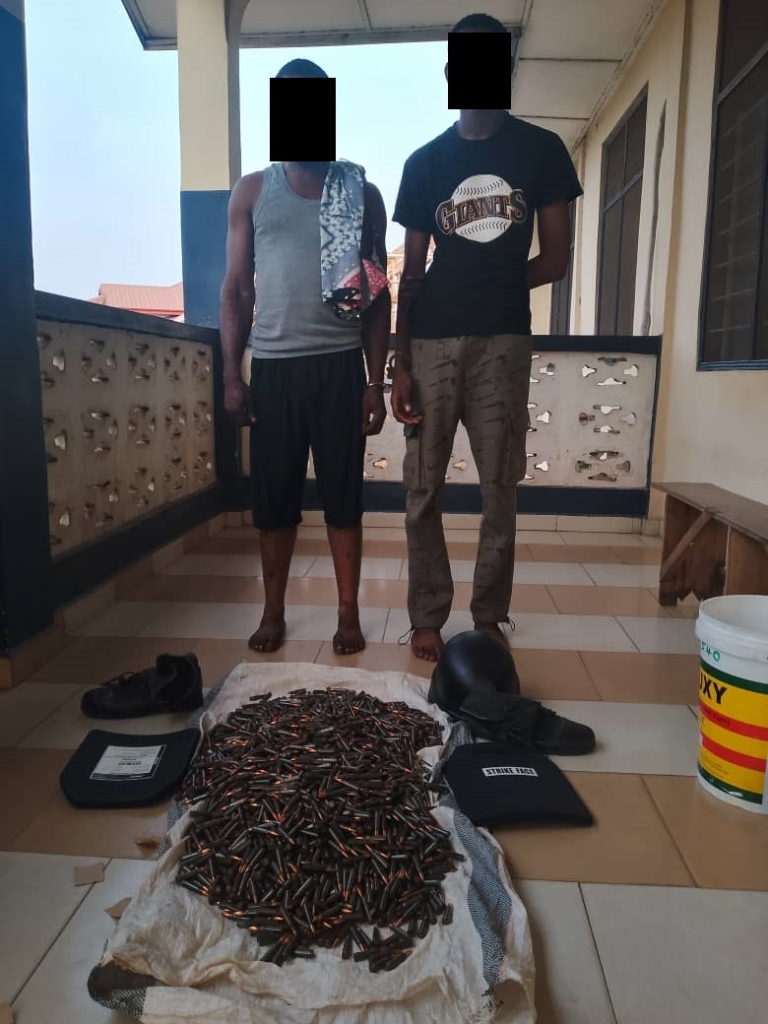
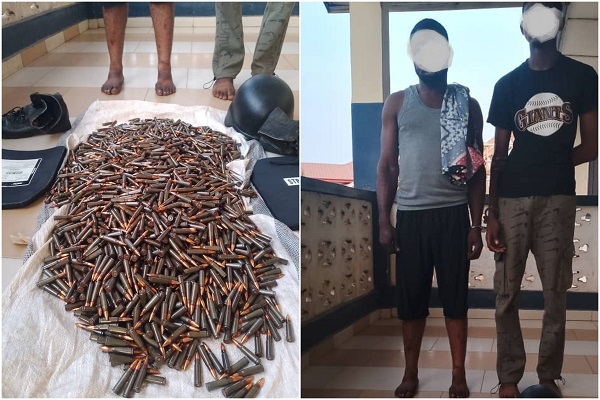
The Ashanti South Regional Police Command has intercepted a massive cache of ammunition and tactical military equipment.

The breakthrough occurred at the strategic Asankare Police Barrier, where eagle-eyed officers halted a potential security threat during a routine stop-and-search operation on Tuesday, December 30.

The illicit cargo was discovered hidden in plastic paint buckets aboard a Kia Granbird commercial bus with registration number GT 5771-18, which was reportedly travelling toward the northern part of the country.

ACP Cephas Arthur, the Deputy Ashanti South Regional Police Commander, provided a detailed inventory of the seized items during a press briefing.

The haul included:

  • 2,600 rounds of live AK-47 ammunition.
  • Two military-grade bulletproof vests.
  • Ballistic helmets.
  • Boots

The volume of ammunition recovered suggests a high-stakes criminal enterprise, and the inclusion of body armour indicates that those behind the shipment were prepared for armed confrontation.

The timing of the seizure is particularly critical as the nation prepares for crossover services and festive gatherings.

ACP Cephas Arthur used the occasion to reassure the public that the police are on high alert to thwart criminal activities during the transition into the New Year.

“He assured police protection on December 31, 2025, and urged Ghanaians to secure their homes against robbers,” the deputy commander noted, emphasising that the police presence would be felt across all major transit routes and residential hubs.

This bust comes at a time of heightened regional concern regarding the transit of small arms and light weapons.

The Asankare Barrier, situated on the main Accra-Kumasi highway, serves as a critical choke point for intercepting contraband moving between the south and the northern sectors of Ghana.

The Regional Command has launched a full-scale investigation to determine the source of the ammunition and the intended recipients.

While the driver and passengers are being interrogated, the police have hinted that more arrests may be imminent as they work to dismantle the supply chain.

As millions of Ghanaians head to various church services and parties to usher in the new year, the Ashanti South Regional Command recommends:

  1. Home Security: Ensure all windows and doors are reinforced before leaving for events.
  2. Neighbourhood Watch: Inform trusted neighbours if you plan to be away for an extended period.
  3. Reporting: Call the police emergency lines (191 or 112) immediately if you notice suspicious vehicles or individuals in your vicinity.

“Our personnel remain committed to ensuring that the festive season remains peaceful,” ACP Cephas Arthur concluded.

DISCLAIMER: The Views, Comments, Opinions, Contributions and Statements made by Readers and Contributors on this platform do not necessarily represent the views or policy of Multimedia Group Limited.

DISCLAIMER: The Views, Comments, Opinions, Contributions and Statements made by Readers and Contributors on this platform do not necessarily represent the views or policy of Multimedia Group Limited.

Bawumia opens clear lead ahead of January 31 flagbearer race

0

Former Vice President Dr Mahamudu Bawumia has opened a commanding lead in the race to lead the New Patriotic Party (NPP) into the 2028 general elections, according to the latest National Tracking Poll by Global InfoAnalytics.

The poll, conducted between December 1 and December 21, 2025, shows Dr Bawumia leading with 56 per cent support among all voters, far ahead of Kennedy Agyapong, who trails with 28 per cent. Dr Bryan Acheampong and Dr Yaw Osei-Adutwum are tied at 6 per cent each, while Kwabena Agyapong polls 4 per cent.

Support for Dr Bawumia is even more pronounced within the NPP’s core base. Among NPP voters, 72 per cent back the former Vice President, reinforcing his dominance ahead of the party’s January 31 leadership poll. Kennedy Agyapong follows with 19 per cent, while Dr Bryan Acheampong records 4 per cent, Dr Osei-Adutwum 3 per cent, and Kwabena Agyapong 1 per cent.

The findings indicate the race tilting in Dr Bawumia’s favour, with his closest challengers trailing by wide margins in voter preference. The data also points to a fragmented opposition within the party, which could further entrench his advantage as the race enters its decisive phase.

The National Tracking Poll was conducted across all 16 regions, using a combination of web-based, telephone and face-to-face interviews, and carries a 99 per cent confidence level with a margin of error of ±1.1 per cent.

With just weeks to go to the January 31 vote, the survey places Dr Bawumia firmly in pole position.

Prophet Roja Prophesies Doom for President Mahama and NDC Government in 2026

0

  • Prophet Roja has prophesied doom for President John Dramani Mahama and the NDC government in their second year in office
  • In a video, the prophet claimed that some individuals would orchestrate an issue that would negatively impact the government
  • Prophet Roja’s concerning prophecy for President Mahama and his government has triggered mixed reactions from Ghanaians

Ghana’s top stories, now easier to find. Discover our new search feature!

Ghanaian prophet Samuel Henry, popularly known as De Lighter Roja, has shared a concerning prophecy about President John Dramani Mahama and the NDC government in 2026.

Prophet Roja, President Mahama, Doom prophecy, NDC government, 2026, Prophet Roja prophecy
Prophet Roja prophesies doom for President John Dramani Mahama and NDC government in 2026 at a church service event on December 26, 2025. Photo source: De Lighter Roja, John Dramani Mahama Source: Facebook

Preaching to his congregation at the recent Boxing Day Watch Night service at his Roja City International Ministry church in Accra on Friday, December 26, 2025, the prophet claimed to have seen betrayal in the NDC government.

Prophet Roja prophesies doom for Mahama, NDC

Prophet Roja claimed that he had received a vision where some influential figures around President Mahama would betray him in 2026.

He said:

“Let us pray. I am seeing betrayal in the NDC government. I am seeing that the people around the president, in the realms of the spirit in 2026, will betray him.”

The controversial prophet, who gained prominence for his accurate doom prophecy about the late Defence Minister Edward Omane Boamah’s demise several months ago, claimed that a scandal would emerge in public. He noted that several secrets would also appear.

The TikTok video of Prophet Roja prophesying doom for President Mahama and his NDC government is below:

Roja prophesies third presidential term for Mahama

Prophet Roja’s doom prophecy for President Mahama and the NDC government comes days after he predicted with certainty that the president would serve a third term in office during an interview on Angel TV’s morning show on Thursday, December 4, 2025.

The prophet maintained that his prediction would come to pass “barring unforeseen circumstances,” suggesting he had insight into ongoing developments that were not yet publicly known.

The religious leader hinted at discussions taking place behind the scenes that would facilitate such a move, though he declined to provide specific details.

Prophet Roja, John Mahama, President Mahama's 3rd Term, NDC Political Strategy, 2028 Ghana Elections, Political prophecies
Prophet Roja sees President John Mahama going for a third term in the 2028 elections. Photo source: @angel1029fm, @officialjdmahama Source: Instagram

When pressed about the apparent contradiction with the president’s earlier commitment, Prophet Roja acknowledged uncertainty but insisted the outcome was inevitable.

The Facebook video of Prophet Roja prophesying about President Mahama’s third term in office is below:

Roja’s prophecy for Mahama, NDC stirs reactions

YEN.com.gh has gathered some comments from social media users below:

Power Palm commented:

“If you are a true man of God, mention that person’s name.”

Bontee wrote:

“This is a prediction. He knows those with presidential ambitions will start their agenda, thereby causing so many problems in the government. It is normal and bound to happen to any ruling government.”

Streetwise Khofi Controlla said:

“I dreamt about this, and it happened when parliament agreed that Mahama can contest for the 3rd term.”

Adwoaaddaimununkum remarked:

“This is not new. Judas even betrayed Jesus Christ. He has to be vigilant and rely on God.”

Prophet Bediako shares doom prophecy for Mahama

Earlier, YEN.com.gh reported that Prophet Bediako shared a doom prophecy for Mahama amid rumours of him seeking a third term in office.

In an interview, the prophet cautioned the president not to listen to advisers and pursue another term as the Ghanaian head of state.

Prophet Bediako claimed that several calamities would befall the country if President Mahama ignored the constitutionally-mandated two-term limit to run for another term in office.

Greater Accra coordinators, polling station executives welcome Bawumia’s welfare policies

0

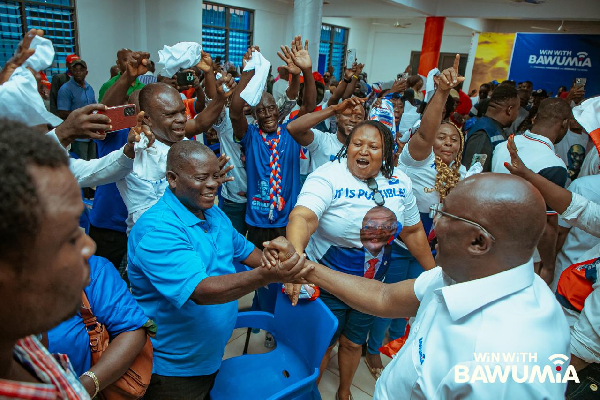
Dr Bawumia in a group picture with some of the coordinators Dr Bawumia in a group picture with some of the coordinators

Former Vice President, Dr Mahamudu Bawumia’s proposals aimed at addressing welfare concerns of members of the NPP have been embraced by grassroot members of the party in the Greater Accra Region.

Bawumia, who has been touring the Greater Accra Region, as part of his national campaign tour for the NPP primaries, has been receiving enormous support from NPP delegates through endorsements but also, his proposed policies for welfare of members have also been largely welcomed.

In his campaign, Dr Bawumia has highlighted neglect and inadequate appreciation of party members, especially at the constituency level, as a major concern and to address them, he has proposed policies, including the creation of a database system of members from the local level, to ensure inclusive welfare for all officials and members.

The database system, Dr Bawumia explains, would acknowledge the efforts of members, record their concerns and address these concerns through effective monitoring.

The former Vice President has also proposed a constituency-based appointment in his government, which will seek to ensure inclusive appointments, by giving each constituency a minimum of ten appointments.

These proposals have been welcomed by electoral area coordinators and polling stations executives of the Greater Accra region.

Announcing their support for Dr Bawumia, about 445 out of 595 electoral area coordinators in the Greater Accra have said that Dr Bawumia’s welfare proposals for grassroot members of the party is one of the reasons they support him.

“We have realised that your vision the grassroot is what the party needs. In fact, if the policies you are proposing had been implemented, we don’t think we would have been out of government,” a spokesman for the coordinators said during Dr. Bawumia’s campaign engagements in Adenta and Madina constituencies yesterday.

“Polling station executives, electoral area coordinators and constituency executives have really suffered for this party, and we are still sacrificing. We welcome your well thought through policies which address the welfare of party members and we believe that by the grace of God, our concerns will be addressed by your proposals after your election.”

Dr Bawumia’s proposals appears to have gone down well not for only delegates and members in the Greater Accra Region.

In his tour of the other regions, party members welcomed the proposals, hailing them as welcome steps to address the perennial issue of exclusion and lack of recognition of hardworking members of the party.

Also, watch below Amnesty International’s ‘Protect the Protest’ documentary as the world marks International Human Rights Day 2025

‘Talk, talk party’ – Professor Kobby Mensah blasts Minority

0

Professor Mensah has accusing them of talking without offering practical solutions Professor Mensah has accusing them of talking without offering practical solutions

Professor Kobby Mensah, an Associate Professor at the University of Ghana Business School (UGBS) and Chief Executive Officer of the Ghana Tourism Development Company Limited, has criticised the Minority in Parliament following their press conference held on Monday, December 29, 2025.

The Minority, led by former Minister of Information, Kojo Oppong Nkrumah, accused the ruling National Democratic Congress (NDC) government of lacking originality and competence in economic management, particularly in relation to the Bank of Ghana’s Gold-for-Reserves programme.

However, reacting to the claims in a post on X, Professor Mensah dismissed the Minority’s criticisms, accusing them of talking without offering practical solutions.

Responding directly to Kojo Oppong Nkrumah, the professor questioned the track record of the Minority while they were in government.

“Which of your ‘old’ ideas reduced the pound sterling from 23 cedis to 14? The dollar from 16 cedis to 11? Or reduced fuel from 20 cedis per litre to 10.37? Talk, Talk Party,” he wrote.

‘No new ideas, just rebranding’ – Minority lashes out at government

The Minority’s press conference focused on what they described as a significant financial loss to the state estimated at $214 million under the Gold-for-Reserves programme managed by the Bank of Ghana.

They are calling for a bipartisan parliamentary inquiry to investigate the circumstances surrounding the losses and to recommend safeguards to prevent a recurrence.

Addressing the media, Kojo Oppong Nkrumah argued that the government has failed to introduce new or superior economic ideas, claiming it has merely repackaged policies inherited from the previous administration.

“The truth about this government is that they have not introduced any superior economic ideas. All they have been doing is rebranding, renaming old things and sometimes even hiding the details until we, the Minority, bring them to the public’s attention,” he said.

He further questioned what innovations the government would introduce once the International Monetary Fund (IMF) programme ends in mid-2026.

“So, when the IMF is no longer here by the middle of 2026 and they are finished rebranding the ideas they inherited, which new ideas would they be introducing? Which old ideas would they now be left with to copy, and who will be shepherding them?” he asked.

Beyond the inquiry, the Minority is also demanding the establishment of a parliamentary ad-hoc investigative committee to probe the Gold-for-Reserves transaction in detail.

They insist that the Bank of Ghana and the Ghana Gold Board must disclose the full fee structure, pricing formula, selection criteria for aggregators, and all foreign exchange arrangements linked to the programme.

According to the Minority, environmental concerns must also be addressed, including the suspension of mining permits in forest reserves and the enforcement of strict traceability measures.

“At present, we have every reason to believe that state money is being misused,” Kojo Oppong Nkrumah stated.

The Minority further expects the Governor of the Bank of Ghana and the Chief Executive Officer of the Ghana Gold Board to appear before the proposed committee to answer questions regarding the transaction.

AM

Also, watch below Amnesty International’s ‘Protect the Protest’ documentary as the world marks International Human Rights Day 2025

“From buying sperms to sleeping with dead bodies” – Ex-robber exposes dark acts by politicians

0

An ex-armed robber has made shocking and disturbing claims about some of the activities he says politicians engage in. According to the ex-robber, some politicians allegedly “rent dead bodies” from mortuaries. He says these claims reveal things that many Ghanaians would find hard to believe, exposing practices that are considered extreme and unethical. The ex-robber did not hold back as he detailed other shocking acts, saying that politicians sometimes go to extreme lengths in ways that defy the public’s understanding of morality.

He added that these actions are part of a hidden world that the average citizen does not see. According to him, “they rent dead bodies from mortuaries.” This statement has sparked widespread reactions, with many questioning the validity of such claims while others express shock at the idea. The ex-robber insists that his claims are based on experiences and knowledge from his time involved in crime and associations with powerful individuals. He said that some of the practices he witnessed are so extreme that even seasoned law enforcement officers would find them difficult to imagine.

In addition to the claims about mortuaries, the ex-robber revealed that some politicians reportedly engage in highly unusual activities, including using bought sperms for unknown purposes. He said these actions are part of an underground network that he was once aware of, and now wants to expose. “From buying sperms to sleeping with dead bodies,” he explained, the activities he described are meant to demonstrate the extremes to which some powerful individuals go to satisfy their desires or carry out secretive plans. These revelations have sparked outrage and disbelief across social media platforms and news outlets.

Experts and social commentators have reacted cautiously, noting that while the claims are shocking, they require thorough investigation to verify. Some argue that such statements, if true, point to deeper issues in the way politics and power interact with social and moral norms in society. Others have criticized the ex-robber, claiming that these statements could be exaggerations intended to gain attention or to settle personal scores. However, the boldness of the claims has made it a trending topic nationwide.

Ghanaians have been left debating the validity of the ex-robber’s statements, asking how such extreme actions could happen without public knowledge. The ex-robber insists that the practices he disclosed are real and that they reflect the dangerous lengths some individuals in power will go to hide their activities. His claims, especially that politicians allegedly “rent dead bodies from mortuaries,” have sparked discussions on ethics, morality, and the need for transparency in public life. Many are calling for authorities to investigate these shocking allegations to determine their truth and to hold accountable anyone found involved.

Source link

Watch as the Asantehene tours the massive estate of Juabenhene Siriboe II

0

Screenshots from the home of Juabenhene Screenshots from the home of Juabenhene

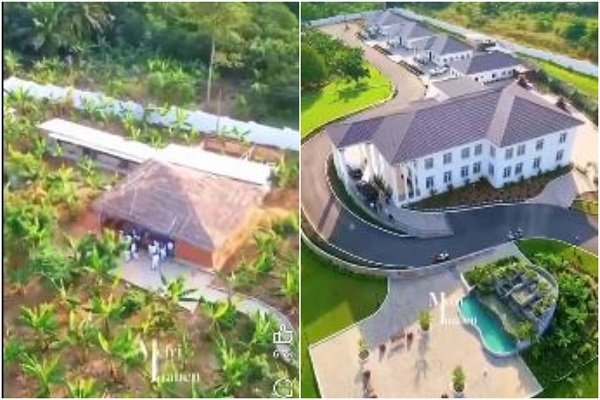
The Paramount Chief of Juaben, Juabenhene Nana Otuo Siriboe II, hosted the Asantehene, Otumfuo Osei Tutu II, and his family at his massive estate over the week in Juaben.

The estate spans a vast area and has several buildings, including a massive mansion.

Videos of the visit showed him being welcomed by the Juabenhene and his household, receiving the king of Asanteman, who was in the company of his wife, Lady Julia Osei Tutu, and some of his children, including Nana Afia Kobi Serwaa Ampem and Nana Kwame Kyeretwie Osei Tutu.

The Juabenhene first took the king and his family through the mansion, showing them the various sections of the building.

Afterwards, they proceeded to what appeared to be a traditional Asante structure, which seemed to have caught the attention of Otumfuo and his family the most.

The structure was built using natural, local materials like mud, wood, and straw.

All the items in it were representations of Akan culture, including the three-stone hearth, called Mukyea in the Akan dialect. The rooms in the structure had traditional mats and lanterns.

Even the water in the structure was traditionally preserved, with palm fibre being used to fumigate it and keep it cold.

Lady Julia Osei Tutu could not help but take a sip of the traditionally preserved water.

Asantehene rejects inclusion of queen mothers in House of Chiefs sittings

Watch videos from the Asantehene’s visit below:

BAI

Israel to bar 37 aid groups from Gaza

0

Israel is to revoke the licenses of 37 aid groups working in Gaza and the occupied West Bank, saying they failed to meet requirements under new registration rules.

Well-known international non-governmental organisations (INGOs) such as ActionAid, the International Rescue Committee and the Norwegian Refugee Council are among those that will have their licenses suspended on 1 January, with their operations to end within 60 days.

Israel said the groups, among other things, had failed to hand over “complete” personal details of their staff.

The move was heavily criticised by foreign ministers from 10 countries including the UK, who said the new rules were “restrictive” and “unacceptable”.

In a joint statement, the foreign ministers of the UK, France, Canada, Denmark, Finland, Iceland, Japan, Norway, Sweden and Switzerland said the forced closure of INGO operations would “have a severe impact on access to essential services including healthcare”.

They added that the humanitarian situation in Gaza remained “catastrophic” and called on Israel’s government to ensure INGOs were able to operate “in a sustained and predictable way”.

Israel’s Ministry of Diaspora Affairs, which is in charge of registration applications, said the new measures would not impact the flow of humanitarian assistance to Gaza.

It added that aid continued to be delivered through “approved and vetted channels”, including UN agencies, bilateral partners, and humanitarian organisations.

It said the primary reason aid groups were having their licences revoked was “the refusal to provide complete and verifiable information regarding their employees,” which it said was critical to preventing “the infiltration of terrorist operatives into humanitarian structures”.

Earlier this month, UN-backed experts said there had been improvements in nutrition and food supplies in Gaza since a ceasefire was brokered between Israel and Hamas in October, but 100,000 people still experienced “catastrophic conditions” the following month.

Israeli military body Cogat, which controls Gaza’s crossings, said the organisations that will be suspended “did not bring aid into Gaza throughout the current ceasefire”.

It added that “even in the past their combined contribution amounted to only about 1% of the total aid volume”.

The Ministry of Diaspora Affairs said that fewer than 15% of organisations providing humanitarian assistance to Gaza were found to be in violation of the new regulatory framework.

That framework includes several grounds for rejection, including:

  • Denying the existence of Israel as a Jewish and democratic state
  • Denying the Holocaust or the Hamas-led attacks on Israel on 7 October 2023
  • Supporting an armed struggle against Israel by an enemy state or terrorist organisation
  • Promoting “delegitimisation campaigns” against Israel
  • Calling for a boycott of Israel or committing to participate in one
  • Supporting the prosecution of Israeli security forces in foreign or international courts

The Humanitarian Country Team of the Occupied Palestinian Territory – a forum that brings together UN agencies and more than 200 local and international organisations – previously warned that the new registration system “fundamentally jeopardises” the operations of INGOs in Gaza and the West Bank.

“The system relies on vague, arbitrary, and highly politicised criteria and imposes requirements that humanitarian organisations cannot meet without violating international legal obligations or compromising core humanitarian principles,” it said.

It added: “While some INGOs have been registered under the new system, these INGOs represent only a fraction of the response in Gaza and are nowhere near the number required just to meet immediate and basic needs.”

According to the Humanitarian Country Team, INGOs currently run or support most of Gaza’s field hospitals and primary healthcare centres, emergency shelter responses, water and sanitation services, nutrition stabilisation centres for children with acute malnutrition, and critical mine action activities.

In a statement, Israel’s Minister of Diaspora Affairs and Combating Antisemitism, Amichai Chikli, said: “The message is clear: humanitarian assistance is welcome — the exploitation of humanitarian frameworks for terrorism is not.”

Other organisations to be suspended include CARE, Medico International and Medical Aid for Palestinians.

DISCLAIMER: The Views, Comments, Opinions, Contributions and Statements made by Readers and Contributors on this platform do not necessarily represent the views or policy of Multimedia Group Limited.

DISCLAIMER: The Views, Comments, Opinions, Contributions and Statements made by Readers and Contributors on this platform do not necessarily represent the views or policy of Multimedia Group Limited.

Police intercept over 2,000 rounds of AK-47 ammunition, bulletproof vests bound for Walewale

0

Two of the suspects and the items seized from them Two of the suspects and the items seized from them

The Ghana Police Service has reportedly intercepted thousands of rounds of ammunition heading for Walewale in the North East Region.

According to a report by Asaase Radio, in addition to the over 2,000 rounds of bullets, the police also intercepted bulletproof vests and other items.

The bullets and the other intercepted items were discovered in a vehicle heading for Walewale.

Three people, including the driver of the vehicle, were arrested during the operation.

“Ashanti Region police intercept Grandbird bus with 2,600 AK-47 rounds bound for Walewale; driver and two others arrested, with bulletproof vests and other gear seized,” the media house wrote on X on December 30, 2025.

The post also contained a picture of the suspects and the items they were allegedly transporting illegally to Walewale, including the bullets and the vests.

Police intercept over 130 cartons of ammunition being trafficked out of Ghana

BAI

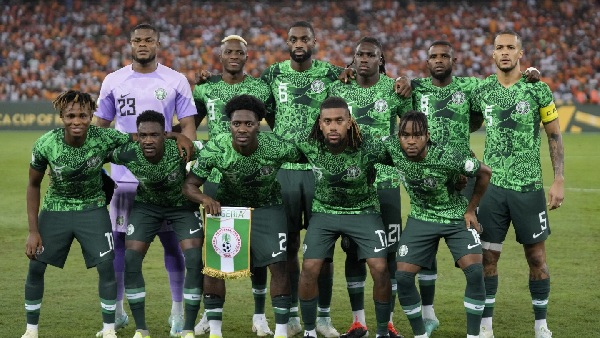
Equatorial Gabon vs. Ivory Coast 2025 livestream: Watch Africa Cup of Nations for free

0

TL;DR: Live stream Gabon vs. Ivory Coast in the 2025 Africa Cup of Nations for free on Channel 4. Access this free streaming platform from anywhere in the world with ExpressVPN.


It’s the final day of group games in the 2025 Africa Cup of Nations and defending champions Ivory Coast are in action against Gabon. Ivory Coast are one of a handful of teams who could realistically win the whole tournament, along with the likes of Morocco and Senegal, and they have Manchester United’s Amad Diallo in the squad.

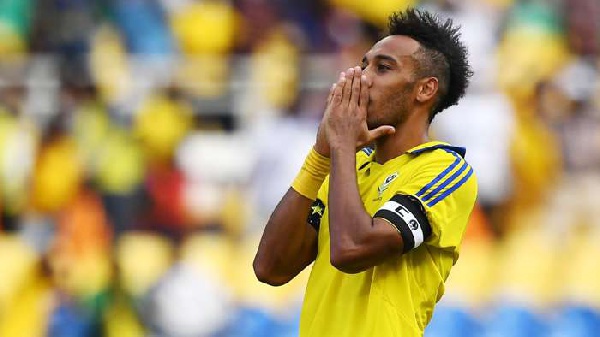
Though Gabon aren’t quite at that level there are a few players, such as Mario Lemina and Pierre-Emerick Aubameyang, who can cause problems for any top team.

Mashable Deals

By signing up, you agree to receive recurring automated SMS marketing messages from Mashable Deals at the number provided. Msg and data rates may apply. Up to 2 messages/day. Reply STOP to opt out, HELP for help. Consent is not a condition of purchase. See our Privacy Policy and Terms of Use.

If you want to watch Gabon vs. Ivory Coast in the 2025 Africa Cup of Nations from anywhere in the world, we have all the information you need.

When is Gabon vs. Ivory Coast?

Gabon vs. Ivory Coast in the 2025 Africa Cup of Nations kicks off at 2 p.m. ET on Dec. 31. This fixture takes place at Stade de Marrakech.

Mashable Top Stories

How to watch Gabon vs. Ivory Coast for free

Gabon vs. Ivory Coast in the 2025 Africa Cup of Nations is available to live stream for free on Channel 4.

Channel 4 is geo-restricted to the UK, but anyone can access this free streaming platform with a VPN. These tools can hide your real IP address (digital location) and connect you to a secure server in the UK, meaning you can unblock Channel 4 to stream AFCON for free from anywhere in the world.

Live stream Gabon vs. Ivory Coast for free by following these simple steps:

  1. Subscribe to a streaming-friendly VPN (like ExpressVPN)

  2. Download the app to your device of choice (the best VPNs have apps for Windows, Mac, iOS, Android, Linux, and more)

  3. Open up the app and connect to a server in the UK

  4. Visit Channel 4

  5. Watch Gabon vs. Ivory Coast for free from anywhere in the world

$12.95 only at ExpressVPN (with money-back guarantee)

The best VPNs for streaming are not free, but most do offer free-trials or money-back guarantees. By leveraging these offers, you can access free live streams of AFCON without actually spending anything. This obviously isn’t a long-term solution, but it does give you enough time to stream Gabon vs. Ivory Coast (plus more 2025 Africa Cup of Nations fixtures) before recovering your investment.

What is the best VPN for Channel 4?

ExpressVPN is the best choice for bypassing geo-restrictions to stream live sport on Channel 4, for a number of reasons:

  • Servers in 105 countries including the UK

  • Easy-to-use app available on all major devices including iPhone, Android, Windows, Mac, and more

  • Strict no-logging policy so your data is secure

  • Fast connection speeds free from throttling

  • Up to eight simultaneous connections

  • 30-day money-back guarantee

A one-year subscription to ExpressVPN is on sale for $99.95 and includes an extra three months for free — 49% off for a limited time. This plan includes a year of free unlimited cloud backup and a generous 30-day money-back guarantee. Alternatively, you can get a one-month plan for just $12.95 (with money-back guarantee).

Watch Gabon vs. Ivory Coast in the 2025 Africa Cup of Nations for free with ExpressVPN.

Atwima Kwanwoma District Poised For Dev’t – DCE

0

Grace Agyemang Asamoah


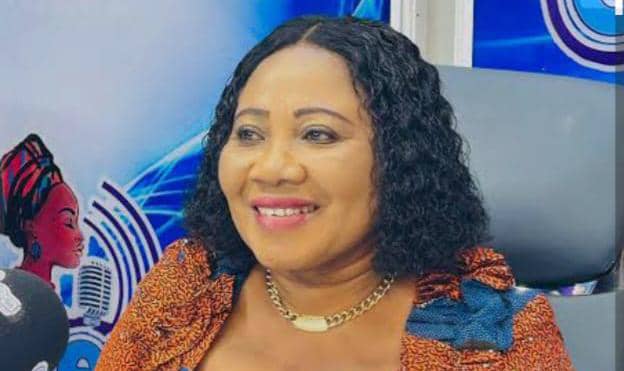
The District Chief Executive (DCE) of the Atwima Kwanwoma District Assembly, Grace Agyemang Asamoah, has expressed confidence that the district is on course for improved living standards as residents celebrate Christmas and prepare for the New Year.

In a Christmas and New Year goodwill message to the people, Madam Agyemang Asamoah prayed for peace, joy and renewed hope in every home, while wishing residents a prosperous year ahead.

She urged families and communities to use the festive season to promote unity, tolerance and peaceful coexistence.

“May this festive season bring peace, joy and renewed hope to every home. Merry Christmas and a prosperous New Year. God bless Atwima Kwanwoma,” the DCE stated.

*Development Drive*
Madam Agyemang Asamoah noted that the District Assembly, under her leadership, has continued to implement programmes aimed at improving the quality of life of residents.

Priority areas include road infrastructure, education, sanitation and healthcare delivery, which she described as critical to sustainable development.

The Assembly has supported the rehabilitation of feeder roads to enhance access to farming communities and facilitate the movement of goods and services.

In the education sector, efforts have been made to improve basic school infrastructure, including classroom renovations and the provision of essential learning materials.

Sanitation and environmental cleanliness have also received attention, with intensified public education and community-led initiatives to promote a healthy living environment.

The district has further benefited from government flagship programmes, notably Planting for Food and Jobs, as well as youth and women empowerment interventions.

*Brighter Outlook*
The DCE, who is known for her inclusive and collaborative leadership approach, reaffirmed her commitment to working closely with traditional authorities, assembly members, opinion leaders and development partners to ensure equitable development across the district.

She called on residents to continue supporting the Assembly’s programmes and to remain law-abiding, stressing that collective effort and unity are essential for progress.

As the year comes to an end, Madam Grace Agyemang Asamoah expressed optimism that the New Year would bring greater development, improved livelihoods and better living conditions for the people of Atwima Kwanwoma.

FROM David Afum, Kumasi

Loss or no loss? The Price of Everything and The Value of Nothing

0

As a father of two with others I care for, I am clear that my spending is not aimed at generating profit for myself. Instead, it is to ensure these dependants have a social, economic, and spiritual life that makes them impactful and productive members of society.

As an entrepreneur, my expenditure is to deliver responsible profits for myself and my shareholders, along with a constructive economic impact that often requires patience to realise. I prioritise value delivery and development, focusing on short-term financial sustainability, with the hope that it will serve as a foundation for medium- to long-term profits. Although these goals are different, they are similar in that both aim to achieve their respective objectives.

The recent debate about the reported US$214mn loss by the BoG in its Gold-for-reserves programme, also known as the Domestic Gold Purchase Programme (DGPP), has been quite fascinating. It has been passionate, sentimental, and technical all in one. Some contend it is a loss, while others argue it is not. So, what exactly is a loss? Can’t we simply agree on what a loss is? In economics, where strict science meets the complexity and flexibility of human nature, almost everything is ambiguous. Therefore, it’s not so straightforward, but can still be honest.

That’s why, while ‘1+1’ equals two everywhere in the world, the success of an economic policy is not consistent everywhere. Even the mighty IMF and World Bank cannot guarantee a perfect outcome in their interventions. There is always an X-Factor.

1.0 LOSS OR NO LOSS?

From an accounting perspective, the establishment of loss is simply total revenue (TR) minus total cost (TC). If TC is greater than TR, you have a loss. In finance, there is sometimes a slight shift. Instead of TR or TC, you may be considering the present value of TR and TC, which may require a discount factor (in layman’s terms, an interest rate) to determine. Let me give an example to explain: imagine investing Ghs100 in a venture at the start of the year and receiving Ghs110 at the end of the year. In accounting terms, you have made a Ghs10 profit. It is as simple as that. However, financial economics looks at it differently. It first considers the opportunity cost — what else you could have done with that money?. Let us say you could have invested in treasury bills or notes at 15% p.a. This means you could have earned Ghs15, not just Ghs10. Since you earned less than the Ghs15 you could have made, you have effectively incurred an economic loss. I am sure you will agree that that book long ‘na wahala’.

In economic policy, it is an entirely different game. Every economic policy intervention must be evaluated on its incremental economic value and aligned with its economic objectives. That is why expenditure on education is not viewed as a cost but as an investment to maintain the quality of labour, which in turn drives and sustains economic growth into the future. This explains why we discuss primary surpluses and deficits or economic costs and benefits, rather than accounting losses or profits.

Each economic policy intervention’s impact, as planned, must align with the desired economic outcomes. For example, an economic policy of promoting exports through export subsidies (a cost to taxpayers) must align with its objectives, which may include inflation, exchange rate stability, GDP growth, employment, socio-economic equality as measured by the Gini and Human Development Indices, etc.

A loss in economic policy terms should be assessed based on the economic outcomes the intervention seeks to achieve, compared to the actual measurable results. The evaluation should consider not only the policy’s costs but also its benefits.

Simply put, “an accounting loss or financial loss is not an economic loss! So not all loss be loss and not all profit na benefit!” 

2.0 THE GOLDBOD

Prior to the formation of the GOLDBOD, one thing was certain: Ghana was not fully benefiting from its gold output. According to the United Nations COMTRADE, the United Arab Emirates imported USD7.1 billion worth of gold from Ghana in 2022 and 2023. Ghana, however, reported official data of USD4.8 billion. Using the UAE (a major importer of our ASM gold) as a benchmark, about one-third (almost 33%) of our production was smuggled and left unaccounted for.

In years past, Ghana had to rely on borrowed foreign exchange through Eurobonds and Syndicated Loans to COCOBOD to build its foreign reserves, mainly due to overdependence on primary exports. The underperformance of cocoa exports and the retention of export receipts offshore (part of Ghana’s stability agreement with foreign mining companies) by Ghana’s foreign-dominated mining companies meant that even if gold production and gold exports improved, it could not support the building of Ghana’s reserve buffers. In the end, Ghana could not borrow itself into perpetuity and ended up with the Domestic Debt Exchange Programme (DDEP) and an external debt restructuring programme, which were integral parts of Ghana’s IMF-supported reforms programme under the broader debt restructuring programme.

The GOLDBOD was set up with clear monetary policy-related objects.

  1. Generate foreign exchange for the country; and
  2. Support the accumulation of gold reserves by the Bank of Ghana.
  3. Oversee, monitor and undertake the buying, selling, assaying, refining, exporting or other related activity in respect of gold.

The policy rationale for these objects is to centralise gold trade, optimise forex inflows, accelerate gold reserve accumulation, and generate national benefits from the entire value chain of the country’s gold resources for economic revitalisation and sustainable growth.

Ghana’s GOLDBOD sources gold from mainly licensed artisanal and small-scale miners, using a regulated network of authorised buyers and aggregators. It pays in cedis based on the Bank of Ghana’s reference rates and either exports the gold or allocates it to the Bank of Ghana for reserve accumulation.

3.0 HAVE WE REALISED OUR OBJECTS?

The year 2025 marked the inception of GOLDBOD, and in just one year, Ghana’s Artisanal and Small-Scale Mining (ASM) gold export value has increased from 63.6 metric tons (mt) in 2024 to 101mt as of 23rd December 2025. Reference is made to actual export volumes in metric tonnes to ensure that the current higher gold prices do not distort our analysis. It should be noted that this is not just a result of a significant surge in production but rather an optimisation of the accounting of Ghana’s gold production by drastically reducing smuggling. This achievement is due to GOLDBOD’s work, and we must acknowledge their contribution. GOLDBOD and its practices have successfully optimised our ‘official’ gold trade.

According to the IMF, the BoG has had to recognise a trading loss of USD214mn (GHS2.4bn). This is undoubtedly an accounting loss. We are also told that it has been due to GOLDBOD disincentivising smuggling by buying at world market prices, thereby being unable to cover its operational costs. From a pure trading perspective, this does not make sense. The pricing strategy to offer world-market prices to miners for buying their gold output is to incentivise them to sell to GOLDBOD rather than to the foreign gold buyers who had become entrenched in the market and were offering prices 1-2% below international prices. This is thus an aggressive entry into the market to break the entrenched foreign dominance in Ghana’s gold trading market, without which the GOLDBOD would have struggled immensely to penetrate. Indeed, it is through this pricing strategy that smuggling has been significantly reduced, and Ghana is fully reaping the benefits of gold exports.

Thus, from a policy perspective, the USD214mn (GHS2.4 bn) trading loss must be viewed differently, not through a financial or accounting lens. For instance, the forex inflows from the reduced smuggling can be transformative and more beneficial to the broader economy, so incurring ‘the loss’ makes sense and becomes an economic policy cost required to yield greater economic policy benefits.

From what I gather in my research and interviews with market players, the ‘trading losses’ also arise from the differentials demanded by gold producers for the difference between open market exchange rates and the Bank of Ghana interbank rates used to price the ASM gold. To this, if the Bank of Ghana’s interbank FX rate is set at Ghs11.0 to US$1.00 and the open market rate stands at Ghs12.0 to US$1.00, producers will demand Ghs12.0, not Ghs11.0. GOLDBOD will increase its buying price to miners, often midway through the differential, through a ‘so-called bonus’ to ensure producers do not lose out on their market reality.

For example, if the world price is $100, the BoG rate is Ghs11.0 to US$1.00, and the open market rate is Ghs12.0 to US$1.00, producers will receive Ghs1,100. If the same producer sells his gold to a smuggler at $100, he will receive GHs1,200 at the open market rate of Ghs12.0 to US$1.00. To disincentivise producers from smuggling, the GOLDBOD adjusts its prices upwards by offering a bonus of about Ghs50 (often about 50% of the FX differential), so producers receive Ghs1,150 and minimise the risk of selling to smugglers. This ‘Ghs50’ is a major reason for the reported ‘trading losses’. This is effectively, a foreign exchange loss.

4.0 DOMESTIC GOLD PURCHASE PROGRAMME (DGPP): LOSS OR NO LOSS?

What we know for sure is that the DGPP policy operation through GOLDBOD has cost us USD214mn and possibly counting. Various explanations have emerged, but the fact is that GOLDBOD is a policy institution tasked with supporting the operationalisation of the DGPP’s monetary policy intervention.

The IMF in its latest staff report stated that, “The scaling up of the Domestic Gold Purchase Program (DGPP) has allowed the BoG to meet its program reserve accumulation objectives, reaching the 2028 reserve coverage target in 2025.” That is a commendation by all standards.

Gross international reserves are always at the core of a currency’s stability. So, the lower the Gross international reserves, the lower the value of a currency in a floating FX rate regime. The DGPP programme has led to an increase in the BoG’s gross reserves from USD8.98bn in 2024 to $11.12bn as of October 2025, and they are projected to reach about $13bn by year-end 2025.

The IMF, in its own papers, have attributed the nominal exchange rate appreciation to the building of reserves and our FX inflows, which is widely known to be driven by the surge in official gold export receipts. Our receipts have surged from two fronts.

  1. The surge in official gold export quantity. We have recovered our one-third loss to smuggling by moving official volumes from 63mt in 2024 to 101mt in 2025. This is attributable to the GOLDBOD policy intervention.
  2. Surge in global gold prices. Prices moved from about an average of $2,386/oz (LBMA data) in 2024 to $3,439.37/oz in 2025, marking a 44% increase.

Undoubtedly, the stars have aligned with our own actions to realise the blessings of the now.

Without any fear of contradiction, our foreign exchange bounce back has been a well-orchestrated home-grown strategy and alignment of monetary and fiscal policy anchored on the productivity of the GOLDBOD under the BoG’s DGPP programme! This is why any discussion of the cost of the GOLDBOD intervention must be carried out together with an evaluation of the enormous economic benefit to Ghana in 2025.

To evaluate the economic benefits of this policy intervention, we will examine these key indicators.

  1. Impact on the USD/GHS exchange rate
  2. Impact on Government debt service savings
  3. Impact on Government’s foreign exchange expenditure savings
  4. Inflation
  5. The import bill
  • Impact on the USD/GHS exchange rate

Ghana moved from an actual BoG interbank GHS/USD average rate of GHs14.2 to US$1.00 in 2024 to 12.53 in 2025, marking a 13% average appreciation. On a year-on-year basis, Ghana moved from a year-end of Ghs14.7 to US$1.00 in 2024 to GHs11.2 to US$1.00 in 2025, marking a 32.47% appreciation.

What is most instructive is the average exchange rate forecast in the IMF’s supervised 2025 budget, which projected a depreciation of about 9%. The 2025 budget was built on the assumption of an average GHS/USD rate of GHs15.95 (which, to be fair, was about the street-market rate as of December 2024). GHs15.95, therefore, serves as the policy benchmark for any fair analysis of the performance of the policy benefits from relevant exchange rate-related policy interventions.

  • Impact on Government’s external debt service


2025 External Debt Payments Amount (USD) GHS Amt @Budget Average Rate (15.95) GHS Amt @Realised Average Rate (12.53) Savings
Interest        504,880,793 8,052,848,642 6,326,156,331 1,726,692,311
Amortization        605,846,212 9,663,247,087 7,591,253,040 2,071,994,046
Eurobond        709,025,252 11,308,952,764 8,884,086,404 2,424,866,360
Total    1,819,752,257 29,025,048,493 22,801,495,775 6,223,552,718

The table above summarises our external debt service position as at mid-December 2025. What it tells us is that our ability to reverse the trajectory of the Ghana cedi from a projected year average of Ghs15.95 to a realised average of GHs12.53 has saved the Ghanaian economy over GHS6.2billion. At year-end closing rates, this saving is USD560mn. This is not a profit but an economic benefit from GOLGBOD policy actions. As stated earlier, in economic policy terms, we focus on policy benefits and costs and not profits or losses.

  • Impact on the Government’s foreign exchange expenditure savings

To assess this, we should ideally examine the government’s foreign-exchange-based expenditure and evaluate the benefits of the Ghana cedi’s appreciation. These will include payments to independent power producers (IPPs), imports by government agencies and vendors, including capital expenditure vendors. Extracting this accurately may be complex at this stage, so I will stick to a single item I can pull out: IPP payments for 2025.


Forex Payment Amount in

US$

Amount in GHS using
@Budget Average Rate GHs15.95 -US$1
Amount in GHS using @
Realised Average GHs12.53 -US$1
Savings in GHS
IPPs          1,887,862,617 30,111,408,740 23,654,918,590 6,456,490,150


From the above we have realised a saving in excess of GHS6.45bn. At year closing rates, this saving is USD582mn.

The IMF country director, Dr Adrian Atler, in a recent interview with Benard Avle of CitiFM, explained that the strengthening of the local currency has played a pivotal role in restoring price stability, helping inflation fall from 24% in 2024 to 6.3% in November 2025, which is the lowest level in four years. He further argued that the contrast between last year’s rapid currency depreciation and this year’s modest appreciation clearly shows how exchange rate management has shaped the inflation path.

There is no denying that the GOLDBOD-inspired currency appreciation is a major contributory factor to the BOG’s ability to reduce inflation from 24% to 6.3% as of the end of November 2025 (Ghana Statistical Service).

Ghana’s import bill is projected to end 2025 at about USD17.7bn. This projection is based on official January to October data.

Forex Payment Amount (USD) Amount in GHS using
@Budget Average Rate GHs15.95 -US$1
Amount in GHS using @Realised Average GHs12.53 -US$1 Net Benefit (GHS)
2025 Import Bill (est) 17,784,000,000 283,654,800,000 222,833,520,000 60,821,280,000


From the analysis above, the comparative saving exceeds GHS60bn for the Ghanaian importer and consumer (including government consumption) and for the economy as a whole. This saving has improved the real spending power of Ghanaians, which Fitch estimates at +2.5% (as at June 2025), over 120% increase from the spending power growth of +1.1% realised in 2024. With inflation heading further down, we can only estimate a larger increase in the Ghanaian’s real spending power.

  1. The appreciation of Ghana Cedis is foremostly a result of the BoG’s domestic gold purchase programme (DGPP) operated by GOLDBOD. In other words, it is a GOLDBOD-inspired currency appreciation.
  2. The direct fiscal savings from the GOLDBOD-inspired appreciation are in excess of 6bn (US$1.142bn), more than 5 times the policy cost of US$214mn (Ghs2.4bn). Ghs6.22bn on external debt service and 6.45bn on IPP payments. If we were to add savings on import-related capex and goods and service expenses across the central government and state-owned enterprises, this would significantly increase.
  3. According to the Bank of Ghana ACT, 2002 (ACT612), the primary object of the Bank of Ghana is to maintain stability in the general level of prices. Achieving 6.3% inflation from 24% in less than a year is a policy outcome success driven by its DGPP programme.
  4. Over GHS60bn savings on our import expenditure have been realised and accrued to the economy.
  5. The US$214mn (Ghs2.4bn) is a policy cost and not a loss, as its economic policy outcomes outweigh its financial cost.

5.0 THE IMF AND THE ‘LOSS’

Let us get it clear, there is no issue with the IMF flagging the US$214mn. It is their estimate of the policy cost. I do not subscribe to the view that the Bretton Woods institutions are haters and wreckers. If it were so, China would not be where it is today. Achieving all the economic benefits without spending US$214mn would have been ideal. These institutions will always push economies to optimise, and that is what they were doing.

Having said that, I am clear that the recovery is a shock to the IMF. A significant and swift depreciation is often the starting point of resolving a balance-of-payments (BoP) problem (Culiuc and Park, 2025). This is the view and expectation within the IMF, as duly captured by the authors who are IMF executives. In their study, which analysed worldwide data from 1971 to 2024, they concluded that “Equilibrium REER depreciations are largest when an IMF-supported program is put in place after the initial depreciation takes place.” Simply put, when countries enter IMF programs, the magnitude of currency depreciation increases, suggesting that depreciation is part of the adjustment mechanism.

Consequently, our currency appreciation is a surprise and an outlier because it happened too soon. Of course, it’s commodity price-driven, without much structural transformation, but the stability is welcome. What they missed is the Ghanaian’s behavioural nature and propensity to smuggle. There is no need to be antagonistic. Just like I said in the beginning, “while ‘1+1’ equals two everywhere in the world, the success of an economic policy is not consistent everywhere”. They are aiding us with what they know, and our homegrown policies must shape what they learn in ways that are practical and unique to Ghana. We have brains too! We are writing the rulebook in Ghana and not in Washington, and this is real progress!!! (to borrow from Harvard Economist Prof Dani Rodrik).

6.0 CONCLUSION

On the back of the realisation of the policy outcomes of low inflation, real fiscal savings and import bill savings, I do not consider the $214mn or GHS2.4bn spent on the DGPP a loss. It is a policy cost worth the spend if it was spent legitimately. Having said that, I must admit that policy must move to reduce or zero out this cost to enable us to maximise the economic benefit from the policy.

The existence and quantum of disparities between Bank of Ghana foreign exchange rates and open market rates are counterproductive and lead to foreign exchange losses. It is imperative that the BoG moves to converge the exchange rates on the market to eliminate room for foreign exchange losses.

In addition, we need to build resilience and transform the economy’s structure to sustain the gains realised so far. We cannot continue to be commodity-dependent!!!

 Economic policy is not accounting; evaluating its impact requires a more holistic approach, or we risk knowing the price of everything and the value of nothing.

 Senyo K. Hosi

Entrepreneur, Finance & Economic Policy Analyst

31st December 2025

 References:

  1. Currency Crises in the Post-Bretton Woods Era: A New Dataset of Large Depreciations, WP/25/222, October 2025
  2. Microsoft Word – Bank of Ghana Act 2002, Act 612.doc
  3. Ghana’s consumer boom: Household spending to hit GH¢129.7bn – Graphic Online
  4. Ghana Imports
  5. PRESS-RELEASE-GHANAS-MACROECONOMIC-PROGRESS-PRAISED-BY-IMF-GOLD-LOSS-CLAIMS-SPECULATIVE-251225.pdf
  6. Cedi stability key to Ghana’s inflation turnaround – IMF
  7. *Ghana: Fifth Review Under the Arrangement Under the Extended Credit Facility, Requests for Modification of the Monetary Policy Consultation Clause and Program Extension, and Financing Assurances Review-Press Release; Staff Report; and Statement by the Executive Director for Ghana; IMF Country Report No. 25/343; December 3, 2025
  8. Ghana: Fourth Review Under the Arrangement Under the Extended Credit Facility, Request for Modification of Performance Criteria, Financing Assurances Review, and Monetary Policy Consultation-Press Release; Staff Report; and Statement by the Executive Director for Ghana in: IMF Staff Country Reports Volume 2025 Issue 175 (2025)
  9. 2025 BUDGET SPEECH
  10. Rodrik, Dani (2008): “is there a new Washington Consensus?” Project Syndicate 11, June 2008

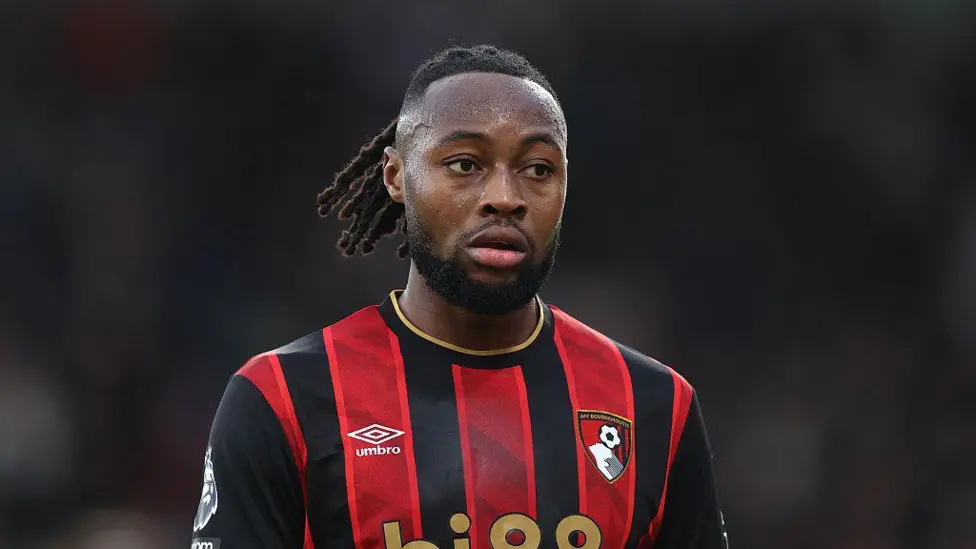
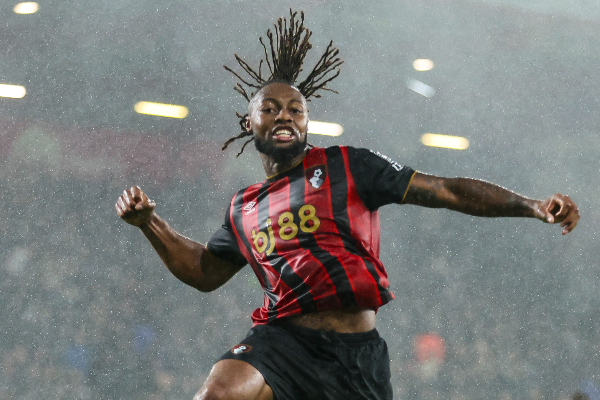
Not Semenyo’s ‘last game’, says Iraola as Man City close in

0

Manchester City are close to agreeing terms with Bournemouth to sign Antoine Semenyo for £65m – but Andoni Iraola insists the forward has “definitely not” played his last game for the Cherries.

City’s move for the Ghana forward, 25, is at an advanced stage with talks over the past 48 hours aimed at closing the finer details of the deal.

They have agreed to meet Semenyo’s £65m release clause, while the player’s representatives were in Manchester on Monday finalising personal terms.

Discussions continued on Tuesday, with sources indicating a total agreement is now close with the January transfer window due to open on Thursday.

Semenyo, who played the full 90 minutes of the 2-2 draw with Chelsea on Tuesday, has been keen for his future to be resolved by 1 January.

However, Iraola is adamant the attacker will play against Arsenal on Saturday, 3 January.

“He is a massive player for us and he will still be with us,” the Bournemouth boss told BBC Match of the Day.

“It is not the last game he has played for us, definitely not.”

Sources have told BBC Sport Bournemouth want him to play against the Gunners and then Tottenham on Wednesday, 7 January before the release mechanism in his deal elapses on 10 January.

As reported by BBC Sport on Sunday, Liverpool retain an interest in Semenyo but, unless the Premier League champions launch a late bid, he is heading to City.

Despite interest from five clubs, including Chelsea, Manchester United and Tottenham, City remain the only one to have made formal contact with Bournemouth.

‘It is like losing two or three players’

Although Semenyo conceded a penalty in the draw at Chelsea, he showed what Bournemouth will be missing should he leave with his two long throws into the box leading to the visitors’ two goals.

At the end of the match, he applauded the away fans in what appeared to be a goodbye to them, with several of his team-mates also coming over to hug him.

Semenyo has scored nine goals and provided three assists for Bournemouth this season, and team-mate David Brooks said his departure will be a big loss.

“I’m not going to sit here and say he doesn’t leave a hole,” the Wales international told BBC Match of the Day.

“He’s our top scorer and he’s been a very, very good player for us over the past couple of years.

“Everyone loves Ants in our team and if he’s going to join someone else we wish him all the best, he’s earned it.”

Former Chelsea and Blackburn striker Chris Sutton added on BBC Radio 5 Live: “Three and a half outstanding seasons as a Bournemouth player – the issue Andoni Iraola’s got is how do you replace him? How do you replace his numbers?

“A phenomenal player who’ll go with the Bournemouth fans’ best wishes. He’s been a top player for them.”

Ex-Aston Villa and Manchester United striker Dion Dublin said Semenyo’s exit would feel like losing more than just one player for Bournemouth.

“As a manager you can think to yourself, ‘bring the money in, I back myself as a coach’, and I’m sure Iraola does,” he added.

“But Semenyo is such a big player that it is like losing two or three players.”

DISCLAIMER: The Views, Comments, Opinions, Contributions and Statements made by Readers and Contributors on this platform do not necessarily represent the views or policy of Multimedia Group Limited.

Tags:  

DISCLAIMER: The Views, Comments, Opinions, Contributions and Statements made by Readers and Contributors on this platform do not necessarily represent the views or policy of Multimedia Group Limited.

Police intercept over 2,000 rounds of AK-47 ammunition, bulletproof vests bound for Walewale

0

Two of the suspects and the items seized from them Two of the suspects and the items seized from them

The Ghana Police Service has reportedly intercepted thousands of rounds of ammunition heading for Walewale in the North East Region.

According to a report by Asaase Radio, in addition to the over 2,000 rounds of bullets, the police also intercepted bulletproof vests and other items.

The bullets and the other intercepted items were discovered in a vehicle heading for Walewale.

Three people, including the driver of the vehicle, were arrested during the operation.

“Ashanti Region police intercept Grandbird bus with 2,600 AK-47 rounds bound for Walewale; driver and two others arrested, with bulletproof vests and other gear seized,” the media house wrote on X on December 30, 2025.

The post also contained a picture of the suspects and the items they were allegedly transporting illegally to Walewale, including the bullets and the vests.

Police intercept over 130 cartons of ammunition being trafficked out of Ghana

BAI

Minority demands bipartisan parliamentary inquiry into BoG-GoldBod $214m loss

0

The Minority in Parliament has called for a bipartisan investigation into the reported $214 million loss by the Bank of Ghana under the Gold-for-Reserves programme.

Kojo Oppong Nkrumah, Member of Parliament for Ofoase Ayirebi addressing journalists in Accra on Monday December 29 stated that the inquiry should be conducted by a parliamentary ad-hoc committee with the power to subpoena all contracts, licenses, intermediaries, and related entities.

He said the committee should require the Bank of Ghana and the Ghana Gold Board (GoldBod) to disclose their fee structures, pricing formulas, aggregator selection criteria, and foreign exchange arrangements linked to the programme.

He further called for the suspension of permits in forest reserves and the introduction of strict traceability measures, citing concerns that state funds may have been used to purchase gold from illegal mining activities.

He added that where negligence or corruption is proven, prosecutions must follow and all recoverable funds returned to the state.

“We are demanding the following: a bipartisan parliamentary inquiry into the circumstances under which the republic of Ghana has lost $214 million heading to $300million to be done here by the parliament of Ghana. We are asking for a parliamentary adhoc investigative committee with power to subpoena all contracts, licences, intermediaries including this power rock monopoly.

“Under this bipartisan enquiry we will be expecting the BoG and the GoldBod to publish the fees structure, the pricing formula, the aggregator selecting criteria and all foreign exchange arrangement that they have tied to this scheme which has led to this loss.

“…One of the things we will be asking for is the suspension of permit in forest reserves and the introduction of serious measures on traceability because as at now we have every reason to believe that state money is being used to buy Galamsey gold…Where negligence or corruption is proven, prosecutions must follow and all recoverable funds must be given back to the state,” Nkrumah stated.

The call by the Minority comes after the International Monetary Fund (IMF) raised concerns over the reported losses, describing them as a potential risk to Ghana’s macroeconomic stability. The IMF attributed the losses to transactions involving artisanal and small-scale mining dore gold and referenced alleged “GoldBod off-taker fees.”

GoldBod, however, has denied incurring any losses, describing the IMF claims as inaccurate. In a response issued earlier this month, the Board’s CEO, Sammy Gyamfi, stated that GoldBod expects an income surplus of no less than 600 million cedis for the 2025 financial year and clarified that it does not charge off-taker fees. He explained that GoldBod’s role is limited to purchasing, assaying, and exporting gold on behalf of the Bank of Ghana, while all trading and sale agreements with off-takers fall under the central bank’s mandate.

Mr. Gyamfi highlighted that GoldBod has contributed over 10 billion dollars in foreign exchange in 2025 through the purchase of more than 100 tonnes of artisanal and small-scale mining gold for the Bank of Ghana. He also noted the Board’s support in purchasing output from large-scale mining companies, which has helped boost Ghana’s foreign reserves and strengthen the cedi.

LIVESTREAMED: Nigeria vs Uganda (2025 AFCON)

0

Video | LIVESTREAMING: Nigeria vs Uganda (2025 AFCON)

<!– –>

<!–
(function(w, d) {
var s = d.createElement(‘script’);
s.src=”//cdn.adpushup.com/45999/adpushup.js”;
s.crossOrigin=’anonymous’;
s.type=”text/javascript”; s.async = true;
(d.getElementsByTagName(‘head’)[0] || d.getElementsByTagName(‘body’)[0]).appendChild(s);
w.adpushup = w.adpushup || {que:[]};
})(window, document);

–>


<!– –>

Ivory Coast’s ruling party increases its majority in weekend vote

0

Alassane Ouattara's party also won the presidential election Alassane Ouattara’s party also won the presidential election

Ivory Coast’s ruling party increased its majority in parliament in elections held at the weekend, while the main opposition party, led by former Credit Suisse CEO Tidjane Thiam, lost half of its seats, provisional results showed.

The strong showing for the Rally of Houphouëtists for Democracy and Peace, or RHDP, should make it easier for President Alassane Ouattara to implement his agenda that includes luring private investment to French-speaking West Africa’s largest economy, the world’s biggest cocoa grower.

Ouattara, an 83-year-old former deputy managing director of the International Monetary Fund who secured a fourth term in October, has also said he would use his mandate to prepare the way for a new generation of political leaders.

The RHDP took 197 of 255 seats in the National Assembly in Saturday’s elections, according to provisional results announced on Monday by the electoral commission, up from 163.

Thiam’s Democratic Party of Ivory Coast, or PDCI, won 32 seats, down from 65, while independent candidates won 23 seats.

Voter turnout was 35.04%, down from 37.88% during the last legislative elections in 2021.

Ouattara first came to power in 2011 after a four-month war.

He was re-elected with more than 89% of the vote in the presidential contest on October 25 in which Thiam and former President Laurent Gbagbo were barred from running.

Gbagbo’s party boycotted this year’s legislative elections, saying they would not be credible.

12 of the best TV shows to watch this January

0

From the return of HBO’s award-winning medical drama to a new Game of Thrones prequel and the latest Harlan Coben mystery on Netflix.

BBC/ Ink Factory/ Des Willie (Credit: BBC/ Ink Factory/ Des Willie)

1. The Night Manager

It has been nearly a decade since the dynamic adaptation of John le Carré’s 1993 novel became a huge critical and popular success. At last, a second season continues the story of Jonathan Pine, the efficient hotel night manager who became an even more efficient spy. But that first run took the story to the end of the novel, and le Carré died in 2020 – so its adapter David Farr had to start from scratch for this one. Tom Hiddleston once again stars as Pine, whose looks, charm and quick wit enabled him to take down an arms dealer. He is now entrenched at MI6, working quietly in a London office, when he goes rogue and follows yet another arms dealer all the way to Colombia. Olivia Colman returns in a supporting role as Angela Burr, who recruited Pine to the agency last time. Among the new characters, Diego Calva plays Teddy Dos Santos, the season’s wily villain, Camila Morrone is his glamorous cohort and Hayley Squires is an MI6 agent working with Pine. Le Carré may be gone, but his novel’s DNA remains, and a third series has already been ordered.

The Night Manager premieres 1 January on BBC One in the UK and 11 January on Prime Video internationally

Ben Blackall/ Netflix (Credit: Ben Blackall/ Netflix)

2. Run Away

The latest of many Netflix adaptations of Harlan Coben novels stars James Nesbitt as Simon, whose college-age daughter, Paige (Ellie de Lange), runs off. His search for her takes him to an underworld of drugs and, when Paige’s controlling boyfriend is murdered, into the kind of cloak-and-dagger mystery Coben is known for. Minnie Driver plays Simon’s wife, Ingrid. Alfred Enoch is Detective Isaac Fagbenle. And Ruth Jones (co-creator and star of Gavin & Stacey) plays Elena, a private investigator who is also searching for Paige, although Simon didn’t ask her to. They form a team with its own energy. “It’s a really lovely onscreen relationship because, well, spoiler alert, it’s not a romance,” Jones said at the series’ London premiere. “It’s refreshing to see that male-female friendship.”

Run Away premieres 1 January on Netflix internationally

Warrick Page/ HBO Max (Credit: Warrick Page/ HBO Max)

3. The Pitt

On paper, The Pitt might have sounded like just another medical drama, but its first season proved to be one of the year’s best shows, full of realism, with lives lost and saved, as doctors, nurses, medical students and patients endlessly grappled with stress. The second season is once again built around Noah Wyle’s character, Dr Robby, whose PTSD is leading him to take a sabbatical. The series’ setting isn’t called the Pittsburgh Trauma Medical Center for nothing. The new season – and its 15 episodes following a single working day in real time – takes place on his last shift before that break, and the show’s creators have added more peril by setting it on the Fourth of July. Wyle tells EW that the holiday will bring “fireworks, alcohol-related accidents, bad judgments [and] celebrations gone awry” as patients stream into the hospital. The new season is set 10 months after the last, which means that most of the previous cast are still around, including Katherine LaNasa as Nurse Dana Evans, Taylor Dearden as empathetic Dr Mel King, Fiona Dourif as Dr Cassie McKay and Patrick Ball as Dr Frank Langdon, just back from rehab.

The Pitt premieres 8 January on HBO Max in the US

Netflix (Credit: Netflix)

4. His & Hers

Small-town murder investigations don’t get more closed-circle than this. Tessa Thompson plays Anna Andrews, a television anchor who leaves Atlanta to report on a killing in her hometown of Dahlonega, Georgia. Jon Bernthal is Jack Harper, an investigator in Dahlonega’s sheriff’s department, who is tackling the murder case there after being forced out of a big city job. Each suspects the other of being the killer, and because they are married to each other (it is fiction) but estranged, each probably has a good instinct about what the other is capable of. Or maybe suspecting an estranged spouse of murder is the ultimate revenge. William Oldroyd, director of the terrific 2016 film Lady Macbeth, with Florence Pugh – not based on Shakespeare, it’s another fraught story of marriage and murder – directed the first episode and is a writer on the show, based on the 2020 novel by Alice Feeney.

His & Hers premieres 8 January on Netflix internationally

Simon Ridgway/ HBO (Credit: Simon Ridgway/ HBO)

5. Industry

This intense, compulsively watchable series dared to blow itself up at the end of last season. The ambitious, sexually voracious, ruthless young friends and rivals at the London investment bank Pierpoint scattered when the firm was taken over by another company, leaving the show to reconstruct itself in this fourth season. Most of the familiar cast returns, including Marisa Abela as Yasmin, last seen getting engaged to the wealthy and wonderfully named Sir Henry Muck (Kit Harington). Her true love, Robert, played by Harry Lawtey, is the one main character not in the new season. Harper (Myha’la) sets out on a business venture of her own. And Max Minghella joins the cast as a tech mogul, creator of a payment processing company called Tender (think PayPal if that helps). Kiernan Shipka plays his executive assistant and Kal Penn the company’s CEO. The show’s creators, Mickey Down and Konrad Kay, have said that this season was influenced by “conspiracy and erotic thrillers”, which should ramp up the enjoyable tension even more.

Industry premieres 11 January on HBO and HBO Max in the US and January on BBC One in the UK

Apple TV (Credit: Apple TV)

6. Hijack

If you happen to be on a hijacked anything – plane, train, whatever – just hope that Idris Elba is there too. In season two of this taut thriller, he returns as Sam Nelson, the business negotiator who talked and stormed his way into saving a hijacked plane full of passengers last time. Now he is in Berlin, searching for the fugitive he holds responsible for that hijacking, when he steps onto an underground train with a bomb attached to it. There are plenty of twists and questions, as the German police and British security services suspect Sam himself is part of the plot. New cast addition Toby Jones and a returning Archie Panjabi play British officials who have their own agenda. Elba is, as always, a charismatic hero, who is savvy enough to manipulate anyone with schemes that aren’t always obvious. “This is a game of poker,” Sam says. “You don’t have to have the best hand to win, you just have to have the best bluff.”

Hijack premieres 12 January on Apple TV internationally

Simon Ridgway/ Netflix (Credit: Simon Ridgway/ Netflix)

7. Agatha Christie’s Seven Dials

Agatha Christie is always in fashion and her novels always seem to draw superb casts to their screen adaptations. This three-part series, based on The Seven Dials Mysteries, is set in 1925 at that most reliable and cinematic of murder-mystery settings, a large country house. A prank gone wrong at a house party leads to death, and Lady Eileen Brent, known as Bundle, sets out to discover who did it. Mia McKenna-Bruce (who made her breakthrough in the 2023 film How to Have Sex) plays Bundle, whom James Prichard, Christie’s great-grandson and an executive producer of the series, has described as “one of my great-grandmother’s raft of interesting, humorous, and sharp young female characters”. Helena Bonham Carter plays Lady Caterham and Martin Freeman is Superintendent Battle in the show, which was written by Chris Chibnall, the creator of a great, darker television mystery series, Broadchurch. “Someone in this room knows more than they are telling us,” one character says in the trailer to the gathered guests. Of course they do. That cosy familiarity is what makes Christie such fun.

Agatha Christie’s Seven Dials premieres 15 January on Netflix internationally

Peacock (Credit: Peacock)

8. Ponies

Emilia Clarke (forever the Mother of Dragons on Game of Thrones) is Bea and Haley Lu Richardson (from The White Lotus’s Sicily season) is Twila in this mismatched-buddy spy thriller set in Moscow in 1977, a year that explains Twila’s giant mop of curly hair.  Bea is a reserved, educated Russian speaker, daughter of Soviet émigrés to the US, and Twila is a brash rebel from a working-class background. Both are now living in the USSR because their husbands are undercover CIA operatives, but when the men are killed in a suspicious plane crash, Bea and Twila go undercover themselves to find out what happened. They are Persons of No Interest, PONIs in spy-talk, whose low profiles as US embassy secretaries, a job they both hate, makes them the perfect underestimated people to infiltrate the KGB. Adrian Lester plays the CIA’s head of the Moscow station and their handler, who figures that together they might make one good agent. There is a dash of wit that comes from Bea and Twila’s contrasting personalities, but the espionage drama dominates as they tangle with some nasty Soviets.

Ponies premieres 15 January on Peacock in the US

Steffan Hill/ HBO (Credit: Steffan Hill/ HBO)

9. A Knight of the Seven Kingdoms

This Game of Thrones prequel is set 100 years before the events of that series, and about a century after House of the Dragon, but don’t expect the same palace intrigue. Based on George RR Martin’s novellas Tales of Dunk and Egg, the show follows Ser Duncan the Tall (Peter Claffey), known as Dunk, and his squire, called Egg (Dexter Sol Ansell). Egg is, by contrast, extremely short, because he is still a child, and readers of the novellas will know that he has a secret connection to the Targaryens, who sit on the Iron Throne. The series puts us in the point of view of Dunk, who has a relatively low status as a hedge knight, unattached to any household. Ira Parker, the series’ showrunner, has described him as “somebody who grew up in the slums of King’s Landing as an orphan”. And unlike the other GOT dramas, this one is quite short, with six half-hour episodes. “It’s not the big, sprawling Game of Thrones that we’ve come to know and love,” Parker said. “This is close and this is intimate.” Still, there is a big jousting tournament as an action centrepiece, and some familiar names, with Bertie Carvel playing Baelor Targaryen, heir to the throne, and Daniel Ings as Ser Lyonel Baratheon.

A Knight of the Seven Kingdoms premieres 18 January on HBO and HBO Max in the US and 19 January on Sky Atlantic in the UK

Philippe Antonello/ FX (Credit: Philippe Antonello/ FX)

10. The Beauty

He’s back. And so soon! Producer Ryan Murphy’s most recent series, the campy legal drama All’s Fair, dropped in November and was widely reviled by critics with descriptions such as “the worst TV drama ever”. It quickly became a hit. Here he is with another buzzy series, this time set in the high-fashion world, where a sexually-transmitted virus turns people into examples of physical beauty and perfection. Of course, there’s a deadly catch, reminiscent of last year’s film The Substance. Evan Peters and Rebecca Hall play FBI agents looking into what nefarious plot might be behind it all. Ashton Kutcher is a villainous tech billionaire (is there any other kind on screen?), creator of a drug called The Beauty, and Anthony Ramos is his employee, known as The Assassin. Guest stars include Isabella Rossellini, Bella Hadid and Ben Platt. Set in Paris, Venice, Rome and New York, the show is based on a graphic novel series by Jeremy Haun and Jason A Hurley, and considering how often Murphy’s over-the-top characters are deliberately cartoonish, that sounds about right.

The Beauty premieres 21 January on Hulu in the US and 22 January on Disney+ in the UK

Apple TV (Credit: Apple TV)

11. Shrinking

With Harrison Ford as its droll standout, this sophisticated comedy has one of the best ensemble casts on television, along with the rare ability to be funny and touching while avoiding any sappiness. The plot has grown from its early focus on Jimmy (Jason Segel) and his unconventional psychiatric methods as he spirals after his wife’s death.  In this third season, Paul (Ford), Jimmy’s friend and mentor, deals with the increasing symptoms of Parkinson’s, while Jimmy seems ready to move into a relationship. Jeff Daniels guest stars as Jimmy’s dad and Michael J Fox plays a Parkinson’s patient, a role tailored to his own well-known experience living with that condition. But it’s the regular cast that shines. Jessica Williams, Luke Tennie, Michael Urie, Christa Miller and Ted McGinley are more comfortable than ever as the friends and neighbours who are endlessly, comically, meddling in each other’s lives. As Bill Lawrence, the show’s co-creator, told TV Insider: “This is a show about a tiny found family that built a nuclear safety bubble around themselves” – and that continues to evolve.

Shrinking premieres 28 January on Apple TV internationally

Netflix (Credit: Netflix)

12. Bridgerton

Season four belongs to the second Bridgerton son, the licentious, artistically-minded  Benedict (Luke Thompson). According to the rules of his society (and of historical romances on TV) it is time for him to grow up and settle down. At a masked ball, he spies a young woman he calls The Lady in Silver, and is instantly taken with her. We soon know, and Netflix has revealed, what he doesn’t: Cinderella-style, she has made her way into the ball but is actually a lowly maid. How will he ever find her unless she loses a shoe? Yerin Ha plays the mysterious love interest, Sophie Baek. She works for another new character, the harsh Lady Araminta Gun (Katie Leung, Cho Chang in the Harry Potter films), who has two daughters to marry off. The regular cast returns, including (for at least a bit) Jonathan Bailey as Anthony Bridgerton, along with Claudia Jessie as the spirited Eloise and Nicola Coughlan as Penelope, now married to Colin Bridgerton and having admitted that she has been the gossiping Lady Whistledown all along. Half of the season premieres this month, and the remaining four episodes on 26 February.

Bridgerton premieres 29 January on Netflix internationally

DISCLAIMER: The Views, Comments, Opinions, Contributions and Statements made by Readers and Contributors on this platform do not necessarily represent the views or policy of Multimedia Group Limited.

DISCLAIMER: The Views, Comments, Opinions, Contributions and Statements made by Readers and Contributors on this platform do not necessarily represent the views or policy of Multimedia Group Limited.

The ‘missed’ prophecies of 2025

0

Rev Isaac Owusu-Bempah (L) and Nigel Gaisie are expected to issue prophecies on December 31, 2025 Rev Isaac Owusu-Bempah (L) and Nigel Gaisie are expected to issue prophecies on December 31, 2025

The year 2025, in less than 24 hours, will come to an end, and as has become a custom, Christians across Ghana would gather at various worship centres for the 31st Night Crossover Services.

At these services, which start on the night of December 31 and end on January 1, pastors issue prophecies into the lives of their congregants as well as some prominent Ghanaians. They also foretell some major events — mostly tragedies — which are supposed to happen in the country.

Before the prophets in the country issue their prophecies for the ensuing year, 2026, let us take a look at some of the prophecies made by some renowned prophets for the year 2025, which didn’t come to pass, possibly because of prayers to avert them, as urged by the men of God.

Rev Owusu Bempeh:

The Founder and Leader of the Glorious Word Power Ministries International, Rev Isaac Owusu-Bempah, made numerous prophecies about events to expect in 2025, which did not happen, including the following:

Mass Blindness

“If we don’t pray this year, many people will experience eye diseases. A lot of people will go blind. I see numerous spectacles shedding tears. We curse that spirit of blindness,” he prayed.

Coronavirus-like disease

The man of God warned about the spread of a deadly disease resembling the coronavirus, which could emerge this year if prayers are not offered to avert it. According to him, he saw numerous people worldwide being affected by this disease.

“Just like the coronavirus we experienced a few years back, if we don’t pray, we will face another deadly disease of similar nature. I see a spirit hanging in the air, spewing the disease from its mouth, spreading it, and causing mass deaths. We must pray to avert this,” he added.

Child deaths

Rev. Owusu-Bempah also prophesied about a disease that could claim the lives of many children in Ghana this year if preventive prayers are not made.

Nigel Gaisie:

The founder and leader of Prophetic Hill Chapel, Nigel Gaisie, also released a series of prophecies set to unfold in 2025, which have so far not happened.

Here are some of them:

Terrible weather conditions in Europe

Gaisie prophesied severe weather disruptions, foreseeing devastating climate conditions in Europe.

A vice president from a West African country will pass away

Gaisie predicted the death of a vice president from a West African country.

Attacks on two traditional leaders, including a beheading

He warned of severe attacks on two traditional leaders, including the potential destoolment and even a beheading.

A significant loss involving a prominent female figure from the Central Region

Gaisie foresaw a significant loss involving a prominent female figure from Ghana’s Central Region, comparing the situation to the tragic death of former Vice President Paa Kwesi Amissah-Arthur, and predicted a state burial.

Prayers needed for American media personality Oprah Winfrey

He called for prayers for American media mogul Oprah Winfrey, suggesting that she may face health challenges.

Pastor Agyemang Elvis:

The leader and founder of Grace Mountain Chapel International, Pastor Agyemang Elvis, the host of the midnight prayer section, Alpha House, also stated that there was going to be a pandemic greater than the COVID-19 pandemic.

“I am not a prophet, but I saw that something terrible is going to happen. There is going to be another serious pandemic in the world. This one is going to be more serious than we ever thought. It is going to have something to do with the skin. No one can touch the infected person because the disease can easily be transmitted through body contact. However, those who will seek the face of the Lord and delight in His words will be saved. Some years ago, I spoke about how they were creating a disease in a lab, but nobody paid attention to me until the coronavirus came into the system,” Pastor Elvis Agyemang stated.

BAI

Nations FC defender Samuel Osei Kuffuor nears Aduana FC switch

0

Samuel Osei Kuffuor plays for Nations FC Samuel Osei Kuffuor plays for Nations FC

Nations FC defender Samuel Osei Kuffuor is reportedly in Dormaa to finalise a transfer to Aduana FC.

The centre-back is set to join the two-time Ghanaian champions. His arrival is expected to bolster Aduana FC’s defensive options as they look to strengthen their squad for the remainder of the 2025/26 season.

The transfer is seen as a strategic acquisition for Aduana FC, who are keen to shore up their backline with an experienced and proven defender.

Kuffuor’s leadership and composure at the back were instrumental in Nations FC’s impressive campaign last season, qualities that Aduana FC manager Aristide Cioaba values highly.

For Nations FC, the potential departure represents a notable loss to their defensive unit but also reflects their growing reputation for developing talent that attracts interest from bigger domestic clubs.

The transfer fee and contract length have not been disclosed, but both clubs are understood to be at advanced stages of negotiations.

If completed, the move would mark one of the more prominent domestic transfers of the January window, with Kuffuor expected to be available for Aduana FC’s upcoming league fixtures once the deal is officially confirmed.

2025 AFCON Group F Match Preview: Gabon vs Ivory Coast

0

Pierre Emerick Aubameyang is the striker of Gabon Pierre Emerick Aubameyang is the striker of Gabon

Already eliminated, Gabon have nothing but pride to play for on Wednesday when they face Africa Cup of Nations defending champions Ivory Coast in the final match of Group F.

The Elephants, however, have yet to secure their final position in the ‘Group of Death’, and Emerse Fae’s team head into the encounter in Marrakesh looking to continue their Cup of Nations unbeaten run under the former midfielder.

Gabon were tipped to compete for the top honours in Group F before the tournament began, but the Panthers instead are heading home after suffering two defeats from two.

While few observers may have predicted Thierry Mouyouma’s men falling to Cameroon in their tournament opener due to the chaos that preceded the Indomitable Lions’ trip to Morocco, Sunday’s defeat to Mozambique sent shockwaves through the continent.

Having entered AFCON 2025 with a 15-match winless run at the continental showpiece, the Mambas’ loss to Ivory Coast extended that sequence to 16 matches; however, it changed against Gabon on Sunday when both teams played out a five-goal thriller.

Not helped by falling 2–0 and 3–1 behind, Mouyouma’s team could not secure the draw needed to keep them alive entering the final round of matches.

Considering that Cameroon and the defending African champions have four points and Mozambique have three, the Panthers cannot advance even as one of the four best third-placed sides due to their loss to the Mambas, with head-to-head points the primary tiebreaker.

Aiming to take advantage of an eliminated opponent, Fae’s men head into Wednesday having not suffered a loss in six matches at the Cup of Nations, a streak stretching back to the previous tournament.

While there might have been pre-AFCON 2023 pressure as hosts, Fae took over mid-tournament with the Elephants only just squeaking through as one of the leading third-placed teams.

However, having had nearly two years in the job, the former midfielder’s team started the ongoing tournament not only as defending champions but after a World Cup qualifying series that ended with the Elephants going unbeaten and not conceding.

Conceding against Cameroon in Sunday’s 1–1 draw means the three-time African champions will not have such a commendable run in Morocco, but they remain undefeated in a competitive game in over a year, with Zambia — in AFCON 2025 qualification in November 2024 — the last team to beat the Elephants.

Entering Wednesday without a defeat to Gabon in the past two games — both in World Cup qualifying — and with just one loss suffered in the last six competitive meetings, the AFCON 2023 winners aim to claim victory to potentially secure top spot in Group F.

Gabon possible starting lineup:

Mbaba; Onfia, Moucketou-Moussounda, Lemina, Ekomie; Kanga, N’Dong; Babicka, Poko, Bouanga; Aubameyang

Ivory Coast possible starting lineup:

Fofana; Doue, Koussounou, Ndicka, Konan; Kessie, Sangare, S. Fofana; Diallo, Bayo, Zaha

Guinea coup leader Doumbouya wins presidential election, results show

0

Mamady Doumbouya came to power through a coup d’état Mamady Doumbouya came to power through a coup d’état

Guinea coup leader Mamady Doumbouya has been elected president, according to provisional results announced on Tuesday, completing the return to civilian rule in the bauxite- and iron ore-rich West African nation.

The former special forces commander, thought to be in his early 40s, seized power in 2021, toppling then-President Alpha Conde, who had been in office since 2010. It was one in a series of nine coups that have reshaped politics in West and Central Africa since 2020.

The provisional results announced on Tuesday showed Doumbouya winning 86.72% of the December 28 vote, an absolute majority that allows him to avoid a runoff.

The Supreme Court has eight days to validate the results in the event of any challenge.

Doumbouya’s victory, which gives him a seven-year mandate, was widely expected. Conde and Cellou Dalein Diallo, Guinea’s longtime opposition leader, are in exile, which left Doumbouya to face a fragmented field of eight challengers.

DOUMBOUYA REVERSED PLEDGE NOT TO RUN

The original post-coup charter in Guinea barred junta members from running in elections, but a constitution dropping those restrictions was passed in a September referendum.

Djenabou Toure, the country’s top election official who announced the results on Tuesday night, said turnout was 80,95%. However, voter participation appeared tepid in the capital, Conakry, and opposition politicians rejected a similarly high turnout figure for the September referendum.

Guinea holds the world’s largest bauxite reserves and the richest untapped iron ore deposit at Simandou, officially launched last month after years of delay.

Doumbouya has claimed credit for pushing the project forward and ensuring Guinea benefits from its output.

His government this year also revoked the licence of Emirates Global Aluminium’s subsidiary Guinea Alumina Corporation following a refinery dispute, transferring the unit’s assets to a state-owned firm.

The turn toward resource nationalism – echoed in Mali, Burkina Faso and Niger – has boosted his popularity, as has his relative youth in a country where the median age is about 19.

POLITICAL SPACE RESTRICTED, U.N. SAYS

Political debate has been muted under Doumbouya. Civil society groups accuse his government of banning protests, curbing press freedom and restricting opposition activity.

The campaign period was “severely restricted, marked by intimidation of opposition actors, apparently politically motivated enforced disappearances, and constraints on media freedom,” U.N. rights chief Volker Turk said last week.

On Monday, opposition candidate Faya Lansana Millimono told a press conference the election was marred by “systematic fraudulent practices” and that observers were prevented from monitoring the voting and counting processes.

The government did not respond to a request for comment.

NPP begins nationwide exhibition of voter register for 2026 presidential primaries

0

The New Patriotic Party (NPP) has announced the commencement of a nationwide exhibition of its voter register ahead of the party’s 2026 presidential election as part of efforts to ensure transparency, accuracy, and credibility in its internal electoral process.

In an official release issued by the party’s Presidential Elections Committee (PEC), the NPP disclosed that the 2026 Presidential Elections Voter Register has been distributed to all constituencies across the country through the various Regional Secretariats.

According to the statement dated December 29, 2025 and signed by William Yamoah, Secretary of the Presidential Elections Committee, the exhibition exercise is intended to give party stakeholders, particularly delegates, the opportunity to verify their details in their respective constituencies and regions.

The exercise is aimed at identifying and correcting errors such as omissions, misspellings of names, incorrect or missing photographs, absent images, and other clerical inaccuracies that could affect participation in the presidential election.

The party has directed Regional Executive Committees and Constituency Executive Committees, acting through their designated IT officers, to formally report any discrepancies detected during the exhibition period for prompt rectification.

The verification exercise is scheduled to begin on Wednesday, December 31, 2025, and end on Monday, January 5, 2026.

To ensure a smooth and transparent process, the NPP has called on Regional and Constituency Executives, Members of the Constituency Council of Elders, Constituency Patrons, and Electoral Area Coordinators to actively support and facilitate the exhibition across all constituencies.

In furtherance of fairness and openness, the party has also invited all presidential aspirants to appoint representatives to observe the exhibition exercise at the constituency level.

The NPP reiterated that the initiative reflects its commitment to upholding a free, fair, transparent, and credible internal electoral process as it prepares for the 2026 presidential contest.

DISCLAIMER: The Views, Comments, Opinions, Contributions and Statements made by Readers and Contributors on this platform do not necessarily represent the views or policy of Multimedia Group Limited.

DISCLAIMER: The Views, Comments, Opinions, Contributions and Statements made by Readers and Contributors on this platform do not necessarily represent the views or policy of Multimedia Group Limited.

When live performances went wrong for Ghanaian artistes

0

Amerado (L) and Black Sherif are among the artistes who had frights on stage in 2025 Amerado (L) and Black Sherif are among the artistes who had frights on stage in 2025

Among many things that are inevitable when it comes to live performances of artistes, stage slips and accidents are ones that mostly top the list.

In 2025, a number of Ghanaian artistes had their fair share of stage accidents, some very hilarious while others were very scary. In this list are some of them.

1. Amerado

Amerado’s stage collapsed during a live performance at Baidoo Bonsoe Senior High Technical School.

In a video that circulated online, the artiste was seen energetically performing before the stage collapsed beneath him, causing him to fall.

The rapper sustained some injuries but has recovered well now.

2. Olivetheboy

“Goodsin” hitmaker Olivetheboy, at the 2025 edition of Tidal Rave, slipped and fell butt-first on stage while performing his hit song “Asylum”.

The artiste made a light-hearted joke out of the incident and continued with his session without sustaining any major injuries.

3. Wendy Shay

Singer Wendy Shay suffered a stage mishap that resulted in her falling while performing live at the 2025 GMB grand finale.

The singer didn’t suffer any injuries and light-heartedly laughed it off.

Text

4. Sefa:

Singer Sefa, while performing at the 40th birthday celebration of business mogul Richard Nii-Armah Quaye on a levelled platform, nearly fell.

She, however, picked herself up and continued her performance.

5. Black Sherif

“Iron Boy” Black Sherif, at the 2025 edition of his annual concert, Zaama Disco, had a brief moment of stage mishap where he slipped.

He, however, got back on his feet to continue his electrifying performance without suffering any injuries.

PAT/BAI

NDC to mark 44th anniversary of 31st December Revolution in Ada

0

The National Democratic Congress (NDC) has announced plans to commemorate the 44th anniversary of the 31st December Revolution in Ada in the Greater Accra Region.

The event is scheduled to take place on Wednesday, December 31, 2026, at Asafotufiam Park in Ada, beginning at 8:00 a.m.

According to the party, this year’s commemoration will be held under the theme: “Consolidating the Reset Agenda: Reflections on the Gains of the 31st December Revolution.”

The anniversary celebration is expected to bring together party leadership, government officials, party faithful, and sympathisers from across the country to reflect on the historical significance of the 31st December 1981 Revolution and its impact on Ghana’s political, social, and economic development.

The annual event traditionally serves as a platform for the NDC to assess the legacy of the revolution and reaffirm its commitment to the principles of accountability, social justice, and national development.

Party officials say the 2026 commemoration will also provide an opportunity to align the ideals of the revolution with the party’s current “reset agenda” and broader governance priorities.

Inside Dangote Refinery’s fight for survival

0

Facing escalating conflicts across numerous areas, the Dangote Refinery is fighting for survival while competitors stand firm. Each day brings renewed resistance, ranging from blocked access to crude oil and persistent fuel imports to confrontations with labour unions. Yet recent events have arguably solidified the founder’s reputation as a tenacious combatant. This report by DARE OLAWIN examines the refinery’s ongoing quest for calm and solid footing following many months of severe challenge.

If he had had a premonition of the battles that awaited him in the refining sector, Alhaji Aliko Dangote himself testified that he would not have built the Lekki $20bn plant. But despite this regret, the billionaire businessman remains resolute; he said he had been fighting battles all his life, though he confessed that the mafias in oil are stronger than the mafia in drugs.

When the $20bn oil refinery came on stream in 2024, Nigerians heaved a sigh of relief. For decades, the nation had endured long queues and the shame of importing petroleum products despite being Africa’s largest crude producer. This was because the government-owned refineries remained dormant despite billions of dollars spent on turnaround maintenance. The Dangote refinery was hailed as the game-changer, a 650,000-barrel-per-day behemoth that would finally break the chains of fuel dependency.

But two years on, the refinery found itself locked in battles that threaten its promise. Instead of a smooth take-off, it grappled with opposition on all fronts, from alleged crude supply denials and international oil traders to entrenched unions and import cartels.

At one time, it was the Nigerian National Petroleum Company Limited; at another time, it was the regulator. Later, the marketers, depot owners and importers joined the battle. When it seemed the refinery had begun to know peace and stability, the workers’ union mobilised tanker drivers to picket it over allegations of disallowing unionisation among its workers.

Aliko once said he planned to build a refinery after the government of the late Umaru Yar’Adua stopped the acquisition of the Port Harcourt and Warri refineries by a consortium of which he was a part. Since inception, the facility, which was initially designed to be sited in the Olokola Free Trade Zone in Ogun State, faced a three-year delay due to the inability of the Dangote Group and the Ogun State Government to agree on issues.

Last year, Dangote disclosed that the delay in securing a site for his petrochemical facility in Ogun State resulted in a $500m loss for his conglomerate. He attributed the financial setback to the protracted process of acquiring Olokola land for a petrochemical facility, which cost him $500m out of the $2.5bn initial drawdown on bank loans.

After the three years wasted in Ogun, the company secured land in the Lekki Free Zone, Lagos, and the journey started. The billionaire recalled how he encountered difficulties in getting capable and trusted engineering, procurement and construction contractors to handle the project, noting that one of the global contractors once tried to sabotage the project.

After about 10 years, the deed was done. The plant was ready. Nigerians were eager to have access to affordable fuel. It was a historic moment for a nation whose refining capacity was almost zero for decades. Unaware of what was on the minds of the existing traders in the downstream, Dangote went to the CEO Forum in Rwanda to say Nigeria would no longer import any fuel.

“Nigeria shouldn’t import anything like gasoline; not one drop of a litre. We have enough gasoline to give to at least the entirety of West Africa and diesel to give to West Africa and Central Africa. We have enough aviation fuel to give to the entire continent and also export some to Brazil and Mexico,” he said.

When Dangote made this comment, the NNPC was the sole importer of petrol due to subsidy payments. The comment triggered a subtle competition in the sector. Dangote refinery was supposed to start petrol production in June 2024, but the crude producers reportedly exported their product, forcing the 650,000-barrel-per-day facility to import feedstock.

Crude war

In June 2024, the Vice President of Oil and Gas at Dangote Industries Limited, Devakumar Edwin, accused international oil companies of plans to frustrate the survival of the refinery. Edwin said the IOCs were “deliberately and wilfully frustrating” the refinery’s efforts to buy local crude by hiking the cost above the market price, thereby forcing the refinery to import crude from countries as far away as the United States.

He added that though the Nigerian Upstream Petroleum Regulatory Commission was trying its best to allocate crude oil for the refinery, “the IOCs are deliberately and wilfully frustrating our efforts, making the refinery pay a $6 premium above the market price.”

Edwin said, “It appears that the objective of the IOCs is to ensure that Nigeria remains a country which exports crude oil and imports refined petroleum products.”

The refinery also traded words with the NUPRC, accusing the upstream regulator of failing to enforce the domestic crude supply obligation. The NUPRC defended itself, arguing that it had facilitated the domestic supply of crude oil to the Dangote refinery and other refineries using the monthly production curtailment platform.

However, oil producers, under the aegis of the Independent Petroleum Producers Group, warned against being forced to sell crude oil to the Dangote refinery. The IPPG said some of its members already owned and were supplying crude oil to local refineries but insisted that the NNPC was in a good position to mitigate the crude supply shortfall faced by local refiners by leveraging its statutory crude allocation for meeting local domestic consumption.

The IPPG said some of its members received letters from the Dangote refinery for crude supply nominations and faulted the approach as bringing them under an obligation, saying it conflicted with the spirit of the willing-buyer, willing-seller framework prescribed by the Petroleum Industry Act 2021.

Naira-for-crude deal

As the battle for local crude supply escalated, President Bola Tinubu waded in, ordering the NNPC to sell crude to the Dangote refinery in naira. The idea was to strengthen the naira by reducing spending of foreign exchange earnings on the importation of crude and fuel into Nigeria.

The President’s Special Adviser on Revenue, Mr Zacch Adedeji, who also serves as Chairman of the Federal Inland Revenue Service, said the move would mitigate Nigeria’s heavy reliance on foreign exchange for crude oil imports, accounting for roughly 30 to 40 per cent of its forex expenditure.

The revenue chief said that by denominating crude oil transactions in naira, the government expects to significantly lighten its forex burden, with estimated annual savings of $7.3bn. It is also expected to reduce monthly forex expenditure on petroleum products to $50m from approximately $660m.

“Monthly, we spend roughly $660m on these exercises, and if you analyse that, that will give us $7.92bn in savings annually,” he stated.

War over direct fuel distribution

During President Tinubu’s visit to the refinery in June, Dangote revealed plans to do something that would shake the country. He later announced the deployment of 4,000 CNG-powered trucks to distribute fuel directly to filling stations and bulk buyers. This marked the beginning of another serious battle against the refinery.

Truck drivers, middlemen, DAPPMAN and others affected by the decision reacted angrily. The sector was truly shaken. Members of the Nigerian Union of Petroleum and Natural Gas Workers shut down refineries and depots nationwide over allegations that drivers were not allowed to join the union.

The National Association of Road Transport Owners said they had lost all their customers to the Dangote refinery. They cried out over job losses. DAPPMAN said the refinery’s price reductions were designed to stifle importers whose cargoes were already at sea.

Depot owners alleged that Dangote sold petrol to international traders at ₦65 cheaper than it sold to local off-takers, claiming the company refused to sell to its members.

But Aliko Dangote said he had to protect his investment because marketers were not buying from him. According to him, DAPPMAN members demanded an annual subsidy of ₦1.5tn to enable them to match the refinery’s gantry prices.

The refinery alleged that its refusal to comply with the subsidy demand was the real reason behind the public criticisms and attacks in October. It reiterated that it had sufficient capacity to meet domestic demand and support exports, with about 500 million litres of fuel monthly.

Between June and September, it said the refinery exported 3,229,881 metric tonnes of petrol, diesel and aviation fuel, while marketers imported 3,687,828 metric tonnes within the same period.

From DAPPMAN, the refinery entered another battle with the Petroleum and Natural Gas Senior Staff Association of Nigeria, which picketed oil and gas facilities over allegations that Dangote sacked about 800 workers who joined the union. Dangote said those dismissed were sabotaging the refinery.

Expansion amid crisis

Amid the crisis, Aliko Dangote said he had begun expanding the refinery from 650,000 to 1.4 million barrels per day. This came as a surprise to many. The courage to expand despite crude shortages and stiff opposition was seen as highly ambitious.

But Dangote appears to have deep confidence in President Bola Tinubu. It appeared the duo held a closed-door meeting where undisclosed agreements were reached.

15% fuel import duty drama

A few days after Dangote announced the expansion plan, the Federal Government imposed a 15 per cent duty on imported petrol and diesel. The policy was meant to discourage fuel imports and support local refining. While refiners welcomed the move, importers warned it could raise fuel prices.

However, less than two weeks later, the Nigerian Midstream and Downstream Petroleum Regulatory Authority announced that “the implementation of the 15 per cent ad valorem import duty on imported premium motor spirit and diesel is no longer in view.”

Though the government said the duty would be reintroduced in the first quarter of 2026, refiners expressed disappointment.

Otedola backs Dangote

Dangote’s billionaire friend, Femi Otedola, emerged as one of his strongest supporters during the crisis. He backed Dangote against accusations of monopolistic tendencies and criticised those resisting reform.

“But times have changed… With the Dangote refinery now supplying fuel locally, the old business model is crumbling,” Otedola said.

Officials of DAPPMAN told our correspondent that “Otedola is entitled to his opinion.”

Dangote winning?

With the resignation of regulators, some argued that Dangote had won the battle, but the war may be far from over. Dangote himself believes the vested interests he is confronting are powerful, but he insists he will never give up.

Conclusion

After months of bruising battles over crude supply, pricing, regulation, distribution, union politics and market share, the Dangote refinery appears to have carved out space for itself through persistence, political backing and an aggressive operational strategy.

Despite crude shortages, price wars, regulatory run-ins and lawsuits, the refinery has stabilised domestic supply, forced long-overdue market adjustments and compelled powerful players in the downstream sector to rethink their old models. Each confrontation tested the strength of the project and the resolve of its founder.

Yet, instead of retreating, Dangote doubled down, not only pushing ahead with production but also embarking on a massive expansion that signals confidence rather than fear.

The refinery may not yet have won the war, but it has survived its most turbulent phase and appears to be entering a more predictable terrain. Its success or otherwise will depend on how major stakeholders adjust to its growing dominance and how the government enforces policies to protect both consumers and local production.

But one thing is clear: most players in the industry are not opposed to the refinery; rather, everyone is fighting for survival — and that is where collaboration becomes critical.

As Adetunji Oyebanji of 11 Plc put it, all players want to recover their costs, which explains why it appears they are fighting Dangote.

For now, the battle seems to have subsided, but experts said it has not ended, especially as parties struggle for survival in an industry long ruled by ‘powerful’ stakeholders.

Scores sleep overnight at Accra Sports Stadium more than 18 hrs ahead of Alpha Hour Convocation

0

In an unprecedented display of religious fervour and endurance, scores of Christians from across the country transformed the Accra Sports Stadium into a massive open-air sleeping camp on the eve of the Alpha Hour Convocation with Pastor Agyemang Elvis.

As early as Monday evening, December 29, 2025, the perimeter of the stadium was teeming with ‘Alpharians’ (devotees of the popular online prayer ministry), many of whom arrived with mats, sleeping bags, and pillows, determined to secure a seat for the historic gathering.

The 2-day Alpha Hour Convocation programe was scheduled for December 30 and December 31, with the first day starting at 3 pm, but even before the stage was set up, many had pitched camp in the evening ahead of the church service.

The Stadium Sanctuary: Sleeping Under the Stars

By midnight, the inner stands of the Osu-based stadium were carpeted with scores of congregants, some wearing Alpha Hour t-shirts.

For these believers, the physical discomfort of sleeping on concrete floors or in plastic chairs was a small sacrifice compared to the spiritual renewal they sought.

“I travelled from Kumasi and arrived at 4:00 PM,” said Martha Mensah, a middle-aged trader. “I knew that if I didn’t come early, I wouldn’t get inside. Sleeping here is part of the blessing; it shows my ‘intentionality’ in seeking the face of God for 2026.”

The atmosphere was a unique blend of a campsite and a cathedral.

While some slept, others were seen in clusters engaging in fire prayers, their voices echoing towards the quiet Osu Cemetery, while some recited scriptures under the glow of their mobile phones.

The Alpha Hour Convocation has become a phenomenon in Ghana’s religious landscape, moving from a midnight YouTube and Facebook livestream to filling the nation’s largest venues.

The “Everyday” Faith of 2025

The event marks the climax of a year that has seen the Alpha Hour ministry grow into a dominant cultural force.

Pastor Agyemang Elvis, the founder of Grace Mountain Ministry, has consistently used his platform to advocate for spiritual discipline and national transformation.

The convocation theme reflects the ministry’s core practice of midnight intercession.

Many at the stadium noted that the overnight stay was a physical manifestation of the consistency they have maintained online throughout 2025.

What to Expect: The Convocation Schedule

The session is expected to feature:

  • Continuous Intercession: Non-stop prayer chains.
  • Testimony Segments: Evidence of breakthroughs recorded by members throughout the year.
  • National Prophetic Mandate: A special session dedicated to peace and prosperity for Ghana in 2026.
  • Worship and praises: Singing and dancing to glorify God.

DISCLAIMER: The Views, Comments, Opinions, Contributions and Statements made by Readers and Contributors on this platform do not necessarily represent the views or policy of Multimedia Group Limited.

DISCLAIMER: The Views, Comments, Opinions, Contributions and Statements made by Readers and Contributors on this platform do not necessarily represent the views or policy of Multimedia Group Limited.

‘I dream of being shortlisted for the Ballon d’Or’ – Antoine Semenyo

0

Antoine Semenyo is a player of Bournemouth Antoine Semenyo is a player of Bournemouth

Bournemouth forward Antoine Semenyo has revealed his ambition to one day be shortlisted for football’s prestigious Ballon d’Or award, signaling his desire to reach the very top of the game.

The 25-year-old is having another stellar season for Bournemouth in the Premier League, scoring nine goals in 17 appearances.

His combination of pace, power, and finishing ability has made him one of the league’s most dangerous forwards.

His performances have caught the attention of several top English clubs, including Liverpool, Manchester United and Chelsea.

Reports indicate he has already given the green light to a potential move to Manchester City in January 2026.

Semenyo spoke about his personal goals during a recent interview, emphasising the confidence that drives his ambitions.

2025 AFCON: Late Appollis penalty fires South Africa into knockout stages

“My ambition is to become the Premier League’s top scorer, and I dream of being shortlisted for the Ballon d’Or one day. I’m confident in myself and my abilities, and I believe I can achieve it,” he said.

Asked on what trophy he prefers to win between the World Cup, the Champions League and the Premier League, the former Bristol City forward was quick to reveal his admiration for winning the coveted World Cup trophy.

“The World Cup, without a doubt. Winning the World Cup with Ghana would be something beyond words,” he added.

FKA/AM

Also, watch below Amnesty International’s ‘Protect the Protest’ documentary as the world marks International Human Rights Day 2025

How Dangote refinery struggles to survive Nigeria’s rigid fuel market

0

Facing escalating conflicts across numerous areas, the Dangote Refinery is fighting for survival while competitors stand firm. Each day brings renewed resistance, ranging from blocked access to crude oil and persistent fuel imports to confrontations with labour unions. Yet recent events have arguably solidified the founder’s reputation as a tenacious combatant. This report by DARE OLAWIN examines the refinery’s ongoing quest for calm and solid footing following many months of severe challenge.

If he had had a premonition of the battles that awaited him in the refining sector, Alhaji Aliko Dangote himself testified that he would not have built the Lekki $20bn plant. But despite this regret, the billionaire businessman remains resolute; he said he had been fighting battles all his life, though he confessed that the mafias in oil are stronger than the mafia in drugs.

When the $20bn oil refinery came on stream in 2024, Nigerians heaved a sigh of relief. For decades, the nation had endured long queues and the shame of importing petroleum products despite being Africa’s largest crude producer. This was because the government-owned refineries remained dormant despite billions of dollars spent on turnaround maintenance. The Dangote refinery was hailed as the game-changer, a 650,000-barrel-per-day behemoth that would finally break the chains of fuel dependency.

But two years on, the refinery found itself locked in battles that threaten its promise. Instead of a smooth take-off, it grappled with opposition on all fronts, from alleged crude supply denials and international oil traders to entrenched unions and import cartels.

At one time, it was the Nigerian National Petroleum Company Limited; at another time, it was the regulator. Later, the marketers, depot owners and importers joined the battle. When it seemed the refinery had begun to know peace and stability, the workers’ union mobilised tanker drivers to picket it over allegations of disallowing unionisation among its workers.

Aliko once said he planned to build a refinery after the government of the late Umaru Yar’Adua stopped the acquisition of the Port Harcourt and Warri refineries by a consortium of which he was a part. Since inception, the facility, which was initially designed to be sited in the Olokola Free Trade Zone in Ogun State, faced a three-year delay due to the inability of the Dangote Group and the Ogun State Government to agree on issues.

Last year, Dangote disclosed that the delay in securing a site for his petrochemical facility in Ogun State resulted in a $500m loss for his conglomerate. He attributed the financial setback to the protracted process of acquiring Olokola land for a petrochemical facility, which cost him $500m out of the $2.5bn initial drawdown on bank loans.

After the three years wasted in Ogun, the company secured land in the Lekki Free Zone, Lagos, and the journey started. The billionaire recalled how he encountered difficulties in getting capable and trusted engineering, procurement and construction contractors to handle the project, noting that one of the global contractors once tried to sabotage the project.

After about 10 years, the deed was done. The plant was ready. Nigerians were eager to have access to affordable fuel. It was a historic moment for a nation whose refining capacity was almost zero for decades. Unaware of what was on the minds of the existing traders in the downstream, Dangote went to the CEO Forum in Rwanda to say Nigeria would no longer import any fuel.

“Nigeria shouldn’t import anything like gasoline; not one drop of a litre. We have enough gasoline to give to at least the entirety of West Africa and diesel to give to West Africa and Central Africa. We have enough aviation fuel to give to the entire continent and also export some to Brazil and Mexico,” he said.

When Dangote made this comment, the NNPC was the sole importer of petrol due to subsidy payments. The comment triggered a subtle competition in the sector. Dangote refinery was supposed to start petrol production in June 2024, but the crude producers reportedly exported their product, forcing the 650,000-barrel-per-day facility to import feedstock.

Crude war

In June 2024, the Vice President of Oil and Gas at Dangote Industries Limited, Devakumar Edwin, accused international oil companies of plans to frustrate the survival of the refinery. Edwin said the IOCs were “deliberately and wilfully frustrating” the refinery’s efforts to buy local crude by hiking the cost above the market price, thereby forcing the refinery to import crude from countries as far away as the United States.

He added that though the Nigerian Upstream Petroleum Regulatory Commission was trying its best to allocate crude oil for the refinery, “the IOCs are deliberately and wilfully frustrating our efforts, making the refinery pay a $6 premium above the market price.”

Edwin said, “It appears that the objective of the IOCs is to ensure that Nigeria remains a country which exports crude oil and imports refined petroleum products.”

The refinery also traded words with the NUPRC, accusing the upstream regulator of failing to enforce the domestic crude supply obligation. The NUPRC defended itself, arguing that it had facilitated the domestic supply of crude oil to the Dangote refinery and other refineries using the monthly production curtailment platform.

However, oil producers, under the aegis of the Independent Petroleum Producers Group, warned against being forced to sell crude oil to the Dangote refinery. The IPPG said some of its members already owned and were supplying crude oil to local refineries but insisted that the NNPC was in a good position to mitigate the crude supply shortfall faced by local refiners by leveraging its statutory crude allocation for meeting local domestic consumption.

The IPPG said some of its members received letters from the Dangote refinery for crude supply nominations and faulted the approach as bringing them under an obligation, saying it conflicted with the spirit of the willing-buyer, willing-seller framework prescribed by the Petroleum Industry Act 2021.

Naira-for-crude deal

As the battle for local crude supply escalated, President Bola Tinubu waded in, ordering the NNPC to sell crude to the Dangote refinery in naira. The idea was to strengthen the naira by reducing spending of foreign exchange earnings on the importation of crude and fuel into Nigeria.

The President’s Special Adviser on Revenue, Mr Zacch Adedeji, who also serves as Chairman of the Federal Inland Revenue Service, said the move would mitigate Nigeria’s heavy reliance on foreign exchange for crude oil imports, accounting for roughly 30 to 40 per cent of its forex expenditure.

The revenue chief said that by denominating crude oil transactions in naira, the government expects to significantly lighten its forex burden, with estimated annual savings of $7.3bn. It is also expected to reduce monthly forex expenditure on petroleum products to $50m from approximately $660m.

“Monthly, we spend roughly $660m on these exercises, and if you analyse that, that will give us $7.92bn in savings annually,” he stated.

War over direct fuel distribution

During President Tinubu’s visit to the refinery in June, Dangote revealed plans to do something that would shake the country. He later announced the deployment of 4,000 CNG-powered trucks to distribute fuel directly to filling stations and bulk buyers. This marked the beginning of another serious battle against the refinery.

Truck drivers, middlemen, DAPPMAN and others affected by the decision reacted angrily. The sector was truly shaken. Members of the Nigerian Union of Petroleum and Natural Gas Workers shut down refineries and depots nationwide over allegations that drivers were not allowed to join the union.

The National Association of Road Transport Owners said they had lost all their customers to the Dangote refinery. They cried out over job losses. DAPPMAN said the refinery’s price reductions were designed to stifle importers whose cargoes were already at sea.

Depot owners alleged that Dangote sold petrol to international traders at ₦65 cheaper than it sold to local off-takers, claiming the company refused to sell to its members.

But Aliko Dangote said he had to protect his investment because marketers were not buying from him. According to him, DAPPMAN members demanded an annual subsidy of ₦1.5tn to enable them to match the refinery’s gantry prices.

The refinery alleged that its refusal to comply with the subsidy demand was the real reason behind the public criticisms and attacks in October. It reiterated that it had sufficient capacity to meet domestic demand and support exports, with about 500 million litres of fuel monthly.

Between June and September, it said the refinery exported 3,229,881 metric tonnes of petrol, diesel and aviation fuel, while marketers imported 3,687,828 metric tonnes within the same period.

From DAPPMAN, the refinery entered another battle with the Petroleum and Natural Gas Senior Staff Association of Nigeria, which picketed oil and gas facilities over allegations that Dangote sacked about 800 workers who joined the union. Dangote said those dismissed were sabotaging the refinery.

Expansion amid crisis

Amid the crisis, Aliko Dangote said he had begun expanding the refinery from 650,000 to 1.4 million barrels per day. This came as a surprise to many. The courage to expand despite crude shortages and stiff opposition was seen as highly ambitious.

But Dangote appears to have deep confidence in President Bola Tinubu. It appeared the duo held a closed-door meeting where undisclosed agreements were reached.

15% fuel import duty drama

A few days after Dangote announced the expansion plan, the Federal Government imposed a 15 per cent duty on imported petrol and diesel. The policy was meant to discourage fuel imports and support local refining. While refiners welcomed the move, importers warned it could raise fuel prices.

However, less than two weeks later, the Nigerian Midstream and Downstream Petroleum Regulatory Authority announced that “the implementation of the 15 per cent ad valorem import duty on imported premium motor spirit and diesel is no longer in view.”

Though the government said the duty would be reintroduced in the first quarter of 2026, refiners expressed disappointment.

Otedola backs Dangote

Dangote’s billionaire friend, Femi Otedola, emerged as one of his strongest supporters during the crisis. He backed Dangote against accusations of monopolistic tendencies and criticised those resisting reform.

“But times have changed… With the Dangote refinery now supplying fuel locally, the old business model is crumbling,” Otedola said.

Officials of DAPPMAN told our correspondent that “Otedola is entitled to his opinion.”

Dangote winning?

With the resignation of regulators, some argued that Dangote had won the battle, but the war may be far from over. Dangote himself believes the vested interests he is confronting are powerful, but he insists he will never give up.

Conclusion

After months of bruising battles over crude supply, pricing, regulation, distribution, union politics and market share, the Dangote refinery appears to have carved out space for itself through persistence, political backing and an aggressive operational strategy.

Despite crude shortages, price wars, regulatory run-ins and lawsuits, the refinery has stabilised domestic supply, forced long-overdue market adjustments and compelled powerful players in the downstream sector to rethink their old models. Each confrontation tested the strength of the project and the resolve of its founder.

Yet, instead of retreating, Dangote doubled down, not only pushing ahead with production but also embarking on a massive expansion that signals confidence rather than fear.

The refinery may not yet have won the war, but it has survived its most turbulent phase and appears to be entering a more predictable terrain. Its success or otherwise will depend on how major stakeholders adjust to its growing dominance and how the government enforces policies to protect both consumers and local production.

But one thing is clear: most players in the industry are not opposed to the refinery; rather, everyone is fighting for survival — and that is where collaboration becomes critical.

As Adetunji Oyebanji of 11 Plc put it, all players want to recover their costs, which explains why it appears they are fighting Dangote.

For now, the battle seems to have subsided, but experts said it has not ended, especially as parties struggle for survival in an industry long ruled by ‘powerful’ stakeholders.

Countries move to ban aisas for Americans as US expands travel restrictions

0

A wave of diplomatic retaliation emerges as U.S. widens travel ban A wave of diplomatic retaliation emerges as U.S. widens travel ban

A wave of diplomatic retaliation is emerging across the globe as the United States widens its travel ban and tightens visa restrictions, prompting several nations to respond by targeting American travellers.

In recent weeks, the U.S. administration expanded its visa ban policy to 39 countries, including Antigua and Barbuda and other Caribbean and African nations, citing security concerns and alleged immigration overstays. The move sparked immediate condemnation from affected governments and has triggered a shift toward visa reciprocity and defensive foreign policy measures.

The most forceful response so far has come from Niger, which has enacted a sweeping prohibition on U.S. citizens:

“Niger is completely and permanently prohibiting the issuance of visas to all U.S. citizens and indefinitely banning entry to its territory,” its government declared.

While the State Department has long advised against travel to Niger due to political instability and security risks, the latest measure represents a major escalation in diplomatic tensions.

Earlier this year, Chad also suspended the issuance of visas to U.S. nationals, announcing the move shortly after being named on a previous U.S. travel ban list.

Chad’s president emphasised the principle of reciprocity:

The suspension will remain “until equality and mutual respect in travel policy is restored.”

While not all newly restricted nations have adopted retaliatory bans, diplomats in multiple capitals are calling for coordinated responses if Washington does not reconsider its stance.

In the Caribbean, where Antigua and Barbuda and Dominica now face U.S. restrictions on business and student visas, leaders are monitoring the diplomatic landscape closely.

Officials warn that if punitive measures continue to escalate, reciprocal action cannot be ruled out across the region.

The sharp rise in visa conflicts signals a shift away from the international travel norms of recent decades. Experts warn that an expanding cycle of retaliatory restrictions could:

• Deepen geopolitical divides

• Complicate global mobility

• Undermine tourism-dependent economies

As the U.S. doubles down on its visa enforcement posture, more countries may soon join Niger and Chad in closing the door to American travellers, setting the stage for a broader global standoff over travel rights and diplomatic respect.

Nigerian billionaire Femi Otedola cashes out of Geregu Power in $750 million deal

0

Nigerian billionaire Femi Otedola has sold his controlling stake in Geregu Power Plc, one of Nigeria’s key electricity producers, in a $750 million deal.

In a landmark $750 million transaction, Otedola has fully exited Geregu Power Plc, one of the country’s most strategic electricity generation companies, marking one of the largest private power-sector divestments in Nigeria’s history.

The sale closes a 12-year investment cycle and significantly boosts Otedola’s standing among Africa’s top billionaires.

The divestment followed a restructuring of Amperion Power Distribution Company Limited, Geregu Power’s majority shareholder.

Through the deal, MA’AM Energy Limited, an Abuja-based energy company, acquired a 95% equity stake in Amperion, effectively taking control of 77% of Geregu Power previously held indirectly by Otedola.

The transaction, which closed on December 29, 2025, did not involve a direct transfer of Geregu shares on the Nigerian Exchange (NGX), leaving the company’s listed shareholding unchanged.

A consortium of Nigerian banks led by Zenith Bank reportedly financed the acquisition, with BlackBirch Capital serving as financial adviser.

The $750 million sale confirms Otedola’s full exit and represents a profit of roughly $618 million, underscoring the scale of value creation in Nigeria’s privatized power sector.

From Commodities to Power

Otedola, who first built his fortune in commodities trading, sold his controlling stake in Forte Oil in 2019 to pivot aggressively into the power sector, making Geregu Power the centrepiece of his strategy.

After acquiring the plant during Nigeria’s power sector privatisation in 2013, he increased his stake to more than 95% before gradually selling down holdings in 2022 and 2023 to bring in institutional investors.

Those investors included the Nigerian government, Afreximbank’s Fund for Export Development in Africa, and China’s State Grid Corporation, a move that strengthened Geregu’s balance sheet and governance profile ahead of its listing on the NGX.

Until the latest transaction, Otedola retained indirect control of about 77% of Geregu Power, overseeing its growth into one of Nigeria’s most profitable power producers.

The sale to MA’AM Energy marks his full exit, concluding a 12-year investment cycle that delivered one of the largest private equity-style returns in Nigeria’s energy sector.

Building a Powerhouse

Under Otedola, Geregu grew from a 40-megawatt plant into a 435-megawatt powerhouse, contributing roughly 10% of Nigeria’s national grid and consistently generating ₦20 billion ($133 million) in annual dividends.

Following the transaction, Geregu Power announced a board reconstitution, with a new chairman and several new directors, while the outgoing executive team stepped down, signalling a complete leadership transition.

Financially, the company remains strong. For the nine months ending September 30, 2025, Geregu reported ₦131.47 billion ($877 million) in revenue, up nearly 17% year-on-year, and a profit after tax of ₦25.1 billion ($167 million), reflecting resilience amid rising costs.

The company is currently valued at ₦2.85 trillion ($1.9 billion) and trades at ₦1,140 ($7.60) per share, making it one of the most capitalised and profitable firms on the NGX.

Wealth and the Bigger Picture

For Otedola, the exit also boosts his personal wealth. Now worth approximately $1.6 billion on the Forbes list after adding roughly $100 million this year, he is expected to climb further in Africa’s billionaire rankings.

He remains chairman and the largest individual shareholder of First HoldCo Plc, where he is focusing more capital on financial services — a strategy reflected in previous exits, including Forte Oil.

Sudan qualifies for AFCON 2025 Round of 16 after Morocco defeat Zambia

0

The Sudanese men’s national team is coached by Kwesi Appiah, the former Black Stars coach The Sudanese men’s national team is coached by Kwesi Appiah, the former Black Stars coach

Sudan has secured qualification for the Round of 16 at the 2025 Africa Cup of Nations (AFCON) as one of the best third-placed teams, following Morocco’s victory over Zambia.

The result ensured that Sudan accumulated enough points to progress from the group stage, marking a significant achievement for the Sultans of Jediane at the continental showpiece.

Sudan’s qualification comes on the back of a historic campaign in which they recorded only their second-ever win in AFCON history during the ongoing tournament.

The milestone further cements the growing impact of head coach Kwesi Appiah, who has guided the team to one of its most successful AFCON performances to date.

Under Appiah’s leadership, Sudan has shown renewed tactical discipline and resilience, enabling it to compete strongly against more established African sides.

The Round of 16 qualification represents a major boost for Sudanese football and a proud moment for the nation, as the Sultans of Jediane continue to defy expectations at AFCON 2025.

Sudan will now await confirmation of their next opponents as the knockout stage of the tournament gets underway.

When revenue collection hurts business

0

When outspoken politician and businessman Kennedy Agyapong, during an outreach engagement in the Central Region in December 2025, said the Ghana Revenue Authority (GRA) must stop intimidating entrepreneurs and instead support job creation, he struck a nerve.

“The GRA should stop treating Ghanaian businessmen like criminals. When people try to build companies in this country, they go through too much frustration. How do we expect to create jobs when the very institutions meant to help are scaring business owners?”

The NPP presidential hopeful is not alone. Similar concerns have been raised before.

In 2024, during an interaction with members of the Ghana Chamber of Commerce and Industry, Vice President Dr. Mahamudu Bawumia also accused the Authority of harassing businesses under the guise of tax collection.

According to Dr. Bawumia, the problem lies in the GRA’s practice of setting unrealistic revenue targets for its officers — a situation that results in overtaxing existing businesses instead of expanding the tax base.

“They are harassing businesses. That harassment is coming from the sort of targets that are created at their office. They are setting unrealistic targets. Because the tax base is narrow, officers are given monthly targets and are left wondering where to find the money.”

“So they return to the same taxpayers — people already paying — and come up with new reasons for them to pay more.”

But beyond the politics and soundbites, one question matters most:

How do Ghanaian businesses actually feel about the GRA’s impact on their survival and growth?

To find out, Business Outlook with Vivian Kai Lokko put the question directly to the public across its social media platforms.

The responses reveal a story that goes far deeper than a simple for-or-against tax debate.

The Verdict from the Polls

Across LinkedIn, X (Twitter), TikTok, and Instagram, one message stood out clearly:
many businesses feel more pressure than support.

LinkedIn — a platform dominated by professionals and formal business operators — showed a more nuanced response:

  • 56% say the GRA is hurting businesses
  • 33% say it is both helping and hurting
  • 11% believe it is helping
    On X (Twitter), opinions were split and uncertain:
  • 38% say hurting
  • 38% say both helping and hurting
  • 19% are not sure
  • 6% say helping
    However, on platforms closer to everyday business activity and informal enterprise, the verdict was far less mixed.
    TikTok
  • 79% say hurting
  • 21% say helping
    Instagram
  • 100% say hurting

What the Data Really Tells Us

This is not a tax-rejection poll.
It is a lived-experience poll.

The closer respondents are to daily cash-flow pressures, informal trading, and survival-driven entrepreneurship, the more negative their perception of the GRA becomes. Platforms like Instagram and TikTok — home to micro-entrepreneurs, traders, creatives, and side hustlers — delivered the harshest verdicts.

Meanwhile, LinkedIn users, often salaried professionals or operators within the formal sector, acknowledged the importance of taxation but still expressed deep frustration.

The message is clear:
the problem is not taxation itself — it is how tax enforcement is experienced.

Supportive or Punitive? That’s the Real Debate

Businesses are not arguing against paying taxes. They are questioning whether the system:

  • understands their cash-flow realities,
  • supports growth during difficult economic cycles, and
  • treats them as partners in development rather than targets for extraction.
    When compliance feels intimidating instead of enabling, the cost is not just frustration — it is slower growth, job losses, and discouraged entrepreneurship.
    As of 2024, SMEs in Ghana contributed about 70% of GDP and accounted for roughly 92% of all businesses — making their survival a national economic priority.

Why This Matters for Ghana’s Economy

Small and medium-sized enterprises are the backbone of Ghana’s economy. They create jobs, drive innovation, and sustain communities. If these businesses consistently feel pressured rather than supported, the long-term consequences go far beyond tax revenue.

A tax system that works must do two things at once:
collect revenue efficiently and build trust with the businesses that generate that revenue.

Right now, trust appears to be the missing link.

The Bottom Line

Kennedy Agyapong’s comments may have reignited the conversation, but the polls suggest the issue is far bigger than politics.

For many Ghanaian businesses, the real question is not:
“Should we pay taxes?”
It is:
“Does the system help us survive long enough to pay them?”

Until that gap is addressed, the perception of the GRA — fair or not — will continue to tilt toward hurting rather than helping.

By Vivian Kai Lokko

The author is the Editorial Lead for Business Outlook with Vivian Kai Lokko, a high-impact digital platform for smart conversations on business, leadership, and the economy.

DISCLAIMER: The Views, Comments, Opinions, Contributions and Statements made by Readers and Contributors on this platform do not necessarily represent the views or policy of Multimedia Group Limited.

DISCLAIMER: The Views, Comments, Opinions, Contributions and Statements made by Readers and Contributors on this platform do not necessarily represent the views or policy of Multimedia Group Limited.

Shatta Wale, Davido, and Moliy light up Bills Micro-Credit Year-End Dinner 2025

0

Dancehall superstar Shatta Wale performed at the event Dancehall superstar Shatta Wale performed at the event

The 2025 End-of-Year Dinner and Awards Night of Bills Micro-Credit Limited in Accra was more than a corporate celebration — it was a night of high-energy performances that had staff and guests dancing and singing along.

From gospel to Afrobeats, the evening’s music segment brought together some of the biggest names in the industry, combining entertainment with the recognition of staff excellence.

Gospel singer Nacee kicked off the night with a stirring ministration, offering a reflective pause before the party atmosphere took over.

Queen Mona4Real then raised the energy with an upbeat performance that had the crowd on their feet, while dancehall superstar Shatta Wale described founder Richard Nii Armah Quaye as “a brother” and ignited the audience with his signature hits.

Adding an international flair, Nigerian superstar Davido delivered a set that had everyone singing and dancing along to his chart-topping songs.

Ghanaian singer Moliy closed the night with soulful performances, leaving guests with unforgettable memories.

Speaking on the entertainment segment, CEO Romeo Richlove Kweku Seshie said the music was more than just fun — it was a way to celebrate staff dedication and foster team spirit.

Board Chairman Kojo Dei Kwarteng encouraged employees to enjoy the festive atmosphere, emphasising that success at Bills Micro-Credit is celebrated with both recognition and joy.

Founder and President of RNAQ Holdings, Richard Nii Armah Quaye, praised staff for their hard work and highlighted the role of entertainment in bonding teams and uplifting morale.

The night proved that at Bills Micro-Credit, corporate celebrations go beyond awards and speeches — they are vibrant, high-energy experiences designed to reward staff, strengthen connections, and create lasting memories.

Skin bleaching delays wound healing process

0

File photo of a woman who has bleached her skin File photo of a woman who has bleached her skin

Dermatologist and Founder of Skin Foundation, Dr Kofi Ansah Brifo, has revealed that indulging in skin bleaching disrupts the skin’s ability to heal itself. Bleaching makes one prone to slow healing of wounds, he said.

According to Dr Brifo, patients tend to blame the doctor if their wounds or injuries are not healing quickly enough.

They ignore the fact that layers of the skin have been peeled off, leaving the bleached skin exposed to all kinds of risks, which slows down the healing process.

Speaking on the GTV Breakfast Show on Tuesday, December 30, 2025, Dr Brifo explained that the potency of steroids in some products affects the collagen, which helps with healing.

He added that surgeries are difficult to perform on bleached skin and cautioned the public to put a stop to bleaching.

“Someone gets involved in an accident and is brought to the emergency room, and you can’t even perform surgery on this person because the skin has been bleached,” he said.

NAiMOS intensifies anti-galamsey fight in Western and Western North Regions

0

Scene from one of the galamsey sites visited by NAiMOS Scene from one of the galamsey sites visited by NAiMOS

The National Anti-Illegal Mining Operations Secretariat (NAiMOS) has intensified the fight against illegal mining (galamsey) in the Western and Western North Regions.

A task force from NAiMOS recently stormed several illegal mining sites at Hiawa in the Amenfi Central District of the two Western Regions.

The task force destroyed assorted illegal mining equipment, including makeshift structures, water pumping machines, and wooden gold washing platforms, among others.

The task force has intensified its anti-galamsey crackdown in areas currently reoccupied by illegal miners, causing severe havoc to water bodies, forests, and farmlands in complete disregard of all environmental laws and regulatory oversight.

NDC to mark 44th anniversary of 31st December Revolution in Ada

0

The National Democratic Congress (NDC) has announced plans to commemorate the 44th anniversary of the 31st December Revolution in Ada in the Greater Accra Region.

The event is scheduled to take place on Wednesday, December 31, 2026, at Asafotufiam Park in Ada, beginning at 8:00 a.m.

According to the party, this year’s commemoration will be held under the theme: “Consolidating the Reset Agenda: Reflections on the Gains of the 31st December Revolution.”

The anniversary celebration is expected to bring together party leadership, government officials, party faithful, and sympathisers from across the country to reflect on the historical significance of the 31st December 1981 Revolution and its impact on Ghana’s political, social, and economic development.

The annual event traditionally serves as a platform for the NDC to assess the legacy of the revolution and reaffirm its commitment to the principles of accountability, social justice, and national development.

Party officials say the 2026 commemoration will also provide an opportunity to align the ideals of the revolution with the party’s current “reset agenda” and broader governance priorities.

When live performances went wrong for Ghanaian artistes

0

Amerado (L) and Black Sherif are among the artistes who had frights on stage in 2025 Amerado (L) and Black Sherif are among the artistes who had frights on stage in 2025

Among many things that are inevitable when it comes to live performances of artistes, stage slips and accidents are ones that mostly top the list.

In 2025, a number of Ghanaian artistes had their fair share of stage accidents, some very hilarious while others were very scary. In this list are some of them.

1. Amerado

Amerado’s stage collapsed during a live performance at Baidoo Bonsoe Senior High Technical School.

In a video that circulated online, the artiste was seen energetically performing before the stage collapsed beneath him, causing him to fall.

The rapper sustained some injuries but has recovered well now.

2. Olivetheboy

“Goodsin” hitmaker Olivetheboy, at the 2025 edition of Tidal Rave, slipped and fell butt-first on stage while performing his hit song “Asylum”.

The artiste made a light-hearted joke out of the incident and continued with his session without sustaining any major injuries.

3. Wendy Shay

Singer Wendy Shay suffered a stage mishap that resulted in her falling while performing live at the 2025 GMB grand finale.

The singer didn’t suffer any injuries and light-heartedly laughed it off.

Text

4. Sefa:

Singer Sefa, while performing at the 40th birthday celebration of business mogul Richard Nii-Armah Quaye on a levelled platform, nearly fell.

She, however, picked herself up and continued her performance.

5. Black Sherif

“Iron Boy” Black Sherif, at the 2025 edition of his annual concert, Zaama Disco, had a brief moment of stage mishap where he slipped.

He, however, got back on his feet to continue his electrifying performance without suffering any injuries.

PAT/BAI

Over 600 people in Jirapa Municipality screened for HIV, hepatitis

0

Some Ghanaians involved in the screening exercise Some Ghanaians involved in the screening exercise

More than 600 people in three communities in the Jirapa Municipality, have undergone HIV, Hepatitis B Virus (HBV) and Hepatitis C Virus (HCV) testing in a community-based health awareness, screening and testing campaign.

Out of the 647 people that registered for voluntary screening, testing and counselling, 13 tested positive for HCV, 19 for HBV, while three had HIV, and all were referred to the Clinic for treatment

The screening exercise was organised by Sahara Advocates of Change (SAC) in partnership with the Hain Polyclinic in the Ping, Nindoo and Hain communities as part of the “Knock and Respond: Breaking Stigmatisation Barrier” project.

The project was being implemented by SAC, in collaboration with the Hain Polyclinic, with support from Gilead Sciences, to encourage registered clients to take their regular medications and to create community solutions to reduce stigma and virus spread.

A statement by SAC to the Ghana News Agency (GNA) in Wa indicated that the project was also to raise awareness and educate the people on HIV, HBV and HCV, and encourage early detection and treatment.

Stigmatisation discourages people from testing for HIV – Dr Bakari

“About 2,000 rural community members were sensitised and now have a clearer perspective of what the diseases are and their impact on their lives if they are infected with it,” the statement said.

It indicated that stigma had forced about 50 clients with HIV and 25 with HBV, who were receiving medication at the Hain Polyclinic to relocate to other communities to access care.

The statement said the campaign facilitated community-led dialogue on addressing stigma and preventing further spread of the diseases, with each community providing its solutions in that regard.

In the Ping community, for instance, the people expressed their resolve to desist from discriminating against persons living with these diseases and to ensure their inclusion in communal activities.

The statement said the Chief of the Nindoo community also encouraged his subjects to support persons living with those diseases by engaging them in communal activities.

At Hain, the women and community leaders called for moral support and inclusion of persons living with HIV and hepatitis in community activities.

They also emphasised the need for precautionary measures to prevent transmission of those conditions.

The statement attributed the relatively high prevalence of those conditions in the area to some cultural and hygiene practices, including sharing calabashes, open defecation and poor handwashing habits.

The statement said the leadership of the Hain Polyclinic expressed gratitude to SAC and Gilead Sciences for the campaign.

They said it would contribute to increased awareness and reduced stigma and transmission rates of those diseases in the area.

Madam Rubelyn Yap, the Executive Director of Sahara Advocates of Change, said the project had achieved its objectives, particularly in creating community-driven solutions to reduce stigma and virus spread.

She noted that the campaign had improved HIV, HBV and HCV awareness in those communities and urged newly diagnosed persons to begin treatment.

Madam Yap also encouraged people to get tested to know their status and to receive treatment without fear of discrimination.

East Legon crime raid: 120 suspects arrested in major police joint operation

‘Talk, talk party’ – Professor Kobby Mensah blasts Minority

0

Professor Mensah has accusing them of talking without offering practical solutions Professor Mensah has accusing them of talking without offering practical solutions

Professor Kobby Mensah, an Associate Professor at the University of Ghana Business School (UGBS) and Chief Executive Officer of the Ghana Tourism Development Company Limited, has criticised the Minority in Parliament following their press conference held on Monday, December 29, 2025.

The Minority, led by former Minister of Information, Kojo Oppong Nkrumah, accused the ruling National Democratic Congress (NDC) government of lacking originality and competence in economic management, particularly in relation to the Bank of Ghana’s Gold-for-Reserves programme.

However, reacting to the claims in a post on X, Professor Mensah dismissed the Minority’s criticisms, accusing them of talking without offering practical solutions.

Responding directly to Kojo Oppong Nkrumah, the professor questioned the track record of the Minority while they were in government.

“Which of your ‘old’ ideas reduced the pound sterling from 23 cedis to 14? The dollar from 16 cedis to 11? Or reduced fuel from 20 cedis per litre to 10.37? Talk, Talk Party,” he wrote.

‘No new ideas, just rebranding’ – Minority lashes out at government

The Minority’s press conference focused on what they described as a significant financial loss to the state estimated at $214 million under the Gold-for-Reserves programme managed by the Bank of Ghana.

They are calling for a bipartisan parliamentary inquiry to investigate the circumstances surrounding the losses and to recommend safeguards to prevent a recurrence.

Addressing the media, Kojo Oppong Nkrumah argued that the government has failed to introduce new or superior economic ideas, claiming it has merely repackaged policies inherited from the previous administration.

“The truth about this government is that they have not introduced any superior economic ideas. All they have been doing is rebranding, renaming old things and sometimes even hiding the details until we, the Minority, bring them to the public’s attention,” he said.

He further questioned what innovations the government would introduce once the International Monetary Fund (IMF) programme ends in mid-2026.

“So, when the IMF is no longer here by the middle of 2026 and they are finished rebranding the ideas they inherited, which new ideas would they be introducing? Which old ideas would they now be left with to copy, and who will be shepherding them?” he asked.

Beyond the inquiry, the Minority is also demanding the establishment of a parliamentary ad-hoc investigative committee to probe the Gold-for-Reserves transaction in detail.

They insist that the Bank of Ghana and the Ghana Gold Board must disclose the full fee structure, pricing formula, selection criteria for aggregators, and all foreign exchange arrangements linked to the programme.

According to the Minority, environmental concerns must also be addressed, including the suspension of mining permits in forest reserves and the enforcement of strict traceability measures.

“At present, we have every reason to believe that state money is being misused,” Kojo Oppong Nkrumah stated.

The Minority further expects the Governor of the Bank of Ghana and the Chief Executive Officer of the Ghana Gold Board to appear before the proposed committee to answer questions regarding the transaction.

AM

Also, watch below Amnesty International’s ‘Protect the Protest’ documentary as the world marks International Human Rights Day 2025