1.5 C
London
Wednesday, December 31, 2025
Home Blog Page 407

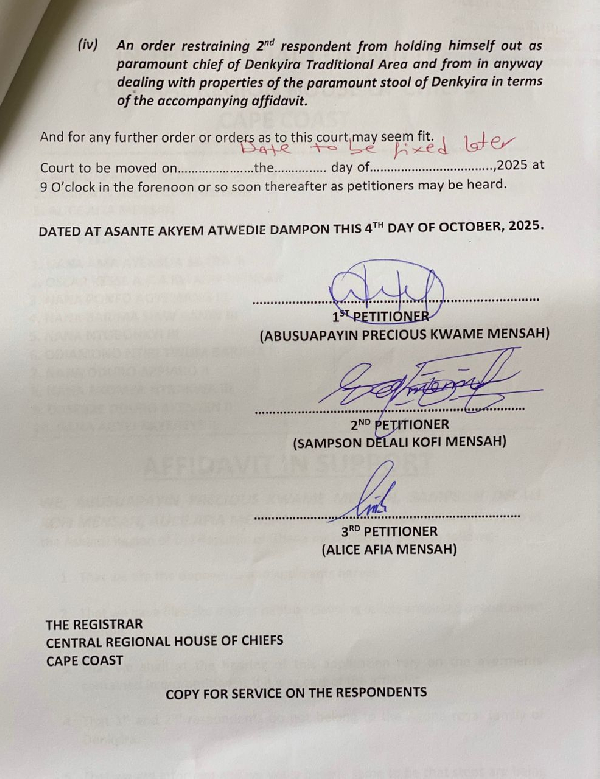
Denkyira royal family petitions against paramount chief installation, citing customary violations

0

Members of the Agona royal family of Denkyira, Old Juabeng, and New Juabeng filed the petition Members of the Agona royal family of Denkyira, Old Juabeng, and New Juabeng filed the petition

Correspondence from Central Region

A dispute has emerged within the Denkyira Traditional Area in the Central Region following the installation of a new Paramount Chief.

The installation has prompted concerns and legal challenges regarding adherence to traditional protocols and customary law.

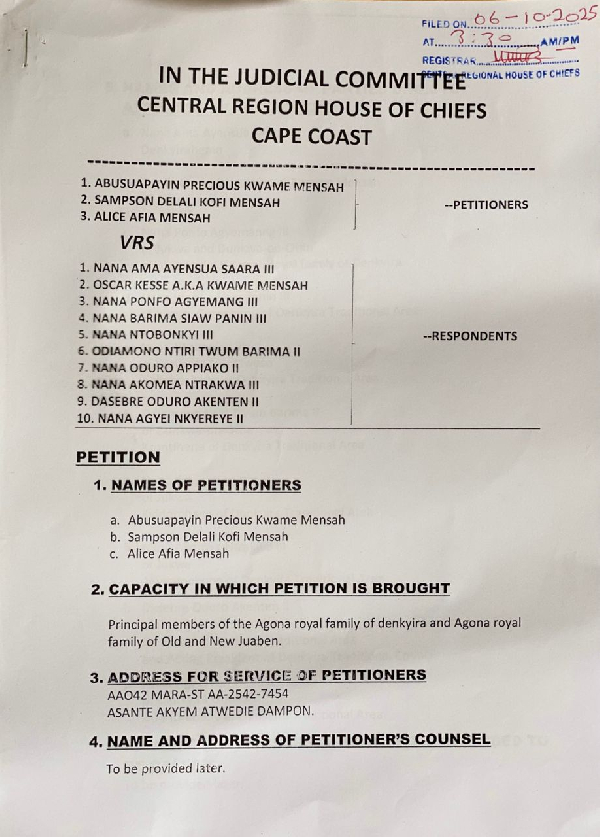
Members of the Agona royal family of Denkyira, Old Juabeng and New Juabeng have filed a petition with the Regional House of Chiefs contesting the nomination of Oscar Kesse, also known as Kwame Mensah, for the position of Paramount Chief.

The petition, filed by Abusuapanyin Precious Kwame Mensah, Sampson Delali Mensah, and Alice Afia Mensah, alleges that Oscar Kesse is not a member of the Agona royal family and, therefore, is not eligible for nomination and installation as chief.

The petition further alleges that the Queenmother of the Denkyira Traditional Council, Nana Ama Ayensua Sara III, nominated Oscar Kesse despite his not having appeared before a vetting committee. It also states that principal kingmakers were allegedly excluded from the selection process.

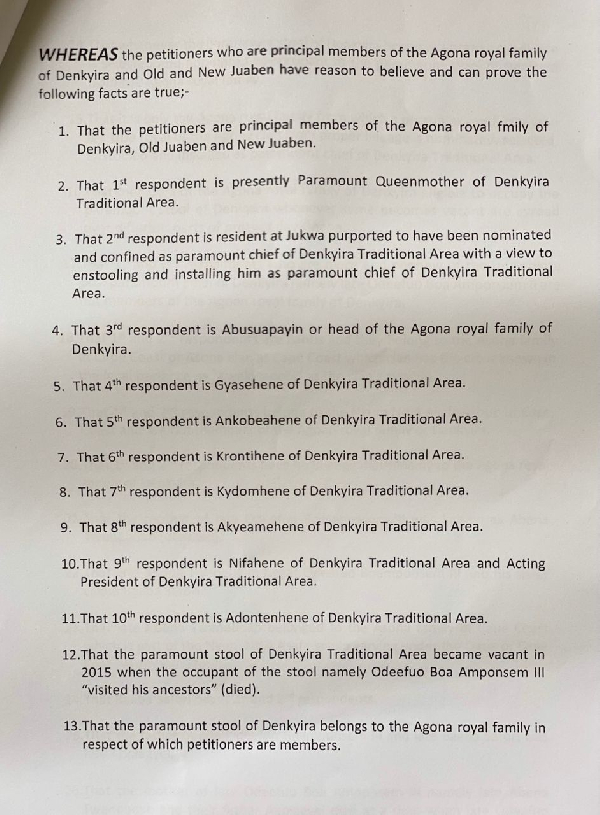
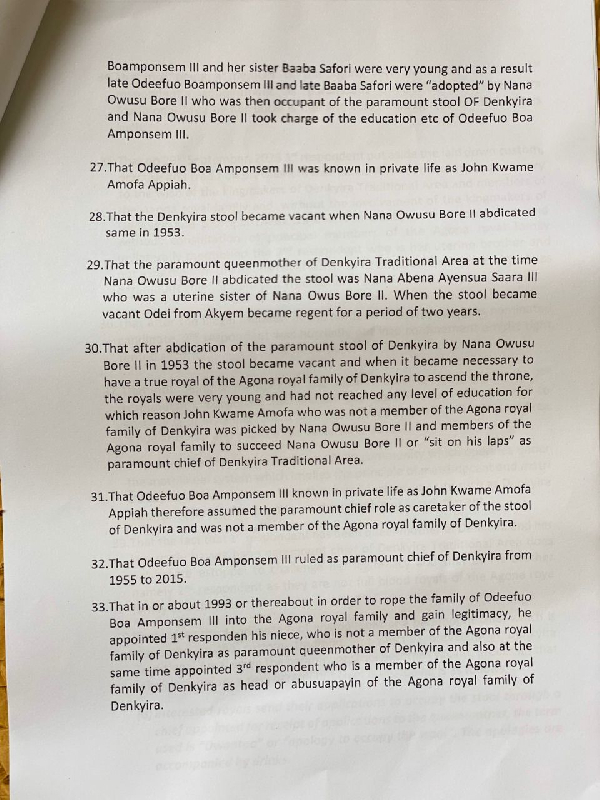
The petition outlines that the Paramount Stool of Denkyira became vacant in 2015 upon the death of Odeefuo Boa Amponsem III.

It asserts that traditionally, the occupant of the stool is selected from the Agona royal family, emphasizing the requirement for a candidate of proper lineage from that clan.

The petitioners claim that the Queenmother and Kwame Mensah, niece and nephew of the immediate past Paramount Chief, are not members of the Denkyira Agona royal family but belong to the Fante Asona family from Cape Coast.

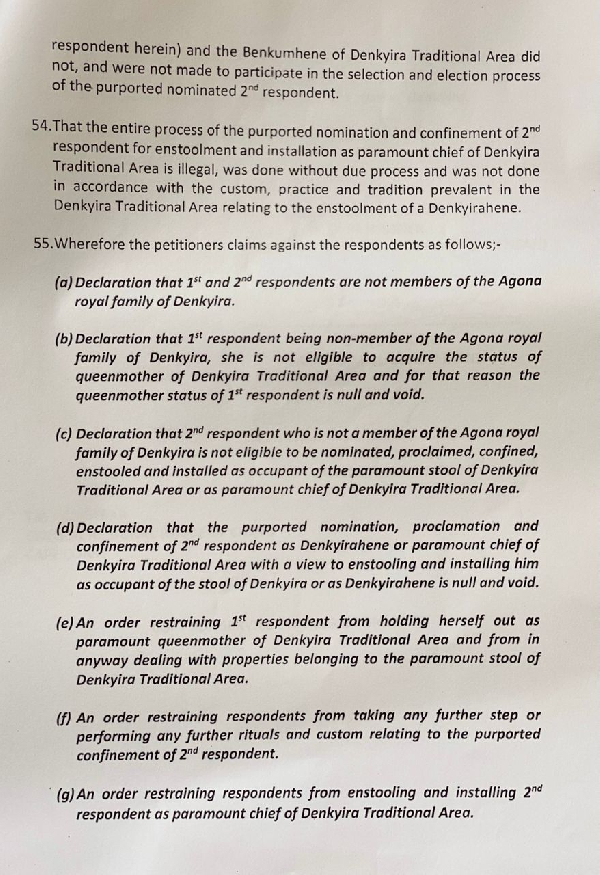
The petition alleges that the Queenmother proceeded with the nomination of Kwame Mensah without following the established customs and procedures.

The petitioners are seeking the following declarations:

• That Nana Ama Ayensua Sara III is ineligible to be Queenmother, not being a member of the Agona royal family.

• That Kwame Mensah is ineligible to be nominated, enstooled, or installed as Paramount Chief, not being a member of the Agona royal family.

• Restraining orders preventing Nana Ama Ayensua Sara III from acting as Queenmother and managing stool properties.

• An order preventing further ritual acts related to the installation.

Adding that they do expect the Regional House of Chiefs to review the petition and address the concerns raised by the Agona royal family.

Source: Agona royals of Denkyira/Old and New Dwaben

See screenshots of the petition below:


DJ Sly King joins Grammy Academy 2025 as first Ghanaian DJ

0

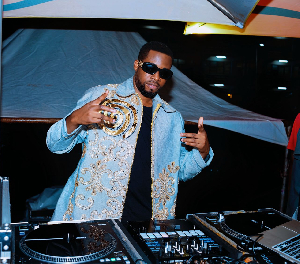
DJ Sly King has been announced as a member of the Recording Academy’s 2025 Grammy class DJ Sly King has been announced as a member of the Recording Academy’s 2025 Grammy class

DJ Sly King has been announced as a member of the Recording Academy’s 2025 Grammy class, placing him among a group of music professionals who help shape the future and decisions of the Grammy Awards.

Widely recognized as one of Ghana’s leading disc jockeys, DJ Sly King has built a strong reputation over the years.

He has performed at some of Africa’s biggest music festivals and events, including the Guinness Ghana DJ Awards, AFRIMA Awards and Afro Nation.

Beyond Africa, he has also graced international stages, performing alongside leading African artists and industry professionals.

DJ Sly King has received several awards at the Guinness Ghana DJ Awards and has been nominated at other West African music ceremonies.

His success underscores his role as an ambassador for Ghana’s music scene on the global stage.

Known for his creative approach and for bridging Ghana’s music industry with the wider world, DJ Sly King’s new membership in the Recording Academy will enable him to vote on Grammy nominees, support music advocacy and represent African talent internationally.

His journey reflects the growing influence and talent of Ghanaian DJs and serves as an inspiration for the next generation of African music leaders.

13-year-old student leads menstrual health campaign to support needy schoolgirls

0

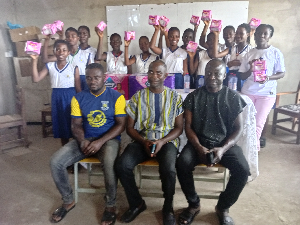
Members of the Sir Bright Foundation at the donation excercise Members of the Sir Bright Foundation at the donation excercise

Correspondence from the Eastern Region

A 13-year-old Junior High School (JHS) student of Halter Academy in Manya-Kpongunor in the Eastern Region, Tamara Oduekie Terkper, has taken a bold step to address menstrual health challenges among girls in her school and community through a campaign dubbed “One Girl, One Pad”.

Working in partnership with the Sir Bright Foundation, a non-governmental organization founded by her father, Bright Terkper — a teacher — Tamara distributed dozens of sanitary pads to her female colleagues as part of efforts to ensure that no girl misses school because of menstruation.

Tamara, who also serves as the Girls’ Prefect of Halter Academy, said she was moved by the plight of her peers who often miss classes or stay home during their periods due to the inability to afford sanitary pads.

“I can see most of my colleagues have problems when they are in their periods — some miss classes and some do not come to school at all because they don’t have pads,” she said in an interview.

“I hope the step I have taken will help them stay in school and perform well in their academics. It’s a good idea if the community comes on board to support girls who miss classes because of this problem.”

Addressing the gathering, Tamara said the gesture was not only about distributing pads but about building care, confidence, and equality among students.

“This gesture is not just about the pads; it’s about care and confidence — ensuring that no girl is left behind because of her period. Together we rise,” she said.

She appealed to Members of Parliament, chiefs, queen mothers, Assembly Members, and opinion leaders to help mobilize and provide sanitary pads to girls from underprivileged homes.

Her father, Bright Terkper, emphasized the need for sustainable community-driven solutions to menstrual poverty.

“As an educator, I’ve met many girls who miss school during their periods because they can’t afford pads. Menstruation is natural; it’s not something girls wish upon themselves,” he said.

“Government’s One Girl One Sanitary Pad initiative cannot reach everyone, so we must all help. Chiefs, MPs, queen mothers, assembly members — everyone must be part of this.”

He further advised girls facing such challenges to seek help from teachers or community leaders rather than resorting to risky behavior for financial support.

The Hidden Struggles Behind Menstrual Poverty

Menstrual health challenges remain a major obstacle to girls’ education and dignity.

Research shows that many schoolgirls, particularly in rural and low-income communities, miss between 3 to 5 school days each month because they cannot afford sanitary products.

Without proper menstrual materials, girls resort to using unhygienic alternatives such as cloth, tissue, or paper, which can lead to infections, embarrassment, and loss of confidence.

The stigma surrounding menstruation also discourages open discussion, leaving many girls to suffer in silence.

The situation often results in poor academic performance, absenteeism, and in some cases, early school dropout — widening the educational inequality between boys and girls.

Tamara’s initiative thus represents not only compassion but also a form of grassroots activism for menstrual equity — an issue that affects thousands of adolescent girls nationwide.

Community Leaders Call for Broader Support

Assemblyman for the Nuaso Old Town Electoral Area, Tetteh Isaac Kofi Nomo, commended Tamara’s initiative and underscored the urgency of making menstrual health support a national priority.

“I’ve had the chance to assist girls with sanitary pads in my area, and that’s when I realized it’s a serious problem. This should be a nationwide concern. The government cannot do it alone — opinion leaders must join the advocacy,” he said.

Similarly, the Assemblyman for the Kpongunor South Electoral Area, John Atter, urged collective community effort to complement government initiatives.

“The government is distributing pads to girls in schools, but that alone is not enough. We, the opinion leaders, NGOs, and community members, must also step in to help the girls in our schools and communities,” he said.

Empowering Boys

The campaign did not leave out the boys. Atter also donated 50 pairs of sandals to male students to support their education.

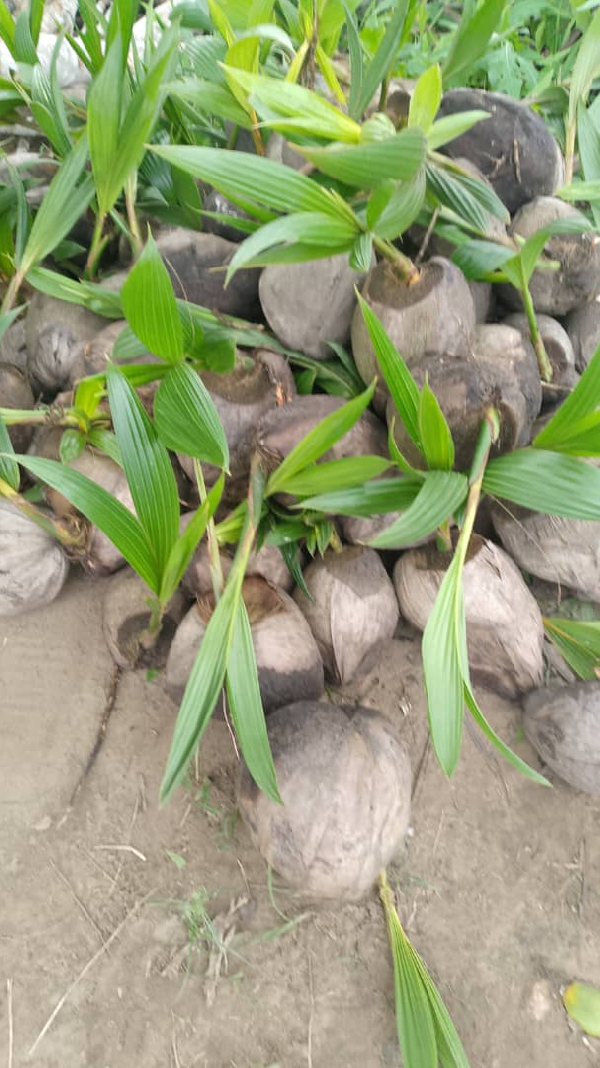
Coordinator for Coconut Federation commends President Mahama for nationwide distribution of seedlings

0

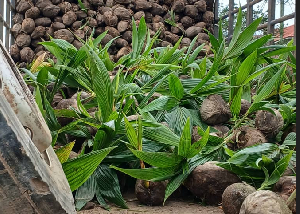
According to Ibrahim, the first phase of the distribution covered 114 farmers According to Ibrahim, the first phase of the distribution covered 114 farmers

The Coordinator for the Coconut Federation in the Oti Region, Husein Ibrahim, has commended President John Dramani Mahama for launching the nationwide distribution of coconut seedlings to farmers under the Presidential Initiatives in Agriculture and Agribusiness (PIAA).

Speaking in an interview on October 18, 2025 on behalf of the Jasikan, Guan and Biakoye District Assemblies, Ibrahim expressed his gratitude to the President and highlighted the positive impact of the initiative on local agriculture.

“I speak on behalf of the Jasikan, Guan and Biakoye District Assemblies and on behalf of the Agric Directors, Sandy Kobla Fiator for Guan, Harrison Adoglosu for Biakoye, Moses Elorm Agbanyo for Jasikan, Rashad Shaibu for Kadjebi as well as the DCE for Biakoye, Eric Kwaku Opong.

“This is a very good initiative and I thank the President for the distribution.

“We also hope that in subsequent years, the President will continue to support us,” he said.

President Mahama directs distribution of 3 million coconut seedlings to farmers

Ibrahim revealed that the seedlings have already been distributed to farmers for planting, with monitoring measures in place to ensure successful growth.

“We have shared the seedlings with the farmers to plant them and we are monitoring to ensure their successful growth,” he added.

According to him, the first phase of the distribution covered 114 farmers, while the second phase benefited 123 farmers.

“The person who received the highest number of seedlings so far is the Volta Region Manager, who had 2,500 seedlings. The rest received between 1,000 and above,” he disclosed.

In a bold, nation-transforming move, President John Dramani Mahama recently launched the distribution of three million elite coconut seedlings under the PIAA.

This flagship programme, financed by the Ghana Exim Bank, is jointly implemented by the Coconut Federation of Ghana (COCOFEG) with support from the Federation of Associations of Ghanaian Exporters (FAGE).

According to Dr Peter Boamah Otokunor, Director of PIAA at the Office of the President, “This initiative is designed to position coconut as a game-changer in Ghana’s agricultural space.

“By targeting over 20,000 farmers across 11 regions, we are not just planting trees we are planting sustainable futures and inclusive prosperity.”

Ghana’s coconut sector currently contributes more than $12 million in annual export value.

However, the growing global demand for coconut and its derivatives including water, oil, coir, husk, milk and cosmetics presents multi-billion-dollar opportunities for the country.

AM/

Watch as Ghanaians share bold ideas to end galamsey

Korle Bu fun games unite over 700 staff in sports, team bonding

0

The 2025 interdepartmental staff fun games saw a variety of activities The 2025 interdepartmental staff fun games saw a variety of activities

The Head of Public Relations at the Korle Bu Teaching Hospital, Mustapha Salifu, has provided detailed reasons for the hospital’s much-anticipated staff games.

In an interview with the media during the hospital’s annual interdepartmental fun games in Accra, Mustapha noted that the reason for the year’s activities is to create team-building opportunities and also help release stress among staff, considering the tedious nature of their work.

“This is something we have been doing over the years, as far back as 2003. We organized it, but along the line, there were breaks… We thought that this is a medium through which we can build team spirit and promote networking because Korle Bu is such a huge place that if you’re in one department, it is difficult to know others in different departments.

“When we organise forums like this, you are able to bring everybody on board, get to know ourselves better and also exercise, because our work is so tedious that some of us don’t even have time to train,” he said.

Mustapha Salifu additionally noted that another objective of the hospital is to build a staff team that can equally participate in other organized corporate games among institutions.

“One of the objectives is to build a Team Korle Bu, so when they are playing the corporate games, we will also be able to field a team.

“You can see a lot of talent on the pitch. I am sure if the Black Queens coaches were around, they would be interested in what the Korle Bu ladies are doing,” he added.

Mustapha also shared that he finds joy in seeing staff from various departments come together and actively take part in the hospital’s annual event.

“For us, it’s quite exciting to be able to gather 21 departments and participate in these games. Looking at it, I can say we have achieved our aim. In our budget, we said we were looking at around 600 people but when we did our count here, we had 730 people with their families.”

He finally called on staff and Ghanaians to engage in physical activities, adding that the hospital would organise another intriguing event in 2026, where staff from other hospitals could partake.

“The body requires some level of exercise, whether you’re a sportsman or not, so we would encourage Ghanaians in general to try and engage in exercising.

“They should look out for the Korle-Bu Staff Fun Games in 2026. It’s going to be mega. We are looking at the possibility of bringing in other hospitals so it can be more competitive,” he added.

The 2025 interdepartmental staff fun games saw a variety of activities including football, basketball, ludo, table tennis, tug of peace, musical chairs among others.

Watch as Ghanaians share bold ideas to end galamsey

Ghana will be a paradise by 2040 if UP is elected in 2028 – Alan Kyerematen

0

The Founder and Interim Leader of the United Party (UP), Alan Kyerematen, has pledged to transform Ghana into an economic “paradise” by 2040 should his party secure the mandate to govern the country in the 2028 general elections.

During the party’s official launch, the former Minister for Trade and Industry, who recently broke away from the New Patriotic Party (NPP), described the UP as a broad-based centrist party. Its core mission, he stated, is to foster a united Ghana and accelerate the nation’s economic and social transformation by mobilizing the collective strengths and talents of all citizens.

Speaking on Thursday, October 16, 2025, Kyerematen declared that the UP’s vision is to establish Ghana as the economic powerhouse of Africa by the year 2040 under a strategic initiative branded as the “Paradise Project” (Vision 2040).

The politician and lawyer further outlined the UP’s mission to build a united, peaceful, secure, and prosperous country that provides equal opportunities for all Ghanaians to realize their full potential, with a particular focus on the youth, women, and other vulnerable groups.

Kyerematen stated that the soul and strength of the UP are anchored on the following core values:

Promoting integrity and ethical leadership at all levels of national endeavour.

Introducing a culture of discipline in all aspects of national life.

Enforcing law and order and upholding respect for the rule of law.

Promoting meritocracy, good work ethics, and a passion for excellence.

Ensuring tolerance for diverse opinions and promoting decency in public discourse.

Instilling patriotism among Ghanaians and prioritizing the strategic interests of the nation above political or individual interests.

Unleashing the entrepreneurial spirit of Ghanaians.

Promoting free speech and freedom of association.

Fighting against dictatorship, oppression, and the subversion of human rights.

Promoting Ghanaian cultural values and traditions.

Mfantseman-Saltpond Development Alliance undertakes water project for Saltpond Municipal Hospital  

0

By Prince Acquah, GNA  

Saltpond (C/R), Oct. 18, GNA – The Mfantseman-Saltpond Development Alliance (MSDA), a community-led development group, has cut the sod for the construction of a sustainable water project for the Saltpond Municipal Hospital to resolve persistent water challenges at the health facility.  

Perennial water shortage has been the bane of the ancient hospital for ages, affecting the delivery of quality health care, sanitation, and attendance. 

As the referral centre for the Mfantseman Municipality serving more than 125,000 residents, the Hospital is sometimes forced to refer patients to other facilities.  

Relatives of inpatients are sometimes compelled to carry water to the hospital owing to the severity of the water situation.  

But patients and staff of the Hospital can now have a sigh of relief because the solar-powered project, which has already began, will provide the hospital with a permanent and self-sufficient water supply system to improve service delivery.  

The project includes the drilling of underground water sources, installation of high-capacity storage tanks, and an electrical pumping and boosting system fully integrated into the hospital’s existing water distribution network.  

The water system is being constructed as a legacy project for the Alliance’s maiden Saltpond Homecoming Festival on the theme: “Rebuilding, reconnecting, rising together.”  

Mr Ernest Egyir De-Graft, the President of the Alliance, highlighting the importance of water to health care, expressed the hope that the project would permanently transform the delivery of health care in the Municipality.  

He explained that the water system would guarantee a reliable, clean, and continuous water supply to sustain healthcare services.  

“This is what community leadership looks like when citizens come together to solve their own challenges rather than wait for others to act.  

“This initiative is a testament to what unity and purpose can achieve,” he noted, adding that when people shared a vision, gave their resources, and acted in faith, transformation became inevitable. 

Mr De-Graft expressed gratitude to all members of the MSDA, both at home and abroad, for supporting the project, and assured that the homecoming festival would be celebrated every year, pledging a new project for each year.  

Mr Paul Amponsah Agyakwa, the Administrator of the hospital, described the project as a timely intervention, recounting the struggles of the facility over the years.  

He recalled that from October 2024 to March 2025, water scarcity reached its peak, compelling patients carry water along with them to the hospital while many others were referred.  

It also took a dire toll on the finances of the hospital as more than GHS4,000 was spent every week on water purchases.  

“Sometimes, you have the money, and you might not even get water to buy and it affected service delivery,” he said.  

Mr Agyakwa was hopeful that the project would fully resolve the situation and the confidence of the community in the hospital.  

“We are grateful to the Mfantseman-Saltpond Development Alliance for this project, and we are hoping that it will go a long way to support quality service delivery for the people of Mfantseman and Saltpond,” he stated.  

Aside from the water challenges, the Administrator also appealed for the renovation and expansion of the hospital to befit its status as a municipal hospital.  

Madam Gifty Ankrah, the Mfantseman Municipal Director of Health, also joined the hospital to thank the Alliance for the project.  

“When cholera broke here, it was a devastating situation because our main challenge has been water.  

“You have really saved us, and we are very grateful,” she stressed.  

GNA  

Edited by Alice Tettey/Linda Asante Agyei  

Tanko Foundation champions youth empowerment at Duamenefa 2025

0

The Founder of the Tanko Foundation and Member of the Council of State for the Volta Region, H.E. Gabriel Tanko Kwamigah-Atokple, has called for stronger partnerships between government, civil society, and the private sector to sustain youth-focused initiatives like the Duamenefa Regional Tournament, describing it as “a living model for social transformation.”

Speaking at the Grand Finale of the 2025 edition of the tournament, held at the Dzodze Penyi Senior High School, H.E. Tanko commended Evangelist Emmanuel Ketaman Evortepe and the Duamenefa Foundation for using sports as a vehicle for peacebuilding, unity, and talent development across the Volta Region.

He explained that the Tanko Foundation’s sponsorship was a “purposeful and deliberate investment in human capital, community safety, and economic growth,” emphasising that the returns were visible in “lives transformed, families lifted, and communities made more cohesive.”

According to him, the partnership has produced tangible outcomes, from scholarships and vocational training to improved healthcare and sports opportunities. “Players from Ave Xevi and other communities now play professionally in Europe. More than a hundred young people have benefited from educational support. Hospital wards have been renovated, and single parents empowered,” he said.

H.E. Tanko urged government and regional authorities to institutionalise support for youth tournaments and to integrate the Duamenefa model into development plans, stressing that sustainable funding and structured talent pathways can turn youth energy into long-term productivity.

He also encouraged the private sector to invest in sports development, describing every cedi spent on youth as “a multiplier investment in peace and productivity.”

“Nation-building is not an abstract exercise,” he concluded. “It is the daily choice to invest in people and create systems that uplift. The Duamenefa Tournament is one such system, a platform for long-term transformation.”

DISCLAIMER: The Views, Comments, Opinions, Contributions and Statements made by Readers and Contributors on this platform do not necessarily represent the views or policy of Multimedia Group Limited.

DISCLAIMER: The Views, Comments, Opinions, Contributions and Statements made by Readers and Contributors on this platform do not necessarily represent the views or policy of Multimedia Group Limited.

Ken Agyapong’s remark about not conceding defeat until official declaration by the EC grounded in law – Analyst

0

Political analyst Emmanuel Alex Nti has provided a legal defense for comments made by Kennedy Agyapong regarding his decision not to concede defeat in any election until an official declaration is made by the Electoral Commission (EC).

Nti contended that the former Assin Central Member of Parliament’s remarks are grounded in law.

Speaking in an interview on Nyankonton Mu Nsem on Rainbow Radio 87.5FM, the analyst underscored that the law explicitly mandates the Electoral Commission as the sole body authorized to declare election results.

He noted that while an individual may choose to accept or concede defeat ahead of an official declaration, it is prudent and proper to allow the EC to make the final announcement to prevent unnecessary tension.

Agyapong, in his capacity as a presidential candidate for his party, had publicly stated that he would never concede defeat in any election unless the Electoral Commission officially announces the final results.

Addressing party supporters during his campaign tour of the Savannah Region, he emphasized his determination to maintain this firm stance throughout the electoral process, particularly in the face of early projections or unofficial announcements.

“Until the last constituency is counted, if I am a presidential candidate, I will never accept defeat,” he declared.

The analyst highlighted a critical distinction between legality and convention. He explained that certain electoral decisions are defined by law, while others are matters of political convention that remain consistent with legal principles.

He pointed out that Agyapong’s assertion aligns with legal provisions, as only the presiding officer of the Electoral Commission has the legitimate authority to declare an election winner in Ghana. Therefore, any other election results presented by individuals or entities prior to the EC’s official announcement are not legally recognized.

Nti affirmed that Agyapong is “correct and adhering to the law” by stating he will not concede until the EC makes its declaration after the final count. Conversely, he noted that if someone chooses to accept defeat prematurely to avert political chaos, that too is a valid position consistent with the law.

However, he clarified that this conventional approach, though useful in maintaining political stability, does not reflect the core legal framework that governs the official declaration of election results.

Sudan head coach Kwasi Appiah applauds Gov’t, Sports Ministry and GFA for inspiring Ghana to 2026 FIFA World Cup

0

Former head coach of Ghana, James Kwasi Appiah who is currently the technical head of Sudanese national team has congratulated and lauded the authorities behind Ghana’s success story to the Mundial next year.

Ghana have secured a slot to participate in the 2026 FIFA World Cup after amassing 25 points in Group I.

The West Africa country’s achievement marks their fifth appearance at the Mundial having top their group this time around after a marathon of qualifier matches. Coach Kwasi Appiah who was a witness to the Black Stars world cup qualifier campaign, has applauded all the authorities who ensured their part was well played for the betterment of the Black Stars making it to FIFA World Cup.

“I would have to congratulate the Government, the Sports Ministry, the FA as well as the technical team, not forgetting the players and supporters for their immense contribution to the team during the qualifiers”

“Ghana is a football loving state and when it comes to football, world Cup is the highest level we all want to witness. For that, if the Black Stars have been able to secure qualification to the world cup, they deserve some applause and I congratulate them all”, he said.

“It’s a well deserved ticket to the tournament, and for the coach”

The 20th FIFA World cup edition will be held in USA, Mexico and Canada next year.

Former head coach of Ghana, James Kwasi Appiah who is currently the technical head of Sudanese national team has congratulated and lauded the authorities behind Ghana’s success story to the Mundial next year.

Ghana have secured a slot to participate in the 2026 FIFA World Cup after amassing 25 points in Group I.

The West Africa country’s achievement marks their fifth appearance at the Mundial having top their group this time around after a marathon of qualifier matches. Coach Kwasi Appiah who was a witness to the Black Stars world cup qualifier campaign, has applauded all the authorities who ensured their part was well played for the betterment of the Black Stars making it to FIFA World Cup.

“I would have to congratulate the Government, the Sports Ministry, the FA as well as the technical team, not forgetting the players and supporters for their immense contribution to the team during the qualifiers”

“Ghana is a football loving state and when it comes to football, world Cup is the highest level we all want to witness. For that, if the Black Stars have been able to secure qualification to the world cup, they deserve some applause and I congratulate them all”, he said.

“It’s a well deserved ticket to the tournament, and for the coach”

The 20th FIFA World cup edition will be held in USA, Mexico and Canada next year.

MTN congratulates Black Stars on 2026 World Cup qualification 

0

By Francis Ofori, GNA

Accra, Oct.18, GNA-MTN Ghana has congratulated the senior national football team, the Black Stars, for their qualification to the 2026 FIFA World Cup, describing the achievement as a true reflection of the team’s indomitable spirit, hard work, and unity of purpose.

Ghana wrapped up their qualifying campaign with a 1-0 victory over Comoros, securing their fifth appearance at the mundial.

According to MTN, the team’s determination throughout the campaign was a testament that with focus and teamwork, success is always within reach.

It reaffirmed its unwavering commitment to supporting Ghanaian football at all levels, while standing firmly behind the Black Stars in their quest to make history on the world stage.

The telecommunication network further emphasized that its vision goes beyond sponsorship, aiming to elevate Ghanaian football to the highest international standards while inspiring the next generation of players and fans.

MTN Ghana, which took up the mantle as the main sponsor of the Black Stars months back, has been instrumental in supporting the team’s journey to the global stage.

Through financial support, logistical backing, and motivational initiatives, MTN has played a key role in creating an environment that has enabled the team to perform with confidence and pride.

Beyond the Black Stars, MTN’s sponsorship extends across all the national football teams both male and female, reinforcing its deep-seated commitment to the holistic growth and development of Ghana football.

The Ghana Football Association (GFA) has on numerous occasions lauded MTN’s long-term investment and partnership, describing it as a cornerstone of football’s revival and sustainability in the country.

GNA

Kenneth Odeng Adade

CAF Awards 2025: Black Queens get multiple nominations

0

Ghana’s senior women’s national team, the Black Queens, have received multiple nominations for the upcoming CAF Awards 2025, a recognition that highlights the team’s impressive resurgence and outstanding performances over the past year.

The Black Queens’ remarkable journey under head coach Kim Lars Björkegren has earned both individual and team accolades, showcasing Ghana’s resurgence in women’s football on the continent.

Head coach Kim Lars Björkegren has been nominated for the CAF Women’s Coach of the Year, following his impressive leadership and tactical brilliance that guided the Black Queens clinch bronze medal in the WAFCON 24.

Captain Portia Boakye, has been shortlisted for the Women’s Player of the Year award. Boakye’s leadership, experience and decisive contributions have been instrumental to the team’s success.

Young midfield sensation Stella Nyamekye has been shortlisted for the CAF Young Player of the Year award. Her creativity, composure and consistency at just a young age have made her one of the most exciting talents in African women’s football.

In the goalkeeping aspect, Ghana’s number one, Cynthia Findiib Konlan, has earned a nomination for CAF Women’s Goalkeeper of the Year. Her commanding presence, crucial saves and reliability between the posts have been instrumental to the Queens’ recent success.

Crowning the list, the team, Black Queens have been nominated for the CAF National Team of the Year, following the outstanding performances and steady rise on the continental stage.

DISCLAIMER: The Views, Comments, Opinions, Contributions and Statements made by Readers and Contributors on this platform do not necessarily represent the views or policy of Multimedia Group Limited.

DISCLAIMER: The Views, Comments, Opinions, Contributions and Statements made by Readers and Contributors on this platform do not necessarily represent the views or policy of Multimedia Group Limited.

Tanker crash at Yamoransa leaves one trapped

0

A petroleum tanker accident at Yamoransa in the Central Region has left one person trapped and raised fresh concerns over the safety of stationary fuel tankers along busy roads.

The tanker, bearing registration number GT-1150-12, was reportedly parked at the roadside when it became involved in a collision. The circumstances surrounding the crash remain unclear.

Emergency responders from the Central Regional branch of the Ghana National Fire Service (GNFS) were called to the scene and arrived promptly. Upon arrival, they found a person trapped inside the damaged vehicle and began rescue operations.

Fire service officials reported that the victim was successfully extricated from the wreckage, although the individual’s condition has not yet been made public.

Scattered personal items and spilled fuel at the crash site posed additional risks, prompting the team to secure the area for safety.

Read also

Mahama rallies support from Grenada PM for UN motion on slavery reparations

Government Commits to Paediatric Cancer Hospital Completion

0

Professor Naana Jane Opoku Agyemang

Vice President Professor Naana Jane Opoku-Agyemang has pledged government partnership with the Catholic Church to complete the Legacy of Hope Paediatric and Childhood Cancer Hospital, addressing a critical gap in Ghana’s healthcare infrastructure for children battling cancer.

The Vice President made the commitment during her address at the Closing Mass of the 2025 Rosary Congress in Accra on Saturday, October 18. The congress, which ran from October 16 to 18 at Christ the King Catholic Church, marked the first such gathering in Accra following the historic maiden congress held in Tamale earlier this month.

The hospital project, situated at Adjen Kotoku in the Ga West District of Greater Accra Region, represents the Catholic Archdiocese of Accra’s ambitious effort to address severe paediatric healthcare shortages in the capital. Currently, Accra relies primarily on Princess Marie Louise Hospital in the city center, with paediatric units scattered across Korle Bu Teaching Hospital, 37 Military Hospital, Greater Accra Regional Hospital, and the University of Ghana Medical Centre.

According to the Catholic Archdiocese of Accra, the healthcare facilities available for millions of children in the capital remain woefully inadequate, placing enormous strain on medical teams and limiting access to specialized care. The Legacy of Hope Hospital specifically targets paediatric and childhood cancer treatment, a field where Ghana’s resources are particularly stretched thin.

The project’s journey has been complex. Originally planned for a site at the Ghana Atomic Energy Commission, the hospital location was moved to Adjen Kotoku in 2023 due to contractual obligations with the commission. Archbishop John Bonaventure Kwofie, who launched the initiative with a sod cutting ceremony in January 2022, confirmed that due diligence had been completed for the new site on land owned by the Catholic Archdiocese of Accra.

This isn’t the first time government has shown interest in the project. Former Vice President Dr. Mahamudu Bawumia pledged support in June 2025, acknowledging the hospital requires substantial funding to finish. Bawumia highlighted government programs like the one constituency, one ambulance initiative and Agenda 111, while noting efforts to extend health insurance coverage for childhood cancers, sickle cell disease, and kidney dialysis.

Professor Opoku-Agyemang’s renewed commitment comes at a significant moment. The government is emphasizing partnerships between church and state to meet socioeconomic needs of citizens, a theme the Vice President has articulated in meetings with various religious organizations since taking office in January.

The Rosary Congress where she made her pledge holds special significance for Ghana’s Catholic community. It was part of a broader spiritual awakening sweeping through the country during the Catholic Church’s 2025 Jubilee Year, organized under the theme “The Holy Rosary: A Path to the Jubilee Grace.”

The maiden Rosary Congress in Tamale, which concluded on October 12, attracted over 5,000 participants and was described by Global Rosary Network founder Fr. David Obeng Paintsil as only the third such congress in Catholic Church history, following events in Poland in 1979 and the United States in 1988. The Accra congress continued that momentum, bringing together faithful for prayer, reflection, and community building.

Whether the government’s partnership with the Catholic Church translates into tangible progress on the hospital construction remains to be seen. The project represents not just infrastructure development but a test of whether collaborative approaches between religious institutions and government can address critical healthcare gaps.

For families whose children need specialized cancer treatment, the hospital cannot come soon enough. Currently, complex paediatric cases often require sending patients abroad, a reality that underscores both the medical and financial barriers facing Ghanaian families dealing with childhood cancer.

The Vice President’s commitment adds political weight to a project that has been years in development. With government backing, adequate funding, and the Catholic Church’s determination, the Legacy of Hope Hospital could eventually provide specialized paediatric cancer care that countless families desperately need.

Bawumia’s Bono East tour signals strong delegate confidence — Gideon Boako

0

A leading member of Dr. Mahamudu Bawumia’s campaign team and Member of Parliament for Tano North, Dr. Gideon Boako, has praised the level of support shown by delegates and party members in the Bono East Region, describing it as a clear sign of confidence in the former Vice President’s leadership.

Dr. Boako, speaking on the Channel One Newsroom on Saturday, October 18, said the overwhelming reception and endorsement the NPP flagbearer hopeful received suggests a strong consensus has already been built among party supporters in the area.

“There is no doubt that there seems to be some kind of consensus built as to who they have decided to give their votes to this time also to lead the party and it is quite refreshing that you start your campaign and in the first region you go to they give you such overwhelming endorsement and give you that kind of positive energy,” Dr. Boako stated.

According to him, the feedback from delegates shows that the support Dr. Bawumia enjoyed in the region during the 2023 NPP presidential primaries is not only intact but even stronger ahead of the upcoming internal elections.

“So if you want to summarise the tour of the Bono East region I can tell you that it is nothing but an optimism the people have shown that in 2023 they went for Dr Mahamudu Bawumia and this time around they are determined to go ago,” he added.

Dr. Bawumia wrapped up his Bono East tour with engagements in all 11 constituencies, ending in Techiman North and South. During his meetings, he assured delegates of his commitment to bringing transformative, world-class development to Ghana if elected President.

He cited major achievements during his tenure as Vice President, including the Ghana Card, mobile money interoperability, and the Zipline medical drone service, as proof of his readiness to lead.

Dr. Bawumia’s visit to the Bono East Region is part of his broader “Our Journey Together” campaign, which seeks to engage New Patriotic Party delegates and grassroots supporters ahead of the party’s presidential primaries.

Read also…

Electability, not seniority, should decide next NPP flagbearer – Adjei-Mensah Korsah

One trapped after accident involving petroleum tanker at Yamoransa

0

The Ghana National Fire Service (GNFS) in the Central Region has swiftly responded to an accident involving a petroleum tanker at Yamoransa, preventing what could have been a major disaster.

According to the GNFS, the Regional Headquarters received an emergency call reporting the crash of a petroleum tanker with registration number GT-1150-12. A rescue crew was immediately dispatched to the scene.

Upon arrival, personnel found the tanker parked at the roadside after the accident, with one victim trapped inside. Personal belongings and spilled oil were scattered across the road, posing both safety and fire risks.

The crew quickly cordoned off the area using safety cones and successfully extricated the trapped victim.

Officials say the swift response helped avert a potential explosion and ensured the safety of bystanders. The GNFS has since cautioned drivers, especially those operating fuel tankers, to exercise extreme caution and adhere to safety regulations to prevent similar incidents.

MTN Showcases Digital Platform Vision at Kigali Summit

0

Mtn Logo

MTN Group is positioning itself at the center of Africa’s digital transformation conversation as Mobile World Congress Kigali 2025 unfolds from October 21 to 23 at the Kigali Convention Centre. The telecommunications giant’s presence at the continent’s premier technology gathering reflects its evolution from traditional operator to platform-led digital ecosystem.

Ralph Mupita, MTN Group President and CEO, will deliver the opening keynote titled “Africa’s Future First: Determining the Path to a Digital Future,” examining how the continent navigates its digital evolution at a crucial juncture. The discussion takes on added weight given projections that Africa’s unique mobile subscribers will surpass 700 million by 2030, creating both massive opportunities and persistent infrastructure challenges.

The keynote will explore familiar yet unresolved issues: closing the usage gap, expanding broadband access, and harnessing emerging technologies like 5G, fintech, and generative artificial intelligence. These aren’t new challenges, but Mupita’s perspective carries particular authority given his role as Deputy Chair of the GSMA and his position on the UN and ITU-affiliated Broadband Commission for Sustainable Development.

Beyond Mupita’s headline appearance, MTN executives will participate in panels addressing infrastructure investment, fintech adoption, AI innovation, and online safety. The company’s exhibition stand promises an immersive experience centered on three flagship platforms that embody its strategic pivot.

MoMo, the mobile money solution that has become synonymous with financial inclusion across MTN’s markets, takes center stage alongside Bayobab, which strengthens continental infrastructure and connectivity. Chenosis, perhaps less familiar to consumers, supports developers through open APIs designed to stimulate innovation across the digital ecosystem.

The stand will also feature the MTN Skills Academy, a capacity-building initiative that has attracted over 228,000 subscribers who have completed more than 97,000 learning activities. These numbers suggest genuine engagement rather than mere registration, though whether the academy translates to meaningful employment pathways remains an open question.

In partnership with Ericsson, MTN will demonstrate several 5G applications that move beyond theoretical benefits. HADO, an augmented reality game being showcased in Africa for the first time, will illustrate low latency capabilities relevant for interactive learning, remote clinical support, and entertainment. A 5G connected robotic dog will demonstrate how such technologies might improve safety and operational efficiency in mining, utilities, and energy sectors.

Ray-Ban smart glasses featuring neural gesture control will point toward future possibilities in accessibility and workforce productivity, though their practical application in African contexts may require creative adaptation. These demonstrations aim to show how 5G can transform education, health, agriculture, energy, and manufacturing across the continent.

The event brings together leaders from government, industry, and technology sectors under GSMA hosting, with Rwanda serving as an increasingly important technology hub. President Paul Kagame will formally open the conference, underscoring the political importance African governments attach to digital transformation narratives.

As a founding partner of MWC Africa, MTN has consistently valued the platform for listening, learning, and exchanging ideas with peers and partners. The company’s participation reflects what it describes as a long-standing commitment to building networks and platforms that deliver value today while advancing technologies that will shape tomorrow.

Whether these demonstrations translate to tangible improvements in connectivity, affordability, and access for ordinary Africans remains the ultimate test. The technology exists, the platforms are being built, and the vision articulates clearly. Implementation across diverse markets with varying infrastructure capabilities, regulatory environments, and consumer purchasing power presents the real challenge that no exhibition stand can fully capture.

For now, MTN’s message emphasizes progress, partnership, and platform thinking as the pathway forward. The three days in Kigali offer a stage to reinforce that narrative to policymakers, partners, and competitors alike.

Kyerematen Rejects Money Politics as United Party Threat

0

Alan Kyerematen
Alan Cash

Alan Kyerematen has pushed back against suggestions that Ghana’s monetized political culture poses a threat to his newly launched United Party, arguing that the vast majority of Ghanaians have grown weary of vote buying and cash-driven campaigns.

Speaking in a TV3 interview monitored, the former Trade and Industry Minister insisted that political monetization primarily benefits a narrow elite within the country’s two dominant parties. According to Kyerematen, out of Ghana’s 13 million registered voters, fewer than half a million actually profit from what he described as the money culture pervading Ghanaian politics.

“If we’re talking about delegates, they don’t even make up one million people,” Kyerematen explained. He contended that this small group capturing financial benefits from political parties represents a tiny fraction of the electorate, while most Ghanaians remain excluded from such arrangements.

The United Party leader believes this widespread frustration creates a natural opening for his centrist political project. The party, which officially received its registration certificate from the Electoral Commission on October 3, was unveiled publicly on October 16 at the Coconut Grove Hotel in Accra.

Kyerematen drew a distinction between legitimate campaign financing and what he termed vote buying. Every political organization needs regular financing to function, he acknowledged, but paying voters directly for their support crosses a line his party refuses to approach. “There’s regular financing, which every political group needs, but monetization, paying to secure votes, is something we reject entirely,” he stressed.

The stance reflects the United Party’s broader positioning as what Kyerematen calls a credible centrist alternative to the New Patriotic Party (NPP) and National Democratic Congress (NDC). He suggested that Ghanaians naturally gravitate toward consensus and balance rather than political extremes, characteristics he claims his party embodies.

“Ghanaians are not extreme people,” Kyerematen said. “They gravitate toward consensus, toward balance, and that’s exactly what we represent.” The party has adopted “Ghana First” as its guiding motto, emphasizing national interest over partisan or personal considerations.

The United Party’s launch comes with ambitious economic promises, including Vision 2040, also known as the Paradise Project, which aims to make Ghana the economic powerhouse of Africa within fifteen years through transformation focused on job creation and business development.

During the TV3 interview, Kyerematen emphasized the urgency of breaking what he called the political duopoly, noting that increasing divisiveness in Ghanaian politics demands a party that can bridge the divide and provide equal opportunities regardless of age, religion, or ethnic affiliation.

Whether the United Party can translate its anti-monetization stance and centrist positioning into electoral success remains uncertain. Interim General Secretary Yaw Buaben Asamoa described the party as offering a home for Ghana’s silent majority, particularly the millions who abstained from voting in the 2024 elections out of frustration with the traditional parties.

Kyerematen’s political journey took a dramatic turn when he resigned from the NPP in 2023 to establish the Movement for Change, which has now transformed into the United Party. His departure from one of Ghana’s two major parties adds weight to his criticism of the existing political structure, though it also raises questions about his ability to build a viable third force.

The former minister’s confidence in overcoming financial disadvantages suggests he’s betting that voter frustration with money politics runs deeper than the resources his opponents can mobilize. Time will tell whether that calculation proves accurate when Ghanaians next head to the polls.

School reporting for first-year SHS students progressing smoothly — GES

0

The Ghana Education Service (GES) says the ongoing school reporting process for first-year Senior High School (SHS) students is progressing smoothly across the country.

According to Daniel Fenyi, Public Relations Officer of the GES, a three-day window — from Saturday, October 18 to Monday, October 20 — was set aside for freshers to report to their respective schools.

Monitoring teams from the Service visited several campuses on the first day of reporting to observe the process and support school authorities.

“We ourselves went round to do some monitoring and see how the freshers are being integrated into the new environment. Largely, the process was ongoing very smoothly in a lot of the places,” Fenyi said on the Channel One Newsroom on Saturday October 18.

He acknowledged that while a few schools were overwhelmed by the number of students arriving on Saturday, the situation in most cases remained under control. He added that some schools had advised students and parents to report on Monday instead, in an effort to ease congestion and better manage the flow of arrivals.

Fenyi encouraged parents who had not yet reported to ensure their wards arrive by Monday to benefit fully from orientation activities and early academic preparations.

“You wouldn’t want your child to miss the first week. If you are able to report by Monday, which is our ideal deadline, we wish that you are still able to do so. That way, your child won’t miss this important orientation exercise,” he explained.

The update from GES comes after the Ministry of Education formally welcomed the estimated 590,000 first-year SHS students placed nationwide for the 2025/2026 academic year. In a statement, the Ministry described this period as a key milestone and praised parents for their patience during the placement process.

As schools begin academic activities, authorities are encouraging students to approach this new chapter with discipline, focus, and enthusiasm, while promising continued support to ensure a smooth and inclusive educational experience for all.

Read also

Education Ministry welcomes 590K new SHS students to begin 2025/2026 academic year


Bawumia promises world-class transformation if elected as president

0

New Patriotic Party (NPP) flagbearer hopeful Dr Mahamudu Bawumia has pledged to deliver world-class development if elected President, citing his record of innovation and digital transformation as proof of his ability to deliver results.

Wrapping up his campaign tour of the Bono East Region, where he visited all eleven constituencies, Dr Bawumia said, “Ghana has shown that we can lead the world in digital innovation. What we have achieved so far is just the beginning.”

He highlighted key initiatives such as the Ghana Card, Mobile Money Interoperability, and the Zipline drone delivery system, saying these have positioned Ghana as a model for digital transformation in Africa.

“The Ghana Card has placed us ahead of countries like the UK, which is now working to build a similar system,” he said.

“Mobile money accounts have grown from 8 million to 24 million, and agents have increased from about 107,000 to nearly 900,000 — all because of the interoperability system.”

Dr Bawumia added that his presidency would build on these gains to drive greater innovation, improve public services, and enhance the lives of Ghanaians.

“When you vote for me, I will bring world-class development,” he assured.

“What I have done as Vice President shows that I can, and will, do even more as President.”

DISCLAIMER: The Views, Comments, Opinions, Contributions and Statements made by Readers and Contributors on this platform do not necessarily represent the views or policy of Multimedia Group Limited.

DISCLAIMER: The Views, Comments, Opinions, Contributions and Statements made by Readers and Contributors on this platform do not necessarily represent the views or policy of Multimedia Group Limited.

Scrap dealer in court for defiling student, infecting her with HIV

0

A 38-year-old scrap dealer has been arraigned before the Akyem Swedru Circuit Court, presided over by Mrs Akosua Ataa Nyarko, for allegedly defiling a 15-year-old first-year student of the St Francis Senior High School and infecting her with HIV.

The accused, Haruna Ishaq, pleaded not guilty to charges of abduction, defilement and willful transmission of HIV. He was granted bail of GH¢60,000 with three sureties to be justified and is expected to reappear in court on October 23, 2025, for trial.

Before the bail, the court had remanded Ishaq in police custody twice. The presiding judge initially considered a third remand, but defence counsels Nana Asare-Djikunu and Richard Offin successfully appealed for bail on health grounds, citing the accused’s need for medical attention.

According to the prosecution, the complainant, the victim’s mother, lives with her daughter at Oda New Lorry Park and trades in iced kenkey and sobolo, while the accused resides at the Oda CMB area. On April 26, 2025, the complainant sent the victim to sell drinks, but she failed to return home for three days.

After an intensive search by the girl’s friends, the accused, realising the mother was looking for her, released the victim. On April 30, 2025, the complainant reported the matter to the Domestic Violence and Victim Support Unit (DOVVSU) of the Ghana Police Service at Oda.

During interrogation, the victim disclosed that the accused had sexual intercourse with her during the three days she was held. Ishaq was subsequently arrested and, in his caution statement, admitted to being in a romantic relationship with the girl and confessed to abduction and defilement.

A medical examination conducted at the Oda Government Hospital confirmed that the victim had been defiled and infected with HIV.

Despite his earlier admission in the caution statement, Ishaq pleaded not guilty when he appeared before the court.


Source: graphic.com.gh

Ministry Welcomes 590,000 SHS Freshers With Call For Discipline

0

Ministry of Education

Over 590,000 first-year students have begun reporting to Senior High Schools across Ghana for the 2025/2026 academic year, with the Ministry of Education urging them to approach this crucial phase of their lives with dedication, discipline, and enthusiasm.

The massive influx began Saturday, October 18, 2025, with students expected to complete reporting by Monday, October 20, 2025. In a statement signed by Hashmin Mohammed, Press Secretary to the Minister for Education, the Ministry described the moment as a major milestone in the students’ academic journey and congratulated them on reaching this significant achievement.

“We urge the students to approach this next phase of their education with dedication, discipline, and enthusiasm,” the Ministry stated, emphasizing the importance of maintaining focus during what many consider the most formative years of academic development.

The Ministry also expressed appreciation to parents and guardians for their patience and cooperation throughout what proved to be a challenging school placement exercise. With over 300,000 students seeking placement but only 76,000 vacancies available in Category A and B schools, the process tested the resolve of families across the country.

The statement announced that placement into schools and residential status for the new academic year has officially closed. Parents were encouraged to proceed to their assigned schools to complete enrollment processes and help their wards settle in smoothly for the commencement of academic work.

Reaffirming its commitment to equitable and inclusive education, the Ministry assured Ghanaians it’s taking all necessary measures to ensure a smooth start to the new school year. However, that assurance comes against a backdrop of significant infrastructure challenges and financial constraints facing the education sector.

The 2025/2026 academic year operates under a blended track system, with both single-track and transitional double-track schools in place. According to schedules released by the Ghana Education Service, single-track schools will end the academic year on August 21, 2026, while double-track transitional schools will close on September 4, 2026.

Under the single-track system, first and second-year students reported on October 18, 2025, while third-year students resumed earlier on October 11, 2025. The first term will run until February 27, 2026, with a Christmas break set for December 20, 2025, to January 4, 2026. The second term begins on May 4, 2026, and closes on August 21, 2026.

For transitional schools, the timetable differs slightly. First-year students reopened on October 18, 2025, while third-year students return on October 27, 2025. Second-year students are expected back on January 5, 2026, for a blended term that includes five weeks of online learning before fully resuming in May.

The 2026 West African Senior School Certificate Examination will take place from April 20 to June 20, 2026, and the 2026/2027 academic year is expected to begin on September 11, 2026.

Education Minister Haruna Iddrisu recently admitted to major challenges in the SHS placement process and outlined urgent interventions. Speaking at a press conference in Accra on Monday, October 14, 2025, he revealed that although over 300,000 students sought SHS placement this year, only 76,000 vacancies exist within Category A and B schools, creating a significant shortfall that triggered widespread public concern.

“What we are witnessing is one of the greatest challenges in the SHS placement process,” Iddrisu said. “The arithmetic simply does not add up. We do not have enough vacancies at the Category A level for the number of desirous and qualified applicants.”

To correct this imbalance, the Minister announced that the Ministry will pursue aggressive infrastructure expansion across selected Senior High Schools, beginning in 2026, to increase intake capacity. He confirmed he’s already initiated discussions with the Minister for Finance for budgetary support and funding allocations to begin implementation.

Beyond placement challenges, schools continue facing serious financial constraints that place overwhelming burdens on school heads. The Conference of Heads of Assisted Secondary Schools has reported that recurrent funds required for smooth running of schools have been in arrears since 2021, making it extremely difficult, especially in day schools, to procure even basic administrative materials such as stationery and examination supplies.

Similarly, feeding grants for perishable and non-perishable food items have been in arrears since June 15, 2025. The one hot meal for day schools is also a challenge, with caterers threatening to stop feeding students if their arrears aren’t paid.

The Ministry of Education set up school placement resolution centers in major regional capitals on Friday, September 18, 2025, to receive complaints from parents and guardians. These centers handle complaints, verify placement details, and provide quick redress.

Speaking to media after visiting the National School Placement Resolution Centre in Accra on Thursday, October 9, 2025, Mohammed expressed satisfaction with the progress made. He noted that the Ministry had significantly reduced the large crowds that initially gathered at the center by moving in more personnel to attend to issues swiftly.

The Mahama administration intends to expand the Free SHS program started in 2017 by the erstwhile Akufo-Addo government to ensure access for all Ghanaian students while improving upon the quality of teaching, learning, and infrastructure.

For the 590,000 students now beginning their SHS journey, the challenges facing Ghana’s secondary education system may seem distant concerns. What matters most is the opportunity before them: three years to develop academically, discover their strengths, and prepare for whatever comes next.

The Ministry’s call for discipline and dedication isn’t empty rhetoric. It reflects recognition that these students face a complex educational landscape marked by infrastructure gaps, financial constraints, and systemic challenges that won’t disappear overnight. How they navigate these realities while maintaining focus on their studies will determine not just their individual futures but Ghana’s collective prospects.

Whether the government can deliver on promises of infrastructure expansion and financial stability remains uncertain. What’s clear is that the class of 2028 has begun their journey, and regardless of the obstacles ahead, their success will depend largely on the dedication and discipline the Ministry has urged them to embrace.

Guinness announces GH¢0.098 per share to all shareholders

0

Guinness Ghana Breweries PLC has announced the payment of a final dividend of GH¢0.098 to all shareholders.

This is in respect of the financial year ended June 30, 2025.

According to a circular from the Ghana Stock Exchange, all shareholders registered in the books of GGB PLC as of the close of business on Monday, October 27, 2025, will be eligible for the final dividend.

The register of shareholders will, however, be closed on Tuesday, October 28, 2025.

In view of the foregoing, the ex-dividend date has been set as Thursday, October 23, 2025.

Consequently, an investor purchasing GGB PLC shares before this date will be entitled to the final dividend.

However, an investor buying GGB PLC shares on or after Thursday, October 23, 2025, will not be entitled to the final dividend.

The final dividend of GH¢0.098 per share will be paid on December 30, 2025.

DISCLAIMER: The Views, Comments, Opinions, Contributions and Statements made by Readers and Contributors on this platform do not necessarily represent the views or policy of Multimedia Group Limited.

DISCLAIMER: The Views, Comments, Opinions, Contributions and Statements made by Readers and Contributors on this platform do not necessarily represent the views or policy of Multimedia Group Limited.

PURC Promises Balanced Tariff Framework After Sunyani Hearing

0

Purc
Public Utilities Regulatory Commission (PURC)

Ghana’s utility regulator has pledged to strike a delicate balance between consumer affordability and utility company sustainability as it finalizes tariff adjustments for the next five years, following intense public consultations that revealed deep anxiety over proposed rate increases.

Speaking at a public hearing on the 2025–2030 Major Tariff Review held in Sunyani, the Executive Secretary of the Public Utilities Regulatory Commission (PURC), Shafic Suleman, said the Commission remains resolute in building a resilient, transparent, and cost-effective utility framework that promotes fairness and efficiency for both service providers and consumers.

“Our duty is to ensure that every Ghanaian receives value for money through fair tariffs that support quality service delivery,” Suleman stated during the engagement. He assured participants there would be strong equilibrium between utility company requests and consumer demands, emphasizing transparency and accountability as guiding principles.

The Sunyani hearing brought together an impressive cross-section of stakeholders, including traditional authorities, local government officials, utility company representatives, market and farmers’ associations, tertiary institutions, and security agencies from the Bono, Bono East, and Ahafo Regions. The gathering provided a crucial platform for participants to dissect proposed tariff adjustments, voice concerns, and contribute to what PURC describes as a participatory tariff-setting process.

Suleman highlighted the strategic importance of reliable utilities to the Bono Region’s economic vitality, describing it as Ghana’s agricultural hub. He noted that farmers depend heavily on electricity and water for mechanized processing, irrigation, and cold storage facilities. Consistent utility supply also remains essential for educational institutions, healthcare facilities, and industrial operations across the region.

“A stable utility sector is the backbone of economic growth,” Suleman added. “When our farmers, hospitals, schools, and industries have reliable electricity and water, productivity increases, and communities thrive.”

He assured participants that feedback gathered during the nationwide hearings would be instrumental in informing the Commission’s final policy decisions for the 2025–2030 Multi-Year Tariff Order. Every submission, question, and recommendation represents the lived experiences of Ghanaian consumers, he said, promising that inputs would be considered carefully alongside utility company proposals to ensure the final tariff decision is both economically sound and socially responsive.

The Bono Regional Minister, Joseph Addae Akwaboa, commended the PURC for its open and consultative approach, describing it as an important step toward strengthening public confidence in the tariff-setting process. He noted that the Commission’s engagement with citizens promotes transparency and inclusiveness, assuring people that their voices truly matter in decisions affecting their livelihoods.

The Omanhene of the Sunyani Traditional Area, Odeefour Ogyeamansan Boahen Korkor, also praised the PURC for its outreach efforts while urging utility providers to intensify public education on tariff adjustments to help consumers better understand the basis for changes.

Representatives from Ghana Water Company Limited, Northern Electricity Distribution Company, Volta River Authority, and GRIDCo attended to justify their proposed tariff revisions. The utility companies explained that adjustments are necessary to maintain infrastructure, replace obsolete equipment, and manage rising operational costs, particularly the increasing expenses associated with treating polluted water sources and sustaining power generation.

William Boateng, Director of Communications at the Electricity Company of Ghana, revealed that ECG has invested $460 million to improve electricity supply but currently faces a $400 million debt, which has necessitated the proposed tariff adjustment. He said customers should understand that the increment aims to help sustain operations and continue delivering reliable power.

Seth Eric Atiapah, Chief Manager of Special Duties at Ghana Water Limited, highlighted the impact of illegal mining and pollution on water company operations. He explained that polluted water bodies significantly increase electricity consumption during treatment, damage equipment, and contribute to operational debt. These challenges are crippling the company’s ability to provide consistent water supply, he said, adding that the tariff increment will help address these issues, pay off debts, and ensure delivery of clean water.

However, not everyone left the hearing satisfied. Some participants, including teachers, health professionals, and traders, voiced concern over the magnitude of the proposed increases. They appealed to the PURC to consider moderate adjustments and recommended that tariff reviews be conducted twice annually instead of multiple times per year, which would allow consumers and businesses to plan their budgets more effectively.

The stakes are substantial. ECG has proposed a 225% increase in its Distribution Service Charge over the 2025–2030 tariff period, requesting an adjustment from the current 19.0875 pesewas per kilowatt hour to 61.8028 pesewas. Such dramatic increases, if approved, would significantly impact household and business expenses across Ghana.

Suleman was appointed Acting Executive Secretary of PURC by President John Dramani Mahama earlier this year. A Senior Lecturer at the Institute for Oil and Gas Studies at the University of Cape Coast, he holds a PhD in Energy and Sustainability from De Montfort University in the UK and specializes in energy economics, energy policy and law, climate change, and risk management.

The public hearing in Sunyani forms part of the PURC’s nationwide consultation process designed to foster transparency, accountability, and inclusivity in determining fair and sustainable utility tariffs for the next five years. The Commission has been conducting similar hearings across all regions, gathering diverse perspectives before finalizing the Multi-Year Tariff Order that will govern utility pricing through 2030.

Whether PURC can satisfy both cash-strapped consumers and debt-laden utility companies remains the critical question as the Commission moves toward its final determination.

Oti Minister Backs Volta Lake Safety Project Renewal

0

Oti Regional Minister Calls For Renewal Of Volta Lake Safety Project

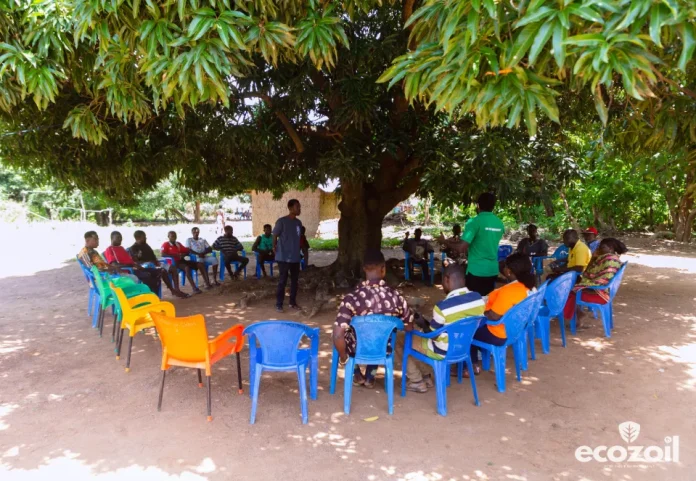
The Oti Regional Minister, John Kwadwo Gyapong, has commended Ecozoil Limited for its dedicated efforts to improve safety and protect lives on the Volta Lake, pledging full support for the renewal of the Volta Lake Transport Safety Project.

The praise came when a delegation from the company, a subsidiary of the Jospong Group, donated 200 life jackets to schoolchildren and residents in the Krachi West District on Friday. The initiative, led by the National Coordinator of the Volta Lake Transport Safety Project, Yaa Ofriwaa, and Business Development Manager Daniel Lamptey, was a direct response to the recent boat disaster that claimed 15 lives.

Gyapong applauded the Jospong Group and Ecozoil for their consistent commitment to community safety, calling them a model of corporate citizenship. “Ecozoil has demonstrated what it means to be a responsible partner in national development,” he stated. “Their response after the recent tragedy shows compassion, leadership, and a genuine commitment to saving lives. I am ready to support them wherever necessary to ensure this initiative continues.”

The minister also pledged his full support for the renewal of the Volta Lake Transport Safety Project, highlighting its crucial past role in safety education and enforcement. “This project made a difference. It improved safety awareness and helped reduce accidents. I strongly support its renewal and will work with the relevant ministries and agencies to make that possible,” he assured.

With the Volta Lake covering over 22 percent of the region, Gyapong stressed the need for a well regulated water transport system to drive growth. “Transport on the lake must be as safe and organised as transport on land,” he emphasized. “We must empower local communities, enforce safety regulations, and make sure every passenger has access to life saving tools.”

The Minister’s call comes amid persistent challenges with safety compliance on the lake. Speaking earlier on The Pulse, Gyapong expressed frustration over the continued refusal of residents in riverine communities to wear life jackets despite several public education efforts and the distribution of hundreds of life jackets.

“It is very difficult to handle this situation. No matter how we try to enforce the laws, no matter the number of life jackets that we give, they don’t want to use them,” he stated, noting that NADMO has brought many life jackets to the communities. The minister described the situation as disheartening, especially following the recent boat tragedy near Kete Krachi.

He revealed that the victims of the recent Volta Lake boat tragedy were travelling a short distance to attend a family funeral, moving from one island to another nearby island when the accident occurred. The minister explained that ongoing rehabilitation works on the Akosombo stretch have caused water from the Volta River to spread into several settlement areas, creating new islands across parts of the Oti Region.

The Transport Minister, Joseph Bukari Nikpe, has announced that personnel will soon be deployed to all boarding points along the Volta Lake to ensure strict compliance with safety protocols, especially the mandatory wearing of life jackets. The directive followed the recent boat disaster on the Oti River, which left many families devastated.

“Anyone who refuses to wear a life jacket will not be allowed to board a canoe or boat,” Gyapong revealed. He added that the deployed officers will also educate passengers and operators on water safety, including the approved passenger limits and other maritime regulations to curb overcrowding and negligence.

As part of a recent visit, Vice President Prof. Naana Jane Opoku-Agyemang, officials from NADMO, and the Ghana Maritime Authority donated over 100 life jackets to residents in the affected community and an additional 500 to adjoining areas, including Krachi Nchumuru. NADMO has also pledged to support the enforcement exercise and sustain public education efforts.

However, Gyapong expressed concern that many residents ignore safety advice despite previous sensitisation efforts by NGOs and local authorities. “The locals are stubborn and difficult to control,” he noted, highlighting child labour on the lake as another challenge, with many children seen paddling or operating canoes at an early age.

The minister assured that the Oti Regional Coordinating Council will work closely with the Transport Ministry and other agencies to strengthen enforcement and ensure lasting safety reforms along the Volta Lake. The coordinated approach involves multiple stakeholders including the Ghana Maritime Authority, which is responsible for regulating water transport.

Gyapong concluded by acknowledging the essential role of the private sector in addressing safety challenges. “Government alone cannot do it all. We need committed private sector partners like the Jospong Group and Ecozoil to help us achieve lasting safety and sustainable development for our people,” he stated.

The donation by Ecozoil forms part of the company’s ongoing campaign to promote safe practices and save lives on Ghana’s inland waterways. The initiative demonstrates how corporate social responsibility can complement government efforts in addressing critical safety challenges, particularly in underserved rural and riverine communities.

The challenge facing authorities is balancing enforcement with community engagement. While strict regulations are necessary, success ultimately depends on changing deeply ingrained behaviours and convincing residents that life jackets are essential safety equipment, not optional accessories. The planned deployment of enforcement officers represents a shift toward mandatory compliance, but sustainable change will require continued education alongside enforcement.

For the Oti Region, where more than a fifth of the territory is covered by the Volta Lake, water transport safety isn’t just a regulatory issue but a matter of economic survival and development. Improving safety standards could encourage more economic activity on the lake, facilitate regional trade, and protect the lives of thousands who depend on water transport for their daily needs.

Wendy Shay, Medikal, Tinny, Empress Gifty, others grace Wale’s ShattaFest

0

Shatta Wale is celebrating his birthday with a concert at the Black Star Square play videoShatta Wale is celebrating his birthday with a concert at the Black Star Square

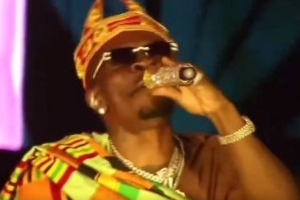
Renowned Ghanaian artiste Charles Nii Armah Mensah Jnr, popularly known as Shatta Wale, is hosting a mega birthday concert at the Black Star Square on Saturday, October 18, 2025.

The concert, dubbed ‘ShattaFest 2025 x Shattabration: The King Calls,’ is free and expected to feature big names in Ghana’s music industry.

The dress code is white. The concert is slated to run until about 10:30 p.m.

Shatta Wale, whose birthday falls on October 17, has reportedly said that the concert is a way to deepen his bond with fans.

Already confirmed performers include Wendy Shay, Medikal, Tinny, JZyNo, Jupitar, and Empress Gifty. Others include Kwame Yogot, Captan, Rashid Metal, Tsoobi Renner, Mandem Yopic, and Chuku Lion.

Watch a livestream of the concert below:

BAI

Watch the latest episode of Health Focus below

Watch as Ghanaians share bold ideas to end galamsey

Ghanaian Waiter in Dubai Earning 3,000 Dirhams Quits to Chase Fashion Dreams Back Home

0

After five years of working as a waiter in Dubai, Ghanaian fashion designer, Emmanuel Owusu, is preparing to return home to Ghana this time, to chase the dream he put on hold.

Emmanuel, 30, moved to the United Arab Emirates in 2020 with the hope of finding better opportunities to support his family and grow his fashion career. Despite having studied fashion design and tailoring in Ghana, the harsh realities of life abroad forced him into the hospitality industry, where he currently earns 3,000 Dirhams (about GHS 10,000) a month.

I didn’t plan to become a waiter, he admitted. But I had to survive. I needed to save money and help my siblings go to school. Fashion had to wait.

Now, with years of savings, business plans, and renewed passion, Emmanuel says he’s ready to return to Ghana and start his own fashion brand. His goal is to open a small studio in Accra and specialize in modern African wear for men and women.

Even though I wasn’t working in fashion, I never stopped designing, he said. I sketched every chance I got. I sent some of my designs to tailors back home to make samples. I’ve been planning this moment for years.

According to Emmanuel, his experience working in Dubai has taught him valuable lessons about time management, customer service, and professionalism, skills he believes will give him an edge in Ghana’s competitive fashion industry.

He plans to name his brand “EO Wear” and hopes to create affordable, stylish clothing that reflects Ghanaian culture with a modern twist. He’s also considering mentoring young designers and sharing his journey to inspire others who may have paused their dreams for financial survival.

There’s nothing wrong with doing what you need to do to survive, he said. But never forget why you started. I’m going back to Ghana not just to make clothes, but to make a difference.

Emmanuel will be returning home in January 2026, and he’s optimistic about what lies ahead. For him, this is not the end of a chapter, but the beginning of a new, long-awaited one.

I’ve served tables for five years, he said. Now it’s time to serve my purpose.

President Mahama’s China diplomacy powers Ghana’s 24-hour economy and green transformation

0

Ghana’s economic transformation has entered a decisive phase under President John Dramani Mahama. His recent engagements in China have deepened Ghana’s strategic partnerships, secured significant investments, and reaffirmed the nation’s readiness to embrace an inclusive and sustainable 24-hour economy.

With clear policy direction, strong diplomatic ties, and dedicated leadership, Ghana is positioning itself as West Africa’s next great centre of industrial growth and innovation.

A vision rooted in purpose

President Mahama’s diplomacy has always been purposeful, grounded in a belief that international partnerships must deliver practical benefits at home. His official visit to Beijing, where he met President Xi Jinping, epitomised that approach turning goodwill into tangible outcomes.

The discussions produced a series of landmark agreements focused on sustainability, infrastructure, and trade. Both leaders reaffirmed their commitment to promoting green transitions, tackling illegal mining, and expanding renewable energy investments.

“Diplomacy must deliver real dividends for our people. Every engagement must bring Ghana closer to industrial strength, sustainability, and shared prosperity.” – President John Dramani Mahama stated.

Strategic gains for national development

The outcomes of the Beijing visit have been both immediate and substantial. China has granted Ghana 400 million RMB in development support this year alone, including 200 million RMB already allocated for a new modern market in Aflao in the Volta Region. Another 200 million RMB will finance new projects selected by the Mahama administration.

Perhaps most significant is the decision to finalise a zero per cent tariff agreement by 28 October 2025, which will make Ghana only the second African country to enjoy such preferential access to China’s vast market. This milestone, combined with Ghana–China trade volumes exceeding 11.8 billion US dollars, promises a new era of enhanced exports and investment flows.

The big push and 24h+: driving Ghana’s economic engine

Central to President Mahama’s development agenda are two flagship programmes. The first is the National Infrastructure Development Programme popularly known as “The Big Push”, a multi-billion-dollar initiative targeting the modernisation of roads, railways, water systems, and key industrial infrastructure across the country.

The second, the 24-Hour Economy and Accelerated Export Development Programme (24H+), is designed to ensure that Ghana’s economy operates efficiently around the clock, boosting production, exports, and employment. Together, these programmes form the cornerstone of a new industrial renaissance, connecting opportunity with productivity.

President Mahama’s recent diplomatic gains with China directly support these programmes- ensuring that infrastructure development and continuous economic activity move hand in hand.

The green city: a model for sustainable growth

Among the initiatives championed by President Mahama is the Green City Project, a transformative plan to create an eco-friendly, high-tech metropolis spanning the Greater Accra, Volta, and Eastern Regions. The Green City will integrate renewable energy, digital infrastructure, and sustainable architecture, setting new standards for urban living in Africa.

An inter-ministerial committee and a transaction advisor have already been appointed to guide its development. The project will not only reduce Ghana’s carbon footprint but also generate thousands of jobs in construction, energy, and technology.

“This city will embody the future we are building – clean, digital, and inclusive,” President Mahama noted. “It is a symbol of what Ghana stands for: progress with responsibility.”

Promoting investment through professional leadership

The drive to attract global investors is being expertly led by Mr Simon Madjie, Chief Executive Officer of the Ghana Investment Promotion Centre (GIPC). A lawyer and a seasoned investment promotion professional, Mr Madjie has been instrumental in positioning Ghana as one of Africa’s most competitive and investor-friendly economies.

At the Presidential Investment Forum in Beijing, Mr Madjie invited Chinese firms to explore opportunities in electric vehicle production, renewable energy, and value-added manufacturing. He underscored Ghana’s strategic advantages from its skilled workforce and renewable energy potential to its rich deposits of lithium, bauxite, and manganese.

“Our message to investors is clear,” Mr Madjie said. “Ghana is open for business, ready for innovation, and committed to protecting your investment through sound policies and strong institutions.”

Mr Madjie also highlighted the potential of Ghana’s industrial zones, including the Dawa Industrial Zone and Appolonia City, as ideal locations for electric vehicle assembly and high-value manufacturing.

The 24-hour economy in motion

The 24-hour economy concept is not a distant aspiration, it is already taking shape. By encouraging industries, logistics, health, digital services, and manufacturing sectors to operate efficiently beyond traditional working hours, the policy is designed to expand employment, strengthen exports, and keep the economy active at all times.

Through the 24H+ framework, Ghana is developing the human capital and infrastructure necessary to sustain round-the-clock productivity. It is a model that supports both large-scale enterprises and small businesses, ensuring that no capable Ghanaian is left without opportunity.

Ghana’s confident march into the future

President Mahama’s engagements in China reflect a leader who understands that effective diplomacy must align with national priorities. His focus on the 24H+, The Big Push, and the Green City demonstrates a coherent, long-term vision for Ghana’s transformation.

Under his leadership, Ghana is regaining momentum, creating jobs, deepening international partnerships, and building infrastructure that will serve generations. With professionals like Mr Simon Madjie(Esq.) advancing Ghana’s investment agenda, the nation stands ready to seize the opportunities of the modern global economy.

President Mahama’s diplomacy has become more than statecraft; it has become a catalyst for sustainable progress. Ghana is not waiting for the future – it is building it, 24 hours a day.

DISCLAIMER: The Views, Comments, Opinions, Contributions and Statements made by Readers and Contributors on this platform do not necessarily represent the views or policy of Multimedia Group Limited.

DISCLAIMER: The Views, Comments, Opinions, Contributions and Statements made by Readers and Contributors on this platform do not necessarily represent the views or policy of Multimedia Group Limited.

Cheaper Rates Mean Nothing Without Money to Lend

0

Godfred Bokpin Economist And Professor Of Finance At The University Of Ghana

The Bank of Ghana has cut its monetary policy rate from 25% to 21.5% in September, with the 91-day Treasury Bill rate falling to 10.3% and average lending rates dropping to 24.15% by August. On paper, these developments suggest businesses and individuals can borrow at lower costs to expand and drive economic activity.

But what if there’s actually no money available to borrow? That’s the paradox Prof. Godfred Bokpin of the University of Ghana Business School is highlighting, arguing that aggressive central bank interventions to defend the exchange rate are absorbing liquidity that could have been available for businesses to borrow at low cost.

The central bank has managed to bring the cedi-dollar rate down significantly, with the currency appreciating more than 40% earlier this year, though it’s experienced volatility, swinging between levels before settling around current rates. These interventions are meant to inspire confidence and demonstrate policy effectiveness.

However, as Prof. Bokpin warns, the billions of cedis used to defend the currency through Bank of Ghana interventions have come at the expense of credit availability. “That credit, which could have been available for businesses to borrow at low cost, expand, and create jobs, is no longer available,” he explained in a recent interview.

The economist describes this as achieving exchange rate gains “at a great cost to private sector competitiveness.” He’s pointed out that while the Bank of Ghana’s interventions have helped stabilize the cedi, they’ve drained liquidity from the financial system, leaving banks cautious and credit scarce.

Speaking at Prudential Bank’s Cedi Appreciation Seminar, Prof. Bokpin said “the kind of interest rate we have can only fund imports and not production or manufacturing”, highlighting how the current environment remains misaligned with growth objectives despite lower policy rates.

He’s drawn comparisons with Kenya, where businesses can borrow at around 10%, contrasting sharply with Ghana’s environment where lending rates remain elevated despite headline improvements. “If our rates are not aligned, we are denying private capital the opportunity to expand and employ,” he noted.

Prof. Bokpin argues that policymakers have become overly fixated on the exchange rate rather than real growth indicators like job creation, business expansion, and productive capacity. He’s cautioned that “32 million people are obsessed with a low exchange rate,” even as this obsession drives destructive activities like illegal mining.

The economist emphasizes that true economic strength should be measured by tangible outcomes, not symbolic victories. Businesses and investors, especially those in the diaspora, care about stability and predictability, not whether the exchange rate is artificially maintained at a particular level.

Prof. Bokpin has also noted that when exchange rate adjustments are too sharp, “projects are put on hold,” as businesses struggle to plan effectively. Gradual, predictable movements would allow firms to make better long-term decisions.

The current situation creates a troubling disconnect. Policy rates signal that borrowing should be getting cheaper and credit should be flowing to productive sectors. The central bank has projected headline inflation will fall within its medium-term target band of 8%, plus or minus 2 percentage points, by year-end, theoretically creating space for even more easing.

GDP grew 6.3% in the second quarter of 2025, with non-oil output expanding 7.8%, led by services and agriculture. External balances have strengthened considerably, with gross international reserves standing at $10.7 billion at end-August, equivalent to 4.5 months of import cover.

Yet despite these improvements, the transmission mechanism from policy rates to actual credit availability appears broken. Banks remain conservative, businesses report difficulty accessing affordable financing, and the productive sectors that government says it wants to support struggle to secure the capital they need.

Prof. Bokpin has credited the current administration for fiscal discipline and economic management, noting clear signs of direction and leadership. He’s acknowledged that inflation fell sharply from 23.8% in December 2024 to 13.7% by June 2025, faster than previous disinflation cycles.

However, he’s urged policy managers to focus on measures that support sustainable growth and ensure adequate credit availability, rather than chasing symbolic victories through exchange rate manipulation. The concern is that short-term optics are undermining long-term development and private sector confidence.

Bank of Ghana Governor Dr. Johnson Asiama has called on banks to “stimulate credit to productive areas of the economy” including agriculture, manufacturing, infrastructure and SMEs, while maintaining prudent risk management. The question is whether banks can actually do this when liquidity is being absorbed elsewhere in the system.

The paradox Ghana faces is this: all the technical indicators suggest the economy is stabilizing and credit should be flowing. Interest rates are falling, inflation is moderating, the currency has strengthened, and fiscal discipline has improved. But if the mechanisms used to achieve exchange rate stability are simultaneously draining the liquidity needed for private sector lending, then the headline numbers mask a more complex reality.

Prof. Bokpin’s fundamental message is that economic policy should prioritize real outcomes over optics. How many jobs are being created? How many businesses are expanding? How productive is the economy becoming? If policymakers lose sight of these fundamentals in pursuit of exchange rate targets, the technical achievements may prove hollow.

The billions of cedis locked in currency defense could alternatively have funded manufacturing expansion, agricultural modernization, or small business growth. That’s the opportunity cost the economist is highlighting, even as he acknowledges the government’s overall economic management efforts.

For businesses watching from the sidelines, the message is sobering: rates may look cheaper on paper, but accessing actual credit remains challenging. The system appears to be caught between competing objectives, stabilizing the currency versus providing liquidity for growth, and for now, the former seems to be winning.

Torkonoo’s suit stalls as AG fails to file response – Kow Essuman

0

Kow Essuman, legal counsel to former President Nana Addo Dankwa Akufo-Addo, has sharply criticised the Attorney General’s handling of the ongoing legal matter involving Chief Justice Gertrude Torkonoo, describing the conduct as “extremely unfair and unconstitutional.”

In an interview, Mr. Essuman revealed that the Attorney General’s Department has yet to file its statement of case in the matter currently before the Supreme Court, despite being named as a defendant.

Ghana Faces Tough Choice on Social Media and Young People

0

social media engagement
social media

Seven million Ghanaians under the age of twenty-five are already online, navigating a digital landscape that offers genuine opportunity alongside genuine danger. Some are learning new skills, launching small businesses, or finding mentorship across borders. Others are encountering cyberbullying, exploitation, and content that harms their mental health. This tension defines the challenge Ghana faces as it grapples with protecting youth in the digital age.

The question isn’t theoretical anymore. Governments worldwide are moving from discussion to action. Australia just became one of the strictest enforcers of youth digital boundaries when it introduced legislation requiring social media platforms to prevent Australians under sixteen from creating or maintaining accounts, effective December 2025. The law targets specific harms including cyberbullying, grooming, sexual extortion, and the documented link between certain online experiences and youth suicide rates.

Ghana hasn’t gone that far. Instead, the country launched the National Child Online Protection Framework in October 2024, developed by the Cyber Security Authority and championed by Second Lady Samira Bawumia. This approach emphasizes collaboration between schools, parents, platforms, and government agencies rather than outright prohibition. The framework aims to guide young people toward safer online behavior while preserving their access to legitimate digital opportunities.

The distinction matters because Ghana’s circumstances differ fundamentally from Australia’s. While Australia has built-in advantages like sophisticated telecommunications infrastructure and high institutional capacity, Ghana operates in a different reality. Many Ghanaian families share single devices across multiple age groups. Internet cafés function as digital classrooms in rural areas where they may be the only access point available. A ban would eliminate opportunity alongside risk.

The enforcement challenge exposes deeper complications. Australia’s approach can work partly because the country has the regulatory infrastructure and resources to audit global platforms and levy penalties reaching fifty million Australian dollars for violations. Ghana hasn’t yet built equivalent capacity. Without enforcement teeth, legislation becomes performative, generating headlines while solving nothing.

Enforcement would also require age verification on a scale Ghana hasn’t attempted. This means collecting biometric data, birth records, and personal identification information from millions of young people. Ghana’s Data Protection Act, while important, remains relatively young, and the institutional capacity to secure that volume of sensitive personal data hasn’t been fully tested. The risk of exposure through inadequate security could create the very harm officials claim they’re preventing.

The digital inequality dimension cuts sharpest. A blanket ban would disproportionately harm rural youth who depend on social media for educational resources, skill development, and job networking. Urban teenagers with resources and technical knowledge could find workarounds. Rural young people would simply lose access. This transforms a protection argument into a mechanism of exclusion that widens rather than closes Ghana’s digital divide.

Evidence from other countries suggests bans don’t solve underlying harms anyway. Young people locked out of regulated platforms don’t suddenly become safer. They may shift to less moderated spaces where actual dangers escalate. Meanwhile, those who genuinely benefit from online connection, learning, and opportunity lose without gaining meaningful protection.

Ghana’s collaborative framework approach offers an alternative. It demands more sustained investment, more stakeholder coordination, and more patience than legislation. But it preserves access while building genuine digital literacy. Young people learning to navigate complex digital environments develop critical thinking skills. Schools and parents equipped with tools become active participants rather than passive regulators. Platforms responding to collaborative pressure implement safety features designed for local context.

The real conversation Ghana needs isn’t whether to ban social media for young people. It’s whether the National Child Online Protection Framework receives adequate resources, consistent stakeholder commitment, and mechanisms to actually work. Because a law that looks good in policy documents but fails during implementation would damage both youth protection and digital access.

Ghana’s seven million young people are already online. The question is whether policy will protect them where they actually are, or simply pretend they don’t exist.

Bokpin Warns Cedi Obsession Masks Deeper Economic Weaknesses

0

Prof Godfred Bokpin
Prof Godfred Bokpin

University of Ghana economist Prof. Godfred Bokpin has warned that Ghana’s policy managers have turned exchange rate management into a competition for political praise rather than a tool for building productive capacity, with billions of cedis spent defending the currency potentially better deployed in growth-generating sectors.

The Professor of Finance has consistently cautioned that the aggressive strengthening of the cedi is coming at great cost to the country, with policies sustaining it eroding private sector competitiveness and threatening environmental sustainability. His comments reflect growing concern that short-term currency gains are masking fundamental structural problems.

According to Prof. Bokpin, Ghana has become “too fixated on the exchange rate, rather than the fundamentals of the economy”, describing recent sharp currency movements as disruption rather than stability. He’s argued that policymakers treat a temporarily strong cedi as a political trophy, using it to project economic competence even when underlying fundamentals remain weak.

The economist explained that resources pumped into defending the currency could have been channeled into productive sectors to stimulate investment, create jobs, and expand domestic production. He warned that the drive to maintain a low exchange rate has contributed to environmental damage, noting that “people are dying, and we are destroying our water bodies, all because 32 million people are obsessed with a low exchange rate”, referencing illegal mining activities.

Prof. Bokpin drew comparisons with China’s economic strategy, noting that despite holding one of the world’s largest foreign exchange reserves, China has historically maintained a managed, stable exchange rate rather than chasing an artificially strong currency. That approach reflects strategic vision focused on long-term productivity, not reactionary obsession with a single indicator.

The drive to keep the cedi strong has drained liquidity, pushed interest rates higher, and weakened business confidence, conditions that ultimately hurt growth more than they help, he noted. Speaking at Prudential Bank’s Cedi Appreciation Seminar, he said “the kind of interest rate we have can only fund imports and not production or manufacturing”, highlighting how currency policy has broader economic consequences.

Prof. Bokpin acknowledged that the Central Bank has been targeting the exchange rate but noted the pace of appreciation was “too aggressive to enable planning and the entire economy to adjust effectively”. He emphasized that economic stability doesn’t mean a fixed exchange rate but rather predictable and moderate variations that allow businesses to plan.

Ghana’s approach, he argued, reflects short-term thinking that focuses on symbolic wins at the expense of long-term resilience. He warned that “any sharp appreciation that is not backed by productivity or structural reforms reverses in a matter of months. It is not sustainable”.

The economist has consistently emphasized that real economic strength isn’t about short-term numbers but about creating jobs and opportunities. While he’s credited the government and Bank of Ghana for fiscal discipline and monetary coordination, he’s cautioned that these gains must translate into affordable financing for businesses and productive investments.

Prof. Bokpin has also highlighted that “Ghana’s economic orientation is not structured to promote exports but to encourage imports”, pointing to deeper structural issues that exchange rate policy alone cannot fix. He noted that the financial system itself is designed to enable imports rather than production.

His warnings come as Ghana’s cedi has experienced significant volatility in 2025. The currency appreciated sharply from GHS 15.45 in March to GHS 10.45 by July before trending back upward to GHS 12.20 by September, illustrating the cyclical pattern he’s described.

Prof. Bokpin urged policy managers to focus on what’s economically right rather than what looks good politically, stressing that short-term optics are undermining development and real sector confidence. He’s called for Ghana to strengthen economic fundamentals and institutions rather than relying on exchange rate management as the primary tool for demonstrating economic competence.

The challenge, according to the economist, is thinking long term and building productive capacity rather than celebrating temporary currency gains that may not reflect genuine economic transformation. Without addressing structural weaknesses in manufacturing, agriculture, infrastructure, and the financial sector’s lending patterns, Ghana risks remaining import-dependent regardless of exchange rate levels.

Cedi Gains Flip Cocoa Pricing Advantage Against Ivory Coast

0

Cocoa
Cocoa

Ghana’s cocoa farmers are now receiving better prices than their Ivorian counterparts in foreign currency terms, thanks to a combination of farmgate increases and the cedi’s sharp appreciation against the dollar, a development that could significantly reduce cross-border bean smuggling.

Finance Minister Cassiel Ato Forson recently announced an increase in the farmgate price to ₵3,625 per 64-kilogram bag, up from ₵3,228.75. That translates to roughly $338.32 per bag at current rates, marking the second upward adjustment this cocoa season. The announcement came just one day after Ivory Coast raised its state-set price by 27% to 2,800 CFA francs per kilogram, the highest in that country’s history.

But here’s where currency dynamics changed everything. When converted at the new exchange rate of ₵10.70 to the dollar, Ghana’s cocoa price now equals approximately $5.29 per kilogram, or around 3,247 CFA francs. That actually exceeds Ivory Coast’s benchmark price, reversing what had been a persistent disadvantage for Ghanaian farmers.

The shift is dramatic when you consider where things stood earlier this season. When the cedi was trading at ₵12.54 per dollar, the same Ghanaian farmgate price translated to just $4.52 or 2,545 CFA francs per kilogram. At that exchange rate, Ivorian beans were about 20% more profitable, creating a massive incentive for smuggling.

According to Ivorian regulators, between 100,000 and 150,000 tonnes of cocoa beans were smuggled across borders last season alone as farmers chased better prices. The cedi’s rebound has essentially closed that arbitrage window, potentially keeping more Ghanaian cocoa within official channels.

The situation highlights how currency movements can reshape agricultural trade patterns without any change in domestic pricing policy. Ghana earns its cocoa revenues in dollars but pays farmers in cedis, so when the local currency strengthens, each dollar converts into fewer cedis. That lifts the crop’s foreign exchange value and makes Ghanaian cocoa more competitive internationally.

However, there’s a flip side to this currency strength. While it discourages illicit trade and supports macroeconomic stability, it could squeeze Cocobod’s profit margins if export earnings can’t keep pace with higher local payouts in dollar terms. The cocoa marketing board will need to carefully balance farmgate pricing with exchange rate trends to maintain both farmer incentives and sustainable operations.

Ivory Coast’s price increase also carries political undertones. The adjustment comes just weeks before a presidential election, a traditional moment for governments to court rural voters through higher producer prices. Ghana’s move, by contrast, appears more economically defensive, responding to both market pressures and the smuggling drain.

Yet even with better pricing parity, Ghana’s fundamental cocoa challenges haven’t disappeared. Production has declined steadily over the past five years, undermined by poor yields, climate pressures, chronic under-investment, and the devastating loss of farmlands to illegal mining activities. Some industry analysts warn that Ecuador could soon overtake Ghana as the world’s second-largest cocoa producer if current trends continue.

For now, though, the cedi’s firm footing has delivered Ghana a short-term tactical advantage. The stronger currency, combined with strategic price adjustments, has narrowed the smuggling window and improved the country’s competitive position in the global cocoa market. Whether that advantage can be sustained depends largely on how long the cedi maintains its current strength and whether Ghana can address its deeper production challenges.

The cocoa sector remains vital to Ghana’s economy, and maintaining farmer confidence through competitive pricing will be essential as the country works to reverse its production decline and protect its position among the world’s top cocoa exporters.

Ghana Needs Market-Driven Agribusiness Strategy, Says Director Otukunor

0

agribusiness
Agribusiness

Dr. Peter Boamah Otukunor, the Director of Presidential Initiatives in Agriculture and Agribusiness, has called for a fundamental shift in how Ghana approaches agricultural development. Rather than maintaining production-focused subsidies, Otukunor argues Ghana must build an agribusiness ecosystem centered on market demand, finance access, and integration into regional trade networks.

“We can no longer treat agriculture as a subsistence activity,” Otukunor stated during recent engagement with agribusiness stakeholders. “Agriculture must be seen as a business, one responsive to market signals, consumer demand, and global competitiveness.” His position reflects growing frustration among policymakers that decades of investment in agricultural inputs and extension services have yielded limited productivity gains because smallholders lack the financial tools and market linkages to scale.

The challenge he identifies cuts to the heart of Ghana’s agricultural dysfunction. Approximately 60 percent of Ghana’s agricultural workforce consists of smallholder farmers who remain systematically excluded from formal credit systems. High interest rates, stringent collateral requirements, and lender perceptions of agricultural risk combine to lock farmers out of the financing needed for equipment, irrigation infrastructure, and quality inputs.

Without accessible credit, smallholders cannot escape rain-fed, low-yield farming systems that perpetuate poverty and food insecurity. Otukunor has advocated for redesigning agricultural finance models to match smallholder realities. Blended finance structures, micro-leasing arrangements, and cooperative credit schemes offer mechanisms to de-risk lending while channeling private capital toward rural agriculture.

Land tenure insecurity compounds the financing problem. Many smallholders, particularly women and youth, face substantial barriers to acquiring or securing long-term leases. Without tenure security, farmers cannot use land as collateral, cannot plan multi-year investments, and cannot attract partnership capital from agribusinesses. Otukunor has pushed for policy reforms that digitize land records, decentralize land administration, and simplify acquisition processes to transform land from a social inheritance into a productive asset.

The third pillar involves deliberate market integration. Ghana’s agriculture has historically operated disconnected from reliable consumer and export markets, generating recurring crises of surplus production followed by price collapse and post-harvest losses. Otukunor emphasizes building supply chain infrastructure including logistics networks, processing facilities, cold storage systems, and regional trade connections that link farmers to buyers across West Africa.

The African Continental Free Trade Area presents significant opportunity if Ghana can position its farmers within structured value chains supported by quality standards and certification systems. Otukunor has noted that Ghana ranks as Africa’s largest coconut producer and the twelfth globally, producing approximately 600,000 metric tons across 90,000 hectares spanning eleven regions. Yet this output remains undermonetized through inadequate downstream processing and market development.

Recent initiatives reflect these principles operationally. The government has launched a Coconut Seedling Distribution Initiative to distribute three million coconut seedlings nationwide, with registration opened in September 2025, aimed at diversifying Ghana’s export sector and accelerating agro-industrialisation.

Otukunor has emphasized that youth and women, who form the backbone of Ghana’s agricultural sector, remain marginalized from opportunity despite their central role in food production and processing. President Mahama is set to launch a school farm initiative on October 21, alongside poultry and livestock training targeting 20,000 young people in modern animal production, and a Youth Agricultural Estate Programme providing commercial farming, irrigation and market access for young graduates.

The transformation strategy Otukunor advocates requires coordinated action across government ministries, financial institutions, private investors, and development partners. Rather than maintaining an input-subsidy model that creates dependency, he envisions Ghana transitioning toward a market-oriented agribusiness economy that attracts young people, empowers women, and generates inclusive prosperity through commercial opportunity rather than welfare redistribution.

His positioning as Director places agricultural modernization at the center of Ghana’s development agenda. Whether the administration can simultaneously address the macro constraints limiting agricultural competitiveness exchange rate volatility, port inefficiency, regulatory complexity will determine whether agribusiness transformation becomes reality or remains aspirational policy.

MTN Yellow ladies walk to raise awareness on breast cancer

0

Members of the MTN Yellow Network, on Saturday, embarked on a five-kilometer health walk to raise awareness about breast cancer in Ghana.

Over 150 members from various branches of the company in Accra took part in the walk, which started at MTN Head Office at Ridge through the National Theatre to Accra Sports Stadium and back.

After the walk, participants were taken through aerobics and other fitness techniques.

The network, which was formed last year, seeks to promote the welfare of women and career guidance of women.

The event aimed at raising GH₵100,000 to support breast cancer awareness initiatives in the country.

Some of the MTN management members who participated in the walk included the Chief Corporate Services and Sustainability Officer, Madam Adwoa Afiriye Wiafe.

In her address, the Chairperson of the network, Madam Antoinette Kwofie, who doubles as  Chief Finance Officer, praised the  MTN CEO, Mr Stephen Blewett for his massive support for the network.

According to the National Institutes of Health and the University of Ghana, Breast cancer is the most common cancer and the leading cause of cancer mortality among women in Ghana.

Supporting data: A 10-year review of cancer deaths at the Korle Bu Teaching Hospital found that breast cancer was the leading cause of cancer death for women.

Contributing factors: Several factors contribute to the high mortality rate, including late diagnosis due to a lack of awareness, cultural attitudes, and limited access to screening facilities. Many women are diagnosed at advanced stages (III and IV), which lowers survival rates.

DISCLAIMER: The Views, Comments, Opinions, Contributions and Statements made by Readers and Contributors on this platform do not necessarily represent the views or policy of Multimedia Group Limited.

DISCLAIMER: The Views, Comments, Opinions, Contributions and Statements made by Readers and Contributors on this platform do not necessarily represent the views or policy of Multimedia Group Limited.

Ghana Pushes Beyond Trade, Seeks Strategic Co-Investment Partnership with Türkiye

0

Investment
Investment

Ghana is advocating for a fundamental shift in its economic relationship with Türkiye, moving from conventional trade arrangements toward joint industrial ventures, technology sharing, and strategic co-investment. The call came at the 5th Türkiye-Africa Business and Economic Forum in Istanbul this week, where Ghana’s delegation outlined how Africa and Türkiye can deepen partnerships to navigate global economic turbulence and create sustainable prosperity.

Speaking at the forum under the theme “Leveraging Türkiye-Africa Relations for Mutual Gains,” Ghana’s Deputy Minister for Trade, Agribusiness and Industry, Sampson Ahi, emphasized that both regions must evolve beyond traditional import-export models. He stressed that meaningful progress requires trust, policy alignment, and structures that ensure mutual benefit rather than one-sided transactions.

Ghana highlighted Africa’s substantial untapped potential through several key assets. The continent’s rapidly expanding young population represents both a demographic dividend and consumer market opportunity. Additionally, the African Continental Free Trade Area, headquartered in Accra, creates unprecedented opportunities for integrated continental commerce. Ghana itself is advancing industrial competitiveness through initiatives including the Accelerated Export Development Programme, Feed the Industry Programme, Made-in-Ghana Promotion Campaign, and the Rapid Industrialisation for Jobs Programme.

Agribusiness remains central to Ghana’s economic transformation strategy, with government policies targeting stronger value chains, increased productivity, and greater small business participation in export markets. Deputy Minister Ahi pointed out that the continent’s global agribusiness market, valued at approximately 3.5 trillion dollars in 2024, is projected to reach nearly 5.8 trillion dollars by 2033, presenting substantial opportunity for ambitious partnerships.

Türkiye has evolved significantly from a trading partner to a strategic investor in Ghana’s economy. Turkish investment now spans infrastructure, healthcare, and manufacturing sectors. Bilateral trade between the nations reached 888 million dollars in 2023 and is projected to exceed 900 million dollars by 2025. Both governments are targeting one billion dollars in trade by 2027, signaling confidence in deepening ties.

However, Ghana indicated that future growth must extend beyond current trading patterns. At present, Ghanaian exports consist primarily of gold and cocoa while Turkish goods dominate manufactured imports. The Deputy Minister called for economic focus to shift toward joint industrial ventures in high-value sectors, particularly pharmaceutical production, renewable energy, agri-food processing, and digital infrastructure.

Achieving this transformation will require deliberate policy harmonization, investment mechanisms that reduce business risks, and strengthened public-private collaboration to attract and retain long-term capital. These structural changes, Ghana argued, are essential for sustained growth beyond cyclical commodity trade.

Ghana characterized Türkiye and Africa as “natural partners,” pointing to Türkiye’s geographic position bridging Europe and Asia, and Africa’s emergence as a global growth frontier. The Deputy Minister proposed a new South-South economic cooperation framework built on shared ambition and innovation rather than traditional donor-recipient dynamics.

Ghana also emphasized its readiness to deepen engagement with Türkiye in turning forum outcomes into tangible investment partnerships that accelerate industrialization. The government appears committed to translating dialogue into concrete action, particularly through mechanisms supporting technology transfer, skills development, and joint ventures that benefit both nations.

The forum represented Ghana’s broader push to reshape its international economic partnerships. While housing, infrastructure, and trade discussions dominated Ghana’s involvement at TABEF, the overarching message centered on transforming relationships from transactional commerce into transformational co-creation that builds institutional capacity and shared prosperity across sectors.

‘One project per year’ – Ashaiman MP pledges

0

MP for the Ashaiman Constituency, Ernest Norgbey speaking at an event MP for the Ashaiman Constituency, Ernest Norgbey speaking at an event

The Member of Parliament (MP) for the Ashaiman Constituency in the Greater Accra Region, Dr Ernest Norgbey, has asserted that the government intends to finalize one new project each year in the constituency for the next four years, ensuring that adequate funding is designated for the successful completion of these projects.

He confirmed this on October 14, 2025, in the Conference Room of the St Augustine Roman Catholic Church located in Ashaiman.

During this meeting, he reviewed his activities from the previous nine months under the new government and shared his plans with constituents through a community engagement.

At the event, representatives from various association groups, traditional leaders, political parties, youth organizations, market women, and Christian groups converged, eager to hear from the MP as he engaged in dialogue with them.

In his opening remarks to the electorate, the Member of Parliament expressed his appreciation to the voters for the confidence they placed in the ruling National Democratic Congress (NDC) under the leadership of President John Dramani Mahama during last year’s election.

While outlining the key infrastructure projects completed in the constituency, the MP emphasized advancements in education, healthcare, road infrastructure, sanitation, and job creation.

He stated that 4000 students who completed the BECE in the Junior High Schools within the constituency and are set to enroll in senior high schools have received support in the form of mattresses, making this constituency the one with the highest number of beneficiaries from this initiative.

“When we examine other nearby constituencies in Greater Accra, it becomes evident that Ashaiman has the largest number of students transitioning to Senior High Schools annually. This indicates that I am assisting a greater number of students compared to other constituencies. Last year, the figure was at its lowest with 3,500 students,” he enumerated.

He also stated that, following the directives of John Dramani Mahama, the work on the E-Blocks initiated by the NDC administration in the Ashaiman Constituency has commenced to create a conducive learning environment for the students of Ashaiman Technical Institute.

Dr Ernest Norgbey further remarked, “We have completed an Assembly Hall for Ashaiman Senior High School to support the school’s social activities. The current Government has allocated funds for other educational projects within the constituency.”

In addressing health issues, he highlighted the initiative to combat dialysis challenges in the country, which is part of the efforts towards the completion of the Municipal Dialysis Center in the constituency, aimed at alleviating the burden on the limited centers available in the country.

“The Agenda 111 is approaching its completion, which will act as an incentive to alleviate the workload at the Ashaiman Polyclinic. Additionally, I have advanced the phase and enhanced the facilities of the polyclinic by finalizing a maternity block to provide comprehensive care for expectant mothers,” he opened.

Regarding road infrastructure, he confirmed that contracts have been awarded to contractors for the completion of several essential inner roads within the constituency. Nevertheless, they will encounter a significant challenge in mobilizing the substantial funds necessary for road construction.

Dr Ernest Norgbey also emphasized the importance of crime reduction, stating, “We are implementing ‘Operation Let Ashaiman Bright,’ ensuring that every street light pole is accompanied by a street light to improve visibility. I have already acquired some motorbikes for the police to enhance patrol efforts.”

In response to concerns about youth unemployment and job opportunities, he urged the youth to seize the chance to join the Community Police and the National Fire Services to mitigate their financial difficulties.

The Member of Parliament also shared details about his partnership with the Ashaiman Old Footballers Association to develop an astroturf featuring an athletic running track and seating capacity.

The Ghanaian Lawmaker has lauded the proactive approach of the Municipal Chief Executive (MCE) of Ashaiman Municipality, Freeman Tsekpo, for his timely execution of all projects within the constituency.

“I am fortunate to have a proactive chief executive. My role is to handle the lobbying, while his role is to ensure implementation, and we are working well together,” he remarked.

Plan to test Liberian schoolchildren for drugs blocked

0

Offices of Liberia's Education Ministry Offices of Liberia’s Education Ministry

Liberia’s Education Ministry has blocked controversial plans to introduce mandatory drug testing in all of the country’s schools.

Speaking to local media, the interim head of the Liberia Drug Enforcement Agency (LDEA), Fitzgerald Biago, said school testing would help address the growing problem of drug abuse.

The announcement sparked a mixed response. Some thought it would help tackle the scourge of drugs, while others saw it as an invasion of privacy, or feared it would cost too much.

Last year, President Joseph Boakai declared drug and substance abuse a national emergency and a recent EU-backed report estimated that one in five young Liberians take drugs.

However, the Education Ministry said it was not aware of any plans to test students and added that such a decision needed to be based on concrete evidence and properly thought through.

Assistant minister in charge of students Sona Toure-Sesay told the BBC that this kind of plan required proper research.

“Let’s assume we are made aware of the proposed initiatives by the LDEA, it will require us to conduct research and review case studies from other countries where this has been successful,” she said.

Toure-Sesay also noted that testing could affect students.

“What happens to students who test positive? What are the social services in place for them? Some of them might be bullied even after returning, and it may affect their overall educational performances.”

She added that a multi-sectoral committee on drug and substance abuse had been set up, headed by the Health Ministry.

Along with strengthening health clubs in schools, she said that this would help to reduce the prevalence of drugs among students.

President Boakai dismissed the leadership of the LDEA in August this year, and recently appointed Biago, a former senior police officer, as interim head of the agency.

Ernest Ofori Sarpong Overwhelmed With Emotions As He Buries His Late ‘Son’ Michael Ofori

0

  • Popular Ghanaian businessman Ernest Ofori Sarpong was present for the funeral and burial of his ‘son’, Michael Kwesi Ofori
  • Michael Kwesi Ofori died on Tuesday, August 12, 2025, and this stirred sadness on social media
  • The General rose to prominence in September 2023 after marrying a relative of a major NPP politician

The funeral service and burial of Dr Ernest Ofori Sarpong’s godson, Michael Kwesi Ofori, was held on Saturday, October 18, 2025.

Michael Kwesi Ofori, also known as the General, died on Tuesday, August 12, 2025. Until his demise, he was the Chief Executive Officer (CEO) of Investors Hub, a consulting firm offering advisory services.

Ernest Ofori Sarpong and his family mourned the passing of Michael Ofori. Photo credit: @thegeneral_worldwide Source: Instagram

He rose to prominence in Ghana after he got married in September 2023. His wedding, held in Kumasi, generated excitement on social media.

The Investors Hub CEO tied the knot with Rita Ofori Acheampong, a relative of former Health Minister, Dr Richard Anane.

His funeral service was held at The Glorious Mega Church, New Gbawe Cathedral in Accra. Aside from his Godfather, Ernest Ofori Sarpong, some members of the East Legon Executive Club were present.

However, Ghana entrepreneur, Osei Kwame Despite, who is the bosom friend of Ernest Ofori Sarpong, was not present.

Ernest Ofori Sarpong’s first child, Cindy and her husband, Richard Peprah, were present.

At the funeral service, the renowned business mogul sat quietly. He was in all black attire and seemed to be in a sombre mood. He was accompanied by his wife.

The final funeral rites were held at the East Legon Executive Fitness Club.

Watch the video below:

Reactions to Michael Ofori’s funeral

YEN.com.gh collated some reactions to the video shared by TinaNewsGh on Instagram. Read them below:

Maame Afua Asantewaa said:

“It’s not easy. Rest in peace.”

Joshua Asiedu Mella wrote:

“Rest well, bro. We will all taste it one day as humans, my condolences to the entire family 😢.”

Eric Damoah said:

“Nana Kwasi, may your soul rest in peace. I met you at the Springs of Joy church at American House, now the Ultimate Charismatic Centre. You were such a nice and gentle protocol during your time of serving the major Prophet Dr Akwasi Agyemang Prempeh, it is well with your soul.”

Chris Larry wrote:

“Hmmmm……it’s well.”

Mahama rallies support from Grenada PM for UN motion on slavery reparations

0

President John Dramani Mahama has reaffirmed Ghana’s commitment to seeking justice for the historical atrocities of slavery, following a conversation with Prime Minister Dickon Mitchell of Grenada.

In a statement shared after what he described as a “garden conversation” with the Grenadian leader on Facebook on Saturday, October 18, Mahama reiterated that during this year’s United Nations General Assembly, he announced Ghana’s intention to file a motion at the UN next year to formally recognise slavery as one of the greatest crimes against humanity.

As the African Union’s Champion for Reparations, Mahama emphasised that the push for recognition and redress is not about seeking charity but demanding justice and restoration for the descendants of enslaved Africans.

“This cause is not a plea for charity, but a demand for justice and restoration,” Mahama said.

He expressed confidence in the support of Prime Minister Mitchell, as well as leaders across the Caribbean and the African Union, in backing the motion at the global forum.


Read also


Dozens of mourners injured at Odinga memorial in Kenya

0

Odinga's body was flown from Nairobi to Kisumu on Saturday for a final public viewing Odinga’s body was flown from Nairobi to Kisumu on Saturday for a final public viewing

Dozens of mourners were injured on Saturday at a memorial service for Kenyan opposition leader Raila Odinga as crowds swelled, with some in critical condition taken to a nearby hospital, a Kenyan Red Cross official told Reuters.

A Reuters witness saw injured people receiving treatment at the scene in the city of Kisumu in western Kenya, the political heartland of Odinga’s Luo tribe.

Two people were killed and more than 160 others were injured at Odinga’s state funeral in Nairobi on Friday, aid group Doctors Without Borders said.

Odinga, a major figure for decades in Kenyan politics who was once a political prisoner and ran unsuccessfully for president five times, died on Wednesday aged 80 in India, where he had been receiving medical treatment.

He commanded a passionate following in the East African nation and a public viewing of his body on Thursday turned deadly when officers opened fire to disperse huge crowds after they breached a gate at a stadium hosting the ceremony. Three people were killed, according to the police.

His body was flown from Nairobi to Kisumu on Saturday for a final public viewing.

Large crowds of people could be seen crying, waving Kenyan flags and at one point pushing one another in a scuffle at the Jomo Kenyatta Stadium in Kisumu.

A road procession had been planned from Kisumu to his Bondo homestead, but following the incident, his body will instead be flown to Bondo, the Standard newspaper said.

GRA Officer in hot water for alleged GH₵2,000 airport extortion

0

A Revenue Officer with the Customs Division of the Ghana Revenue Authority (GRA) stationed at the Kotoka International Airport, Torgbe Agbeti Dordoe, has appeared before an Adentan Circuit Court for allegedly extorting GH₵2,000 from a businessman without issuing an official receipt.

Dordoe, who was before the court presided over by Angela Attachie last Monday, pleaded not guilty to the charge of extortion. 

He was granted bail in the sum of GH₵10,000 with one surety to be justified. The case has been adjourned to January 21, 2026.

Brief facts

Presenting the facts, the prosecutor, Chief Inspector Maxwell Lanyo, told the court that the complainant, Horgli Wise Roland, is a businessman residing at Villagio Residence, Airport West, Accra.

According to him, the complainant returned to Ghana from Dubai on February 15, 2025, with two sets of BOSE musical instruments.

While going through arrival formalities, the accused officer, Dordoe, who was on duty, calculated the official customs duty at GH₵21,000, which the complainant paid and received an official receipt for.

However, the complainant reminded the accused that he had earlier brought the same set of instruments into the country on November 28, 2024, during which Dordoe allegedly collected GH₵2,000 in cash from him as customs duty but failed to issue a receipt.

When the complainant reminded Dordoe of the previous transaction and requested that he check the system to print the missing receipt, the officer allegedly failed to do so.

Feeling dissatisfied, the complainant lodged a report at the Airport Police Station, leading to two detectives being assigned to invite Dordoe for questioning. Upon meeting him at his post, Dordoe reportedly said he was on duty and promised to report to the station on February 17, 2025.

Chief Inspector Lanyo said the police later sent a letter to the officer in charge of the GRA Customs Division at the airport requesting confirmation of the alleged payment, but no response was received.

A follow-up letter sent to the Customs Headquarters on April 4, 2025, also went unanswered.

Subsequently, on April 28, 2025, Dordoe was served with a criminal summons to appear before the court on May 12, 2025. He appeared as directed and was later arrested and taken to the Airport Police Station.

After investigations, he was charged with the offence of extortion and arraigned before the court.

Fit-again Ghana defender Nathaniel Adjei over the moon after making FC Lorient squad – Ghana Latest Football News, Live Scores, Results

0

Ghana international defender Nathaniel Adjei has expressed his delight after making a timely return to the FC Lorient squad ahead of their Ligue 1 clash with Stade Brestois on Sunday.

Adjei was sidelined for several months after sustaining a serious injury earlier in the season, a setback that halted his impressive start to life in France following his move from Swedish side Hammarby IF.

The 23-year-old’s absence was deeply felt by FC Lorient, who have been inconsistent at the back since the start of the season.

His return to the matchday squad is a major boost for manager Olivier Pantaloni, who has consistently lauded the young defender’s discipline, work ethic, and leadership qualities beyond his years.

Reports indicate that Adjei impressed the technical team with his sharpness and commitment in training, convincing them that he is ready to return to competitive action.

The Orange lads will be counting on Adjei’s physical presence and composure at the back as they aim to climb up the Ligue 1 table.

Speaking to GHANASoccernet.com after being named in the squad, Adjei said he was over the moon and expressed both gratitude and determination.

“It’s been a tough period, but I’m thankful to God, my family, and the club’s medical staff for standing by me. I’ve worked hard to get back, and now I just want to help the team,” Adjei remarked.

Sunday’s match against Brest will not only test Lorient’s defensive resolve but also serve as a symbolic moment for Adjei, who is keen to re-establish himself as one of the most promising young defenders in French football.

If he features, it will mark his first competitive appearance since his injury layoff, and a significant step in what he hopes will be a strong comeback season.

‘Don’t chase fame abroad without first mastering your craft at home’

0

Nigeria-based Ghanaian actor, Qwasi Blay Nigeria-based Ghanaian actor, Qwasi Blay

As a growing number of Ghanaian actors seek opportunities in Nigeria’s bustling Nollywood, Nigeria-based Ghanaian actor Qwasi Blay has issued a crucial piece of advice: build an unshakeable foundation at home before venturing abroad.

Speaking with ‘Graphic Showbiz,’ Blay, whose real name is Godwin Kwesi Blay Ekra Jnr, emphasised that success on the international stage isn’t about chasing fame but about mastering one’s craft with discipline and a strong sense of identity.

“Ghanaian actors should start from home, get the foundation right, and build themselves before moving out of their comfort zone. Don’t chase fame abroad without first mastering your craft at home. Every actor is an ambassador of their country, so before you step out, make sure you’re bringing your best,” Blay stated.

For Blay, a solid foundation is built on three pillars: identity, originality, and discipline.

He urged actors not to shed their Ghanaian essence in an attempt to fit in.

“As an actor, you need to have your own identity. Our speech, our rhythm, and our essence as Ghanaians are unique. Don’t lose that. Develop your voice, your style, and your artistic essence,” he explained.

He stressed that Nollywood is a fiercely competitive international arena where excuses are not tolerated.

“Once you leave your comfort zone, you have to bring your A-game. There’s no room for lapses,” Blay noted, adding that this makes it imperative for actors to refine their technique, range, and camera presence in Ghana first.

Blay was quick to clarify that he is not discouraging the move to Nigeria.

“No, I wouldn’t advise against it. If the opportunity comes, grab it. But if it’s not there, stay focused, build yourself here, and be ready. Opportunities aren’t only in Nigeria; they’re everywhere,” he stated.

He also reminded aspiring actors that rejection is a universal part of the profession, whether in Nollywood, Bollywood, or Hollywood.

“Even in Ghana, you can attend auditions and not get picked. It happens everywhere. For me, challenges are part of life, part of the journey,” he added.

Blay speaks from experience. His own cross-border career began in 2023 after working with actress and producer Selassie Ibrahim on the Showmax original ‘The Billionaire’s Wife.’

Playing her son on screen opened doors to Nigerian producer Uche Mbunabo’s network, leading to his Nollywood debut in The Brothers’ Rivalry in March 2024.

Reflecting on Nollywood’s global success, Blay identified key areas where Ghana can learn and grow. He pointed to Nigeria’s relentless energy and cultural pride.

“Nigerians have numbers, yes, but beyond that, their energy is unmatched… That’s the extra edge,” Blay explained.

He clarified that Ghanaians are not lazy but could benefit from the stronger culture of discipline and efficiency in Nigeria.

It’s wrong to claim Nollywood made Ghanaian actors famous – Kofi Adjorlolo

Another critical lesson he noted is the vigorous promotion of culture by Nigerians.

“What I’ve realised about Nigerians is they never joke with their heritage. Like Indians, they find every chance to project their culture. That’s something we need to emulate more,” he advised.

Finally, Blay highlighted the need for Ghana to treat filmmaking as a serious business, much like Nigeria has done with platforms like YouTube.

“In Nigeria, filmmaking is treated as a business, not just a passion. Passion keeps you going, but business keeps you grounded. That’s what Ghana is lacking right now,” he stated.

He, however, expressed optimism that with the right structure and mindset, “we will get there.”

ID/AE

Consider paying Torkornoo’s entitlement – Prof Gyampo appeals to Mahama

0

Prof Ransford Gyampo is the Chief Executive Officer of the Ghana Shippers Authority Prof Ransford Gyampo is the Chief Executive Officer of the Ghana Shippers Authority

The Chief Executive Officer of the Ghana Shippers Authority, Prof Ransford Gyampo, has made an appeal to President John Dramani Mahama on behalf of former Chief Justice Gertrude Araba Sackey Torkornoo.

He appealed to the president to pay the entitlements owed to the former Chief Justice, emphasising that, if for nothing else, it should be done on humanitarian grounds.

Chief Justice Gertrude Torkornoo sacked

Prof Gyampo acknowledged that Justice Torkornoo may have misconducted herself while serving as Chief Justice, which led the Justice Pwamang Committee, established to investigate petitions calling for her removal, to recommend her dismissal.

He, however, added that paying the entitlements owed to Torkornoo could prevent any further actions from being taken by her.

“I am part of the school of thought that wants to appeal to President Mahama to consider paying the removed Chief Justice her entitlements on humanitarian grounds… She may have misconducted herself as per the work of the Pwamang Committee, but purely on humanitarian grounds, I was part of the school of thought that believes that in order not to lose all her entitlements, maybe some appeals can be made to the president to consider purely from a humanitarian ground,” he said.

President John Dramani Mahama removed the Chief Justice, Gertrude Araba Esaaba Sackey Torkonoo, from office after a constitutional inquiry established misconduct on her part.

The removal, announced in a statement dated September 1, 2025, followed the receipt of a report from a committee constituted under Article 146(6) of the 1992 Constitution to investigate a petition brought by a Ghanaian citizen, Daniel Ofori, against her.

According to the Presidency, the committee found that Justice Torkonoo had engaged in ‘stated misbehaviour’ within the meaning of Article 146(1).

Here is why Chief Justice Torkonoo was removed

Although the details of the misconduct were not fully disclosed, the report concluded that her conduct was inconsistent with the high office she occupied and, therefore, warranted removal.

MAG/AE

Watch as Ghanaians share bold ideas to end galamsey

‘I Want To Die But I Want To Eat Tteokbokki’ writer don die

0

Dem bin applaud Baek Se-hee 2018 memoir sake of how honest e show mental health conversations Dem bin applaud Baek Se-hee 2018 memoir sake of how honest e show mental health conversations

Baek Se-hee, wey be di South Korean writer of bestselling memoir I Want to Die but I Want To Eat Tteokbokki don die at di age of 35.

Her 2018 book, na a compilation of conversations wit her psychiatrist about her depression, wey be cultural phenomenon wit di themes of mental health wey readers across di world fit relate wit.

Dem write di book originally for Korean language, but di book go international afta dem publish di English translation for 2022.

Di details wey surround her death neva dey clear.

Baek bin donate her organs – her heart, lungs, liver and kidneys – wey bin don help to save five lives, di Korean Organ Donation Agency tok for statement on Friday.


Di statement bin also include comments from her sister, wey say Baek bin wan to “share her heart wit odas through her work, and to inspire hope”.

I Want to Die but I Want to Eat Tteokbokki, wey dem bin publish for 2018, bin sell more dan a million copies worldwide and dem translate am for 25 countries.

Dem bin celebrate di runaway bestseller sake of say she make conversations around mental health normal and how e dey affect inner struggles – di most of dem na di writer personal conflict between depressive thoughts and her appreciation for simple joys.
“Di human heart, even wen e wan die, many times want to eat tteobokki di same time too,” na di most popular line for di book.

Who be Baek Se-hee

Dem born her for 1990, Baek Se-hee do creative writing for university and she bin work for five years for one publishing house, according to her short biography on Bloomsbury Publishing, wey bin produce di English version of her 2018 memoir.

Anton Hur, wey bin translate Baek book into English, bin write for Instagram say her organs don save five pipo but “her readers go know say she touch yet millions of lives more wit her writing”.

“My thoughts dey wit her family,” im write.

For ten years, she bin receive treatment for dysthymia, one mild but long-lasting type of depression, wey bin form di background of her bestseller, na wetin her Bloomsbury bio tok.

Dem bin publish di sequel, I Want to Die but I Still Want to Eat Tteokbokki, for Korean language for 2019. Dem bin also publish di English translation for 2024.

Tributes dey pour for social media. “Rest softly,” one of di comment on Instagram tok. “Thank you as you save us wit your honesty.”

Another Instagram user bin say anytime dem read Baek memoir, dem dey get “deep comfort from every sentence and dem bim dey grow wit am”.

“To create any single book wey fit lift pipo up… no be easy task, and I get respect for you wey I no fit describe for you to achieve,” dem write.

Dr. Bawumia promises to build on Ghana’s digital gains to deliver world-class development

0

Former Vice President and New Patriotic Party (NPP) flagbearer hopeful, Dr. Mahamudu Bawumia, has promised world-class development for Ghana if elected president. He argues that his record as Vice President—especially his focus on innovation and technological advancement—proves this goal is achievable.

Dr. Bawumia highlighted key government achievements like the Ghana Card and Mobile Money Interoperability as major strides in digital transformation, noting that the Ghana Card puts Ghana ahead of many developed nations, including the UK, which is now considering a similar system.

Classic Button-Down Gowns For Women

0

Button-down gowns have been a staple in women’s fashion for decades, and for good reason. They are classic, versatile, and can be dressed up or down for any occasion. Whether you’re heading to the office, going out for a casual lunch, or attending a fancy event, a button-down gown is the perfect choice.

There are many different styles of button-down gowns for women, but the classic Oxford shirt is a timeless favorite. These gowns are usually made from durable cotton fabric and feature a buttoned collar, buttoned cuffs, and a button-down front. They come in a variety of colors and patterns, making it easy to find one that suits your personal style.

Another popular style of button-down gown for women is the chambray gown. Chambray is a lightweight, breathable fabric that is perfect for warmer weather. Chambray gowns typically have a more relaxed fit and can be worn with jeans for a casual look, or with tailored pants for a more polished ensemble.

For a more feminine twist on the classic button-down gown, consider a blouse with ruffles, lace, or embroidery. These details add interest and flair to a traditional gown and can be dressed up with a skirt or dress pants for a special occasion.

When shopping for a button-down gown, it’s important to consider the fit and fabric. Look for a gown that fits well in the shoulders and bust, with enough room to move comfortably. Choose a fabric that is breathable and easy to care for, such as cotton or a cotton blend.

Classic button-down gowns for women are a wardrobe essential that can take you from work to weekend with ease. Whether you prefer a traditional Oxford gown, a casual chambray gown, or a feminine blouse with embellishments, there are plenty of options to choose from. Invest in a few quality button-down gowns and you’ll always have a timeless and versatile piece to reach for in your closet.

Alan would have been NPP’s frontrunner if he had stayed – Ekow Essuman

0

Counsel to former President Akufo-Addo has said that the flagbearer of Movement for Change, Alan Kyerematen, would have been the frontrunner in the New Patriotic Party’s (NPP) upcoming presidential primaries had he remained in the party.

Speaking on Joy Prime Prime Insight on Saturday, October 18, 2025, Ekow Abaka Essuman noted that timing and patience are critical in politics, stressing that Mr. Kyerematen’s departure from the party cost him a strong opportunity for a political comeback.

“If Alan Kyerematen had stayed in the NPP after losing the primaries to Dr. Bawumia, around this time, he would have probably been the frontrunner in our primary,” Mr. Essuman said.

When asked if he felt Mr. Kyerematen had lost a political opportunity, he replied:

“Yes, politics is all about timing. You bid your time, or you find the right opportunity, and then you strike. Barack Obama, when he realized that the opportunity window had opened, he struck.”

Mr. Kyerematen, who served as Minister of Trade and Industry under President Akufo-Addo, resigned from the New Patriotic Party in 2023 after placing third in the party’s Super Delegates Congress.

He subsequently formed the Movement for Change and contested the 2024 presidential election as an independent candidate.

DISCLAIMER: The Views, Comments, Opinions, Contributions and Statements made by Readers and Contributors on this platform do not necessarily represent the views or policy of Multimedia Group Limited.

DISCLAIMER: The Views, Comments, Opinions, Contributions and Statements made by Readers and Contributors on this platform do not necessarily represent the views or policy of Multimedia Group Limited.

Adom-Otchere questions transparency in alleged Telecel-AT Ghana deal

0

Host of Good Evening Ghana, Paul Adom-Otchere, has expressed deep concern about what he describes as a lack of transparency in the alleged takeover of AT Ghana by Telecel, warning that the deal could have serious implications for the country’s telecommunications sector.

Speaking on The Big Issue on Channel One TV on Saturday, October 18, Adom-Otchere described the situation as “very dangerous,” calling for greater accountability and clarity from government officials involved in the process.

“There is something very dangerous happening in the AT-Telecel matter,” Adom-Otchere said. “The point is that there is very little transparency in this problem and the minister must come better.”

He questioned the rationale behind the reported transaction, citing figures that suggest Telecel — which allegedly owes about GHS400 million — is positioned to take over AT Ghana, a company said to have a smaller debt of about GHS200 million.

“If these figures are true, then it means that the company with a bigger debt is being asked to take over the company with the smaller debt,” he noted.

Adom-Otchere also raised questions about a pledged $150 million investment from an entity named Rektron, reportedly undergoing evaluation by KPMG on behalf of the Ministry of Communications. He criticised the lack of follow-up on the findings of that assessment.

“There is also the issue of a $150 million that has been pledged by an investor called Rektron to invest in AT, which according to the minister had been subjected to a KPMG analysis. That KPMG analysis is yet to come out… He has not come back to say what KPMG said,” Adom-Otchere said.

Beyond the financial and procedural concerns, the broadcaster warned about the human impact of the alleged transaction, stressing that government decisions in critical sectors like telecommunications must not lead to mass layoffs.

“There are concerns that about 1,000 jobs may be lost,” he cautioned. “The important thing is that no minister for Ghana who has been elected should make any policy decision in a sensitive sector like telecoms that should occasion job losses.”

His comments follow a recent denial by Telecel Ghana of claims by the Minority in Parliament that it is involved in a “secret takeover” of AT Ghana. At a press briefing on October 15, Ranking Member on the Communications Committee, Matthew Nyindam, argued that the transaction went beyond a private business deal and had implications for national interest.

Telecel, however, dismissed the allegations as “misleading” and “inaccurate.” The company explained that its collaboration with AT Ghana stemmed from a directive by the National Communications Authority (NCA) to provide national roaming support after AT Ghana’s network sites were shut down by ATC Ghana over unpaid debts.

According to Telecel, the arrangement is temporary and is being supervised by KPMG, which was appointed by the government to assess the matter. The company also rejected claims that it is financially distressed, stating that it has invested more than US$240 million in its Ghana operations since acquiring the business in 2023.

“Till date, none of the over 600 employees in the organisation have been made redundant as promised,” the company said, noting that it has consistently been certified as a “Top Employer.”

Telecel further defended its corporate social responsibility initiatives, saying all sponsorship requests were initiated by local Traditional Councils, not government officials.