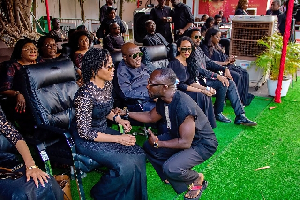
Veteran Yoruba actor Ebun Oloyede, popularly called Olaiya Igwe, has shared one of the deepest regrets of his life.
The actor said his regret was refusing to lend his car to gospel singer Tope Alabi and her husband for their wedding.
Naija News reports that he narrated the incident during Tope Alabi’s 55th birthday celebration, recalling how he had just bought a Mercedes-Benz V-Boot, proudly labeled “Ololade Mr Money 1” after the success of his film.
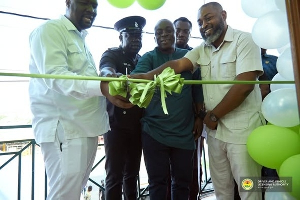
Accra, Oct. 31, GNA – The Design and Technology Institute (DTI) has commissioned Africa’s first American Welding Society (AWS)-certified Welder Training and Testing Centre, marking a significant milestone in Ghana’s technical and vocational education and training (TVET) landscape.
The state-of-the-art facility, located at DTI’s campus, is equipped with a 40-booth workshop, digital welding simulators, and a metallurgical training laboratory.
It is designed to train and certify Ghanaian welders to international standards, positioning them for opportunities both locally and globally.
Speaking at the commissioning ceremony, Dr. Archibald Buah-Kwofie, Acting Director of the Nuclear Power Institute at the Ghana Atomic Energy Commission, described the centre as a “strategic national asset” and a “catalyst for transforming Ghana’s TVET landscape.”
“This facility is not just another training centre. It is a bold statement that Ghana is ready to train its youth to world-class standards,” he said.
Dr. Buah-Kwofie also underscored the importance of welding in Ghana’s emerging nuclear energy sector, noting that certified welders would be critical in the construction and maintenance of future nuclear facilities.
He called for a national welding dialogue to establish a framework for standardizing training, aligning curricula, and certifying welders across the country.
“This commissioning must inspire us to do more. Every region of Ghana should have access to a world-class TVET facility,” he added.
DTI President, Ms. Constance Swaniker, highlighted the institute’s five-year journey advocating for stronger collaboration between academia and industry.
She noted that the skills mismatch between graduates and industry needs has contributed to high youth unemployment and low productivity.
“DTI’s 70% employability score, validated by the ISE assessment, is a testament to our commitment to co-designed curricula, entrepreneurship training, and industry-led instruction,” she said.
The centre integrates soft skills training facilitated by clinical psychologists and arts-in-education specialists, ensuring graduates are not only technically competent but also emotionally intelligent and workplace-ready.
Ms. Swaniker said the initiative reflected a growing alignment between the public and private sectors to build a skilled, confident, and globally competitive workforce among Ghana’s youth.
She said the Centre, equipped with a 40-booth workshop, digital welding simulators, and a metallurgical testing laboratory, will offer internationally certified training and testing services to meet the demands of both local and global industries.
“This Centre sets a new benchmark for human capital development in Ghana’s TVET sector,” Ms. Swaniker said.
“It creates dignified, well-paying job opportunities for our youth, reduces costs and delays for industry, and transforms petroleum revenues into human capital dividends for Ghana.”
Ms. Swaniker highlighted the importance of bridging the gap between academia and industry, noting that the disconnect had contributed to high youth unemployment and limited productivity.
She cited global examples from China and India where structured collaboration between academia and industry has led to innovation and job creation.
She said DTI’s efforts over the past five years—including strategic partnerships, curriculum alignment, and work-based learning initiatives—had resulted in a 70 percent employability score for its graduates, according to the IFC Vitae Assessment.
The Centre adopts the AWS SENSE curriculum and aims to produce highly skilled welding and fabrication professionals who meet international standards.
It will also serve as a hub for training, inspection, and testing services for the industry.
Ms. Swaniker expressed gratitude to the Mastercard Foundation and other stakeholders for their continued support in advancing TVET in Ghana.
Mr Isaac Tetteh, DTI’s Welding and Fabrication Department Head, emphasized the centre’s role in producing globally competitive welders aligned with AWS, ASME, and ISO standards.
He called for strategic partnerships with international certification bodies and local regulators to expand certification opportunities and support Ghana’s industrialization agenda.
Additionally, he highlighted its state-of-the-art Mechanical and Metallurgical Testing Laboratory as a game-changer for the country’s industrial sector.
“For the first time in Ghana’s TVET space, organisations in oil and gas, power generation, mining and construction can conduct all required mechanical tests and welder qualifications locally,” Mr. Tetteh said, adding that it would significantly reduce dependency on international testing services and support local content development.
Furthermore, he announced plans to position DTI as the continent’s ‘Welding Centre of Excellence’ through strategic partnerships with globally recognised bodies such as DNV and ABS.
These collaborations will pave the way for advanced professional certifications, including Certified Welding Inspector and NDT certifications, crucial for the Ghana’s industrialisation and energy transition.
Moreover, Mr. Tetteh reaffirmed centre’s commitment to holistic development, integrating soft skills training facilitated by clinical psychologists to produce “well-rounded professionals who are not only technically competent but also emotionally intelligent, disciplined, and industry-ready.
The Centre adopts the AWS SENSE curriculum and aims to produce highly skilled welding and fabrication professionals who meet international standards.
It is expected to reduce reliance on foreign labour, enhance local content in major infrastructure projects, and create dignified, well-paying jobs for the country’s youth. GNA Christian Akorlie
Accra, Oct 31, GNA- As part of touching base with NDC party faithful, a former Deputy Upper West Regional Minister and former District Chief Executive , Mr Abu K. K., has commenced a week-long thank-you tour of the Daffiama/Bussie/Issa (DBI) Constituency. The aim was to express appreciation to National Democratic Congress (NDC) executives and supporters for their immense contribution to the party’s resounding victory in the 2024 general election.
In a statement copied to the Ghana News Agency in Accra on Friday, Mr Kasangbata explained that the visit was a continuation of his long-standing commitment to the grassroots, recalling how he personally toured the constituency during the 2024 campaign period to mobilize support for the NDC’s presidential and parliamentary candidates. He said it was only right to return and thank the people for responding positively to his call and working tirelessly to secure victory for the party.
“As part of the exercise, the meetings were clustered into two and held at Tabiasi and Wogu clusters, in the ultra-modern party offices constructed by Hon. Abu K. K. himself as his personal contribution to the NDC’s development in the constituency”.
The tour, according to the statement officially began on 29th October 2025 in the Issa Zone, aims to recognize and celebrate the selfless contributions of zonal and polling station executives whose dedication and commitment ensured a decisive win for the party.
Addressing the gatherings, the formerDeputy Upper West Regional Minister commended the executives for their hard work and loyalty throughout the campaign period and encouraged them to remain proud of the choice they made, stressing that the NDC government had already begun implementing sound economic policies.
He cited the decline in inflation and improved economic performance within the first nine months of the NDC government as evidence that the party’s leadership was delivering on its promises to restore stability and growth to the Ghanaian economy.
Mr Abu also acknowledged the high expectations among party members but urged them to exercise patience, unity, and faith in the government’s ongoing efforts to address their needs. He reminded them that meaningful progress could only be achieved when the NDC remained in power and called for continued togetherness to sustain victory in future elections.
Using himself as an example, the former Deputy Regional Minister advised supporters not to lose hope if their personal expectations have not yet been met. He assured them that the party valued every contribution and would ensure that all loyal members were duly recognized in due course.
He reaffirmed his unwavering commitment to the development of the Daffiama/Bussie/Issa Constituency and the Upper West Region, urging members to remain steadfast, disciplined, and united behind the NDC government as it continued to deliver on its mandate for a better Ghana.
As part of the next phase of his thank-you tour, he was expected to visit the Fian, Bussie, and Daffiama zones, where he would engage party members and stakeholders to complete the land acquisition process for the construction of similar ultra-modern party facilities across the constituency—further demonstrating his dedication to strengthening the NDC’s grassroots structures and promoting inclusive development.
He indicated that after the first leg of his thank-you tour in the DBI Constituency, he will continue to all other constituencies in the Upper West Region, where he actively participated during the campaign period. “These include Nadowli-Kaleo, Lawra, Lambussie, Nandom, Sissala West, Sissala East, Jirapa, and Wa Central, where he intends to replicate similar engagements with party members and stakeholders.” GNA Edited by George-Ramsey Benamba
The business community says reliable and affordable energy will be crucial to sustaining the country’s industrialization drive as government advances plans for a 24-hour economy.
President of the Ghana Union of Traders Association (GUTA), Joseph Obeng, speaking on the sidelines of the Power Energy Ghana Expo and BuildExpo Ghana 2025, said high energy costs continue to pose a major challenge for manufacturers and traders seeking to expand their operations.
As part of it recommendations, GUTA is urging greater efforts to scale up the adoption of renewable energy, emphasizing the need to make clean energy sources more affordable and accessible to businesses.
“In our quest to industrialize as a nation, it is very important we have affordable energy sources otherwise it will be in vain because of competition with the rest of the world. It is very important for us to access affordable energy sources rather than the old and obsolete ones that produce energy at a higher cost,” he said.
Deputy Energy Minister, Richard Gyan-Mensah, speaking on behalf of the sector minister, outlined key initiatives being implemented to transform Ghana’s energy sector and enhance efficiency across the value chain.
“Here in Ghana, we recognise that energy is the backbone of industrialisation – every factory that opens, every business that expands, and every home that lights up is powered by the silent force of electricity and infrastructure.
“That is why Government continues to prioritise reforms, innovation, and private sector collaboration to build a more resilient, inclusive, and future-ready energy economy.
“The Ministry has embarked on major reforms across the entire energy value chain. These include IPP tariff rationalisation to ensure affordability while protecting investor confidence, competitive and transparent procurement frameworks for all new generation and infrastructure projects, strengthening the Cash Waterfall Mechanism to guarantee fair and predictable payments across the sector, accelerating renewable energy adoption including the localisation of solar assembly lines and battery storage solutions, digitalisation of sector operations – from data-driven planning to smart distribution systems and crucially, enhancing local content participation so that Ghanaian enterprises can become integral players in our green transition,” he added.
India’s High Commissioner to Ghana, Manish Gupta, also expressed his country’s commitment to strengthening bilateral cooperation with Ghana, particularly in key sectors such as energy, trade, and technology.
Okyeame Kwame interacting with Dr Zanetor Agyeman-Rawlings
Kwame Nsiah-Apau, alias Okyeame Kwame, has mourned the passing of former First Lady Nana Konadu Agyeman-Rawlings.
In a Facebook post on Thursday, October 30, 2025, the rapper and singer-songwriter shared photos from when he and his family visited the Ridge residence of the Rawlings’ to commiserate with them.
OK, as he is sometimes called, penned a moving eulogy to Agyeman-Rawlings as caption.
He underlined her strength and said she was a glowing example he was proud to point to whenever he encouraged girls who were evaluating their suitors.
The Hiplife icon emphasised his appreciation of the grave moment the Agyeman-Rawlings children were in, given that their patriarch, former President Jerry John Rawlings, passed in 2020, and now their matriarch had joined him.
He admitted he did not know what he would do were his mother to join his late father.
Okyeame Kwame highlighted his grief when he revealed he could not muster words of condolence for the Agyeman-Rawlings who, apparently, recognised him as a son of their mother.
The decorated musician assured his words would be saved for a tribute song to be released soon.
“My father died a long time ago and I still cry sometimes because I miss him dearly,” OK wrote.
“My mother is still alive, but I know that no amount of meditation and mindfulness can prepare me for her departure.”
He said, “When I visited the Rawling’s Family, I couldn’t say any words of encouragement cos I know their pain goes deeper than my words.
“Awwww, awww, ohhhhh!” he cried, remembering: “Mrs Agyemang Konadu was so strong. She was so full of life and smiles. She was that example I could point to when I was telling young girls to see the potential in men instead of their cash and power. She was a powerhouse of strength, patience and dedication.”
“I have lost a Mum and a motivator,” he grieved, emphasising: “Ghana, due due due [woe, woe, woe].”
“When I greeted her youngest daughter she said, ‘Mummy’s other Son’. I couldn’t hold my tears back,” the author noted.
“I will put my pain in a song for such a great woman,” he promised, praying: “Da yie [rest in peace]!”
Nana Konadu Agyeman-Rawlings passed on October 23, at Ridge Hospital, Accra. She was 76.
The Founder and leader of Open Arms Ministry, St Sark, has fiercely criticised President John Dramani Mahama for his perceived failure to decisively tackle illegal mining, popularly known as galamsey.
St Sark, a disappointed spiritual leader, accused President Mahama of relaxing his stance despite previous campaign pledges to eradicate the menace, questioning why a state of emergency has not been declared.
Speaking at a passionate press conference held at his church premises, the controversial man of God asserted that all forms of mining activities, except deep mining, should be immediately halted to safeguard the nation’s future.
St Sark, who expressed deep concern over the devastating impact of galamsey, including the loss of innocent lives, birth deformities and various ailments, lamented the destruction caused by a “few greedy individuals” at the expense of the majority.
He vehemently dismissed arguments that declaring a state of emergency would lead to job losses for an estimated 4 million Ghanaians involved in mining.
Describing such comments as ‘senseless,’ St Sark declared that “Galamsey kills more than every disease in Ghana.
“Trying to shield individuals involved means we don’t know what we are doing as a nation.”
The furious man of God highlighted the plight of over 15 million farmers, whose livelihoods and farmlands are being destroyed by galamseyers.
He argued that it is illogical to prioritize the employment of 4 million “destroyers” while neglecting the critical role of farmers in feeding the country and preventing starvation.
“I get annoyed whenever I hear such an argument from people,” St Sark stated.
“If you say declaring a state of emergency could render about 4 million Ghanaians jobless, what about the over 15 million farmers who have had their farmlands destroyed by these wicked individuals who are enemies of God?
“Are these innocent farmers not rendered jobless, and our country too affected? They shouldn’t annoy me with such arguments.”
He further disclosed that thorough research had revealed that almost 90 percent of individuals engaged in galamsey already possess other jobs.
“Go and ask if most of these miners do not have jobs already. Over 90 percent of them already have jobs. Why are we doing these things to ourselves as a nation?” he quizzed.
He identified many as drivers, mechanics, masons, steel benders and carpenters who are lured into mining by the pursuit of quick money and greed, ultimately leading to environmental degradation.
Drawing on biblical references, St Sark emphatically declared that all who destroy water bodies, forests, and lands, as well as those who condone such acts, are “the worst enemies of God.”
He therefore issued a stern warning to President John Dramani Mahama, urging him to cease condoning these individuals with “flimsy excuses” and to promptly declare a state of emergency.
St Sark expressed profound disappointment that the former president had failed to take this decisive action even after a recent meeting with Civil Society Organizations (CSOs).
Tragedy as farmer drowns while seeking loan to send child to SHS
The wait is over! The GhanaWeb Excellence Awards 2025 is officially launched. Let’s Celebrate impact, innovation and excellence across Ghana.
Who deserves to be honoured this year?
Nominate now 👉 https://ghanaweb.com/ghanaexcellenceawards/nominate
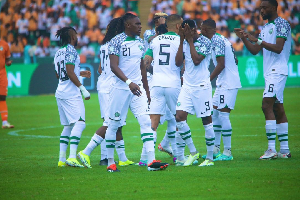
The Super Eagles will face Gabon’s Panthers in the first semi-final on Thursday, November 13
The Nigeria Football Federation (NFF) has confirmed that the Super Eagles will open camp in Rabat, Morocco, on Sunday, November 9, as preparations begin for the 2026 FIFA World Cup playoffs.
Head coach Eric Chelle is expected to unveil his squad list for the crucial mini-tournament next week, as Nigeria target qualification for the intercontinental playoffs, a pathway that could secure Africa’s 10th World Cup slot.
The Super Eagles will face Gabon’s Panthers in the first semi-final on Thursday, November 13, 2025 while Cameroon and the Democratic Republic of Congo will contest the second semi-final.
The winners of both matches will meet in the final, with the eventual champion earning the right to compete in the intercontinental playoff.
The Confederation of African Football (CAF) is set to conduct a “draw” to determine the venues for the matches.
However, both the El Barid Stadium and the Prince Moulay El Hassan Sports Complex in Rabat have been earmarked as potential hosts for the fixtures.
Nigeria are aiming to return to the World Cup after missing out on the 2022 edition in Qatar and Chelle’s side will be eager to make a strong statement when camp opens next week.
Former Manchester United midfielder Paul Scholes says he stopped doing commentary work to fit his schedule around the routine of his autistic son Aiden.
The former England playmaker co-parents the 20-year-old with his ex-wife.
After retiring as a player in 2013, the 50-year-old moved into management before working in the media as a pundit and commentator.
“Everything I’m going to do now just works around him,” Scholes said on the Stick to Football podcast.
“I do studio work, but everything is built around his day.
“Last season on Thursday nights I’d do the Europa League for Manchester United. That’s the night I’d usually have him, so he was getting all agitated, biting and scratching. He knows the pattern’s not there straight away.”
Scholes initially kept his son’s diagnosis secret during his playing career and revealed he was dropped by United manager Sir Alex Ferguson while attempting to handle the situation privately.
“I never got a break from it, even when playing – it was very hard in those days,” Scholes, one of United’s key players in the 1999 Treble season, added.
“I don’t think they diagnosed it until he was two-and-a-half years old. But you knew early something was wrong, but then you get the diagnosis, and I’d never heard of it.
“I remember the first time after it, we were playing Derby away and I just didn’t want to be there.
“I remember the manager dropped me the week after, and I hadn’t told anyone. I ended up telling them a few weeks later, as it was quite hard.
“Even now, I don’t want sympathy or anything. I just thought, even if I did speak to someone about it, it’s not going to help Aiden.
“The big concern now is, because you’re getting a bit older, what happens when you’re not here? That’s the thing that’s now on my mind all the time.”
Autism spectrum disorder – its medical name – is the name for a range of conditions that affect how a person communicates and interacts with the world around them, as well as their interests and behaviour.
It is not a disease or an illness, but a condition that somebody is born with, and it is estimated that one in every 100 people in the UK is autistic.
DISCLAIMER: The Views, Comments, Opinions, Contributions and Statements made by Readers and Contributors on this platform do not necessarily represent the views or policy of Multimedia Group Limited.
DISCLAIMER: The Views, Comments, Opinions, Contributions and Statements made by Readers and Contributors on this platform do not necessarily represent the views or policy of Multimedia Group Limited.
The State of Global Air 2025 report has revealed that about a third of deaths from Chronic Obstructive Pulmonary Disease (COPD) in Ghana are attributable to air pollution.
Data from the report, produced by the Health Effects Institute (HEI), in collaboration with the Institute for Health Metrics and Evaluation (IHME) and the NCD Alliance, also indicated that 33% of deaths from both lung cancer and neonatal outcomes were also caused by air pollution, while 39% of lives lost from Ischemic heart disease could be linked to contaminated air.
What is COPD?
Chronic Obstructive Pulmonary Disease (COPD) is a common lung disease that restricts airflow and causes breathing problems.
Emphysema, which is when your alveoli become damaged and enlarged, causing shortness of breath and chronic bronchitis, where your large airways become inflamed, narrowing your airways, creating lots of mucus and inducing a cough, are examples of COPD, but people who suffer from either often suffer symptoms of both.
COPD can trap bacteria in your lungs, leading to infections, and also prevent oxygen from getting into your body, causing complications like Pneumonia and respiratory failure.
Source: Health Effects Institute. 2025
A study published by Frontiers in Medicine and conducted byEmmanuel Mensah, Min Liu, Lingling Pan, Wei Lu, Susheng Zhou, Liqin Zhang, Yusheng Cheng, Shuoshuo Wei andLei Yusheng Zha, found that “Ghana’s absolute COPD burden is increasing, driven by preventable risk factors such as household air pollution.”
The study found that from 1990 to 2021, “Ghana saw a 157% increase in COPD deaths (from 693 to 1,782), compared to a 49% global increase. Ghana’s age-standardised death rate (ASDR) declined by only 7%, far below the global reduction of 37%. COPD prevalence in Ghana tripled, rising from 0.1 to 0.3 million, while incidence increased by 215% and Disability-Adjusted Life Years (DALYs) by 171%.”
32,500 deaths
Air pollution remains a significant threat to lives in Ghana, with 32,500 confirmed to have died in 2023, according to the The State of Global Air 2025 report.
The new figure is a nearly two percent rise from the previous year, which saw about 31,900 deaths in the country attributed to air pollution.
While the new numbers pale in comparison with those from China, which recorded 2,051,000 deaths in 2023 and India, whose air pollution-attributable deaths rose to 2,006,000 that year, the ratio of the deaths to the population in Ghana remains disproportionately high.
470,000 lives were lost from ozone, most of which were linked to COPD.
“It will get me into trouble again!” laughs Ghana President John Mahama upon the conclusion of our interview.
A few weeks earlier, Mahama’s Foreign Minister had visited the U.S. State Department, only to be immediately confronted with an op-ed that his boss had written for the U.K. Guardian newspaper. In it, Mahama eruditely excoriates U.S. President Donald Trump’s baseless claims of a white genocide in South Africa and calls his “unfounded attack” on its President Cyril Ramaphosa in a fractious Oval Office meeting “an insult to all Africans.”
“They asked, ‘Did your President actually write this?’” Mahama tells TIME in his presidential office within Accra’s Jubilee House. “He says, ‘Yes, my President is a writer and likes to express himself.’ And they said, ‘Well, he’s President now. Can you ask him to put his pen down?’”
Even if Mahama does acquiesce and pause his writing, it’s extremely doubtful he will ever stop shooting from the hip. On Sept. 25, the 66-year-old used a speech at the U.N. General Assembly to accuse its Security Council of exercising “almost totalitarian guardianship over the rest of the world,” while demanding that an African member be added to this apex body and the abolition of its veto power. “The future is African!” he said to rapturous applause.
President of Ghana John Mahama speaks during the United Nations General Assembly (UNGA) on Sep. 25, 2025 in New York City. Michael M. Santiago—Getty Images
A little showy, sure—but far from empty talk. By the year 2050, over 25% of the world’s population is expected to hail from the African continent, including a third of those aged 15 to 24. Africa’s combined GDP was $2.6 trillion in 2020 but is projected to reach $29 trillion by 2050. Africa boasts three of the world’s 20 fastest-growing tech hubs, including first place: Nigeria’s Lagos.
But while the trajectory is indubitable, the ascent is far from smooth, as Ghana’s recent experiences neatly encapsulate. The West African nation of 34 million has long been painted as a continental success story due to its democratic and economic stability. However, Mahama was returned for a second nonconsecutive term in January with his homeland embroiled in an acute economic malaise, characterised by a huge debt burden, soaring costs, and youth unemployment at a staggering 38.8%.
In just half a year, Mahama succeeded in restoring stability—halving inflation, strengthening the national cedi currency by 30%, and embarking on a radical “Resetting Ghana” agenda. He rolled out a 24-hour economy to empower businesses and public institutions to operate around the clock, abolished onerous levies on online purchases and betting wins, and established a code of conduct for all government officials to fight corruption.
He pledged to wipe fees for all first-year students in public tertiary institutions and distribute free feminine hygiene products to school-age girls nationwide. To fight joblessness, he unveiled plans to train one million coders over four years, providing the talent to bolster a nascent tech sector.
“We must improve security to make sure that the streets are safe for people to be able to go to work and come back,” says Mahama. “So we know what our responsibilities are.”
But politics is dealing with the unforeseen, and an almighty curveball was looming over the Pacific. Less than three weeks after Mahama’s Jan. 7 inauguration, the Trump Administration began gutting USAID, which had allocated $12.7 billion to sub-Saharan Africa, accounting for 0.6% of the region’s GDP.
According to the Pretoria-based Institute of Security Studies, the aid cuts could push 5.7 million more Africans into extreme poverty by next year. Meanwhile, two to four million additional Africans are likely to die annually as a result of reduced global aid budgets, estimates the Africa Centre for Disease Control and Prevention. Within South Africa alone, cuts to HIV/AIDS programs could result in an additional 500,000 deaths over the next decade, reports the Desmond Tutu HIV Centre.
Ghana lost $156 million allocated for HIV and AIDS control, combating malaria, as well as research, governance, and education. Still, the cuts were “not fatal,” says Mahama. “All I did was to tell our Finance Minister to make adjustments … so we have covered it with our budget. We’re fine, but not so in some other countries. I was speaking to one of my colleague presidents, and the USAID withdrawal has shut down their school feeding program. With countries like that, it will have quite a huge effect.”
As such, Mahama’s term coincides with a new paradigm for Africa. Despite vast agricultural and mineral wealth, the continent faces limited access to global markets, unfair trading conditions, and a lack of investment. These challenges hinder economic growth, perpetuate poverty, and prevent many Africans from realising their full potential.
The hope is that, armed with new technology, the decline of foreign aid serves as a rallying call that compels African countries to forge their own paths, free from the constraints of aid dependency and external policy pressures. And while challenges persist, there are already signs that hidebound profligacy is being replaced by newfound autarky. “Ghana will manage,” says Mahama. “And it teaches us to be self-reliant.”
Mahama talks with an unruffled, languid poise that belies the candour of his words—a fitting tribune for a new era of African confidence. He was born in the small town of Damongo in Ghana’s bucolic northwest. His father was a prominent rice farmer and local MP under Ghana’s first post-colonial leader, Kwame Nkrumah. After graduating with a degree in history from the University of Ghana, Mahama taught at a secondary school before pursuing a post-graduate degree in social psychology in Moscow, graduating in 1988. His experiences amid the Soviet Union’s death throes burnished the impression that every nation must forge its own path distinct from cookie-cutter dogma. After returning to Ghana, Mahama worked for the Japanese Embassy and Plan International NGO before standing for parliament in 1996.
Mahama’s first term as president from 2012 until 2017 might best be described as underwhelming. There was a severe power crisis and a slew of corruption allegations, including the revelation that Mahama received a Ford Expedition valued at $100,000 from a contractor while serving as vice president. (A subsequent probe cleared Mahama of graft, though it decreed the gift broke rules and the car was returned.) GDP dropped from 9.3% when Mahama began his term to a low of 2.1% in 2015.
Posters of presidential candidate John Mahama and opposition counterpart Nana Akufo-Addo are seen on a wall on Oct. 23, 2012 in Accra ahead of December elections. Pius Utomi Ekpei—AFP/Getty Images
By 2017, growth had recovered to 8.1% but by then, voters had made up their minds not to hand Mahama a second term. Yet his successor fared even worse, plunging Ghana into an economic crisis owing to fiscal mismanagement, a lack of economic diversification, and excessive public debt from unsustainable borrowing and spending. In 2022, Ghana—the world’s sixth-biggest producer of gold and number two exporter of cocoa—defaulted on its domestic and foreign debt obligations.
It hasn’t taken long for Mahama to steady the ship—success rendered all the more impressive against the background of aid cuts. Problems with the aid culture are well-documented. While aid provided ready cash, only a tiny fraction actually went to African stakeholders themselves. USAID tried stridently to have a quarter of its budget spent through local organisations. However, the highest they ever achieved was about 10%, and last year, it actually dropped. “Western consulting companies, contractors, think tanks, NGOs, got a lot of the money that was meant to go to Africa,” says Bright Simons, head of research at the IMANI Centre for Policy and Education, an Accra-based think-tank. “So Africans were never able to build capacity with this money.”
In healthy economies, citizens pay income taxes in return for public goods. Repeated studies have shown how foreign aid short-circuits this relationship, making governments accountable to donors rather than constituents, who, spared the hardship of paying levies, are less likely to hold officials to account. Meanwhile, the easy access to cash gnaws away at professionalism and fosters corruption. Every year, an estimated $88.6 billion—some 3.7% of Africa’s GDP—leaves the continent as illicit capital flight, according to U.N. data.
“Aid engenders laziness on the part of the African policymakers,” writes Baroness Dambisa Moyo, a Zambia-born economist, in Dead Aid: Why aid is not working and how there is another way for Africa. “This may in part explain why, among many African leaders, there prevails a kind of insouciance, a lack of urgency, in remedying Africa’s critical woes.”
It’s criticism that has become widely accepted. Zambia’s President Hakainde Hichilema described the USAID cuts as a “long overdue” wake-up call, while his Rwandan counterpart, Paul Kagame, opined that the continent cannot “rely on the generosity of others forever,” adding: “I think from being hurt, we might learn some lessons.” While Mahama laments the way the aid Band-Aid was ripped off, he says that the end result will be positive—even if there are harsh lessons for Africa regarding U.S. priorities in this new world order. Aside from the aid withdrawal, the Trump Administration has hiked tariffs across Africa, including 15% on Ghanaian exports. Mahama cannot hide his frustration.
“One country cannot say, ‘I want to be an island by myself, so I’ll slap tariffs on you because I want to bring manufacturing back,’” says Mahama. “These tariff negotiations took many years under the WTO to achieve, and so for one person to start slapping everybody with tariffs.” Mahama breaks off in exasperation. “I don’t think it’s a very effective way of conducting foreign policy.”
What the aid cuts and tariff hikes mean for America’s standing overseas remains to be seen. After all, USAID was founded by President John F. Kennedy by executive order in 1961 at the height of the Cold War precisely to counter overseas Soviet influence. Today, the U.S. is embroiled in a new era of Great Power competition with China, whose clout is swelling across the globe, not least in resource-rich Africa. Mahama says the Trump administration’s nativist pivot “takes away U.S. soft power and opens [Africa] up for other players to come in.”
It’s not just superpowers that are clamouring for a piece of the action. Gulf nations, India, and Europe are seeking to leverage the opportunity. In August, London Mayor Sadiq Khan made the first-ever African trade mission by a holder of his office, visiting Ghana as well as Nigeria and South Africa. “At a time when President Trump is attacking international students, we in the U.K. should be encouraging talented international students to come to our British universities,” he told TIME in Accra.
Still, the U.S. denies that it is in retreat, with the State Department highlighting the more than 100 American companies doing business in Ghana across many sectors, including oil and gas, healthcare, small modular nuclear reactors, and mining. On July 24, Google launched its Artificial Intelligence Community Centre in Accra alongside $37 million in support for research and innovation in Africa. In particular, Rolf Olson, Chargé d’Affaires ad interim at the U.S. Embassy in Accra, insists to TIME that Washington is “ready to partner with President Mahama and his administration in combating illegal and corrupt activity” such as illegal gold mining, which he says “has been fed by foreign actors, including Chinese firms and nationals.”
Yet the adversarial tone isn’t shared by Mahama, who says “the Chinese government has been supportive” of law enforcement efforts. “I don’t like to focus on just China.” And the fact that Washington is quite clearly preoccupied with Beijing renders the new U.S. posture “surprising,” says Mahama. “I can understand U.S. insecurity when it comes to China … but that’s when you need your allies. That’s when you need Canada, that’s when you need Mexico, that’s when you need the E.U. But if you are threatening the E.U. and all others with 50% tariff increases, South American countries with 100% tariff increases, you can’t tell the objective of this whole policy. Collaboration would have been better than the current global tensions.”
Washington’s efforts to paint China as the bad guy are undermined by the clear perception that American engagement is now rooted in interests rather than values. Still, while China has been ramping up its overseas investment, especially through its $1 trillion Belt and Road Initiative—a trade and infrastructure network spanning the globe—there’s little chance it will (or even wants to) replace U.S. wholesale.
While Beijing is laser-focused on ports, pipelines, and railways, the type of capacity-building engagement long characterised by USAID isn’t part of their strategy. China won’t fund projects promoting gender equity, affirmative action, training impartial judges, or improvements on regulatory performance in African nations, as these are not things that its government values at home.
Although self-reliance is Africa’s goal, the challenge is achieving true autonomy without structural transformation of nations that remain highly unproductive. Every country around the planet that has achieved structural transformation—from the Asian Tigers to the Balkans—has relied on large injections of foreign capital. Because when the status quo in sub-Saharan Africa is so unsatisfactory—with substandard education, healthcare, security, and so on—these tend to be the focus of domestic resources. Consequently, the bulk of future-focused projects are funded by donor agencies: green transition, incorporating AI, youth leadership, and media literacy.
In Ghana, for instance, USAID was a big investor in eco-tourism—attracting foreign visitors to nature sites to provide alternative livelihoods, so people will move away from illegal mining. “So even though the overall amount of aid is small, when you remove it, you create a very big gap in that future-rented segment of the country’s structural transformation,” says Simons of IMANI. “The future does not often appear as essential because we are so focused on the present. But the present cannot take us anywhere.”
The issue is how to inject capital without falling prey to some of the pitfalls of aid dependency. With commodity prices at record highs, Africa’s natural resource endowments are among the first areas to receive attention. And freed from the client-benefactor relationship that aid engenders, African nations are insisting upon local processing and refining to retain more of the downstream benefits.
“One thing we’d better get away from is this paternalistic attitude,” Khan says. “The ‘helping hand’ is a better approach, because people are then able to trade.”
For decades, the largesse of Western nations put their African counterparts in an awkward predicament, where they must “play polite” while the sovereignty of their resources is diluted, says Marcus Courage, CEO of Africa Practice, a business consultancy. “Now, African governments have recognised that they have more autonomy and must use it to become more self-reliant and to achieve genuine financial sovereignty.”
Guinea, the world’s top bauxite exporter, has begun mandating that foreign mining companies invest in local alumina refineries to increase value. Non-compliant firms, such as Emirates Global Aluminium, have seen licenses withdrawn. In Ghana, the nation’s first commercial gold refinery opened in August 2024, and Mahama launched a new regulator, GoldBod, to crack down on smuggling and boost state revenues. Gold exports have increased 75% year-on-year as a result. “It means that Ghana is able to get more from its gold resources,” says Mahama.
Technology can also help Africa unleash its hidden potential. The continent is home to 60% of the planet’s uncultivated arable land that is capable of sequestering immense amounts of carbon, yet only 16% of the global carbon credits market. This presents an untapped opportunity for African nations to monetise their mature forests and pristine wetlands, which are particularly prized for carbon capture. Opportunities also abound to sell credits for switching from fossil fuel stoves—some 80% of sub-Saharan Africans use wood or charcoal for cooking—to solar or biomass.
So far, Kenya, Gabon, and Tanzania have been first movers, with nations like Ghana, Uganda, and Zambia trying to catch up. The Congo Basin rainforest, for one, removes carbon from the atmosphere with a value of $55 billion per year, according to the Centre for Global Development (CGD), or equivalent to 36% of the GDP of the six countries that host the forest. “This asset can and should be seen as akin to mineral or oil deposits that have significant benefits for the countries that host them,” argues the CGD in a 2022 report.
Ghana has 288 forest reserves of which 44 have been invaded by illegal gold miners. “We’ve been able to liberate nine of them,” says Mahama. “And we have a program for starting a reclamation of those forest reserves to restore them.”
Forest wardens walk into Kyebi Forest Reserve in the East Akim Municipal district in Ghana. Cristina Addehuela—AFP/Getty Images
But it’s not just carbon. While the world gushes over Africa’s natural resources, trouble brews with utilising them—pollution, corruption, human rights abuses, and criminal infiltration. But what if there was a way to leverage such resources while they remained undisturbed? The global tokenisation of illiquid assets—everything from vintage paintings or vinyl records to collectors’ cards or real estate—is slated to become a $16 trillion business opportunity by 2030, according to the Boston Consulting Group. There is a growing clamour to use blockchain technology to tokenise commodities such as Ghana’s gold reserves, Botswana’s diamond reserves, and Zimbabwe’s platinum.
But while more efficient monetisation of natural resources would provide a shot in the arm, the crux is leveraging that windfall to diversify the economy beyond extractive industries—futureproofing economies for when commodity prices drop.
Mahama wants Ghana to move past mining and agriculture into processing and agribusiness, including foods and beverages, refined vegetable cooking oils and things like that. “We’re looking at digital services, fintechs, textiles, manufacturing,” he says.
For Mahama, Africa should not just seek to export to developed states but instead trade with itself. He cites the 2018 creation of the African Continental Free Trade Area—the world’s largest free-trade area, comprising a $3 trillion market—as an underutilised opportunity. In July, Narendra Modi came to Accra on his first visit by an Indian Prime Minister for three decades, and Mahama says the two leaders discussed sharing technology to boost Ghana’s budding pharmaceutical sector. “Already, we export [pharmaceuticals] in limited ways to our West African neighbours,” says Mahama. “But the African Continental Free Trade Area expands us beyond our 34 million population market to a 1.3 billion market.”
Of course, all this potential requires investment to realise. And while the drying up of no-strings aid money may well prove beneficial in the long term, the lack of alternative finance remains a problem. While self-financing is the ultimate goal, it will be a long road. African nations collectively possess only 20 sovereign wealth funds with a capitalisation of $97.3 billion—less than 1% of the global total.
Compounding issues, many African countries pay four times more interest on their debt than high-income nations, despite often having lower debt-to-GDP ratios. As a result, an average African government spends 18% of all state revenue on interest alone, according to the Tony Blair Institute for Global Change (TBI), compared to 3% for E.U. nations.
The TBI has proposed a new cost-efficient $100 billion debt-swap facility administered by multilateral development banks to essentially consolidate and refinance existing liabilities at concessional rates. Kenya, for one, is servicing an international loan of $1.5 billion at 9.5% interest. Refinancing at 3% would save $97.5 million annually.
Of course, $97.5 million is a colossal amount that could be used to fund schools, hospitals, and key infrastructure. Still, it is less than half the $225 million Kenya was due to receive from USAID, of which half in turn was due to be spent on healthcare. The U.S. is not the only country to slash aid—the U.K. is cutting its aid spending from 0.7% of GDP pre-pandemic to 0.3% by 2027—though the manner in USAID was atomised, combined with steep tariffs, still leaves a nasty taste for Mahama.
“Since the end of the Second World War, we’ve had a world that has been more interdependent and has dealt with international relations in a multilateral fashion,” he says. “Things are changing now. It looks like unilateralism has become the order. But it does not help anybody because the world progresses together.”
DISCLAIMER: The Views, Comments, Opinions, Contributions and Statements made by Readers and Contributors on this platform do not necessarily represent the views or policy of Multimedia Group Limited.
DISCLAIMER: The Views, Comments, Opinions, Contributions and Statements made by Readers and Contributors on this platform do not necessarily represent the views or policy of Multimedia Group Limited.
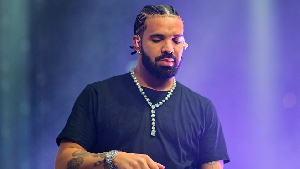
Canadian rap musician Drake is appealing the dismissal of his defamation lawsuit against Universal Music Group over Kendrick Lamar’s Grammy-winning diss track “Not Like Us,” according to a court filing on Wednesday.
Drake will ask the 2nd U.S. Circuit Court of Appeals in Manhattan to overturn the October 9 dismissal by U.S. District Judge Jeannette Vargas.
UMG releases Drake’s and Lamar’s music. It did not immediately respond to a request for comment on Drake’s appeal but has said it was pleased with the dismissal.
Drake, whose given name is Aubrey Drake Graham, sued UMG in January over its promotion of “Not Like Us,” saying the song deceives listeners into believing the false accusation that he is a pedophile.
The lawsuit follows a decade-long feud in which Drake and Lamar released diss tracks said to target each other. Lamar is not a defendant.
In dismissing the case, Vargas said Lamar’s lyrics were not defamatory because they amounted to opinion.
“Although the accusation that Plaintiff is a pedophile is certainly a serious one, the broader context of a heated rap battle, with incendiary language and offensive accusations hurled by both participants, would not incline the reasonable listener to believe that ‘Not Like Us’ imparts verifiable facts,” Vargas wrote.
The appeals process could last at least several months.
“Not Like Us” won Grammy Awards in February for record and song of the year and spent three weeks atop Billboard’s Hot 100. Lamar performed it at this year’s Super Bowl halftime show.
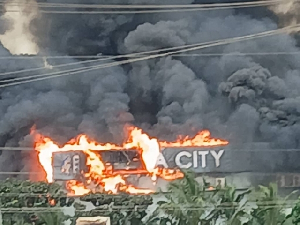
The newly-opened China City Mall at Santasi, Kumasi, Ashanti Region, has been razed.
The fire destroyed the business’s entire structure, together with goods therein. The incident sent shoppers and workers fleeing.
The Ghana National Fire Service (GNFS) are yet to determine the cause of the Thursday, October 30, 2025, fire but have launched an investigation into the matter.
At the scene were personnel of the National Disaster Management Organisation (NADMO), to help with recovery efforts. They have reported no casualties so far.
The England Football Association has pledged its support to the young striker
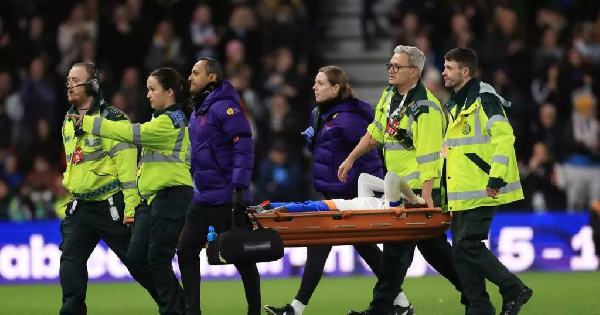
Arsenal have confirmed that English-Ghanaian forward Michelle Agyemang will miss the remainder of the season after suffering a ruptured anterior cruciate ligament.
The teenager sustained the injury during England’s 3-0 friendly win over Australia at Pride Park earlier this week.
Agyemang was stretchered off the field in visible pain after an awkward landing midway through the match.
The 19-year-old had joined Brighton & Hove Albion on loan for the 2025-26 campaign to gain regular first-team experience.
In a statement on Thursday October 30, 2025, Arsenal said, “We can confirm that Michelle Agyemang suffered a ruptured anterior cruciate ligament injury while playing in England’s 3-0 win over Australia in Derby on Tuesday.
“The 19-year-old forward will miss the remainder of the 2025-26 season as a result of the injury.
“We are in close contact with Brighton as we determine a treatment and recovery programme for Michelle.”
“We can confirm that Michelle Agyemang suffered a ruptured anterior cruciate ligament whilst on international duty.
“Wishing all the best with your recovery, Mich – we’ll be with you every step of the way.”
The England Football Association also pledged its support to the young striker as she begins her rehabilitation process.
Agyemang had been tipped as one of the brightest prospects in English women’s football and was expected to feature prominently for Brighton this season before the setback.
Posting on Instagram after her diagnosis, Agyemang expressed disappointment but vowed to return stronger.
“Disappointed that results show a torn ACL. Recovery starts now, I will be back stronger than before,” she wrote.
ACL injuries are among the most serious setbacks for footballers, often requiring several months of recovery and rehabilitation.
Agyemang’s absence is a significant blow to both club and country, but Arsenal say she will receive the best medical support available to aid her comeback.
The Majority Chief Whip, Rockson-Nelson Dafeamekpor, has blamed Committee Chairpersons for the persistent low attendance of Members of Parliament during plenary sessions.
According to him, some Committee Chairpersons deliberately schedule meetings at the same time the House is in session, making it difficult to achieve the required quorum for business to proceed.
This comes after a parliamentary attendance report revealed that a significant number of Members of Parliament (MPs) missed sittings without official permission.
The report, which covers 43 sittings held between January and March 2025, showed that a number of MPs absented themselves, some for more than 20 days without official permission.
Addressing the issue on the floor of Parliament, Mr. Dafeamekpor said despite repeated calls for a review of committee meeting times, some Chairpersons have remained uncooperative.
“The records will bear me out that I drew the attention of the leadership of the committees to this matter. Mr. Speaker, we have discovered that some leaders of committees are arranging committee business in the afternoon when we have all agreed that committee business should be arranged in the morning, so that at 2 p.m. we will be ready to conduct business in the House,” he said.
He pointed out that the day’s Order Paper contained several advertised committee meetings scheduled for the afternoon, in clear disregard of prior agreements.
“Today’s Order Paper shows that there are advertised meetings of committees for the afternoon when we had encouraged them to shift those sittings to the morning so that we have adequate numbers in the afternoon to conduct business,” he added.
The Chief Whip urged committee leaders to adhere to the agreed schedule to ensure effective participation of Members and the smooth running of parliamentary proceedings.
The government has disclosed that Ghana’s gold industry contributed GH¢88.1 billion to the national Gross Domestic Product (GDP) in 2024, with gold exports reaching US$11.2 billion as of August 2025.
Vice President Professor Naana Jane Opoku-Agyemang made this revelation during the inauguration of the Newmont Ahafo North Mine on Thursday, October 30, 2025.
She noted that the mining sector remains a key driver of Ghana’s economy, with the latest figures underscoring its central role in job creation, revenue generation, and investment attraction.
“The opening of the Ahafo North Mine is an act of partnership and progress, and the fruit of mutual respect and collaboration,” Professor Opoku-Agyemang stated.
“Last year, Ghana’s gold industry contributed GH¢88.1 billion to our GDP. Also, this year, our gold exports reached a record of US$11.2 billion. These figures demonstrate and encourage more confidence in our economy, governance, and national potential.”
The Vice President further described the over US$1 billion investment in the Ahafo North Mine as a testament to Ghana’s ability to attract major global investors.
She emphasised that the project would not only boost national revenue but also stimulate development in the Ahafo Region and beyond through local employment and community projects.
Bagbin joins IPU peace task force on Russia-Ukraine war
“It will get me into trouble again!” laughs Ghana President John Mahama upon the conclusion of our interview.
A few weeks earlier, Mahama’s Foreign Minister had visited the U.S. State Department, only to be immediately confronted with an op-ed that his boss had written for the U.K. Guardian newspaper. In it, Mahama eruditely excoriates U.S. President Donald Trump’s baseless claims of a white genocide in South Africa and calls his “unfounded attack” on its President Cyril Ramaphosa in a fractious Oval Office meeting “an insult to all Africans.”
“They asked, ‘Did your President actually write this?’” Mahama tells TIME in his presidential office within Accra’s Jubilee House. “He says, ‘Yes, my President is a writer and likes to express himself.’ And they said, ‘Well, he’s President now. Can you ask him to put his pen down?’”
Even if Mahama does acquiesce and pause his writing, it’s extremely doubtful he will ever stop shooting from the hip. On Sept. 25, the 66-year-old used a speech at the U.N. General Assembly to accuse its Security Council of exercising “almost totalitarian guardianship over the rest of the world,” while demanding that an African member be added to this apex body and the abolition of its veto power. “The future is African!” he said to rapturous applause.
President of Ghana John Mahama speaks during the United Nations General Assembly (UNGA) on Sep. 25, 2025 in New York City. Michael M. Santiago—Getty Images
A little showy, sure—but far from empty talk. By the year 2050, over 25% of the world’s population is expected to hail from the African continent, including a third of those aged 15 to 24. Africa’s combined GDP was $2.6 trillion in 2020 but is projected to reach $29 trillion by 2050. Africa boasts three of the world’s 20 fastest-growing tech hubs, including first place: Nigeria’s Lagos.
But while the trajectory is indubitable, the ascent is far from smooth, as Ghana’s recent experiences neatly encapsulate. The West African nation of 34 million has long been painted as a continental success story due to its democratic and economic stability. However, Mahama was returned for a second nonconsecutive term in January with his homeland embroiled in an acute economic malaise, characterised by a huge debt burden, soaring costs, and youth unemployment at a staggering 38.8%.
In just half a year, Mahama succeeded in restoring stability—halving inflation, strengthening the national cedi currency by 30%, and embarking on a radical “Resetting Ghana” agenda. He rolled out a 24-hour economy to empower businesses and public institutions to operate around the clock, abolished onerous levies on online purchases and betting wins, and established a code of conduct for all government officials to fight corruption.
He pledged to wipe fees for all first-year students in public tertiary institutions and distribute free feminine hygiene products to school-age girls nationwide. To fight joblessness, he unveiled plans to train one million coders over four years, providing the talent to bolster a nascent tech sector.
“We must improve security to make sure that the streets are safe for people to be able to go to work and come back,” says Mahama. “So we know what our responsibilities are.”
But politics is dealing with the unforeseen, and an almighty curveball was looming over the Pacific. Less than three weeks after Mahama’s Jan. 7 inauguration, the Trump Administration began gutting USAID, which had allocated $12.7 billion to sub-Saharan Africa, accounting for 0.6% of the region’s GDP.
According to the Pretoria-based Institute of Security Studies, the aid cuts could push 5.7 million more Africans into extreme poverty by next year. Meanwhile, two to four million additional Africans are likely to die annually as a result of reduced global aid budgets, estimates the Africa Centre for Disease Control and Prevention. Within South Africa alone, cuts to HIV/AIDS programs could result in an additional 500,000 deaths over the next decade, reports the Desmond Tutu HIV Centre.
Ghana lost $156 million allocated for HIV and AIDS control, combating malaria, as well as research, governance, and education. Still, the cuts were “not fatal,” says Mahama. “All I did was to tell our Finance Minister to make adjustments … so we have covered it with our budget. We’re fine, but not so in some other countries. I was speaking to one of my colleague presidents, and the USAID withdrawal has shut down their school feeding program. With countries like that, it will have quite a huge effect.”
As such, Mahama’s term coincides with a new paradigm for Africa. Despite vast agricultural and mineral wealth, the continent faces limited access to global markets, unfair trading conditions, and a lack of investment. These challenges hinder economic growth, perpetuate poverty, and prevent many Africans from realising their full potential.
The hope is that, armed with new technology, the decline of foreign aid serves as a rallying call that compels African countries to forge their own paths, free from the constraints of aid dependency and external policy pressures. And while challenges persist, there are already signs that hidebound profligacy is being replaced by newfound autarky. “Ghana will manage,” says Mahama. “And it teaches us to be self-reliant.”
Mahama talks with an unruffled, languid poise that belies the candour of his words—a fitting tribune for a new era of African confidence. He was born in the small town of Damongo in Ghana’s bucolic northwest. His father was a prominent rice farmer and local MP under Ghana’s first post-colonial leader, Kwame Nkrumah. After graduating with a degree in history from the University of Ghana, Mahama taught at a secondary school before pursuing a post-graduate degree in social psychology in Moscow, graduating in 1988. His experiences amid the Soviet Union’s death throes burnished the impression that every nation must forge its own path distinct from cookie-cutter dogma. After returning to Ghana, Mahama worked for the Japanese Embassy and Plan International NGO before standing for parliament in 1996.
Mahama’s first term as president from 2012 until 2017 might best be described as underwhelming. There was a severe power crisis and a slew of corruption allegations, including the revelation that Mahama received a Ford Expedition valued at $100,000 from a contractor while serving as vice president. (A subsequent probe cleared Mahama of graft, though it decreed the gift broke rules and the car was returned.) GDP dropped from 9.3% when Mahama began his term to a low of 2.1% in 2015.
Posters of presidential candidate John Mahama and opposition counterpart Nana Akufo-Addo are seen on a wall on Oct. 23, 2012 in Accra ahead of December elections. Pius Utomi Ekpei—AFP/Getty Images
By 2017, growth had recovered to 8.1% but by then, voters had made up their minds not to hand Mahama a second term. Yet his successor fared even worse, plunging Ghana into an economic crisis owing to fiscal mismanagement, a lack of economic diversification, and excessive public debt from unsustainable borrowing and spending. In 2022, Ghana—the world’s sixth-biggest producer of gold and number two exporter of cocoa—defaulted on its domestic and foreign debt obligations.
It hasn’t taken long for Mahama to steady the ship—success rendered all the more impressive against the background of aid cuts. Problems with the aid culture are well-documented. While aid provided ready cash, only a tiny fraction actually went to African stakeholders themselves. USAID tried stridently to have a quarter of its budget spent through local organisations. However, the highest they ever achieved was about 10%, and last year, it actually dropped. “Western consulting companies, contractors, think tanks, NGOs, got a lot of the money that was meant to go to Africa,” says Bright Simons, head of research at the IMANI Centre for Policy and Education, an Accra-based think-tank. “So Africans were never able to build capacity with this money.”
In healthy economies, citizens pay income taxes in return for public goods. Repeated studies have shown how foreign aid short-circuits this relationship, making governments accountable to donors rather than constituents, who, spared the hardship of paying levies, are less likely to hold officials to account. Meanwhile, the easy access to cash gnaws away at professionalism and fosters corruption. Every year, an estimated $88.6 billion—some 3.7% of Africa’s GDP—leaves the continent as illicit capital flight, according to U.N. data.
“Aid engenders laziness on the part of the African policymakers,” writes Baroness Dambisa Moyo, a Zambia-born economist, in Dead Aid: Why aid is not working and how there is another way for Africa. “This may in part explain why, among many African leaders, there prevails a kind of insouciance, a lack of urgency, in remedying Africa’s critical woes.”
It’s criticism that has become widely accepted. Zambia’s President Hakainde Hichilema described the USAID cuts as a “long overdue” wake-up call, while his Rwandan counterpart, Paul Kagame, opined that the continent cannot “rely on the generosity of others forever,” adding: “I think from being hurt, we might learn some lessons.” While Mahama laments the way the aid Band-Aid was ripped off, he says that the end result will be positive—even if there are harsh lessons for Africa regarding U.S. priorities in this new world order. Aside from the aid withdrawal, the Trump Administration has hiked tariffs across Africa, including 15% on Ghanaian exports. Mahama cannot hide his frustration.
“One country cannot say, ‘I want to be an island by myself, so I’ll slap tariffs on you because I want to bring manufacturing back,’” says Mahama. “These tariff negotiations took many years under the WTO to achieve, and so for one person to start slapping everybody with tariffs.” Mahama breaks off in exasperation. “I don’t think it’s a very effective way of conducting foreign policy.”
What the aid cuts and tariff hikes mean for America’s standing overseas remains to be seen. After all, USAID was founded by President John F. Kennedy by executive order in 1961 at the height of the Cold War precisely to counter overseas Soviet influence. Today, the U.S. is embroiled in a new era of Great Power competition with China, whose clout is swelling across the globe, not least in resource-rich Africa. Mahama says the Trump administration’s nativist pivot “takes away U.S. soft power and opens [Africa] up for other players to come in.”
It’s not just superpowers that are clamouring for a piece of the action. Gulf nations, India, and Europe are seeking to leverage the opportunity. In August, London Mayor Sadiq Khan made the first-ever African trade mission by a holder of his office, visiting Ghana as well as Nigeria and South Africa. “At a time when President Trump is attacking international students, we in the U.K. should be encouraging talented international students to come to our British universities,” he told TIME in Accra.
Still, the U.S. denies that it is in retreat, with the State Department highlighting the more than 100 American companies doing business in Ghana across many sectors, including oil and gas, healthcare, small modular nuclear reactors, and mining. On July 24, Google launched its Artificial Intelligence Community Centre in Accra alongside $37 million in support for research and innovation in Africa. In particular, Rolf Olson, Chargé d’Affaires ad interim at the U.S. Embassy in Accra, insists to TIME that Washington is “ready to partner with President Mahama and his administration in combating illegal and corrupt activity” such as illegal gold mining, which he says “has been fed by foreign actors, including Chinese firms and nationals.”
Yet the adversarial tone isn’t shared by Mahama, who says “the Chinese government has been supportive” of law enforcement efforts. “I don’t like to focus on just China.” And the fact that Washington is quite clearly preoccupied with Beijing renders the new U.S. posture “surprising,” says Mahama. “I can understand U.S. insecurity when it comes to China … but that’s when you need your allies. That’s when you need Canada, that’s when you need Mexico, that’s when you need the E.U. But if you are threatening the E.U. and all others with 50% tariff increases, South American countries with 100% tariff increases, you can’t tell the objective of this whole policy. Collaboration would have been better than the current global tensions.”
Washington’s efforts to paint China as the bad guy are undermined by the clear perception that American engagement is now rooted in interests rather than values. Still, while China has been ramping up its overseas investment, especially through its $1 trillion Belt and Road Initiative—a trade and infrastructure network spanning the globe—there’s little chance it will (or even wants to) replace U.S. wholesale.
While Beijing is laser-focused on ports, pipelines, and railways, the type of capacity-building engagement long characterised by USAID isn’t part of their strategy. China won’t fund projects promoting gender equity, affirmative action, training impartial judges, or improvements on regulatory performance in African nations, as these are not things that its government values at home.
Although self-reliance is Africa’s goal, the challenge is achieving true autonomy without structural transformation of nations that remain highly unproductive. Every country around the planet that has achieved structural transformation—from the Asian Tigers to the Balkans—has relied on large injections of foreign capital. Because when the status quo in sub-Saharan Africa is so unsatisfactory—with substandard education, healthcare, security, and so on—these tend to be the focus of domestic resources. Consequently, the bulk of future-focused projects are funded by donor agencies: green transition, incorporating AI, youth leadership, and media literacy.
In Ghana, for instance, USAID was a big investor in eco-tourism—attracting foreign visitors to nature sites to provide alternative livelihoods, so people will move away from illegal mining. “So even though the overall amount of aid is small, when you remove it, you create a very big gap in that future-rented segment of the country’s structural transformation,” says Simons of IMANI. “The future does not often appear as essential because we are so focused on the present. But the present cannot take us anywhere.”
The issue is how to inject capital without falling prey to some of the pitfalls of aid dependency. With commodity prices at record highs, Africa’s natural resource endowments are among the first areas to receive attention. And freed from the client-benefactor relationship that aid engenders, African nations are insisting upon local processing and refining to retain more of the downstream benefits.
“One thing we’d better get away from is this paternalistic attitude,” Khan says. “The ‘helping hand’ is a better approach, because people are then able to trade.”
For decades, the largesse of Western nations put their African counterparts in an awkward predicament, where they must “play polite” while the sovereignty of their resources is diluted, says Marcus Courage, CEO of Africa Practice, a business consultancy. “Now, African governments have recognised that they have more autonomy and must use it to become more self-reliant and to achieve genuine financial sovereignty.”
Guinea, the world’s top bauxite exporter, has begun mandating that foreign mining companies invest in local alumina refineries to increase value. Non-compliant firms, such as Emirates Global Aluminium, have seen licenses withdrawn. In Ghana, the nation’s first commercial gold refinery opened in August 2024, and Mahama launched a new regulator, GoldBod, to crack down on smuggling and boost state revenues. Gold exports have increased 75% year-on-year as a result. “It means that Ghana is able to get more from its gold resources,” says Mahama.
Technology can also help Africa unleash its hidden potential. The continent is home to 60% of the planet’s uncultivated arable land that is capable of sequestering immense amounts of carbon, yet only 16% of the global carbon credits market. This presents an untapped opportunity for African nations to monetise their mature forests and pristine wetlands, which are particularly prized for carbon capture. Opportunities also abound to sell credits for switching from fossil fuel stoves—some 80% of sub-Saharan Africans use wood or charcoal for cooking—to solar or biomass.
So far, Kenya, Gabon, and Tanzania have been first movers, with nations like Ghana, Uganda, and Zambia trying to catch up. The Congo Basin rainforest, for one, removes carbon from the atmosphere with a value of $55 billion per year, according to the Centre for Global Development (CGD), or equivalent to 36% of the GDP of the six countries that host the forest. “This asset can and should be seen as akin to mineral or oil deposits that have significant benefits for the countries that host them,” argues the CGD in a 2022 report.
Ghana has 288 forest reserves of which 44 have been invaded by illegal gold miners. “We’ve been able to liberate nine of them,” says Mahama. “And we have a program for starting a reclamation of those forest reserves to restore them.”
Forest wardens walk into Kyebi Forest Reserve in the East Akim Municipal district in Ghana. Cristina Addehuela—AFP/Getty Images
But it’s not just carbon. While the world gushes over Africa’s natural resources, trouble brews with utilising them—pollution, corruption, human rights abuses, and criminal infiltration. But what if there was a way to leverage such resources while they remained undisturbed? The global tokenisation of illiquid assets—everything from vintage paintings or vinyl records to collectors’ cards or real estate—is slated to become a $16 trillion business opportunity by 2030, according to the Boston Consulting Group. There is a growing clamour to use blockchain technology to tokenise commodities such as Ghana’s gold reserves, Botswana’s diamond reserves, and Zimbabwe’s platinum.
But while more efficient monetisation of natural resources would provide a shot in the arm, the crux is leveraging that windfall to diversify the economy beyond extractive industries—futureproofing economies for when commodity prices drop.
Mahama wants Ghana to move past mining and agriculture into processing and agribusiness, including foods and beverages, refined vegetable cooking oils and things like that. “We’re looking at digital services, fintechs, textiles, manufacturing,” he says.
For Mahama, Africa should not just seek to export to developed states but instead trade with itself. He cites the 2018 creation of the African Continental Free Trade Area—the world’s largest free-trade area, comprising a $3 trillion market—as an underutilised opportunity. In July, Narendra Modi came to Accra on his first visit by an Indian Prime Minister for three decades, and Mahama says the two leaders discussed sharing technology to boost Ghana’s budding pharmaceutical sector. “Already, we export [pharmaceuticals] in limited ways to our West African neighbours,” says Mahama. “But the African Continental Free Trade Area expands us beyond our 34 million population market to a 1.3 billion market.”
Of course, all this potential requires investment to realise. And while the drying up of no-strings aid money may well prove beneficial in the long term, the lack of alternative finance remains a problem. While self-financing is the ultimate goal, it will be a long road. African nations collectively possess only 20 sovereign wealth funds with a capitalisation of $97.3 billion—less than 1% of the global total.
Compounding issues, many African countries pay four times more interest on their debt than high-income nations, despite often having lower debt-to-GDP ratios. As a result, an average African government spends 18% of all state revenue on interest alone, according to the Tony Blair Institute for Global Change (TBI), compared to 3% for E.U. nations.
The TBI has proposed a new cost-efficient $100 billion debt-swap facility administered by multilateral development banks to essentially consolidate and refinance existing liabilities at concessional rates. Kenya, for one, is servicing an international loan of $1.5 billion at 9.5% interest. Refinancing at 3% would save $97.5 million annually.
Of course, $97.5 million is a colossal amount that could be used to fund schools, hospitals, and key infrastructure. Still, it is less than half the $225 million Kenya was due to receive from USAID, of which half in turn was due to be spent on healthcare. The U.S. is not the only country to slash aid—the U.K. is cutting its aid spending from 0.7% of GDP pre-pandemic to 0.3% by 2027—though the manner in USAID was atomised, combined with steep tariffs, still leaves a nasty taste for Mahama.
“Since the end of the Second World War, we’ve had a world that has been more interdependent and has dealt with international relations in a multilateral fashion,” he says. “Things are changing now. It looks like unilateralism has become the order. But it does not help anybody because the world progresses together.”
DISCLAIMER: The Views, Comments, Opinions, Contributions and Statements made by Readers and Contributors on this platform do not necessarily represent the views or policy of Multimedia Group Limited.
DISCLAIMER: The Views, Comments, Opinions, Contributions and Statements made by Readers and Contributors on this platform do not necessarily represent the views or policy of Multimedia Group Limited.
The government has announced plans to procure 500 new buses over the short to medium term to strengthen the operations of Metro Mass Transit Limited (MMTL) and enhance public transport across the country.
The Minister for Transport, Joseph Bukari Nikpe, made the announcement in Parliament on Thursday, October 30, 2025, outlining the initiative as part of the government’s broader strategy to revitalise public transportation and support Ghana’s economic transformation agenda.
According to the minister, about 150 buses are expected to arrive early next year, marking the first phase of the rollout.
Mr. Nikpe noted that Metro Mass Transit’s current fleet of just 134 operational buses has made it difficult for the company to sustain operations, expand routes, and meet the growing demand for affordable and reliable public transport.
Responding to questions from Members of Parliament, the minister said the new procurement forms part of a wider plan to modernise terminal facilities, improve service quality, and create more employment opportunities in the sector.
“Mr Speaker, I wish to announce to this House that the company is in the process of acquiring new buses—about 500 of them over a short to long term—to augment our operations,” Mr. Nikpe stated.
““These buses will be deployed within the country to optimise existing routes and establish new ones in underserved areas.”
He further revealed that Metro Mass Transit is taking steps to operationalise aspects of a 24-hour economy, starting with its vehicle maintenance department and traffic unit, to ensure buses remain available and functional at all times.
Ridge Hospital staff jubilant over new digital health software – Beyuo
Bagbin joins IPU peace task force on Russia-Ukraine war
Accra, Oct. 30, GNA – Crafted Climate, a Ghanaian start-up, is participating in the 5th AirLab Microsensor Challenge, joining 32 global manufacturers in advancing affordable air quality monitoring.
The Accra-based company is the only Ghanaian entrant and one of two African participants, alongside a firm from Kenya. Its sensors are being evaluated exclusively in Ghana.
Dr Adrian Arfire, a sensor systems and robotics engineer at Airparif’s Meteorology and Innovation Department, confirmed the participation during a visit to Afri-SET, the host of the Accra site.
“Yes, we have one participant from Ghana, Crafted Climate. They are quite new. Their sensors are being evaluated only in Ghana, not in India or France,” he told the Ghana News Agency.
Airparif, the organisers of the Challenge, is a Paris-based organisation established in 1979 and mandated by the French Ministry of Environment to monitor air quality across the Île-de-France region, including the Paris metropolitan area.
Dr Arfire said the challenge, now in its fifth edition, independently assesses low-cost air quality sensors to provide governments, researchers, and the public with reliable performance data.
This year’s edition attracted 32 manufacturers, submitting around 50 sensor solutions for testing across three sites: Paris, Bengaluru, and Accra.
The Ghana deployment, running from mid-September to mid-January, involves testing sensors against reference monitors to evaluate data quality, usability, environmental impact, and cost.
Results would be announced at a final event, with top performers recognised.
Dr Allison Felix Hughes, Facility Manager of Afri-SET and Head of the Department of Physics at the University of Ghana, said Crafted Climate’s participation highlights the potential of Ghanaian innovators in a competitive global field.
“It is significant to have a Ghanaian start-up in this global competition. It allows them to test their product in real conditions, see how it performs during the Harmattan, and gain visibility with manufacturers and funders,” he said.
Dr. Hughes emphasised that Ghana and the region would benefit from increased access to sensors and collaboration with global experts like Airparif.
“For us, this is an opportunity to learn, improve our technical skills, and raise awareness about air pollution. For the manufacturers, including Crafted Climate, it provides valuable data to improve their algorithms and bring their products closer to the accuracy of reference monitors,” he explained.
Air pollution in Ghana is characterised by high levels of particulate matter from traffic, industrial operations, and domestic fuel use.
Crafted Climate’s participation in the global challenge supports efforts to improve environmental data for informed decision-making.
Ghanaian singer Sista Afia has opened up about a disturbing encounter with a fan that left the individual hospitalized after she struck him with a microphone.
Speaking in an interview with Andy Dosty on Hitz FM, the “Weather” hitmaker recounted how uncomfortable she feels when fans attempt to touch her while she’s making her way to the stage.
“I hate it when people like to touch me when I’m going on stage, especially the fans. It’s something I don’t like at all—it’s very uncomfortable for me. One time, somebody pressed me so hard, and I hit him with a mic. The person had to go to the hospital,” she said.
According to her, the incident occurred during one of her performances when a fan inappropriately touched her “front part.”
Feeling violated and acting on impulse, she struck the individual with her microphone.
Sista Afia explained that although there was security present at the event, the disorganized nature of the show made it difficult for her to access the stage safely.
“My first instinct was to react immediately. Sometimes, you have to go through the crowd to reach the stage, especially when the event isn’t well organized. So, when the guy did that, my first instinct was to find out who it was, and I hit him with the mic so hard,” she narrated.
The singer expressed her frustration with how poorly coordinated some events can be, noting that such situations often expose artistes to harassment and safety risks.
Reflecting on her journey in the music industry, Sista Afia also lamented that despite her efforts, she often feels unappreciated.
“I may never be a favourite in the music industry despite all my efforts,” she added.
Justice Avril Lovelace-Johnson chaired the five-member panel that heard the case
A five-member panel of the Supreme Court, on Wednesday, October 29, 2025, dismissed an application by former Director-General of the National Intelligence Bureau (NIB), Kwabena Adu-Boahene, for the court to remove the judge presiding over his ongoing prosecution.
Adu-Boahene, through his lawyer, Samuel Atta Akyea, asked the court, under the Supreme Court’s supervisory jurisdiction, to restrain the High Court judge from continuing with the case on grounds of alleged bias, prejudgment, and unfair treatment.
But the Supreme Court panel, in a 5-0 unanimous decision, threw out the application. The court ruled that the application lacked merit, stating that it would give the full reasons for its judgment on November 5, 2025.
The Law Platform, in a post shared on X on Wednesday, gave details of the justices who sat on the case.
According to the post, Justice Avril Lovelace-Johnson presided over the five-member panel.
Below are brief details of the members of the panel that sat on Adu-Boahene’s case:
Atta Akyea reacts as SC dismisses Adu-Boahene’s request for trial judge’s removal
Justice Avril Lovelace-Johnson:
Justice Avril Lovelace-Johnson was appointed to the Supreme Court in 2019 by former President Nana Addo Dankwa Akufo-Addo.
She previously served as a High Court judge and later as a Justice of the Court of Appeal before joining the Supreme Court.
Justice Lovelace-Johnson has sat on a number of high-profile cases, including the “Vacant Seat Case,” where she dissented from the ruling that overturned the declaration of four seats vacant by the Speaker of Parliament.
Richard Adjei-Frimpong JSC
Justice Richard Adjei-Frimpong was appointed to the Supreme Court by former President Nana Addo Dankwa Akufo-Addo.
He was sworn into office on January 3, 2024. Before his appointment to the Supreme Court, he was a Justice of the Court of Appeal.
Justice Adjei-Frimpong was one of the justices who voted to dismiss the application filed by former Chief Justice, Justice Gertrude Torkornoo, challenging her removal.
Senyo Dzamefe JSC
Justice Senyo Dzamefe is one of seven Supreme Court judges recently appointed by President John Dramani Mahama. Before his appointment, he was a Justice of the Court of Appeal, appointed to the Court of Appeal in 2010.
He served as a Justice of the High Court before his promotion to the Court of Appeal.
He was the chairperson of the Dzamefe Commission, which looked into the performance of Ghana’s senior men’s football team, the Black Stars, at the 2014 FIFA World Cup in Brazil.
Dennis Dominic Adjei JSC
Justice Dennis Dominic Adjei is also one of the newly appointed justices of the Supreme Court.
Before his appointment to the apex court of the land, he was a judge of the Court of Appeal of Ghana, appointed in July 2010. He is also a judge of the African Court, having been elected to the court in July 2022 for a six-year term.
Additionally, he is one of the nine members of the Advisory Committee of the International Criminal Court.
Kweku Tawiah Ackaah-Boafo JSC
Justice Kweku Tawiah Ackaah-Boafo is also one of the new Supreme Court judges. He was a judge at the Court of Appeal, appointed in 2022, after serving as a High Court judge for years.
He was one of the justices who presided over the Republic v. Ato Forson & 2 Others ambulance case and wrote the lead judgment, which exonerated the current Minister of Finance, Dr Cassiel Ato Forson, of any wrongdoing.
As a High Court judge, he also presided over what became known as the Ex Parte Zanetor case, where he ruled that Article 94(1)(a) of the Constitution is clear and does not call for interpretation after the candidature of the Member of Parliament for Klottey Korle, Zanetor Agyeman-Rawlings, was challenged.
BAI/AE
Tragedy as farmer drowns while seeking loan to send child to SHS
The wait is over! The GhanaWeb Excellence Awards 2025 is officially launched. Let’s Celebrate impact, innovation and excellence across Ghana.
Who deserves to be honoured this year?
Nominate now 👉 https://ghanaweb.com/ghanaexcellenceawards/nominate
The Driver and Vehicle Licensing Authority (DVLA) has officially opened a new ultra-modern service centre in Dansoman, marking a major milestone in the Authority’s drive to enhance service delivery through strategic Public Private Partnerships (PPP).
The new Dansoman DVLA Ultra Centre, opened on Tuesday, October 28, 2025, is a fully equipped, state-of-the-art facility designed to provide the full range of DVLA services, including vehicle registration, driver licensing, and testing.
The centre will serve clients within Dansoman and surrounding communities, helping to reduce congestion at other DVLA offices in the Greater Accra Region.
Speaking at the inauguration ceremony, DVLA Chief Executive, Julius Neequaye Kotey, described the project as a shining example of what can be achieved through effective collaboration between the public and private sectors.
“This ultra centre represents a significant step forward in our mission to modernise operations and bring our services closer to the people,” Mr. Kotey stated.
“It is the product of a successful partnership built on innovation, efficiency, and shared commitment to public service.”
He expressed appreciation to the project partners for their “initiative and unwavering dedication” in bringing the vision to life.
Kotey also reaffirmed DVLA’s readiness to explore additional Public-Private Partnerships (PPPs) to expand service access and improve customer experience nationwide.
The opening of the Dansoman Ultra Centre forms part of the DVLA’s broader modernisation agenda, which includes digitalisation, infrastructure expansion, and improved customer service.
Kotey emphasised that the Authority remains committed to leveraging technology and partnerships to make licensing and vehicle registration processes more efficient, transparent, and client-focused.
“The success of this project reinforces our belief that when the public and private sectors work together, we can deliver world-class services to Ghanaians,” he added.
Ghana forward Antoine Semenyo has been nominated for the Goal of the Month award in the Premier League for the second time this season.
The AFC Bournemouth star bagged nomination with his sensational solo against Fulham in the month of October.
Semenyo netted a brace in the comeback win, but his first in the 3-1 victory was a sensational solo, which saw him take on two players before squeezing the ball past Fulham goalkeeper Bernd Leno.
The 25-year-old will face competition from Liverpool’s Mohamed Salah, teammate Justin Kluivert and Moises Caicedo of Chelsea.
Other players in contention for the accolade are Loum Tchauona of Burnley, Newcastle’s Nick Woltemade, Emiliano Buenda of Aston Villa and Zian Flemming of Burnley.
Semenyo was previously nominated for Goal of the Month in September for his stunning strike against Liverpool on the opening night.
The former Bristol City forward has scored six goals and delivered three assists in nine Premier League games this season.
The Minority in Parliament has called on the Office of the Special Prosecutor to immediately investigate the Municipal Chief Executive (MCE) for Birim Central, Solomon Kusi Brako, over what it describes as “fake fines” allegedly imposed on illegal miners in Akyem Oda.
In a press statement signed by Second Deputy Minority Whip, Jerry Ahmed Shaib, the caucus says it is scandalised by the MCE’s admission that illegal miners were fined various sums of money for mining illegally in the area and then released to continue their activities.
This follows revelations that some of the miners, said to be NDC branch executives, complained after the same MCE who took money from them later directed the National Anti-Illegal Mining Operations Secretariat to their site to burn their equipment.
After newspaper reports based on a leaked tape from an NDC platform, the MCE held a press conference where he confirmed that the Municipal Finance Officer collected the money as “legal fines” and produced receipts to support his claim.
The Minority, however, is questioning why the President’s representative in Birim Central would defend such actions.
“Why will the President’s representative in Akyem Oda defend the imposition of fines for illegal mining, with all its devastating effects, and compromise the President’s supposedly avowed interest in fighting galamsey?” the caucus asked.
The NPP MP further accused the MCE of acting beyond his powers.
“Does the MCE possess the prerogative to collect fines?” it queried, citing the Local Governance Act, 2016 (Act 936), which vests the power to impose and collect fines solely in the courts.
The caucus also referenced Section 46 of the Minerals and Mining Act, 2006 (Act 703), which states that anyone who contravenes the law commits an offence punishable by a court-determined fine or imprisonment.
“We in the Minority can now say of a fact that the MCE is engaged in ultra vires,” the statement added.
The Minority also cast doubt on the receipts presented by the MCE during the press conference, pointing to inconsistencies that suggest an attempt to cover up alleged extortion.
According to the statement, the MCE showed the “original receipt” still fixed in the booklet — contrary to standard practice where the original is issued to the payer and duplicates remain in the book.
The caucus said this irregularity, coupled with the timing of the receipt dated September 25, 2025, raises suspicion that no real payment was made.
Official records from the Birim Central Assembly also contradict the MCE’s claims.
The Minority noted that while the MCE said GH₵55,000 was collected as fines from illegal miners, the Assembly’s 2026 Budget presentation reported total revenue from fines for 2025 as just GH₵12,813.
“If this payment was indeed legitimate and properly receipted, why does it not appear in the Assembly’s official financial report?” the statement asked, describing the discrepancy as evidence of “possible misappropriation.”
The Minority insists it has credible documents and materials to support an independent investigation.
“We call on the relevant state agencies, particularly the Office of the Special Prosecutor and the Ministry of Local Government, to immediately initiate a probe into the conduct of the Birim Central MCE and officials involved,” the statement signed by Second Deputy Minority Whip, Jerry Ahmed Shaibu, concluded.
It added that if the President’s commitment to fighting illegal mining is genuine, “this matter presents a critical test case” for the government’s resolve to tackle corruption and restore public confidence.
DISCLAIMER: The Views, Comments, Opinions, Contributions and Statements made by Readers and Contributors on this platform do not necessarily represent the views or policy of Multimedia Group Limited.
DISCLAIMER: The Views, Comments, Opinions, Contributions and Statements made by Readers and Contributors on this platform do not necessarily represent the views or policy of Multimedia Group Limited.
Nigerian singer, Tiwa Savage, has shut down claims that Afrobeats is currently having its worst performance in two decades.
Reputable music executives, including Paul Okoye aka Paulo, and DJ Big N, have claimed that Afrobeats is declining in separate interviews and social media posts.
However, speaking at the Unstoppable Africans event recently, Savage boasted that Afrobeats is unstoppable.
She argued that, contrary to claims that the genre was declining, it is gaining more ground on charts and tours.
She also spoke about the cultural impact of Afrobeats, recalling that she used to be unhappy about being an African growing up in London, but the positive image Afrobeats is giving the continent has made her become proud of her race.
The singer noted that Afrobeats has achieved a lot despite not having enough support, structure or infrastructure.
“Afrobeats is the fastest growing genre in the world. We kind of created it with nothing; no support, no infrastructure, no real belief even from our own people initially.
“I remember growing up in London, and I was not happy being African. But now I’m so proud because of how big Afrobeats is growing.
“There was a conversation at one point that Afrobeats is going to have its 15 minutes of fame and then fade away. But we are still here. We are not slowing down. In fact, we are filling out stadiums, and we are getting the biggest songs on the charts right now.
“I don’t know how true this is, but apparently, one in every four black persons is a Nigerian or an African.
“So, we are not going anywhere. As much as they are trying to quiet us down, the music is not going anywhere. We are Africans and we are unstoppable,” she remarked.
DISCLAIMER: The Views, Comments, Opinions, Contributions and Statements made by Readers and Contributors on this platform do not necessarily represent the views or policy of Multimedia Group Limited.
DISCLAIMER: The Views, Comments, Opinions, Contributions and Statements made by Readers and Contributors on this platform do not necessarily represent the views or policy of Multimedia Group Limited.
Liverpool have been hit with a fresh setback after Dutch-Ghanaian full-back Jeremie Frimpong was ruled out for around six weeks with another hamstring injury.
The 24-year-old, who has Ghanaian roots despite representing the Netherlands internationally, sustained the injury during Liverpool’s 5-1 victory over Eintracht Frankfurt last week.
It marks a recurrence of the problem that already forced him to miss several early-season fixtures following his summer transfer from Bayer Leverkusen.
Club sources told Liverpool Confidential that Frimpong is unlikely to return before early December, meaning he will miss several key matches.
The timing is particularly difficult for Liverpool, who have suffered a dramatic dip in form and lost six of their last seven games across all competitions.
Manager Arne Slot’s side now face a demanding stretch of fixtures against Aston Villa, Real Madrid, and Manchester City before the international break.
After that, Liverpool will play six matches in just 17 days, including domestic and European ties against Nottingham Forest, PSV Eindhoven and Inter Milan.
Frimpong’s absence leaves Liverpool short on defensive options at right back.
Conor Bradley, who recently recovered from his own injury, is the only fit senior specialist available.
Calvin Ramsay impressed in the recent defeat to Crystal Palace and could be called upon again, while Joe Gomez and Dominik Szoboszlai remain possible alternatives.
The injury compounds a frustrating start to Frimpong’s Anfield career.
Highly rated for his pace and attacking play, he joined Liverpool in the summer to strengthen their flanks but has struggled for consistency due to fitness issues.
Former President John Dramani Mahama has underlined the need for the churches in the country to scale up moves to exert a more positive influence on Ghanaian politics.
He was speaking as a Special Guest of Honour at the 9th Regional Council meeting of the Ashanti East Region of Assemblies of God, Ghana, at the Living Waters Chapel branch of the Church in Kumasi.
Commenting on: Send the Light 2024, which is this year’s theme for Assemblies of God, Ghana, former President Mahama encouraged the Christian community to spare no efforts to send the light of the gospel to help dispel the dark spots in politics.
Mr Mahama, who is a member of Assemblies of God, further encouraged politicians to “respond to the critical call of God “ as they pursue their ambitions.
The General Superintendent of Assemblies of God, Ghana Rev Stephen Wengam called for peaceful, free and fair elections in December, and led the audience to pray for same.
Preaching the sermon on: “ Send en Light Because There Are Still More Lands To Be Possessed, Rev Wengam asked Christians to be the light of the world. He also challenged pastors “ to be up to the task “ by leading their congregations to win souls and plant more churches, adding that “ this is the supreme assignment of the church.”
Rev Wengam ordained a number of pastors and elevated some to the rank of Exhorters and Licentiates.
An award was presented to former President Mahama for “representing Christ well in politics.”
Rev Wengam who doubles as Vice Chairman of Africa Assemblies of God Alliance also officiated at the 9th Regional Council meeting of the Ashanti North Region of Assemblies of God, Ghana in Kumasi where he ordained pastors and elevated others to the ranks of Exhorters and Licentiates.
He charged the pastors and local assemblies to plant churches in unreached communities. They should also embark on door-to-door evangelism to grow their churches and expand Assemblies of God globally.
The Regional Superintendent, Rev George Ampofo outlined the vision of the Council to plant more churches and build more infrastructure.
Vice President Prof Jane Naana Opoku-Agyemang has reaffirmed the government’s commitment to transforming Ghana’s aquaculture industry into a key driver of food security, job creation and sustainable development.
Speaking at the Aquaculture Ghana 2025 Conference, the Vice President highlighted the sector’s impressive growth, noting that aquaculture production has risen from 45,000 metric tonnes to 108,000 metric tonnes in recent years. She, however, emphasised that more must be done to meet national demand, reduce post-harvest waste, and strengthen the entire value chain.
Prof Opoku-Agyemang described agriculture and aquaculture as central pillars in Ghana’s journey toward achieving the Sustainable Development Goals (SDGs).
Guided by the Fisheries and Aquaculture Development Act, 2005, she said the government remains focused on promoting innovation, inclusion and environmental sustainability within the sector.
To further boost growth, the Vice President announced that the government will soon launch an Aquaculture Development Fund to improve access to finance, enhance infrastructure and accelerate research and technology transfer across the country.
She noted that the aquaculture industry already supports millions of livelihoods, from hatcheries and feed mills to processors, traders and exporters.
The government, she added, aims to make aquaculture a major source of employment for youth and women entrepreneurs.
Prof Opoku-Agyemang also revealed plans to establish a One-Stop Aquaculture Licensing Regime and a National Aquaculture Commission, envisioned as a Centre of Excellence for training, research and large-scale fish production.
Addressing sector challenges such as high feed and energy costs, limited renewable energy access, inadequate processing infrastructure and disease outbreaks, the Vice President assured stakeholders that comprehensive reforms are underway to tackle these bottlenecks.
She underscored the importance of public-private partnerships in scaling up production, processing, and exports, urging investors to work collaboratively to unlock the full potential of Ghana’s aquaculture economy.
“Aquaculture development,” she said, “will drive green jobs, industrial growth, and rural transformation becoming a catalyst for climate resilience and economic renewal.”
The Minority in Parliament has lashed out at the Municipal Chief Executive (MCE) of Birim Central, Solomon Kusi Brako, for allegedly collecting cash from illegal miners operating in the Akyem Oda area.
In a press release signed by Second Deputy Minority Whip, Jerry Ahmed Shaib, the caucus says it is “scandalised” by the MCE’s admission that illegal miners were fined various sums of money and released to continue their operations.
The matter gained attention after some of the miners, who identified themselves as NDC branch executives, complained that the same MCE who took money from them later directed the National Anti-Illegal Mining Operations Secretariat to their site to burn their equipment.
The Minority said, following a leaked tape and subsequent media reports, the MCE held a press conference confirming that his Municipal Finance Officer collected the money as “legal fines.” He also displayed receipts to back the claim.
Mr Shaib has questioned why the President’s representative in the municipality would defend fines for illegal mining when such acts are devastating the environment and undermining the government’s supposed fight against galamsey.
The group also challenged the legality of the MCE’s actions, insisting he had no authority to impose or collect fines. Citing the Local Governance Act, 2016 (Act 936), and the Minerals and Mining Act, 2006 (Act 703), the Minority said the power to impose and collect fines rests solely with the courts.
“The MCE is engaged in ultra vires,” the statement read.
The caucus further pointed to inconsistencies in the receipts the MCE displayed at his press conference.
They noted that the original receipt — dated September 25, 2025, and still attached to the booklet — should have been detached and issued to the payer. The Minority says this anomaly suggests an attempt to cover up the alleged extortion.
Official records from the Birim Central Municipal Assembly have also raised red flags.
According to the Assembly’s 2026 budget presentation, total fines collected for 2025 amounted to GH₵12,813 — far below the GH₵55,000 the MCE claimed was collected from illegal miners.
The Minority says this gap exposes “serious questions about accountability, transparency, and possible misappropriation” at the Birim Central Assembly.
They have called on the Office of the Special Prosecutor and the Ministry of Local Government to investigate the matter immediately.
“The government must take decisive and transparent action to restore public confidence and prove that the fight against galamsey is not mere rhetoric but a genuine national priority,” the statement concluded.
DISCLAIMER: The Views, Comments, Opinions, Contributions and Statements made by Readers and Contributors on this platform do not necessarily represent the views or policy of Multimedia Group Limited.
DISCLAIMER: The Views, Comments, Opinions, Contributions and Statements made by Readers and Contributors on this platform do not necessarily represent the views or policy of Multimedia Group Limited.
President of the NPP Patriots, Calvin Mensah, has strongly criticized the recent directive from the Minister of Education, Haruna Iddrisu, mandating strict adherence to no-haircut policies in second-cycle institutions.
Calvin Mensah, speaking on Movement TV, argued that the timing of such a directive is misplaced, urging the Minister to shift his attention to more pressing challenges within the education sector.
Speaking in reaction to the Minister’s pronouncements at the 75th Anniversary celebrations of Mawuli School, where Iddrisu empowered the Ghana Education Service (GES) and school heads to strictly control student behavior and appearances, Mensah labeled the focus on hairstyles as an “outdated form of control.”
“In a modern educational system that aims to nurture creativity, confidence and innovation, enforcing mandatory haircuts is an outdated form of control that does more harm than good,” Mensah stated.
According to him, education today is supposed to shape minds, not appearances. Adding that when institutions focus on uniformity of looks instead of quality of thought, they unconsciously suppress individuality and self-expression, two key pillars of modern education and leadership development.
He further disclosed that such utterances to parents is an insult to them since they usually know and choose what is best for their wards.
The education minister had emphasised that schools are meant to “mould character, not to host beauty contests” and warned that “giving in on hair today could lead to demands regarding shoes and dress codes tomorrow.”
He stressed, “We’ll not tolerate today, we’ll not tolerate it tomorrow, in so long as we are moulding character. Anybody who thinks that your child will walk into any institution of learning, as if that Child was to attend a beauty contest, the school environment is not for that purpose and not cut for that purpose and will not tolerate that as an institution.”
However, Mensah believes this directive diverts attention from critical issues.
“At a time when our focus should be on digital literacy, innovation, and youth empowerment, it is deeply disappointing that we are still debating on hair. The Ministry of Education must instead tackle the real issues affecting our schools: wrong school placements, lack of access to nutritious meals, inadequate clean water, and poor learning conditions that hinder sound education and mental growth.”
He further elaborated, “My point is that leadership, especially in education, must prioritize issues that have real impact on students’ growth and well-being. The conversation shouldn’t be about controlling appearance, but about improving access, welfare, and quality. Policies like the haircut directive feel outdated because they don’t solve any of the pressing challenges students face daily. Wrong placements, poor nutrition, lack of clean water, and mental health struggles.”
Addressing potential perceptions of his stance as political, Mensah clarified, “That’s a fair question, and I understand why some may see it that way. But my position isn’t political; it’s patriotic and progressive. When young people speak on national issues, it shouldn’t always be reduced to politics.
“I’m speaking as a Ghanaian who believes our education system should match the times we live in. If calling for better school conditions and a focus on student welfare is seen as political, then perhaps it’s time we redefine what true patriotism looks like.”
The NPP Patriots’ President is therefore calling for a renewed focus on the substantive challenges within Ghana’s educational system, urging the Ministry of Education to prioritize policies that foster genuine learning and student well-being over perceived superficial disciplinary measures.
Tragedy as farmer drowns while seeking loan to send child to SHS
The wait is over! The GhanaWeb Excellence Awards 2025 is officially launched. Let’s Celebrate impact, innovation and excellence across Ghana.
Who deserves to be honoured this year?
Nominate now 👉 https://ghanaweb.com/ghanaexcellenceawards/nominate
The policy blueprint has a strong focus on stakeholder engagement
Ghana has become the first country in West Africa to launch a national policy blueprint for plastic alternatives and non-plastic substitutes.
The blueprint, which was launched earlier this year, sets out a roadmap for establishing a thriving industry that can create over 300,000 jobs in Ghana over the next two decades.
Dr Ebenezer Laryea, Reader (Professor) at Aston University and Project Director for FRESHPPACT, expressed his excitement about the implementation of the policy blueprint, which is being supported by the UK Government and the United Nations Conference on Trade and Development (UNCTAD).
The implementation of the policy blueprint is a collaborative effort between the government, NGOs, research institutions and the private sector. Dr. Laryea emphasized the importance of strong stakeholder networks in ensuring the success of the project.
The policy blueprint has a strong focus on stakeholder engagement, including with SMEs, big businesses, consumers, and research institutions.
The implementation of the policy blueprint is expected to have numerous economic and environmental benefits, including creating over 300,000 jobs in Ghana over the next two decad harnessing the benefits of the Africa Continental Free Trade Area (AfCFTA) and the ECOWAS sub-region reducing plastic waste and promoting a cleaner environment and ncreasing trade opportunities for Ghana.
The government has expressed its commitment to the project, with Professor Nana Amoah, Head of the Environmental Protection Agency (EPA), demonstrating a deep understanding of the process.
Dr Laryea praised the government for its support and cooperation, citing President John Dramani Mahama’s vision for job creation and environmental protection.
He called on all Ghanaians to support the implementation of the policy blueprint, emphasising the need for a paradigm shift in the way we think about plastic use and waste management.
He also urged Ghanaians to take advantage of the economic opportunities presented by the transition to plastic alternatives and non-plastic substitutes.
Tragedy as farmer drowns while seeking loan to send child to SHS
The wait is over! The GhanaWeb Excellence Awards 2025 is officially launched. Let’s Celebrate impact, innovation and excellence across Ghana.
Who deserves to be honoured this year?
Nominate now 👉 https://ghanaweb.com/ghanaexcellenceawards/nominate
President of the NPP Patriots, Calvin Mensah, has strongly criticized the recent directive from the Minister of Education, Haruna Iddrisu, mandating strict adherence to no-haircut policies in second-cycle institutions.
Calvin Mensah, speaking on Movement TV, argued that the timing of such a directive is misplaced, urging the Minister to shift his attention to more pressing challenges within the education sector.
Speaking in reaction to the Minister’s pronouncements at the 75th Anniversary celebrations of Mawuli School, where Iddrisu empowered the Ghana Education Service (GES) and school heads to strictly control student behavior and appearances, Mensah labeled the focus on hairstyles as an “outdated form of control.”
“In a modern educational system that aims to nurture creativity, confidence and innovation, enforcing mandatory haircuts is an outdated form of control that does more harm than good,” Mensah stated.
According to him, education today is supposed to shape minds, not appearances. Adding that when institutions focus on uniformity of looks instead of quality of thought, they unconsciously suppress individuality and self-expression, two key pillars of modern education and leadership development.
He further disclosed that such utterances to parents is an insult to them since they usually know and choose what is best for their wards.
The education minister had emphasised that schools are meant to “mould character, not to host beauty contests” and warned that “giving in on hair today could lead to demands regarding shoes and dress codes tomorrow.”
He stressed, “We’ll not tolerate today, we’ll not tolerate it tomorrow, in so long as we are moulding character. Anybody who thinks that your child will walk into any institution of learning, as if that Child was to attend a beauty contest, the school environment is not for that purpose and not cut for that purpose and will not tolerate that as an institution.”
However, Mensah believes this directive diverts attention from critical issues.
“At a time when our focus should be on digital literacy, innovation, and youth empowerment, it is deeply disappointing that we are still debating on hair. The Ministry of Education must instead tackle the real issues affecting our schools: wrong school placements, lack of access to nutritious meals, inadequate clean water, and poor learning conditions that hinder sound education and mental growth.”
He further elaborated, “My point is that leadership, especially in education, must prioritize issues that have real impact on students’ growth and well-being. The conversation shouldn’t be about controlling appearance, but about improving access, welfare, and quality. Policies like the haircut directive feel outdated because they don’t solve any of the pressing challenges students face daily. Wrong placements, poor nutrition, lack of clean water, and mental health struggles.”
Addressing potential perceptions of his stance as political, Mensah clarified, “That’s a fair question, and I understand why some may see it that way. But my position isn’t political; it’s patriotic and progressive. When young people speak on national issues, it shouldn’t always be reduced to politics.
“I’m speaking as a Ghanaian who believes our education system should match the times we live in. If calling for better school conditions and a focus on student welfare is seen as political, then perhaps it’s time we redefine what true patriotism looks like.”
The NPP Patriots’ President is therefore calling for a renewed focus on the substantive challenges within Ghana’s educational system, urging the Ministry of Education to prioritize policies that foster genuine learning and student well-being over perceived superficial disciplinary measures.
Tragedy as farmer drowns while seeking loan to send child to SHS
The wait is over! The GhanaWeb Excellence Awards 2025 is officially launched. Let’s Celebrate impact, innovation and excellence across Ghana.
Who deserves to be honoured this year?
Nominate now 👉 https://ghanaweb.com/ghanaexcellenceawards/nominate
Minister of Sports and Recreation, Kofi Adams, has announced that companies investing in sports sponsorship will receive tax incentives once the long-awaited Sports Fund Bill is passed into law.
Speaking about the government’s new approach to sustainable sports financing, the Minister said the Sports Development Fund will introduce a structured and transparent system to track funding and corporate contributions across all sporting disciplines.
“We’ve not really had a formalised and structured funding of sports,” Adams said.
“Government’s plan now is to have a sports development fund. The bill will soon be laid in Parliament, and once we have that fund, there will be tracking of funding and support from corporates. Those who fund will also benefit from some tax incentives.”
He added that the policy seeks to motivate private sector involvement in sports by ensuring sponsors are duly recognised and rewarded for their contributions.
The initiative forms part of broader government efforts to create a sustainable sports ecosystem in Ghana and reduce overreliance on public funding.
The Sports Fund Bill, once approved, will serve as a key pillar in financing sports development and athlete welfare nationwide.
The Krowor Municipal Assembly has announced collaborative efforts with the Member of Parliament and Ghana Water Limited to address the ongoing water challenges in the municipality following the shutdown of the desalination plant.
In an interview with Citi News, the Municipal Chief Executive, Ing. Paul Afotey Quaye, disclosed that the plant had been operating at only 20 percent capacity for several months before its eventual closure, exacerbating water shortages across multiple communities.
He said temporary water supplies have been arranged for the most affected areas, while plans are underway to install community storage tanks as a sustainable, long-term solution. He also urged residents to store water as authorities work to restore regular supply.
“One of the short-term solutions is to give community members relief. And so the assembly, working together with the MP, will provide water to the communities in water tanks to give them some relief.
“But as a long-term solution, we’ll provide the community storage tanks connected to the Ghana Water grid. So when water comes into the network, we store. Community members can use the household water, when they deplete them, then they can fall on the community storage tanks,” he explained.
The policy blueprint has a strong focus on stakeholder engagement
Ghana has become the first country in West Africa to launch a national policy blueprint for plastic alternatives and non-plastic substitutes.
The blueprint, which was launched earlier this year, sets out a roadmap for establishing a thriving industry that can create over 300,000 jobs in Ghana over the next two decades.
Dr Ebenezer Laryea, Reader (Professor) at Aston University and Project Director for FRESHPPACT, expressed his excitement about the implementation of the policy blueprint, which is being supported by the UK Government and the United Nations Conference on Trade and Development (UNCTAD).
The implementation of the policy blueprint is a collaborative effort between the government, NGOs, research institutions and the private sector. Dr. Laryea emphasized the importance of strong stakeholder networks in ensuring the success of the project.
The policy blueprint has a strong focus on stakeholder engagement, including with SMEs, big businesses, consumers, and research institutions.
The implementation of the policy blueprint is expected to have numerous economic and environmental benefits, including creating over 300,000 jobs in Ghana over the next two decad harnessing the benefits of the Africa Continental Free Trade Area (AfCFTA) and the ECOWAS sub-region reducing plastic waste and promoting a cleaner environment and ncreasing trade opportunities for Ghana.
The government has expressed its commitment to the project, with Professor Nana Amoah, Head of the Environmental Protection Agency (EPA), demonstrating a deep understanding of the process.
Dr Laryea praised the government for its support and cooperation, citing President John Dramani Mahama’s vision for job creation and environmental protection.
He called on all Ghanaians to support the implementation of the policy blueprint, emphasising the need for a paradigm shift in the way we think about plastic use and waste management.
He also urged Ghanaians to take advantage of the economic opportunities presented by the transition to plastic alternatives and non-plastic substitutes.
Tragedy as farmer drowns while seeking loan to send child to SHS
The wait is over! The GhanaWeb Excellence Awards 2025 is officially launched. Let’s Celebrate impact, innovation and excellence across Ghana.
Who deserves to be honoured this year?
Nominate now 👉 https://ghanaweb.com/ghanaexcellenceawards/nominate
Renowned playwright and founder of Roverman Productions, James Ebo Whyte, aka Uncle Ebo Whyte, has paid a courtesy call on the newly appointed Executive Director of the National Theatre of Ghana, Henry Herbert Malm.
This is part of his ongoing collaboration with the institution.
The meeting, held at the National Theatre on Tuesday, served as both a gesture of goodwill and a reaffirmation of the long-standing partnership between Roverman Productions and the Theatre.
For the past 17 years, Roverman Productions has been one of the Theatre’s most consistent and influential partners, presenting a rich catalogue of stage plays that have drawn large audiences and contributed significantly to the sustainability of live theatre performances in Ghana.
This partnership has not only strengthened the Theatre’s performance calendar but also advanced its mandate to promote and develop the performing arts while providing a platform for authentic Ghanaian storytelling.
During the visit, the National Theatre boss expressed a heartfelt appreciation to Mr Ebo Whyte for his unwavering support and loyalty as a consistent patron of the National Theatre.
Mr Malm further assured him of management’s commitment to enhancing the Theatre’s facilities and creative environment to make the space even more conducive for artists, audiences, and future collaborations.
Mr Ebo Whyte, in turn, conveyed his gratitude to the Theatre’s leadership and the entire technical and administrative team who have supported Roverman Productions throughout the years.
He also expressed optimism for an even more fruitful partnership under the new leadership, reaffirming his commitment to the shared vision of promoting Ghanaian theatre and creative talent.
DISCLAIMER: The Views, Comments, Opinions, Contributions and Statements made by Readers and Contributors on this platform do not necessarily represent the views or policy of Multimedia Group Limited.
DISCLAIMER: The Views, Comments, Opinions, Contributions and Statements made by Readers and Contributors on this platform do not necessarily represent the views or policy of Multimedia Group Limited.
Special Prosecutor Kissi Agyebeng has reaffirmed his office’s commitment to ensuring the extradition of former finance minister Ken Ofori-Atta, despite reports suggesting challenges in the process.
Providing an update at a press conference on Thursday, October 30, 2025, he said the Office of the Special Prosecutor (OSP) is working closely with the Office of the Attorney General to complete the extradition procedures.
He stressed that the process is on course and will not be derailed by speculation or misinformation.
Text
“It’s unfortunate that there’s been talk about dockets and we’ve refused to give the docket and all. That is beside the point; that is not the issue at all,” he stated.
“The issue is that you need to get it right the first time; you don’t keep going back and forth.”
He further clarified that legal processes are being meticulously followed to ensure Ofori-Atta’s return to face justice, emphasising that he will still be extradited even if he has US citizenship.
“US citizenship status doesn’t prevent extradition. We will not give up; we will still move on with the processes and ensure that Ghanaians become less restive and appreciate the work we’re doing with the Attorney General,” Kissi Agyebeng noted.
The OSP has announced that it will charge Ken Ofori-Atta and five other former government officials by the end of November 2025, following a detailed investigation into alleged corruption and financial irregularities linked to contracts between the Ghana Revenue Authority (GRA) and Strategic Mobilisation Ghana Limited (SML).
“The outcome of the investigation is that the OSP will charge the following persons with various corruption and corruption-related offences before the end of November 2025,”
Ofori-Atta was first identified by the OSP in January 2025 as a suspect in several corruption-related cases, including alleged irregularities in contracts with Strategic Mobilisation Ghana Limited (SML), expenditures linked to the National Cathedral project, and issues in health and tax refund operations.
‘There was no genuine need for contracting SML’ – Kissi Agyebeng
He was declared a fugitive in February 2025 after failing to honour multiple OSP summonses.
His lawyers later requested that his name be removed from the wanted list, promising he would return. However, after he again failed to appear before the OSP in June 2025, his fugitive status was reinstated and the OSP indicated it would pursue extradition while maintaining the Interpol Red Notice.
Ten months after being first declared a fugitive, Ofori-Atta has neither been arrested in the United States nor voluntarily returned to Ghana.
JKB/AM
Short hair won’t stop double-salary scandals’ – Ras Mubarak fires back at Haruna Iddrisu
The Office of the Special Prosecutor (OSP) will by the end of November 2025 file charges against former Finance Minister Ken Ofori-Atta and five others over their roles in the controversial revenue assurance contracts between the Ghana Revenue Authority (GRA) and Strategic Mobilisation Ghana Limited (SML).
Those expected to face prosecution include former Commissioner-Generals of the Ghana Revenue Authority, (GRA) Dr Ammishaddai Owusu-Amoah and Emmanuel Kofi Nti, as well as GRA officials, Isaac Crentsil and Kwadwo Damoa, Ernest Akore, former Technical Advisor at the Ministry of Finance.
Text
Addressing a press conference in Accra on Thursday, October 30, 2024, the Special Prosecutor Agyebeng said, “The outcome of the investigation is that the OSP will charge the following persons with various corruption and corruption-related offences before the end of November 2025.”
He noted that months of investigations revealed acts of corruption, abuse of office and serious breaches of procurement laws in the awarding and execution of the contracts.
“There was no genuine need for contracting SML for the work it purported to perform,” Kissi Agyebeng said.
‘There was no genuine need for contracting SML’ – Kissi Agyebeng
He further revealed that the GRA failed to submit the full agreements between SML and its third-party collaborators, a lapse he said undermined transparency and accountability in the entire process.
“The investigations revealed glaring statutory breaches, conflicts of interest and unjustified payments tied to the SML agreements,” the Special Prosecutor noted.
He disclosed that the OSP will recover GH¢125 million from Strategic Mobilisation Ghana Limited (SML).
“The OSP will recover a total amount of GH₵125 from SML by way of disgorgement of unjust enrichment of overpayment by the return of the benefit this amount obtained unfairly at the expense of the Republic,” he added.
Ken Ofori-Atta was first identified by the OSP in January 2025 as a suspect in several corruption-related cases, including alleged irregularities in contracts with Strategic Mobilisation Ghana Limited (SML), expenditures linked to the National Cathedral project, and issues in health and tax refund operations.
He was declared a fugitive in February 2025 after failing to honour multiple OSP summonses.
His lawyers later requested that his name be removed from the wanted list, promising he would return. However, after he again failed to appear before the OSP in June 2025, his fugitive status was reinstated, and the OSP indicated it would pursue extradition while maintaining the Interpol Red Notice.
Ten months after being first declared a fugitive, Ofori-Atta has neither been arrested in the United States nor voluntarily returned to Ghana.
JKB/AM
Short hair won’t stop double-salary scandals’ – Ras Mubarak fires back at Haruna Iddrisu
Kennedy Agyapong, flagbearer hopeful of the New Patriotic Party
Flagbearer hopeful of the New Patriotic Party (NPP), Kennedy Agyapong, has vowed not to accept the outcome of the party’s January 2026 delegates election if he is recorded zero votes in any constituency, particularly in the Northern region of Ghana.
According to Agyapong, although he is a strong advocate for peace, he cannot accept results that he believes are unfair or manipulated.
Kennedy had earlier recalled the 2023 primaries, stating that some people had shown him evidence of voting for him despite him receiving zero votes in certain areas.
He warned that if any such irregularities occur again, particularly in the northern constituencies, he would respond similarly in the southern regions.
Speaking in a video shared on social media, Agyapong said, “I’m assuring you this time, if we get zero from any constituency, we will not accept a result.
“I’m telling you, I am for peace but I’m advising them, if they give zero, let them try and see. We are all men in this party. What you do in the North, I will do it in the South. I want to state it in practical terms because it’s too much. That is too much.”
Oda MP details why he rejected Kennedy Agyapong
The NPP will elect its flagbearer ahead of the 2028 general elections in 2026.
Agyapong is competing for the position against former Vice President Dr Mahamudu Bawumia, former Agriculture Minister Bryan Acheampong, former Education Minister Dr Yaw Osei Adutwum and former party General Secretary Kwabena Agyei Agyepong.
AM
Watch CCTV footage of alleged soldier assaulting two civilians inside a pharmacy
Tragedy as farmer drowns while seeking loan to send child to SHS
The wait is over! The GhanaWeb Excellence Awards 2025 is officially launched. Let’s Celebrate impact, innovation and excellence across Ghana.
Who deserves to be honoured this year?
Nominate now 👉 https://ghanaweb.com/ghanaexcellenceawards/nominate
French President Emmanuel Macron (L) and President Mahama (R)
President John Dramani Mahama of Ghana and French President Emmanuel Macron held extensive bilateral talks at the Élysée Palace on Thursday October 30, 2025, focusing on security cooperation, economic development and regional stability on the sidelines of the 2025 Paris Peace Forum.
The meeting opened on a solemn note, with President Macron offering his condolences over the recent passing of Ghana’s former First Lady, Nana Konadu Agyeman-Rawlings.
Both leaders praised the Paris Peace Initiative and reaffirmed their commitment to strengthening relations between Ghana and France.
A key focus of the discussions was Ghana’s request for French assistance in combating piracy within its territorial waters.
President Mahama sought France’s support in safeguarding Ghana’s maritime integrity against growing piratical threats in the Gulf of Guinea.
The two presidents also discussed a proposed French concessionary loan for Ghana’s health sector, which is currently awaiting parliamentary approval.
President Mahama urged his French counterpart to leverage his influence with the International Monetary Fund (IMF) to help secure Ghana’s access to the facility from the French Development Bank, noting Ghana’s improved debt-to-GDP ratio.
In his capacity as the African Union (AU) Champion of African Financial Institutions, President Mahama advocated for closer collaboration to renegotiate loan agreements at lower interest rates to support infrastructure development across Africa.
He further emphasised Ghana’s role as host of the African Continental Free Trade Area (AfCFTA) Secretariat and highlighted the need for enhanced road infrastructure to promote intra-African trade.
President Mahama attends Paris Peace Forum
President Mahama also drew attention to Ghana’s ambitious One Million Coders Programme, which has already registered over 200,000 students.
He requested French support to train more French language teachers to improve language education in Ghanaian schools.
President Macron, in response, outlined several forthcoming opportunities for collaboration including the VivaTech Summit in Nairobi in May 2026, where Ghana could showcase its digital innovation capabilities; the African Union–European Union Summit in Angola and the June 2026 G7 Summit, where France intends to advocate for increased international support for Ghana.
President Mahama also raised the issue of reparations for slavery, an initiative currently championed by Ghana.
President Macron expressed support for the effort, noting that France had already criminalised slavery but cautioned that the reparations discourse should acknowledge the involvement of multiple actors beyond Western powers.
The two leaders additionally discussed the worsening security situation in the Sahel region, particularly terrorist incursions in Mali and other member countries of the Alliance of Sahel States (AES).
President Macron commended President Mahama’s leadership in the subregion and Ghana’s ongoing economic reforms, pledging France’s continued support for Ghana’s development agenda.
Tragedy as farmer drowns while seeking loan to send child to SHS
The wait is over! The GhanaWeb Excellence Awards 2025 is officially launched. Let’s Celebrate impact, innovation and excellence across Ghana.
Who deserves to be honoured this year?
Nominate now 👉 https://ghanaweb.com/ghanaexcellenceawards/nominate
The Lands Commission has launched an aggressive ground rent collection and compliance enforcement exercise across some of Accra’s most expensive neighbourhoods, marking one of its boldest moves yet to boost state revenue and restore discipline in land administration.
The ongoing operation is covering prime enclaves including Airport Residential Area, East Legon, Tema Motorway Industrial Area, and the North Industrial Area, where teams from the Greater Accra Regional Lands Commission are personally delivering ground rent demand notices to property owners and lessees.
Led by the Acting Greater Accra Regional Lands Officer, Dr Pius Asumadu, and supervised by Surv. Owusu Peprah, Regional Head of the Public and Vested Lands Management Division (PVLMD), the exercise is part of a nationwide effort to ensure that individuals and corporate entities occupying state lands honour their lease obligations.
Preliminary findings from the exercise have revealed widespread irregularities in the use and management of public lands in the capital. Officers identified numerous instances of unauthorized land use changes, unapproved subletting, illegal redevelopment of properties into apartments, and non-payment of ground rent for several years.
Dr Asumadu described these activities as “a worrying trend that undermines the integrity of Ghana’s land administration system.”
He explained that some lessees have turned residential plots into commercial facilities without seeking the Commission’s consent, while others have subdivided and resold lands contrary to lease covenants.
In response, the Commission has announced tough compliance measures, including a comprehensive review of leases, variation of terms to reflect current land use, and upward revision of ground rents.
Persistent defaulters risk having their names published in national newspapers and forfeiting their lands through lawful re-entry, in line with the provisions of the Land Act, 2020 (Act 1036).
The Lands Commission is urging all lessees whether or not they have received a demand notice to voluntarily visit the nearest Lands Commission office to verify their payment status and settle arrears.
The Commission says the ground rent collection drive is a crucial part of its broader reform agenda to streamline land administration, protect public lands from encroachment, and improve revenue generation for national development.
Officials have hinted that similar exercises will soon be extended to other regions, with a focus on high-value government lands in Kumasi, Takoradi, and Tamale.
The Lands Commission’s renewed enforcement posture reflects its determination to promote responsible land stewardship, enhance public trust, and strengthen institutional integrity in Ghana’s land sector.
Watch CCTV footage of alleged soldier assaulting two civilians inside a pharmacy
Tragedy as farmer drowns while seeking loan to send child to SHS
The wait is over! The GhanaWeb Excellence Awards 2025 is officially launched. Let’s Celebrate impact, innovation and excellence across Ghana.
Who deserves to be honoured this year?
Nominate now 👉 https://ghanaweb.com/ghanaexcellenceawards/nominate
Despite growing speculation linking him with a move to Real Madrid, Antoine Semenyo remains fully focused on continuing his brilliant form with Bournemouth, as the Cherries enjoy a historic start to the Premier League season.
The 25-year-old forward has been central to Bournemouth’s success, netting six goals and assisting three in nine matches to lift the club to second in the table. His blend of power, pace, and precision has made him one of the Premier League’s most exciting players.
While pundits such as Troy Deeney have tipped him for future stardom, even suggesting he could play for Madrid, sources close to the player indicate Semenyo is intent on helping Bournemouth sustain their title challenge.
Under Andoni Iraola, the Ghanaian has evolved into a leader in attack, thriving in a system that prioritises vertical football and fluid transitions. His consistency has filled the void left by big-money departures like Milos Kerkez and Dean Huijsen, proving his importance to the team’s structure.
Semenyo’s focus now is to maintain his rhythm and guide the Cherries through a demanding schedule before turning attention to international duty with Ghana. With the 2026 World Cup on the horizon, the in-form forward’s performances could define both club and country’s ambitions in the coming months.
Wiesi (U/E), Oct. 30, GNA – A solar-powered mechanised water system has been commissioned at Wiesi, a farming community in the Builsa district to address water scarcity and promote peaceful coexistence between local residents and transhumant herders.
The facility, valued at about GH¢350,000, was constructed under the Peaceful Cross-Border Pastoral Mobility and Social Stability in the Sahel (MOPSS) Phase II project (2023-2026), implemented by the Netherlands Development Organisation (SNV) and its consortium partners with funding support from the Danish International Development Agency (DANIDA).
The other consortium partners include the Maroobé Billital Network (RBM), the Association for the Promotion of Livestock in the Sahel and Savannah (APESS), the Network of Farmers’ and Producers’ Organisations of West Africa (ROPPA), Rural Hub, and CARE Denmark.
The commissioning formed part of MOPSS’ broader efforts to promote peaceful co-existence, inclusive natural resource management, and livelihood resilience among pastoralist and farming communities across northern Ghana to reduce conflicts over water resources.
The MOPSS project is a regional initiative being implemented in seven West African countries, namely Ghana, Burkina Faso, Mali, Niger, Benin, Togo, and Côte d’Ivoire, to strengthen social stability and improve cross-border pastoral mobility and inclusive local economy.
Speaking at the commissioning ceremony in Wiesi, Mr Amadi Coulibaly, MOPSS Project Manager, SNV, said the mechanised borehole marked another milestone in the consortium’s commitment to improving access to safe and reliable water for both people and livestock, while fostering peaceful coexistence between pastoral and host communities.
“The borehole we inaugurate today represents more than just access to clean water. It symbolises hope, inclusion, and collaboration, a testament to what is possible when communities, local authorities, and development partners work together with a shared vision,” he said.
He expressed appreciation to the Government and people of Denmark for their generous support and partnership through DANIDA and encouraged the Builsa South District Assembly and the beneficiaries to take full ownership of the facility to ensure proper maintenance and equitable access.
“SNV remains committed to working with the Government of Ghana, local authorities, and communities to strengthen livelihoods, promote peace, and build climate-resilient systems that serve everyone,” he added.
The solar-powered water system includes a high-yield borehole and a 5,000 litre capacity overhead tank, capable of providing a steady water supply throughout the year and it is designed to serve both human and livestock needs.
It has separate sections but multiple fetching points and drinking troughs for residents and animals, with different taps for fetching water, and four watering troughs, three for cattle and one for small ruminants such as goats and sheep.
To ensure long-term sustainability, a Borehole Management Committee (BMC) comprising representatives of traditional authorities, pastoralists, farmers, agricultural officers, women, and youth has been established and trained to oversee maintenance, cost recovery, and equitable access.
Mr Mohammed Abdul-Ganiyu Shitu, Technical Advisor on the MOPSS project, SNV, said the design ensured that people and livestock did not interfere with one another, promoting hygiene and reducing potential sources of conflict.
“This project is aimed at easing the pressure on local water sources and promoting peaceful coexistence between farmers and herders. When people and animals have access to water, the chances of conflict reduce drastically,” he said.
Imam Hanafi Sonde, National President, Ghana National Association of Cattle Farmers, commended the choice of the Wiesi as it laid along, a major livestock movement corridor and hosts several pastoralists from Burkina Faso and other neighbouring countries and urged the government to invest in similar projects to reduce farmer-herder conflicts in farming communities.
Madam Anne Musah, the Builsa South District Chief Executive, commended the MOPSS’ consortium and their sponsors, for investing in water, which was a major challenge in the area, adding that it would help reduce tension in the community over access to water.
Nab Akanaab Apoom-Ween, the Chief of Wiesi Community, expressed gratitude for the gesture and added that the water system would strengthen the unity and social cohesion between the residents and the pastoralists in the community for shared development.
THE BLACK QUEENS of Ghana delivered a commanding performance to defeat Egypt 4–0 in the second leg of the 2026 Women’s Africa Cup of Nations (WAFCON) qualifier at the Accra Sports Stadium, sealing their qualification for next year’s tournament in Morocco.
Ghana, who had won the first leg 3–0 in Ismailia, completed the job in emphatic fashion to advance with a 7–0 aggregate victory.
The Queens dominated proceedings with a potent attack led by Princess Marfo and Doris Boaduwaa, while Evelyn Badu, Grace Asantewaa, and Jennifer Cudjoe controlled the midfield. Cynthia Findiib Konlan was solid between the posts, keeping the visitors at bay throughout.
After a goalless first half, Doris Boaduwaa broke the deadlock in the 52nd minute before doubling Ghana’s advantage just three minutes later, finishing off a fine combination between Grace Asantewaa and Princess Marfo.
Comfort Yeboah made it 3–0 in the 57th minute, and Boaduwaa completed her hat-trick in stoppage time to cap off a superb display.
The result marks a significant milestone for the Black Queens as they return to the continental stage with renewed confidence.
Ghana will now aim to build on their strong resurgence, having claimed bronze at the 2025 Women’s Africa Cup of Nations, where they edged South Africa 4–3 on penalties in a thrilling third-place playoff.
There was chaos at the University of Cape Coast (UCC) on Thursday as the National Science and Maths Quiz (NSMQ) Quarterfinal contest involving Adisadel College, Prempeh College, and Mfantsipim School was delayed.
Reports from the scene indicate that several students were assaulted as they attempted to gain entry into the UCC auditorium, where the much-anticipated contest was scheduled to take place.
Eyewitnesses say tensions flared as security personnel and students clashed at the entrance, though the reasons for the assault remain unclear.
Videos and photos circulating on social media show students in school uniforms being pushed back from the auditorium gates, with some reportedly sustaining injuries.
The incident caused significant confusion and delayed the start of the contest, which had drawn large crowds of supporters from the three elite schools.
Organisers of the competition, Primetime, issued an official statement indicating that the highly anticipated clash between Adisadel College, Prempeh College, and Mfantsipim School will take place at a later date.
The Speaker of Ghana’s Parliament, Rt. Hon. Alban Sumana Kingsford Bagbin, has been appointed to the Inter-Parliamentary Union’s Task Force on the peaceful resolution of the war in Ukraine.
The appointment, made by the IPU President, highlights Speaker Bagbin’s integrity, impartiality, and proven ability to build trust among conflicting parties. He joins seven other distinguished parliamentarians from across the six IPU geopolitical groups.
In a letter confirming the appointment, IPU Secretary General Martin Chungong stated, “We are confident that your leadership and experience will enhance the work and impact of the Task Force in its mission to support diplomatic efforts in seeking a peaceful resolution to the war in Ukraine.”
Established as an ad-hoc body in March 2022, the IPU Task Force has provided a platform for dialogue between Ukrainian and Russian parliamentarians. Since its inception, it has convened over 13 meetings, conducted a mission to Kyiv and Moscow in July 2022, and held biannual consultations during IPU Assemblies.
Speaker Bagbin, a seasoned international peace negotiator, will participate in hearings, discussions with Ukrainian and Russian delegations, and engage government leaders from both countries. His involvement is expected to strengthen the Task Force’s efforts to promote dialogue and seek a peaceful resolution to the ongoing conflict.
The appointment underscores Ghana’s active role in supporting global diplomatic initiatives and fostering international peace.
Read also
NHIS system saga: Okoe Boye part of Lightwave contract mess – Akandoh
Quantum Terminals posted profit after tax of GH¢23.6 million for the nine months ended September 30, 2025, maintaining profitability despite foreign exchange headwinds and rising operational costs at its strategic LPG storage facilities, according to management financial statements released by the Ghana Stock Exchange listed company.
The result represents a 6.3% increase from the GH¢22.2 million earned in the corresponding period of 2024, demonstrating the company’s ability to navigate volatile macroeconomic conditions while servicing critical petroleum infrastructure that supports Ghana’s energy security.
Revenue declined to GH¢52.7 million from GH¢59 million in the prior year period, driven primarily by lower throughput fees and premium charges from customers using the company’s storage and loading facilities. The company operates an LPG evacuation terminal at Atuabo near the Ghana Gas Processing Facility with 750 metric ton storage capacity, capable of loading up to 1,500 metric tons daily across eight truck loading bays.
What kept Quantum profitable despite the revenue decline was significantly improved foreign exchange management. The company recorded a foreign exchange gain of GH¢7 million compared to a devastating GH¢17.8 million loss during the same period last year. That’s a GH¢24.8 million swing that essentially salvaged the year’s results and demonstrates how Ghana’s relatively stable cedi in 2025 has benefited companies with dollar denominated debt obligations.
Direct operational costs surged to GH¢6.7 million from GH¢3.9 million, with direct wages and salaries nearly doubling to GH¢5.1 million from GH¢2.8 million. The sharp increase in personnel costs likely reflects adjustments to match Ghana’s elevated inflation environment and the need to retain skilled workers in the competitive petroleum sector.
General and administrative expenses also climbed substantially, reaching GH¢23.6 million compared to GH¢13 million in the prior year. Travel and accommodation expenses increased to GH¢1.4 million from GH¢1 million, while group cost recovery expenses rose to GH¢2.6 million from GH¢1.6 million, reflecting the higher cost structure facing Ghanaian businesses.
The company’s balance sheet tells a more encouraging story. Total assets reached GH¢496.2 million, essentially unchanged from GH¢496.5 million at the end of September 2024, but the composition shifted meaningfully. Long term debt declined dramatically to GH¢29.7 million from GH¢80.4 million, representing a 63% reduction that speaks to aggressive debt paydown.
That debt reduction came primarily from the company’s bond and EAIF loan facilities. The Ghana Fixed Income Market 10 year bond dropped to GH¢10 million from GH¢20 million, while the EAIF loan facility fell to GH¢20.7 million from GH¢61.5 million. These reductions demonstrate Quantum’s commitment to deleveraging, though it comes at the cost of reducing financial flexibility for future growth initiatives.
Cash and bank balances stood at GH¢12.5 million at quarter end, down from GH¢19.8 million a year earlier. The company maintains additional liquidity through its debt service reserve accounts totaling GH¢19.4 million, down from GH¢21.9 million. These restricted accounts ensure Quantum can meet its bond obligations even during periods of operational stress.
Shareholders’ equity expanded to GH¢371.5 million from GH¢333.7 million, with retained earnings turning positive at GH¢58.7 million compared to a deficit of GH¢9.6 million previously. The turnaround in accumulated profits reflects the company’s sustained profitability and strategic decision to prioritize earnings retention over aggressive dividend distributions as it works through its debt obligations.
Operating cash flow remained robust at GH¢27.2 million before taxes and interest, though this declined from GH¢50.1 million in the prior year period. After servicing debt with GH¢10.2 million in loan interest payments and paying GH¢8.8 million in taxes, net cash from operating activities totaled GH¢9.1 million compared to GH¢21.2 million previously.
The company deployed GH¢20.4 million toward repaying borrowings, while investing GH¢2.9 million in property, plant and equipment. This capital allocation prioritizes debt reduction over expansion, a prudent strategy given the need to maintain bondholder confidence and reduce interest expense.
Fair value imputed interest income reached GH¢16.7 million, representing accounting adjustments related to related party receivables that totaled GH¢154.9 million on a non current basis. These intercompany balances with entities like Quantum Gas HoldCo and The Quantum Terminals Group reflect the integrated structure of the broader Quantum Group’s operations.
Finance costs totaled GH¢8.4 million for the nine months, down from GH¢11 million in the prior year despite higher interest rates in Ghana’s debt markets. The decline reflects the reduced debt balances as the company systematically pays down its obligations. Bond interest and charges consumed GH¢3.5 million, while loan interest and fees took another GH¢4.8 million.
Earnings per share came in at GH¢0.21, up from GH¢0.20 in the corresponding period of 2024, based on the company’s 110 million shares outstanding. The stable share base and modest earnings growth provide shareholders with predictable returns, though the lack of dividend payments means investors must rely on potential capital appreciation for returns.
EBITDA totaled GH¢25.6 million compared to a much stronger GH¢55.6 million in the prior year period, reflecting the revenue decline and cost pressures before accounting for the foreign exchange gain that ultimately supported bottom line profitability. This EBITDA compression highlights the operational challenges facing the business independent of forex movements.
Property, plant and equipment stood at GH¢296.5 million, down slightly from GH¢311.6 million, with depreciation outpacing new capital investments. The company’s storage tanks, civil works, and loading infrastructure represent critical assets that require ongoing maintenance and eventual replacement, creating long term capital needs that must be balanced against debt service obligations.
Quantum Terminals made history in 2018 as the first non financial institution to list a corporate bond on the Ghana Fixed Income Market, issuing a 10 year tenor guaranteed 75% by GuarantCo, an AA rated development finance institution. The bond also listed on London Stock Exchange’s International Securities Market, making it the first local currency corporate bond from Ghana and West Africa to achieve that distinction.
The company has maintained a strong track record of meeting its bond obligations, most recently transferring GH¢1.7 million for September interest payments well ahead of the required deadline. This consistent compliance with bond covenants supports investor confidence and potentially paves the way for future capital market access by other Ghanaian corporates.
Looking at the competitive landscape, Quantum Terminals remains one of Ghana’s key petroleum infrastructure providers, with its Atuabo facility strategically positioned to offtake LPG produced as a byproduct at the Ghana Gas Processing Facility. The terminal handles LPG that supports cleaner cooking alternatives to wood and charcoal, contributing to health and environmental benefits particularly for women and children who spend more time exposed to cooking fumes.
The third quarter results demonstrate Quantum’s resilience in a difficult operating environment. While revenue pressures and cost inflation create headwinds, aggressive debt reduction and improved forex management position the company on a firmer financial foundation. The challenge ahead is whether Quantum can reverse the revenue decline and stabilize margins while continuing to service its remaining debt obligations.
For bondholders, the aggressive debt paydown provides comfort that the company takes its obligations seriously and is willing to sacrifice growth opportunities to maintain financial stability. For equity investors, the lack of dividends and modest earnings growth may limit near term returns, though the strengthening balance sheet and strategic asset base offer longer term value as Ghana’s LPG market continues developing.
The company’s work in progress account stood at just GH¢2.3 million compared to GH¢12.6 million a year earlier, suggesting minimal expansion projects currently underway. This reflects management’s conservative approach during a period focused on financial consolidation rather than aggressive capacity additions.
Inventory levels remained modest at GH¢838,000, down slightly from GH¢940,000, consisting primarily of spare parts, tools, and minimal fuel stock. The low inventory requirements reflect the nature of Quantum’s business model, where customers own the LPG being stored and the company primarily provides infrastructure and handling services rather than holding product for its own account.
Trade receivables increased marginally to GH¢5.8 million from GH¢5.6 million, with the company maintaining an impairment provision of GH¢50,600 against potential bad debts. The relatively small receivables balance relative to annual revenue suggests efficient collections processes or contractual arrangements that minimize credit exposure to customers.
Current tax liabilities declined to GH¢3.9 million from GH¢5.1 million, reflecting payments made during the period and adjustments to tax provisions. The company paid GH¢8.8 million in income taxes during the nine months, demonstrating its role as a meaningful contributor to government revenues despite operating in a capital intensive sector with substantial depreciation shields.
The deferred tax liability increased to GH¢68.2 million from GH¢73 million, driven by temporary differences between book and tax treatment of assets, particularly the revalued property, plant and equipment that forms the bulk of Quantum’s asset base. These deferred taxes will become payable over time as assets are depreciated or disposed of.
What stands out most in these results is the stark contrast between Quantum’s operational performance and its overall profitability. Strip away the foreign exchange gain, and the company would have posted significantly weaker results. That vulnerability to forex movements underscores the risk inherent in operating dollar denominated debt in a cedi functional currency environment, even as it also demonstrates how much Ghana’s improved currency stability in 2025 has benefited companies in Quantum’s position.
The LPG sector in Ghana continues facing structural challenges around pricing, distribution infrastructure, and competition from traditional fuels. Quantum’s role as an evacuation terminal makes it dependent on gas production volumes at the upstream facility and customer decisions about how much LPG to offtake and store. The company can’t easily control its top line growth, making cost discipline and financial management the primary levers available to management.
Looking ahead to the final quarter and into 2026, Quantum faces questions about whether it can stabilize or grow revenues while continuing to reduce costs to offset inflationary pressures. The company’s debt maturity profile will also matter, with investors watching whether the aggressive paydown creates sufficient headroom to weather any operational challenges or whether additional capital might eventually be needed to maintain and upgrade aging infrastructure.
For now, though, Quantum Terminals has delivered what bondholders and shareholders needed to see: profitability maintained, debt reduced substantially, and financial discipline enforced even when it means foregoing growth opportunities. In Ghana’s volatile business environment, sometimes survival and stability represent success stories of their own.
The National Food Buffer Stock Company (NAFCO) has announced that the Ministry of Food and Agriculture (MoFA) is preparing to seek Cabinet approval for an additional GH₵100 million in funding to support the large-scale purchase of surplus food commodities, including maize and rice.
The move is part of efforts to meet Ghana’s annual staple food consumption threshold of 6.8 million metric tonnes and to build up the 10 percent annual food reserve requirement under the national food reserve programme.
According to NAFCO, the fresh request follows an initial Cabinet release of GH₵100 million, which was used to procure 60,000 bags of rice, 120,000 bags of maize, and 10,000 bags of gari for strategic reserves.
Speaking at a media briefing on Wednesday, October 30, Deputy Chief Executive Officer of NAFCO, Osmond Amuah, said the additional funding is crucial to prevent post-harvest losses and enhance food security.
He further disclosed that NAFCO’s Producer Price Determination Committee has set a floor price of GH₵5 per kilogram of paddy rice to guide purchases and ensure fair compensation for farmers.
This intervention, he explained, is aimed at clearing the over 200,000 metric tonnes of unsold rice currently stored in warehouses across northern Ghana.
NAFCO’s initiative aligns with government’s broader strategy to strengthen Ghana’s food security framework and reduce dependence on imports by promoting local production and sustainable storage systems.
Peasant Farmers cry for help as 200,000 metric tons of local rice remain unsold
The Global AI Show returns to Abu Dhabi on December 8 and 9, 2025, at Space42 Arena, bringing together more than 5,000 attendees, 200 AI experts, and 150 exhibitors under the ambitious theme AI:2031: Accelerating Intelligent Futures as the United Arab Emirates cements its position as a global artificial intelligence powerhouse.
Organized by VAP Group in partnership with Times of AI, this year’s edition represents the most expansive gathering yet for an event that has become the UAE’s premier platform for exploring how artificial intelligence will reshape economies, societies, and governance over the next decade.
The choice of Abu Dhabi as host city reflects more than geography. The emirate is driving initiatives like the $500 billion Stargate Consortium, ADQ’s Growth Lab, and development of the world’s largest AI campus, positioning itself at the forefront of what organizers describe as a global AI revolution that extends far beyond Silicon Valley.
The event operates with strategic support from the Abu Dhabi Convention & Exhibition Bureau, the National Program for Artificial Intelligence, and the Cyber Security Council, signaling government level commitment to establishing the UAE as both an innovation hub and ethical regulator for artificial intelligence technologies.
Speaker lineups this year include Dr. Ott Velsberg, Estonia’s Chief Data Officer who architected one of the world’s most advanced e governance systems, and Andy Tang, Managing Partner at Draper Dragon, whose firm has backed AI unicorns across health technology, fintech, and frontier tech sectors. H.E. Dr. Mohamed Al Kuwaiti, the UAE government’s head of cybersecurity, will address protecting digital ecosystems for national resilience, while Dr. Marwan Al Zarouni from Dubai Blockchain Center will explore intersections between blockchain, AI, and national policy frameworks.
Philippe Gerwill, a digital futurist advocating human centric AI adoption, rounds out a speaker roster designed to move conversations beyond hype toward actionable insights for governments, enterprises, and citizens navigating rapid technological change.
Session topics span artificial general intelligence, AI applications in space exploration, healthcare transformation, educational innovation, and autonomous mobility systems. The programming aims to bridge theoretical possibilities with practical implementation challenges facing organizations attempting to deploy AI at scale.
What distinguishes this gathering from countless other technology conferences is its explicit focus on the 2031 timeframe, a deliberate choice that aligns with UAE national strategies including the Centennial 2071 plan and the National AI Strategy. These frameworks prioritize developing AI research and education infrastructure, creating inclusive and ethical AI systems, attracting global talent and capital, and enhancing cybersecurity resilience.
The event expects 72% of attendees to hold C level, director, VP, or founder positions, creating networking opportunities between decision makers who control capital allocation, technology adoption, and policy formation. For startups and scale ups, access to UAE royal family offices and sovereign wealth funds represents a distinctive value proposition unavailable at most technology gatherings.
VAP Group, the organizing company, operates across the UAE, UK, India, and Hong Kong with a team exceeding 170 professionals. Beyond the Global AI Show, the firm runs the Global Games Show and Global Blockchain Show, positioning itself at intersections of emerging technologies reshaping digital economies. The company’s 12 year track record in consulting around AI, blockchain, and gaming provides institutional knowledge about how these sectors evolve and interconnect.
Early bird ticket pricing remains available for a limited period, though organizers haven’t disclosed what standard pricing will become once promotional periods expire. The two day format allows for depth in individual sessions while maintaining enough variety that attendees from different sectors and specializations can find relevant programming.
Abu Dhabi’s infrastructure for hosting large scale international events has expanded significantly in recent years, with venues like Space42 Arena offering modern facilities designed for technology focused conferences. The emirate’s investments in hospitality, transportation, and digital connectivity aim to make it seamless for international participants to attend multi day events without the friction points that sometimes plague conferences in less developed locations.
The timing in early December positions the event after major American technology conferences but before year end holidays, potentially capturing executives finalizing 2026 technology budgets and strategic plans. For AI companies seeking Middle Eastern partnerships or customers, the concentrated access to regional decision makers offers efficiency compared to individual business development trips.
Whether the Global AI Show delivers on its ambitious promises about shaping the next decade of intelligent systems remains to be seen. Technology conferences routinely overstate their importance and impact. However, the combination of serious government backing, participation from credible technical leaders rather than just motivational speakers, and Abu Dhabi’s genuine financial commitments to AI infrastructure suggests this gathering represents more than typical conference circuit theater.
For Ghana and African nations watching from afar, events like this underscore how quickly the global AI landscape is evolving and how Middle Eastern petrostates are leveraging energy wealth to fund positions in technology sectors that will define 21st century economic competitiveness. The question isn’t whether African countries should care about gatherings in Abu Dhabi, but rather how quickly they can develop their own strategies for participating in AI driven transformation rather than becoming mere consumers of systems designed and deployed elsewhere.
Registration information and full agendas are available through the event’s official website at globalaishow.com, with organizers encouraging early registration to secure preferred access levels and networking opportunities.
Enterprise Group posted consolidated profit after tax of GH¢289.2 million for the nine months ended September 30, 2025, though the figure represents a modest decline from the GH¢311.2 million recorded during the same period last year, according to unaudited financial statements released by the insurance and financial services conglomerate.
The results show Ghana’s oldest insurance company navigating a challenging environment while maintaining profitability across its diversified operations spanning life insurance, general insurance, pensions, real estate, and funeral services.
Group net income reached GH¢572.6 million, essentially flat compared to the GH¢573.6 million generated in the first nine months of 2024. What’s notable is how the company achieved similar top line numbers despite significant headwinds in the insurance finance line, which saw net insurance finance expenses balloon to GH¢274 million from just GH¢84.4 million a year earlier.
That GH¢190 million swing in finance costs tells a story about the investment environment Enterprise Group has been operating in. Higher interest rates and market volatility create both opportunities and challenges for insurers who manage substantial investment portfolios to back their policy liabilities.
The company’s core insurance operations delivered insurance revenue of GH¢1.33 billion, up from GH¢1.20 billion in the prior year period. However, insurance service expenses also climbed to GH¢794.6 million, while reinsurance arrangements cost the group GH¢175.4 million compared to a small gain of GH¢1.6 million last year. These dynamics compressed the net insurance service result to GH¢89.7 million from GH¢328.6 million previously.
Investment income provided crucial support, reaching GH¢411 million for the group compared to GH¢123.5 million in the same period of 2024. That’s more than tripling investment returns year over year, reflecting both the higher yield environment Ghana’s fixed income markets have been offering and potentially some strategic repositioning of the group’s investment portfolio.
On the balance sheet side, total assets expanded to GH¢4.61 billion from GH¢3.65 billion at the end of September 2024, representing a 26% increase. Investment securities led the growth, climbing to GH¢2.95 billion from GH¢2.10 billion, reinforcing the company’s role as a major institutional investor in Ghana’s capital markets.
Insurance contract liabilities, which represent the group’s obligations to policyholders, increased to GH¢1.99 billion from GH¢1.58 billion. The growth in liabilities tracks with the expansion in insurance revenue and reflects the accumulation of policy reserves as the business writes more coverage.
Cash and bank balances stood at GH¢413 million at quarter end, down from GH¢531.5 million a year earlier. The decline partly reflects the group’s decision to deploy more capital into higher yielding investment securities rather than hold excess cash in an inflationary environment.
Shareholders’ equity attributable to owners reached GH¢1.31 billion, up from GH¢1.23 billion, while the group paid out GH¢21.5 million in dividends during the period. Non controlling interests, representing minority stakes in subsidiaries like Enterprise Life and Enterprise Insurance, totaled GH¢456.9 million.
Operating cash flow generation remained robust at GH¢690.9 million, though investing activities consumed GH¢614.1 million, primarily for net acquisitions of investment securities and property and equipment purchases totaling GH¢76.9 million. The property investments likely relate to the group’s ongoing real estate development projects, including its 7th Avenue office complex.
Basic earnings per share came in at GH¢1.09, down from GH¢1.19 in the prior year period, reflecting the slight decline in attributable profit despite a stable share count of 258.9 million shares.
The results come as Enterprise Group’s share price has surged 72.2% year to date to GH¢3.41, making it one of the stronger performers on the Ghana Stock Exchange in 2025. That market performance suggests investors remain confident in the group’s long term trajectory despite the near term earnings compression.
Enterprise Group was recently named among the Financial Times’ top 100 fastest growing companies in Africa with a compound annual growth rate of 27.6%, recognition that underscores the group’s track record of navigating Ghana’s volatile macroeconomic environment while delivering consistent growth.
The company operates through seven business segments across Ghana, Nigeria, and The Gambia, with subsidiaries including Enterprise Life, Enterprise Insurance, Acacia Health, Enterprise Trustees, Enterprise Properties, and Enterprise Funeral Services. This diversification provides some insulation when individual business lines face headwinds.
Looking at the cash flow statement, the group generated GH¢760.6 million from operations before taxes and levies, paid GH¢48.7 million in income taxes, and remitted GH¢25 million in growth and sustainability levy, Ghana’s additional corporate tax imposed to support fiscal consolidation efforts.
What stands out in these results is Enterprise Group’s ability to maintain profitability while absorbing substantially higher insurance finance costs and reinsurance expenses. The investment income surge provided a crucial offset, but the compression in core insurance margins suggests the group faces ongoing pricing and underwriting discipline challenges in a competitive market where customers remain price sensitive.
For investors, the question heading into the final quarter is whether Enterprise Group can sustain its investment income momentum and whether insurance margins will stabilize or face further pressure. The 26% asset growth and expanding policy base position the company well for future earnings, but converting that growth into bottom line results remains the management challenge in what continues to be a difficult operating environment.
As part of efforts to address the growing challenge of disinformation and misinformation which can undermine democratic institutions, social cohesion and effective leadership, the Konrad Adenauer Stiftung (KAS) Ghana Office in collaboration with the National Queen mothers Ghana, Bono Region chapter has organized a workshop for Queen Mothers in the region.
The 6th Annual Queen Mothers workshop which took place in Sunyani was on the theme “Combating Disinformation and Misinformation: The role of Queen Mothers in Ensuring Good Governance “
In her welcome address, the President of the Bono Queen Mothers Platform and Paramount Queen Mother of the Drobo Traditional Area, Nana Yaa Ansua III observed that disinformation and misinformation are a major threat to security in communities.
“I am particularly grateful to our development partners KAS and the resource personnels for agreeing to come and take us through this workshop aimed at equipping us in our bid to combat disinformation and misinformation in our localities.
“One of the major threats to our security in the localities is this disinformation and misinformation and I am excited we are being trained about it, so we impact our various localities,” she said.
Speaking at the gathering, the Programmmes Director of the Konrad Adenauer Stiftung, Ghana Office, Dr Joseph Darmoe explained the rationale for the program.
“The key reason for this workshop is to provide the Queen Mothers with the necessary capacity to address issues of disinformation and misinformation in our echo system. We want them to understand their roles and how to properly manage relevant information so that there would be peace and harmony in the various communities”, he noted.
Dr James Kwabena Bomfeh Jnr who serves as a lecturer at the University of Professional Studies (UPSA) in Accra, was one of the Facilitators for the workshop.
He admonished the Queen Mothers to ensure they stay away from partisan politics.
“The office they hold is political, but it is not partisan in nature as we have seen in contemporary times.
“So, for them to be able to win the respect and honor deserving of that office, it is important they stay above the fray and do what is dignifying” he added.
The Ambassador-Designate of the Republic of Ghana to the Czech Republic Theresah Adjei- Mensah who was the Chairperson for the conference, entreated the Queen Mothers to ensure they leave lasting legacies in their localities.
“You need to thrive to make impacts in your communities just as some Queen Mothers did in the past. You are the Custodians of our traditions, and a lot is expected from you”, she stated.
About KAS Ghana.
The Konrad Adenauer Stiftung (KAS) is a political foundation based in Germany whose mission is to promote democracy, rule of law, social market economy, and human rights worldwide.
Watch CCTV footage of alleged soldier assaulting two civilians inside a pharmacy
Tragedy as farmer drowns while seeking loan to send child to SHS
The wait is over! The GhanaWeb Excellence Awards 2025 is officially launched. Let’s Celebrate impact, innovation and excellence across Ghana.
Who deserves to be honoured this year?
Nominate now 👉 https://ghanaweb.com/ghanaexcellenceawards/nominate