The Bank of Ghana (BoG) expects lending rates in the country could drop to around 10 percent by the end of 2026, earlier than previously projected, as macroeconomic conditions improve, Governor Dr Johnson Pandit Asiama has said.
Speaking at the central bank’s year end Festival of Nine Lessons, Carols and Thanksgiving Service in Accra on December 19, 2025, Dr Asiama attributed the anticipated decline to a combination of disinflation, currency stability and an improving growth outlook, even as global and domestic risks persist.
“I am on record as having said that I would like to see lending rates below 10 percent before the end of my term,” Dr Asiama told staff. “If there is one thing I pray for each morning, it is that our businesses can borrow below 10 percent, and that the youth, who are so innovative, can access affordable credit to pursue their ideas. We are already on course.”
The Governor noted that the Ghana Reference Rate (GRR), the benchmark for the lowest lending rates, is currently around 15 percent, a sharp decline from previous years. The GRR has fallen dramatically from 29.72 percent in January 2025 to 17.86 percent in October 2025, signalling improved liquidity and easing money market conditions.
“When we came in, lending rates were well beyond where they should be. Now, we are hopeful that by the end of next year, we could actually reach the 10 percent threshold originally envisaged for the next three years,” he said. The accelerated timeline represents significant progress for an economy that saw lending rates well above 27 percent during the height of recent economic challenges.
Average lending rates in Ghana have fallen sharply within 2025, dropping from about 32 percent to between 21 and 22 percent. However, Dr Asiama noted stark variations in the cost of credit across banks. While some banks price loans around the GRR, others charge as high as 39 percent, depending on borrower risk profiles.
The Governor stressed that narrowing these gaps and reducing overall credit costs is key for sustaining Ghana’s economic recovery. “It is one of the things I want to be judged by at the end of my tenure: seeing lending rates as low as they can be,” he said. “Lower rates mean stronger businesses, more jobs and faster economic growth.”
However, Dr Asiama cautioned that Ghana remains vulnerable to external shocks as a small, open economy. He pointed to geopolitical tensions, volatile trade conditions and an uneven global recovery as factors that could impact inflation, food prices and financial stability.
“Something remote can go wrong somewhere in the Middle East or the United States economy, and it impacts us,” he noted. While fundamentals have improved, he stressed that risks have not disappeared and vigilance remains essential.
The Governor attributed the progress made in 2025 to discipline and restraint, which helped the central bank and the wider economy avoid a repeat of the instability seen in 2022. He explained that pressures were contained before escalating into crises, preserving trust and stabilising expectations.
“When I assumed office earlier in the year, the challenge was not a lack of ideas or policy tools, but an erosion of confidence in signals, coordination and the consistency of policy implementation,” Dr Asiama recalled. “At the time, market behaviour reflected uncertainty rather than conviction, and in such an environment, even well intended actions struggled to gain traction.”
He described 2025 as a period marked by difficult choices and decisions whose consequences extended far beyond the moment they were taken. The reforms undertaken during the year played a critical role in restoring monetary and market discipline, stabilising the cedi and significantly slowing inflation.
Dr Asiama also highlighted recent legislative reforms, including amendments to the Bank of Ghana Act, which strengthened governance, enhanced operational independence and reduced the risk of crisis driven liquidity interventions. He noted that these changes were designed to ensure that the conditions which led to the domestic debt exchange and pension losses in 2022 do not recur.
Additionally, the passage of the Virtual Asset Service Providers law has brought crypto related activities under regulation. “Effectively, virtual assets trading is now legal and no one is going to be arrested for doing crypto, but we now have the framework to manage the risks involved,” Dr Asiama stated.
The Governor explained that the law allows the central bank to manage risks rather than ignore them, bringing digital asset activities into a regulated framework that protects consumers while enabling innovation.
Looking ahead to 2026, Dr Asiama announced plans for a comprehensive people strategy to enhance staff development, leadership succession and workplace culture. He revealed efforts to strengthen subsidiaries such as Ghana International Bank in London and the Bank Hospital, as well as the creation of a new subsidiary to manage real estate and assets acquired during the financial sector cleanup.
Plans are also underway to unlock value from idle real estate assets held by the Bank. The Governor said the central bank expects to continue reforms aimed at improving efficiency, deepening supervision and investing in staff development.
“Progress has given us room to move, but it also calls for vigilance. The work is not finished. This is just the beginning,” Dr Asiama added.
The Governor’s four year term, which began in early 2025, initially set 2028 as the target for achieving single digit lending rates. The revised timeline to end of 2026 reflects the faster than expected improvement in macroeconomic indicators.
Ghana’s economic recovery has been supported by multiple positive indicators. The cedi appreciated by about 30 percent against the United States dollar in 2025, making it one of the best performing currencies globally this year. Inflation has declined steadily and is now trending at around 8 percent, well within the Bank of Ghana’s target band of 6 to 10 percent.
Gross international reserves stand at US$10.7 billion, providing about 4.7 months of imports cover, serving as a cushion against external shocks. Ghana also recorded a trade surplus of US$4.1 billion in the first four months of 2025, with the current account surplus at US$2.1 billion in the first quarter alone, largely due to gold and cobalt exports.
At the 127th Monetary Policy Committee (MPC) meeting held recently, Dr Asiama acknowledged that while the cost of borrowing remains high, recent data shows undeniable progress. “I’ve said before that I want to see average lending rates at 10 percent by the end of my tenure and I still stand by that. We are doing everything we can to make sure we achieve it,” he said.
The Governor has also been vocal about the need for commercial banks to support Ghana’s export strategy. Speaking at various forums, he called on banks to strengthen export finance desks, support agro processing and non traditional exports, and engage more deliberately with trade opportunities under the African Continental Free Trade Area (AfCFTA).
“The banking sector must not sit on the sidelines of Ghana’s export agenda but help shape it,” he said, urging banks to design export ready loan products and build sector specific expertise.
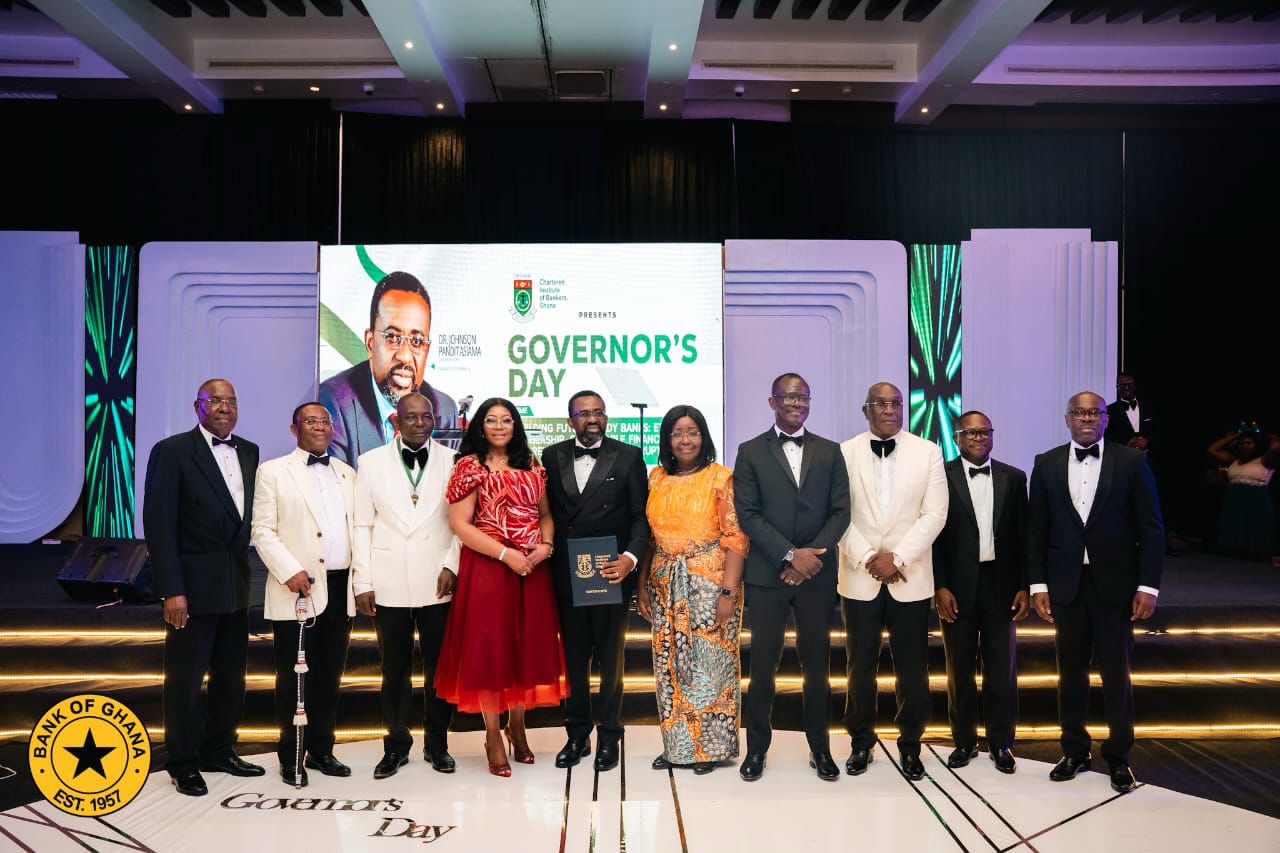
At the Governor’s Day Annual Bankers’ Dinner organized by the Chartered Institute of Bankers, Dr Asiama disclosed that the central bank is also working to reduce the Non Performing Loan (NPL) ratio to 10 percent by the end of 2026. The current NPL ratio stands at 19.5 percent as of October 2025.
He explained that the improving macroeconomic environment should provide room for intelligent loan restructuring by commercial banks without compromising prudential standards. “If 2025 was the year confidence was rebuilt, then 2026 must be the year that confidence is put to work carefully, productively and with judgment in service of a stronger, more competitive Ghanaian economy,” he said.
The Governor stressed that asset quality within the banking sector must remain a top priority, especially as interest rates begin to ease. As of the end of 2024, eleven banks recorded capital ratios below the prudential threshold. However, by November 2025, that number had reduced to five, reflecting recapitalization efforts, enhanced supervision and improved macroeconomic conditions.
Dr Asiama also announced that significant progress has been made in modernizing the payments ecosystem, with the completion of the National Payment Systems Strategy for 2025 to 2029. The strategy provides a coordinated roadmap for interoperability, cybersecurity, instant payments and broader infrastructure modernization.
The Governor acknowledged that small and medium sized enterprises, which form the backbone of the economy, are among the hardest hit by high interest rates, limiting their ability to expand operations and create jobs. “When borrowing costs are lowered, businesses can invest, grow and employ more people,” he explained.
Speaking at the Association of Ghana Industries (AGI) Corporate Forum earlier in 2025, Dr Asiama proposed structured engagement mechanisms between the Bank of Ghana and AGI, including quarterly consultative forums on industrial credit access and foreign exchange policy, sector specific research partnerships to identify policy bottlenecks, and enhanced information sharing on regulatory changes and financial market trends.
“We need to unlock greater flows of sustainable capital and private investment. We are laying the foundations for an economy that is not just recovering, but which is rising with purpose,” he noted at the forum.
The government forecasts a primary budget surplus of 1.5 percent of gross domestic product in 2026, while the overall deficit is forecast to narrow to 2.2 percent from a projected 2.8 percent in 2025. Economic growth is expected to accelerate at 4.8 percent in 2026, up from 4 percent in 2025.
Ghana’s easing cycle mirrors similar moves by regional peers. South Africa’s Reserve Bank recently reduced its benchmark lending rate by 25 basis points to 6.75 percent, the lowest since October 2022, following Zambia’s central bank 25 basis points cut earlier in the month. Both moves were motivated by slowing inflation and efforts to support economic recovery.
With inflation trending downwards and the cedi strengthening, analysts see a clearer path to credit for firms and households. Lower borrowing costs are expected to improve access to credit for businesses and households, stimulating economic activity while maintaining stability.
The Bank of Ghana has also confirmed that it will shift to using 14 day bills to manage liquidity and improve the transmission of monetary policy, further signaling its commitment to creating a more responsive and efficient financial system.