4.8 C
London
Friday, December 26, 2025
Home Blog Page 156

World Bank, TCDA ramp up palm oil sector review after 2026 budget

0

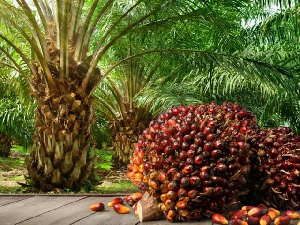
A pile of ripe palm oil fruits sits in front of tall, green oil palm trees A pile of ripe palm oil fruits sits in front of tall, green oil palm trees

The World Bank, a key development partner of the Tree Crops Development Authority (TCDA), is set to deepen its engagement in Ghana’s oil palm sector through an intensive scoping mission, days after the 2026 Budget highlighted major policy interventions for the industry.

The mission, scheduled for a week long field tour, will take officials to major industrial players including Benso Oil Palm Plantation PLC and Twifo Oil Palm Plantations (TOPP) in the Western and Central Regions. The team will also visit artisanal oil palm processing facilities to interact with women processors and smallholder farmers, who form the backbone of the value chain.

Ghana’s ambition outlined in the 2026 Budget is to achieve self-sufficiency in palm oil production by 2032 under the newly launched National Policy on Integrated Oil Palm Development. The policy, running from 2026 to 2032, aims to cultivate over 100,000 hectares of new plantations and generate an estimated 250,000 direct and indirect jobs.

Presenting the budget to Parliament, Minister for Finance Dr. Cassiel Ato Forson emphasized that the initiative would be spearheaded by the Tree Crops Development Authority in close collaboration with the Oil Palm Research Institute and private sector partners.

Acknowledging that oil palm is a long-gestation crop requiring patient capital, the government has established a US$500 million Oil Palm Development Finance Window in partnership with the World Bank, other development finance institutions, and the Development Bank Ghana (DBG).

“To address this, we are establishing a Dedicated US$500 million Oil Palm Development Finance Window. Conventional short-term commercial loans are ill-suited for a crop that takes nearly seven years to reach full maturity,” Forson said.

The world bank team includes Abel Lufafa – Practice Manager, Agriculture and Food Global Practice, West and Central Africa, Ashwini Sebastian – Senior Agriculture Economist , George Amoasah – Senior Environmental Specialist, Emmanuel Abeka – Senior Social Development Specialist, Ebenezer Ansah – Agriculture Economist.

The TCDA team on the other hand includes

Dr. Andy Osei Okrah , CEO, TCDA , Mr. Stephen Asante Acquah , Deputy CEO , Fin and Admin, Dr. Kofi Twum Antwi, Director of Operations , Mr Yaw Agyei Agyapong, Oil Palm Value Chain Specialist and PR Team of TCDA.

The World Bank’s expanded scoping mission is expected to provide technical insight and guide future support for the sector, reinforcing Ghana’s long-term vision of building a competitive, inclusive, and sustainable oil palm industry.

Fans Heartbroken As Jailed Televangelist Reportedly Loses Younger Sister

0

  • Fans were left heartbroken after news broke that Nana Agradaa’s family had suffered another tragedy with the death of her sister
  • In a video, her brother, One Gig, shared a heartbreaking tribute as he announced that their beloved younger sister, Yaa Diego Ba, had died
  • Ghanaians filled the comments section with sorrow, with many followers of the jailed televangelist expressing their condolences to her grieving family

Controversial Ghanaian evangelist, Nana Agradaa, has reportedly lost her younger sister, Yaa, also known as Diego Ba.

Nana Agradaa reportedly loses younger sister, Yaa Diego Ba. Source: Facebook

Nana Agradaa’s brother, One Gig, shared details of the tragedy in a TikTok post seen by YEN.com.gh on the page UK Media GH, shared on November 22, 2025.

In the post, Nana Agradaa’s brother mourned the death of their sibling with a heartbreaking tribute.

“My words cannot show the love I have for you, my sister, but my tears can show how much I’m going to miss you. Your memory will forever be a treasure. May your soul Rest In Peace, Sister Yaa Diego Ba.” he stated.

The post also contained a video showing some lovely moments of Yaa Diego Ba before her demise.

The TikTok video with details of Nana Agradaa’s sister’s death is below.

Nana Agradaa jailed for fraud

The death of Nana Agradaa’s sister occurred months after she was jailed for fifteen years for fraud and charlatanic advertisement.

An Accra Circuit Court convicted her following a three-year trial and sentenced her to the Nsawam Female Prison.

She has recently grabbed headlines over reports that her physical condition had deteriorated in prison.

Osofo Appiah Biblical, who has an ongoing court case with the preacher at the Accra High Court, stirred sadness following an interview in which he described her changed physical appearance.

Reactions to Nana Agradaa’s sister’s death

YEN.com.gh compiled some comments reacting to the video announcing the tragic death of Nana Agradaa’s sister.

Ewura Abena said:

“Eeiii, I don’t even know what to say, hmmm.”

Richmond Addo wrote:

“Aww, may her soul rest in eternal peace.”

Isaac Joejo Andam commented:

“Oh, Sorfo Maame, RIP. Well, may God give her a good place in heaven 🙏.”

Dorcas Adu Boahemaah said:

“Aww, my sister, my friend, Yaa RIP.”

“Time for bold action” – Mahama pushes decentralization of Accountant-General’s department to fight ghost names

0

President Mahama has called for the decentralization of the Accountant-General’s Department to district levels to improve payroll accountability and eliminate ghost names.

President John Dramani Mahama is pushing for the decentralization of the Controller and Accountant-General’s Department as part of broader reforms to strengthen public financial management, reduce payroll fraud, and improve governance across the public sector.

Navigating a world too tall

0

Every day, they move through our streets, offices, and public spaces, yet many of their struggles remain unseen. For little people in Ghana, living with dwarfism means balancing everyday ambitions with a society that is still slow to fully accept them.

Medical experts define dwarfism as a condition of unusually short stature or small size, often caused by genetic or medical factors such as achondroplasia. While the condition may affect height, its social implications run much deeper.

Sophie Acheampong, a civil servant in her late 40s, a wife and mother living with dwarfism, shared that her personal experiences growing up inspired her to create a support system for others like her, ultimately leading to the formation of the Association of Persons with Little Stature.

“I grew up in a middle-class family, and I attended one of the elite schools where it was not allowed for students to mock others with special needs. I also have siblings who were very protective of me, so much that you couldn’t even look at me twice in public without consequences,” she said.

While her family and school provided early support, Sophie said this was not enough to shield her from societal stigma. “Sometimes I get hurt by negative comments from people, but it is even more painful seeing my son, who also has dwarfism, face the world without the same protection I had as a child.”
Winfred Kwame Ntumi, Secretary of the association, recounted similar experiences from his youth: “My brothers encouraged me whenever I came home upset about being mocked or pointed at. Even in school, I worked harder than many of the so-called ‘normal’ students to prove myself.”

Beyond social stigma, little people face daily physical challenges. Stepping into public spaces is often a mental battle for acceptance. “A little child can see you and start screaming; it’s embarrassing and has made me limit my movements in public. Hospital examination tables are too high, buses have steep first steps, schools have staircases without ramps, and even washrooms are not designed for us,” she added.

The Little Persons Association called on the government to recognise little persons as a distinct category in population censuses to improve policymaking. “There are features of ours that do not tally with those of children. By now, the government should allocate a column or page specifically for persons with little stature,” the association noted.
Nii Kpakpo Pappoe, Steering Committee member on the Human Rights Forum for CHRAJ, said Ghana still has a long way to go in eliminating discrimination. “Many little persons have been neglected by their families and communities. We hope the Persons with Disability Bill is passed into law to promote inclusivity in workplaces and schools,” he said.

Despite these challenges, many little people continue to excel in entrepreneurship, arts, sports, and activism, proving that ability, not height, defines a person’s worth. Their stories of resilience and contribution challenge society to look beyond stature and embrace true inclusivity.

Odira Nwobu: Another Nollywood actor d!es

0

Popular Nigerian actor and content creator, Odira Nwobu, has passed away.

His death was first made public on Monday through a Facebook post by fellow content creator and blogger, Awuzie Frankline, who shared a video showing the actor lying lifeless.

Although Frankline did not give official details about the circumstances surrounding the death, reports circulating online claim that Nwobu died only a few hours after clubbing in South Africa over the weekend.

Accra-Kumasi expressway will boost productivity

0

Minister for Roads and Highways, Kwame Governs Agbodza, has revealed that the planned Accra-Kumasi expressway will significantly enhance productivity and reduce travel time.

Speaking on Channel One TV’s Point of View with Bernard Avle on Monday, November 24, the Minister explained that the new expressway is designed to address the challenges posed by the current route, which passes through several built-up communities, causing delays and congestion.

“Accra and Kumasi have become the most important cities. Currently, no matter how you see it, if want to travel Accra-Kumasi, since the road goes through built up communities, the impediment exists.

“We are saying that, we are building a new alignment of an express road which cuts down travel time by 40% cuts the 250 KM to less than 200 KM. I believe this is a very important productivity enterprise. It is not simply building an alternative road from Accra to Kumasi,” he stated.

The Adaklu MP also highlighted plans to integrate a railway alongside the expressway. He explained that the railway is intended to transport goods efficiently while protecting the integrity of the expressway for long-term use.

He assured Ghanaians that the government remains committed to completing the dualisation of the existing Accra-Kumasi Highway, which will be carried out in stages. The dualisation project, he noted, will continue alongside the construction of the new expressway to ensure that both existing and future transport needs are met.

Kasoa-Winneba road to be completed June 2026 – Agbodza

Ghana’s Democracy In A Neighborhood Of Coups

0


The map of West Africa is being redrawn by soldiers. As coups topple governments from Mali to Gabon, and a recent attempt rattled Nigeria, Ghanaians watch from a democratic island increasingly surrounded by a sea of junta rule. The question is no longer abstract, but urgent: Are we safe?

Since 2020, a coup wave has re-drawn the political map of Africa. From Mali and Burkina Faso to Gabon and Niger, soldiers have toppled governments. Just recently, the world watched as a coup attempt in Nigeria, the region’s giant, was narrowly thwarted. Meanwhile, in Madagascar, a political crisis featuring arrests and a disputed election echoes the region’s authoritarian drift. This isn’t distant news; it’s a creeping reality at Ghana’s doorstep.

The fallout is already inside the house. Over 15,000 asylum seekers, fleeing the chaos of Burkina Faso’s coup, have crossed into Ghana’s impoverished Upper East and Upper West regions. This humanitarian crisis strains local resources in one of the country’s most vulnerable areas. Next door in Togo, the construction of a new military base, with reported Russian experts, signals a region bracing for conflict.

Ghana stands as a democratic fortress in this turbulent neighborhood, but its walls are showing cracks. The World Bank labels its economy “in distress,” burdened by unsustainable debt. This economic squeeze is a classic vulnerability that coup-plotters elsewhere have exploited, capitalizing on public frustration over corruption and a high cost of living.

Now, a profound constitutional drama threatens to shake Ghana’s democratic foundations to their core. The unprecedented lawsuit by dismissed Chief Justice Gertrude Torkornoo against the state at the ECOWAS Court is more than a personal legal battle; it is a stress test for the entire system.

Her dismissal by President Mahama and her subsequent demand for $10 million in compensation have ignited a national firestorm. Is this a necessary constitutional process or a political witch-hunt? The public is deeply skeptical. This case, playing out on both national and regional stages, risks deepening that cynicism.

The outcome will resonate far beyond the courtroom. A prolonged crisis risks scaring away the foreign investment Ghana’s fragile economy desperately needs. More importantly, it could weaken the very institutions that protect Ghana from the kind of instability engulfing its neighbors. When citizens lose faith in the judiciary and see political battles overshadowing governance, the appeal of “strongman” alternatives can grow.

The coup trend in Africa is not random. It thrives where institutions are weak, economies fail, and people lose faith. Ghana’s democratic resilience, once taken for granted, is now its most valuable and vulnerable asset. How it navigates this internal judicial crisis will determine not just the fate of a chief justice, but the strength of its fortress walls against the gathering storm.


By Seun Faleye

No court should grant such orders in two hours – Sory questions Supreme Court decision benefiting Afenyo-Markin

0

Legal practitioner Thaddeus Sory has alleged that personal interests, rather than national considerations, influenced the actions of Minority Leader Alexander Afenyo-Markin during matters relating to the petition against former Chief Justice Gertrude Torkonoo.

Sory claimed that Afenyo-Markin’s involvement had implications for fairness and transparency.

He recounted that his client’s petition referenced Afenyo-Markin directly.

MoFA to supply only local seeds from 2026 – Eric Opoku

0

The Minister for Food and Agriculture, Eric Opoku, has announced a major policy shift that will see Ghana rely exclusively on locally produced seeds for its agricultural programmes starting in 2026.

Speaking at the Government Accountability Series in Accra on Monday, November 24, the minister said the decision follows years of disruption caused by delays in the arrival of imported seeds, which often reached farmers long after the planting season had passed.

“To tackle this, the government has prioritised local seed production as a strategic imperative for food security… From 2026, MoFA will only supply locally sourced seeds to the Ghanaian farmers,” he announced.

The minister said the change is expected to boost the local seed industry, improve seed availability, and ensure timely delivery to farmers—all of which are critical for improved yields and national food security.

Mr. Opoku stressed that achieving seed sovereignty is essential for the country’s long-term agricultural stability. “Without seed sovereignty, there can be no food security,” he noted.

He highlighted the capacity and potential of Ghana’s agricultural research institutions, saying they possess the expertise required for seed research, development and testing. The ministry, he added, is fully prepared to work with them to strengthen domestic seed production systems.

DISCLAIMER: The Views, Comments, Opinions, Contributions and Statements made by Readers and Contributors on this platform do not necessarily represent the views or policy of Multimedia Group Limited.

DISCLAIMER: The Views, Comments, Opinions, Contributions and Statements made by Readers and Contributors on this platform do not necessarily represent the views or policy of Multimedia Group Limited.

CETAG declares indefinite strike over gov’t’s failure to implement NLC award

0

CETAG says government has failed to implement the National Labour Commission arbitral award CETAG says government has failed to implement the National Labour Commission arbitral award

The Colleges of Education Teachers Association of Ghana (CETAG) has withdrawn its services, effective Monday, November 24, 2025, due to the government’s failure to fully implement the National Labour Commission (NLC) arbitral award issued on May 2, 2023.

According to the association, continued government inaction has left it with no alternative but to withdraw all services across the country’s 46 Colleges of Education.

The decision follows an emergency National Executive Committee (NEC) meeting held on November 19, 2025, after which CETAG said the government had “persistently failed to fully implement the National Labour Commission (NLC) arbitral award of 2nd May 2023, despite repeated engagements and reminders.”

In a memorandum issued to members, the association said several unresolved grievances had triggered the strike.

Among the issues cited were:

Non-payment of All-Year-Round Work Compensation for additional duties performed in 2022 across 39 Colleges of Education, with CETAG noting that “only partial payment [has been] made to Accra College of Education.”

Outstanding Book and Research Allowance arrears for the 2023/2024 and 2022/2023 academic years.

Unpaid Book and Research Top-up arrears for the 2021/2022 academic year, owed specifically to Akrokerri College of Education.

Downgrading of teaching staff holding master’s degrees, which CETAG said “undermines professional dignity and violates agreed conditions of service and the Labour Act, 2003 (Act 651).”

The association has ordered a complete halt to academic and administrative duties.

“Members are to cease all teaching, supervision of students on STS, and related academic duties immediately. No member should return to the lecture halls until all the listed grievances are fully resolved,” CETAG directed.

It further stressed that the industrial action was “legitimate and a lawful response to the government’s breach of agreements and disregard for the NLC arbitral award.”

Reaffirming its commitment to quality teacher education, CETAG insisted it would not allow its members to be “exploited, disrespected, or further impoverished.”

Its leadership urged all local chairpersons to ensure strict compliance, adding: “We urge all members to stand firm and united in this action until justice is served.”

The strike means services, including teaching, community engagements, STS support and supervision, and project work vetting, have all been withdrawn.

Ghana welcomes rescission of Trump’s 15% tariffs on cocoa, other agric products; forecasts $60m in revenue boost

0

Samuel Okudzeto Ablakwa is the Minister of Foreign Affairs Samuel Okudzeto Ablakwa is the Minister of Foreign Affairs

The United States Administration has officially informed the Government of Ghana that President Trump’s 15% imposition of tariffs on cocoa and certain qualifying agricultural products from Ghana has been rescinded, Minister of Foreign Affairs, Samuel Okudzeto Ablakwa, has announced.

He left a statement on his Facebook page on Monday, November 24, 2025.

“US diplomats confirm to me that the 15% tariff reversal came into effect on November 13, 2025, following President Trump’s new Executive Order,” Mr Ablakwa said.

“Other agricultural products from Ghana now exempted include cashew nut, avocado, banana, mango, orange, lime, plantain, pineapple, guava, coconut, ginger, and assorted peppers,” he also enumerated.

The minister optimistically forecast: “With an estimated annual Ghanaian cocoa beans export to the US averaging 78,000 metric tons, and at the current spot price of $5,300/MT, Ghana stands to raise additional revenue of US$60 million (GHS667 million) each year resulting from Trump’s tariff rescission.”

“Ghana welcomes this positive development from the US, which is the world’s leading importer of chocolate and cocoa products,” Mr Ablakwa emphasised.

“Ghana and the USA will continue to forge closer and mutually beneficial relations,” he noted in conclusion.

Ernestina Fosuh Furiously Exits Court After Alleged Altercation with Abusuapanin’s ‘Son’

0

  • Daddy Lumba’s sister, Ernestina Fosuh, stirred reactions online after storming out of the Kumasi High Court in anger after an alleged altercation
  • In a video, the late singer’s elder sister could be seen in a heated mood, describing the alleged altercation and recording ‘evidence’ as she vowed to take action
  • The incident occurred as the trial between Daddy Lumba’s two wives, Akosua Serwaa and Odo Broni, entered its sixth day at the premises

Daddy Lumba’s elder sister, Ernestina Fosuh, popularly known as Akosua Brimpongmaa, grabbed attention online after she stormed out of the Kumasi High Court in anger.

Daddy Lumba’ s elder sister, Ernestina Fosuh, angrily storms out of Kumasi High Court following alleged altercation on November 24. Image credit: @khalifacreed Source: TikTok

The sixth day of the court case between Daddy Lumba’s wives, Akosua Serwaa and Odo Broni, over who should be recognised as the late singer’s spouse, came off on November 24, 2025.

In a video seen by YEN.com.gh, Ernestina Fosuh, who has been present for the entire case, exited the court premises angrily following an alleged physical altercation.

She stood on the compound and was heard demonstrating the alleged violent physical actions of another individual, alleged to be one of the sons or nephews of Abusuapanin Kofi Owusu.

Ernestina Fosuh claimed that the individual had grabbed a phone and smashed it, although it was unclear whether it was her phone or if it belonged to someone else.

After demonstrating the alleged attack, a fuming Ernestina Fosuh appeared to take either photographic or video evidence of the alleged assailant’s car.

Aside from Daddy Lumba’s sister, other members of the late singer’s immediate family were also seen expressing anger at the incident.

According to an eyewitness at the Kumasi High Court, the incident occurred between a relative of Abusuapanin Kofi Owusu and one of Ernestina Fosuh’s relatives, after Daddy Lumba’s sister confronted the family head.

The TikTok video of Ernestina Fosuh fuming following an alleged altercation at the Kumasi High Court is below.

Ernestina Fosuh pushes back against December 13 funeral

Ghanaian highlife legend, Daddy Lumba, died on July 26, 2025, leaving his family embroiled in a bitter dispute over his funeral and inheritance.

Ernestina Fosuh, together with Akosua Serwaa, filed a court case at the Kumasi High Court seeking an injunction to be placed on his funeral.

Akosua Serwaa stated that she had been sidelined in preparations for her late husband’s funeral and accused the family head, Abusuapanin Kofi Owusu, of deliberately pushing her aside.

Ernestina Fosuh also argued that an autopsy needed to be conducted to determine her late brother’s cause of death before any funeral is held.

On October 28, 2025, the Kumasi High Court dismissed Akosua Serwaa’s injunction application and gave Abusuapanin Kofi Owusu the go-ahead to proceed with the funeral.

Ernestina Fosu invoked Otumfuo’s great oath on Abusuapanin in the aftermath of the ruling, seting in motion a traditional process to settle their differences over the funeral.

A panel of chiefs set up by the Asantehene, Otumfuo Osei Tutu II, moved the funeral date by a week from December 6 to 13.

Speaking after a court hearing on November 21, she stated that she remained opposed to Daddy Lumba’s funeral being held in December.

“Excuse me for saying that Charles (Daddy Lumba) is not a chicken. Only two weeks for his funeral? No. The funeral will not happen,” she stated.

The Instagram video of Ernestina Brimpongmaa speaking about Daddy Lumba’s funeral date is below.

Daddy Lumba, Lumba sister, Ernestina Fosuh, Abusuapanin Kofi Owusu, Lumba family head, Lumba funeral fund
Daddy Lumba’s sister, Ernestina Fosuh, files a report against Abusuapanin Kofi Owusu over alleged withdrawals from the funeral fund. Image credit: @framesbyabrefa, @plus1tv Source: TikTok

Ernestina Fosuh reports Abusuapanin to Kumasi Police

Previously, YEN.com.gh reported that Ernestina Fosuh filed a complaint against her uncle, Abusuapanin Kofi Owusu, over withdrawals from Daddy Lumba’s funeral fund.

Fosuh, accompanied by a group of other family members and Daddy Lumba’s longtime friend, Papa Shee, made the report on November 19.

Comfort Ocran rallies youth as Springboard marks 18 Years

0

The Executive Director of the Springboard Road Show Foundation, Comfort Ocran, has reaffirmed the organisation’s commitment to empowering young people as Springboard celebrated 18 years of nationwide impact at its 2025 Grand Finale held at the University of Professional Studies, Accra on Saturday 22nd November.

Addressing thousands of participants, Comfort Ocran said the Ghana Grows programme “is not ending today; it is only beginning,” adding that hope must be treated as a practical skill young people can apply. She noted that since 2007, Springboard’s nationwide interventions have reached more than one million young people across Ghana and West Africa.

Under the Ghana Grows programme, delivered in partnership with the Mastercard Foundation, Springboard has engaged more than 500,000 participants.

In 2025 alone, 145,605 young people took part, with young women making up 93.3 percent of the total. Another 3,469 persons with disabilities participated across all sixteen regions.

Comfort Ocran said many participants have moved into agriculture, agribusiness, and TVET pathways, contributing to better livelihoods in their communities.

Technical Director of the Foundation, Rev. Albert Ocran, urged the youth to prioritise excellence, collaboration, and value creation as anchors for national progress. He reminded them that progress is a collective effort, saying, “You cannot build something significant working alone, if you want to go farther and faster, go together.” He encouraged young people to build networks, share what works, and support one another as they rise.

The Grand Finale drew an audience of more than 6,000, including young women, young men, persons with disabilities, traditional leaders, institutional heads, and associations.

As part of the celebration, five rising changemakers were honoured under the Young Innovators Awards. The awardees, three young women and two persons with disabilities, included Kow Aboagye Ghunney (Agriculture), Clara Messe (Akorfa) (Agribusiness), David Wakpal (ATVET), Mary Tetteh (Most Promising Agripreneur and YLO Model Ambassador), and Justine Mauda A. Aniaku (Best YLO Facilitator).

Emelia Asamoah, Head of Workforce Development at the Mastercard Foundation, commended Springboard for helping reshape perceptions about agriculture and vocational careers. She noted that TVET enrolment has risen by 193 percent since 2020 and praised the progress of young farmers under the Ghana Grows programme, saying, “These sectors were once seen as fallback options, but Ghana Grows is proving they are innovative and future focused.”

Building on these achievements, Dr. Kafui Mills-Odoi, Head of Inclusion for Nigeria at the Mastercard Foundation, encouraged the young innovators and wider youth audience to pursue growth with confidence and preparation. “You must have confidence and believe, not only to secure a job, but to maintain it and grow in it,” she said.

“Your voice is not just the sound you make; it is the influence you carry. Take time to prepare, to build competence, and to understand the challenges around you so you can create real solutions.”

Fury in Ghana Police Service as retired DCOP is promoted to COP to allegedly boost his pension

0

The information gathered alleged that there is a fury in the Ghana Police Service following the surprise promotion of retired senior officer Arhin Kwasi Annor to the rank of Commissioner of Police (COP).

According to reports, Mr Arhin retired in September 2025 as a Deputy Commissioner of Police (DCOP), was promoted in October, with the elevation backdated to 1 September 2025.

OSP deceived public over Ofori-Atta’s red notice “redaction” – Lawyers allege

0

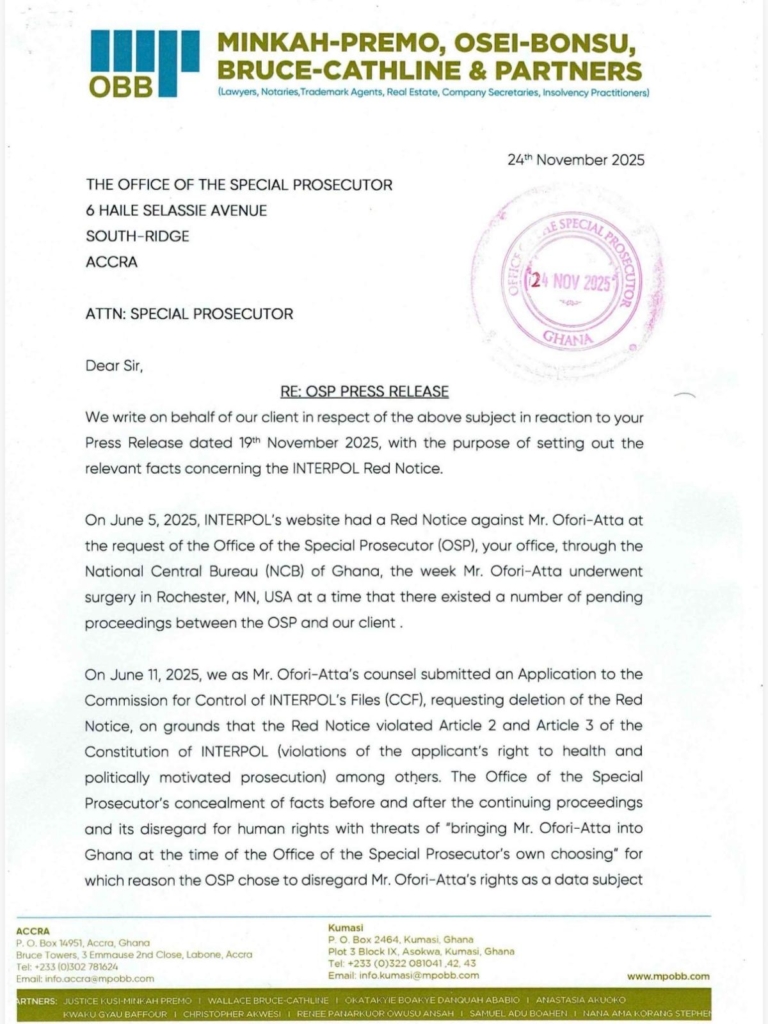
Law firm Minkah-Premo, Osei-Bonsu, Bruce-Cathline & Partners, acting on behalf of former Finance Minister Ken Ofori-Atta, has accused the Office of the Special Prosecutor (OSP) of misleading the public regarding the removal of Mr Ofori-Atta’s image and details from INTERPOL’s website.

In a letter dated November 24, 2025, the lawyers said the OSP’s November 19 press release falsely suggested that the “redaction” of Mr Ofori-Atta’s red notice was a routine process pending a final decision by INTERPOL’s Commission for the Control of Files (CCF).

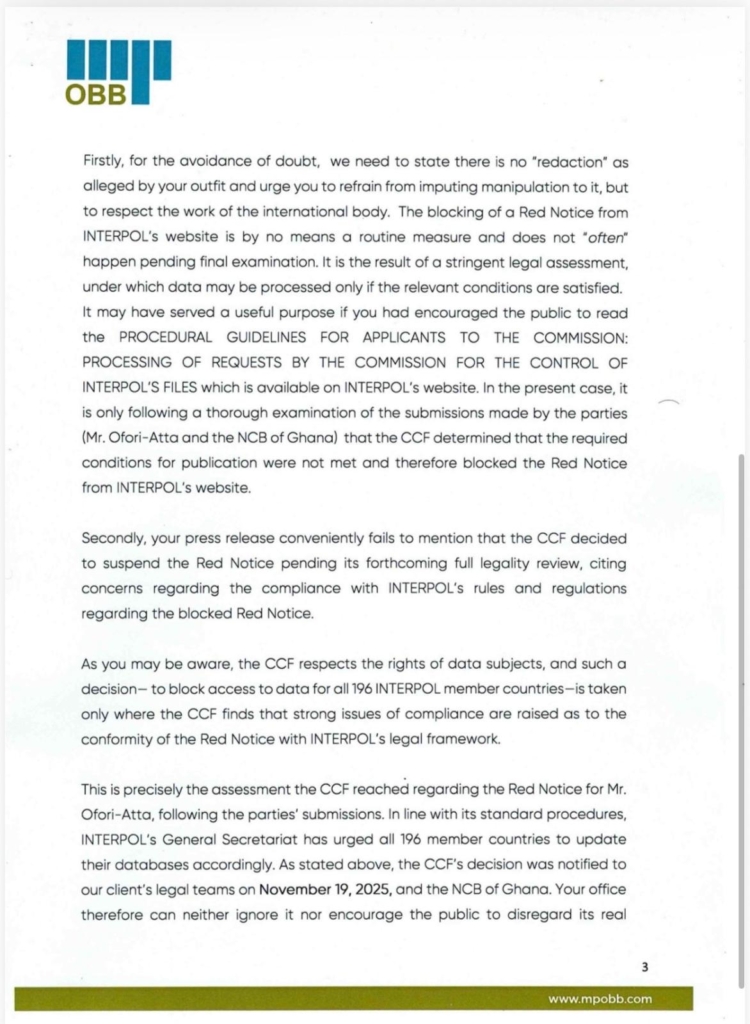
According to the lawyers, there was no redaction, but rather a complete blocking of the red notice by INTERPOL after a stringent legal assessment established that the notice violated the organisation’s rules.

The law firms explained that on “June 11, 2025, it submitted a formal application to the CCF requesting the removal of the red notice, arguing that it breached Articles 2 and 3 of INTERPOL’s constitution, including Mr Ofori-Atta’s right to health and protection against politically motivated prosecution.”

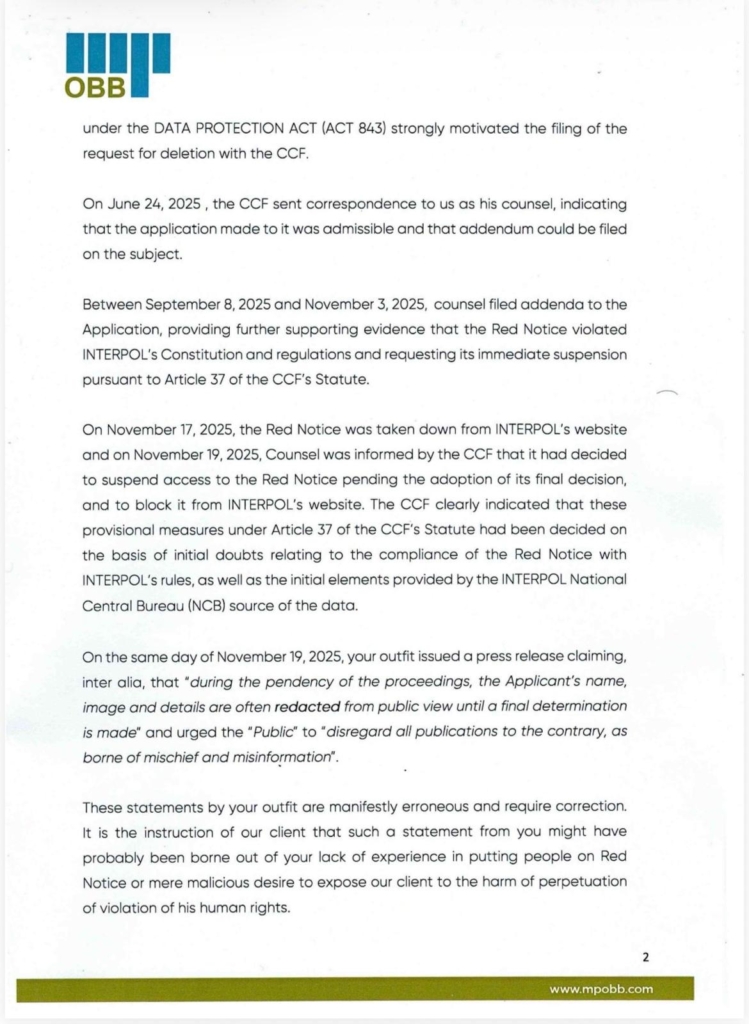
Following the submission of further evidence between September 8 and November 3, the firm said the CCF concluded that the required conditions for publication were not met.

They added that on November 17, 2025, INTERPOL took down the red notice from its website, and on November 19, the CCF notified the lawyers that it had decided to suspend access to the Red Notice pending a full legality review.

The firm emphasised that such a suspension is rare and occurs only when there are “strong issues of compliance” with INTERPOL’s legal framework.

OSP Withheld Critical Facts – Lawyers

The lawyers criticised the OSP for omitting these details in its public communication, accusing the office of concealing key facts and creating the impression that the removal was part of a standard confidentiality process.

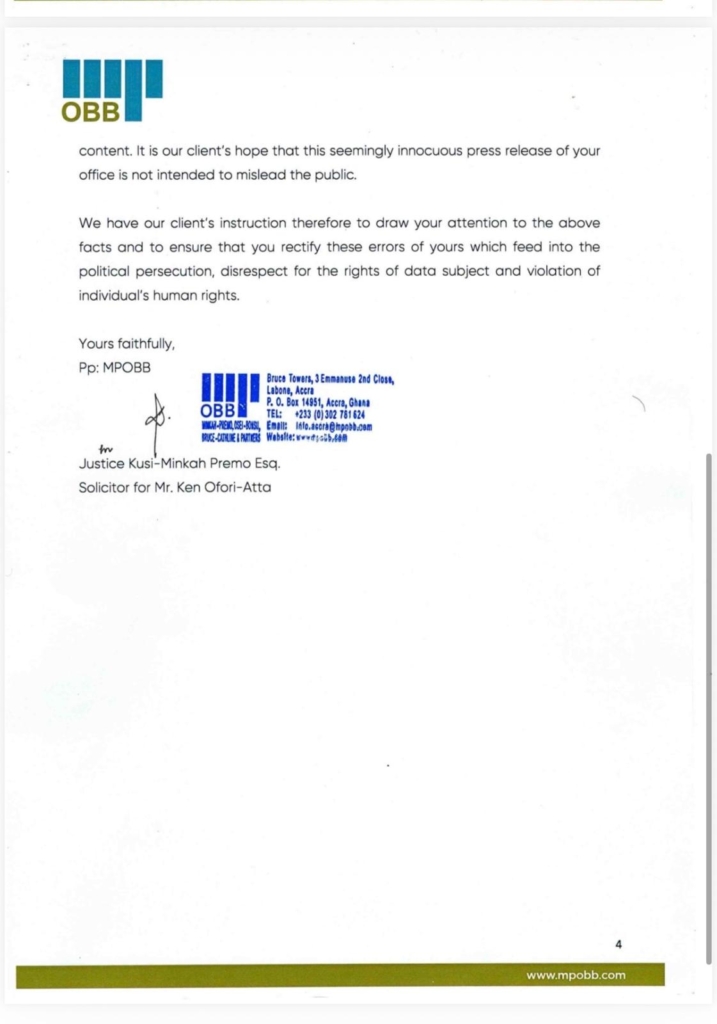
“It is our client’s instruction that such a statement from you might have been born out of your lack of experience in putting people on Red Notice or mere malicious desire to expose our client to harm,” the letter stated.

Political Persecution Concerns

The lawyers further argued that the OSP’s actions, combined with threats to bring Mr Ofori-Atta to Ghana while he was undergoing surgery in the United States, amounted to political persecution and disregard for his human rights.

They urged the OSP to correct what they described as “manifestly erroneous” statements, warning that the comments undermine the integrity of international legal processes.

DISCLAIMER: The Views, Comments, Opinions, Contributions and Statements made by Readers and Contributors on this platform do not necessarily represent the views or policy of Multimedia Group Limited.

DISCLAIMER: The Views, Comments, Opinions, Contributions and Statements made by Readers and Contributors on this platform do not necessarily represent the views or policy of Multimedia Group Limited.

‘Dr Bawumia will win NPP presidential primary’

0

Prophet Samuel Henry, popularly known as Prophet Roja play videoProphet Samuel Henry, popularly known as Prophet Roja

Prophet Samuel Henry, popularly known as Prophet Roja, has stirred conversations within the political and religious space after making a bold prophetic declaration about the New Patriotic Party’s (NPP) upcoming presidential primary slated for January 31, 2026.

According to him, Dr Mahamudu Bawumia is destined to win the contest and should be regarded as the “eventual victor.”

30 out of 45 Central Regional NPP youth organisers declare support for Bawumia

In a sermon delivered to his congregation on November 23, 2025 in Kumasi, Prophet Roja stated that although he has maintained silence over the internal contests of the NPP, he has received divine direction to speak this time.

He urged supporters of Dr Bawumia to begin celebrating because, in the spiritual realm, “the victory has already been secured.”

From Central to Eastern Region: Bawumia’s relentless ‘Journey Together to Victory’ continues

“I haven’t said anything regarding the upcoming presidential primaries of the NPP which will select their flagbearer for the 2028 general elections,” he declared. “But this time, I will say something. Tell the supporters of Bawumia to jubilate—let them celebrate—because he will win. He will win because the one who must win did not show responsibility.”

Prophet Roja, who is the founder of Roja City International Church, has built a reputation as a prophetic voice whose declarations often generate national attention. Many of his followers regard his revelations as accurate and spiritually inspired, adding to the influence he wields in both religious and social circles.

His prophetic ministry gained renewed prominence recently when he foretold the death of Apostle Dr Kwadwo Safo, founder of the Kantanka Group. Shortly after his prophecy, Apostle Safo’s family officially announced his passing, lending weight to Prophet Roja’s earlier declaration.

In that prophecy, he urged the government to honour the late industrialist, insisting that Apostle Safo held “keys” capable of unlocking Ghana’s long-awaited breakthrough in industrial and technological development.

With the NPP’s internal elections drawing closer, Prophet Roja’s latest prophecy is expected to ignite debate among party members, political watchers, and the general public. While some may view it as spiritual insight, others may interpret it as yet another layer in the increasingly heated contest for the party’s 2028 presidential ticket.

Nonetheless, Prophet Roja insists that his message is not political commentary, but a divine instruction delivered at the appointed time.

‘He wanted sex’ – Woman assaulted by husband in viral video recounts ordeal

EC Staffer behind petition for Jean Mensa’s removal interdicted

0

Joseph Blankson Adumadzie, a staff member of the Electoral Commission (EC) who petitioned President John Dramani Mahama to remove Chairperson Jean Mensa and her two deputies, has revealed that he is currently on interdiction.

Mr Adumadzie, who filed the petition under Article 146 of the Constitution over alleged misconduct by the three top EC officials, explained that his current situation at the Commission was not the reason he decided to speak out. He said his decision was prompted by broader concerns over how the Commission was being run.

According to him, he has been on interdiction for sometime now over issues related to Biometric Verification Devices (BVDs).

“For a while now I don’t go to work. I have not resigned, I have not been sacked. I am on an interdiction. It’s a whole lot,” he said on Citi Eyewitness News on Monday November 24. He explained that the interdiction stemmed from allegations linking him to old BVDs that were reportedly found in a refuse dump.

He insisted that the claims against him were false. “It was about these BVDs. They were saying things that were not true about me but I don’t want to go there. Yes, the old machines, but they are not with me and it is not even true. That is the whole thing,” he said.

Mr Adumadzie further disclosed that the Commission took legal action against him but failed to prove the allegations in court.

“They sued me and couldn’t prove anything. And for one year I won the case, and I have sued them,” he added.

He clarified that his decision to petition President Mahama was not driven by personal anger or his interdiction. Instead, he said it was motivated by concerns about the Commission’s integrity and the need for accountability at the highest levels.

In the petition he submitted to the President, Mr Adumadzie cites 12 grounds of alleged misconduct against the Chairperson and her deputies, including cronyism, abuse of office and gross incompetence. He argues that their actions have weakened public confidence in the EC and pose a threat to Ghana’s electoral credibility.

He has since called on President Mahama to refer the petition to the Chief Justice to determine whether a prima facie case exists, in line with constitutional procedures.

Read also

EC staff petitions Mahama to remove Chairperson Jean Mensa, deputies

Nkrumah had the Tema Motorway; Mahama has the Kumasi Expressway

0

In 1964, the opposition fiercely criticized Dr Kwame Nkrumah, Ghana’s first President and founding father, when he initiated the construction of the Tema Motorway.

The project, designed to link Accra with the port and industrial hub of Tema, as well as serve landlocked neighbouring countries clearing goods through Ghana, was dismissed as a wasteful use of scarce national resources.

Agric Minister outlines key developments under Feed Ghana Programme in past nine months

0

Minister for Food and Agriculture, Eric Opoku, has announced significant progress under the government’s Feed Ghana Programme, introduced by the Mahama administration to transform agriculture, boost food security, create jobs and reduce the country’s dependence on food imports.

Speaking at the Government Accountability Series in Accra on Monday, November 24, the Minister said several key interventions have been rolled out within the past nine months to modernise Ghana’s agricultural sector and increase productivity.

Mr Opoku stated that the programme has already delivered 10 new small dams and the rehabilitation of eight existing irrigation dams.

In addition, 250 solar-powered boreholes have been provided for farming communities and second-cycle schools across the five northern regions, as well as the Bono and Ahafo regions.

He said rehabilitation works are also ongoing on several major irrigation schemes. These include the 850-hectare Vea Irrigation Scheme in the Bolgatanga and Bongo districts of the Upper East Region, the 880-hectare Weta Irrigation Scheme in the Ketu North Municipality of the Volta Region, and the 100-hectare Tanoso Irrigation Scheme in the Techiman Municipality of the Bono East Region.

Similar upgrades are underway on the 930-hectare Kpong Irrigation Scheme in the Shai Osudoku and Lower Manya districts, the 200-hectare Ashaiman Irrigation Scheme, and the 245-hectare Aveyime Irrigation Scheme in the Volta Region.

Mr Opoku added that 25 out of 35 planned solar-powered boreholes have been completed, with the remaining 10 expected to be finished in the first quarter of 2026. A further 44 solar-powered boreholes are being developed for selected districts in northern Ghana.

The Minister also announced that processes have begun for the development of new inland valleys to expand rice production.

These include the 175-hectare Anunuso Inland Valley in the Anunuso, Brofoyedu, Nkwawkwanua, and Awaham communities; the 150-hectare Atonsu Inland Valley in the Atonsu and Abramaso communities; and the 647-hectare Kawampe Inland Valley serving nine communities in the Bono East Region.

Other sites include the 114-hectare Odaho and Odamu inland valleys in Yaw Nkrumah and Donuaso, and the 114-hectare Waamu-Kumi Inland Valley in the Ashanti Region.

Mr Opoku further revealed that the Government of Ghana and the Korea Rural Cooperation (KRC) are constructing irrigation infrastructure on 100 hectares of land to support rice seed production.

He assured the public that the Mahama administration is committed to expanding irrigation systems to ensure all-year-round farming.

He announced that 10,000 tonnes of high-quality rice seed will be produced by 2027, saying, “Ghana will be well on its way to rice seed independence.”

Highlighting progress in stabilising food prices, the Minister recalled that food inflation reached an unprecedented 61 per cent in January 2023, dropped to 28.3 per cent in January 2025, and had further declined to 9.5 per cent by October 2025.

Mr Opoku said these outcomes demonstrate the gains being made through the Feed Ghana Programme and other agricultural policies aimed at enhancing food production and strengthening Ghana’s agricultural foundation.

DISCLAIMER: The Views, Comments, Opinions, Contributions and Statements made by Readers and Contributors on this platform do not necessarily represent the views or policy of Multimedia Group Limited.

DISCLAIMER: The Views, Comments, Opinions, Contributions and Statements made by Readers and Contributors on this platform do not necessarily represent the views or policy of Multimedia Group Limited.

Mahama government determined to execute 24hr economy policy – Prof Benedicta Fosu-Mensah

0

Prof Benedicta Fosu-Mensah is Lecturer and Communications Team Member of the governing NDC Prof Benedicta Fosu-Mensah is Lecturer and Communications Team Member of the governing NDC

Lecturer and Communications Team Member of the governing National Democratic Congress (NDC), Prof Benedicta Fosu-Mensah, has reaffirmed the government’s commitment to fully implementing its flagship 24-hour economy policy.

Speaking on Metro TV on Monday, November 24, she emphasised that the initiative remains a central pillar of President John Dramani Mahama’s developmental agenda and will be pursued with seriousness and urgency.

According to Prof Fosu-Mensah, the 24-hour economy is designed to stimulate growth, boost productivity, and create sustainable jobs across various sectors.

She argued that the policy goes beyond extended working hours, noting that it includes deliberate investments in security, energy stability, and business incentives to ensure that round-the-clock economic activity is viable.

“This is not a slogan; it is a comprehensive economic strategy,” she said.

She explained that several ministries and state agencies have already begun aligning their operational frameworks to support the policy’s rollout.

24-Hour Economy policy remains a ‘confusing mix of ideas’ – Amin Adam

Prof Fosu-Mensah added that the initiative will particularly benefit manufacturing, logistics, health, hospitality, and digital services.

In her view, the long-term impact will be increased competitiveness, stronger local industries, and expanded opportunities for young people entering the labour market.

Prof Fosu-Mensah concluded that the Mahama government’s determination to execute the 24-hour economy demonstrates its commitment to modernising Ghana’s economic architecture.

She urged the public to support the initiative, describing it as a transformational policy that will reposition Ghana for accelerated development.

“We are ready, prepared, and focused on delivering this for the benefit of all Ghanaians,” she asserted.

Watch the promo to GhanaWeb’s latest documentary, which uncovers the evolution of ‘kayamata,’ an exploitative practice fueled by love charms and manipulation, titled, “The Dark Side of Kayamata,’ below:

Patrick Boamah rejects Minority Leader position

The wait is over! The GhanaWeb Excellence Awards 2025 is officially launched. Let’s celebrate impact, innovation and excellence across Ghana.

Who deserves to be honoured this year?


Nominate now 👉 https://ghanaweb.com/ghanaexcellenceawards/nominate

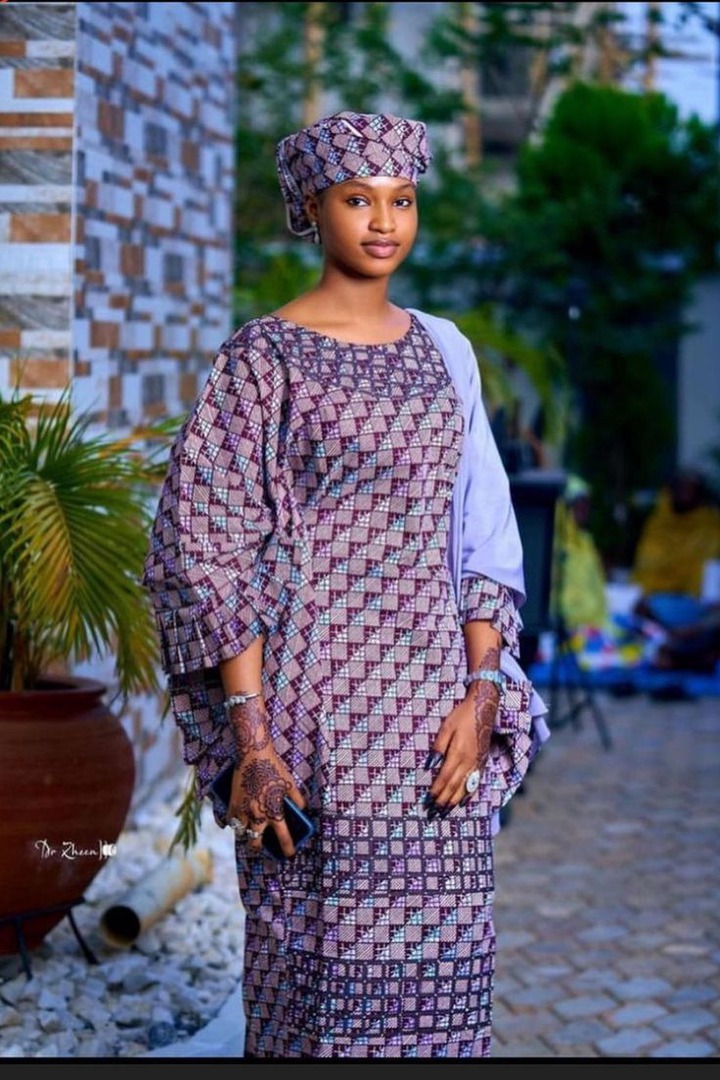
Best Ankara Designs That You Need as a Lady

0

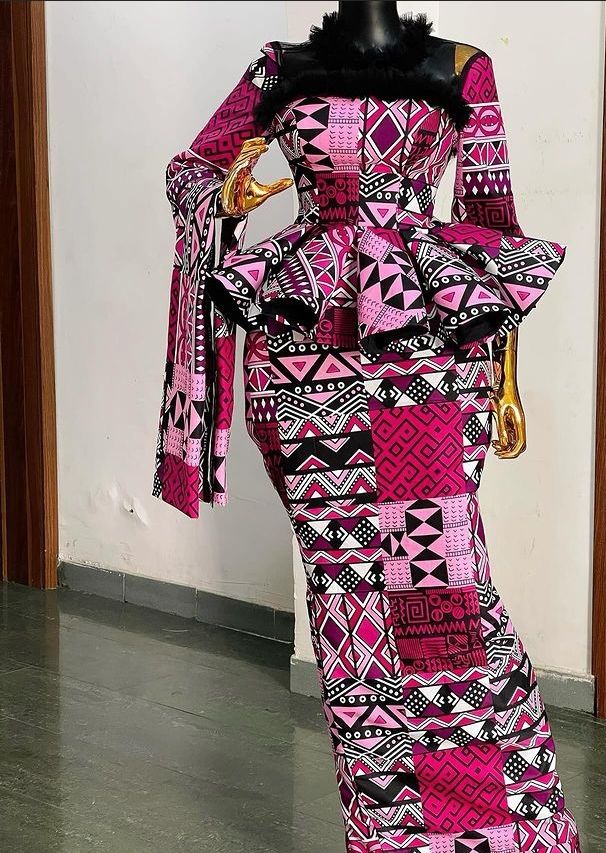
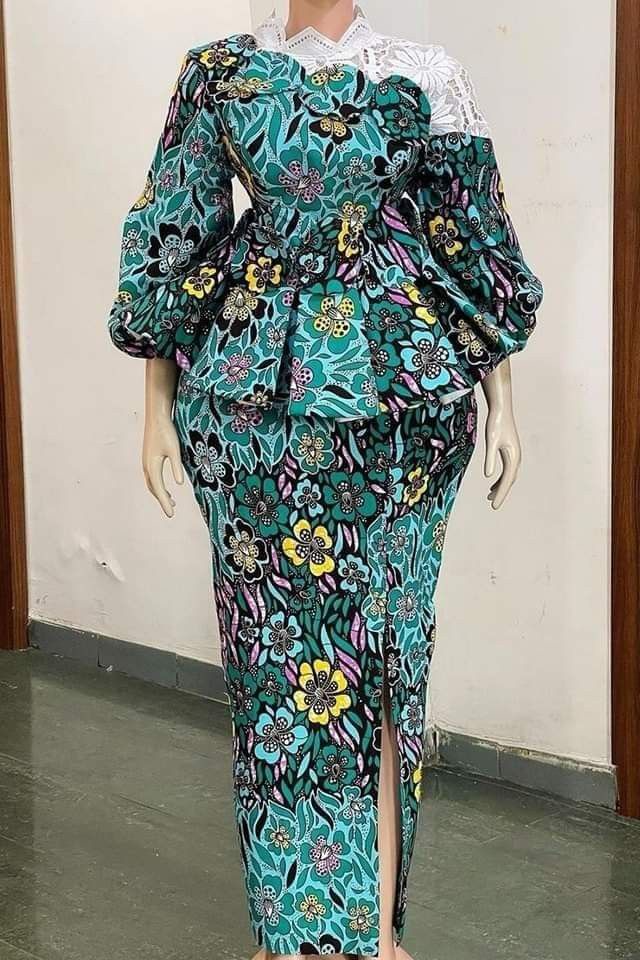
Ankara fabric has long been a symbol of African heritage and style, blending vibrant colors and bold patterns into stunning fashion statements. As a lady, incorporating Ankara designs into your wardrobe is not just a cultural expression but a powerful way to showcase elegance, creativity, and confidence. Whether for casual outings, formal events, or traditional ceremonies, there’s always an Ankara style that speaks to your personality.

One of the most beloved Ankara designs is the peplum top and skirt. This style accentuates the waist and gives a flattering silhouette that suits all body types. Paired with heels and minimal accessories, it’s perfect for weddings, church services, or other semi-formal occasions.

Another must-have is the Ankara jumpsuit. Bold, chic, and modern, the jumpsuit combines comfort with sophistication. Whether sleeveless or long-sleeved, it brings a trendy twist to the traditional fabric and works well for both day and night events.

For ladies who love to make a statement, the Ankara ball gown is a showstopper. With layered or flowing skirts and detailed bodices, these gowns are ideal for special occasions like red carpet events, engagements, or milestone celebrations.

Also, don’t overlook the Ankara blazer or kimono jackets. They can be effortlessly thrown over jeans, dresses, or office wear, adding a burst of color and uniqueness to everyday fashion.

Every lady should own at least one standout Ankara piece. It’s more than just fashion — it’s identity, tradition, and modern elegance rolled into one. Choose designs that reflect your style, and wear them with pride.

A long list of levies driving costs through the roof

0

For many Ghanaians, buying a car has become an increasingly expensive decision, whether brand new or used. While global supply chain shocks, currency depreciation, and inflation are often cited as the main culprits, a lesser-known but equally significant factor lies in the long list of taxes, fees, and statutory charges imposed at Ghana’s ports.

A typical Bill of Entry for a vehicle import reveals more than 20 different taxes, levies, and charges, many of which are applied regardless of the age, type, or value of the vehicle. Even when some items show “0.00” during exemptions or special waivers, they remain mandatory cost components for most importers.

Collectively, these charges make Ghana one of the most expensive destinations to clear vehicles in West Africa.
Here is a breakdown of these charges and why stakeholders say the cumulative effect is prohibitive.

1. The Core Taxes That Drive Up Costs

A number of major taxes form the backbone of Ghana’s vehicle import regime:
Import Duty (Code 01)

This is a major component of clearance costs, calculated on the CIF value of the vehicle. Rates vary by vehicle type and capacity, but they significantly raise the base clearing cost.

Import VAT (02) and Import NHIL (47)

The standard VAT and National Health Insurance Levy charged on imports. When combined with other VAT-related charges, importers complain that VAT is applied multiple times in the clearance chain.

ECOWAS Levy (06)

A community levy paid on imports into ECOWAS member countries. While relatively small, it adds to the cumulative expense.

Special Import Levy – SIL (78)
A 2% levy originally introduced as a temporary measure but now part of the port tax ecosystem.

1% Withholding Tax on Imports (56)
Usually applied to registered businesses, this reduces immediate cash flow and adds to upfront port costs.

2. Administrative and Agency Fees

These charges are attached to specific regulatory or public service agencies:
Processing Fee (05)

A general administrative charge paid on every import declaration.

Vehicle Examination Fee (31)
Charged for physical inspection of vehicles.

Vehicle Certification Fee (16)
Paid when DVLA certifies the imported vehicle prior to registration.

Ghana Shippers Authority SNF Fee (45)
A statutory fee supporting the operations and regulatory work of the Shippers Authority.

MoTI e-IDF Fee (72)
The electronic import declaration fee mandated by the Ministry of Trade and Industry.

GHS Disinfection Fee (63)

Introduced during the peak of COVID-19, this fee initially covered disinfection of cargo. Importers argue that the persistence of such charges beyond the emergency period is unnecessary.

3. Network and System Charges

These technology-related fees have become some of the most controversial:
Network Charge (32)
Network Charge VAT (33)
Network Charge NHIL (48)
Network Charge GETFund Levy (89)
COVID-19 Network Charge (39)
The “network charge” cluster relates to fees imposed for the use of the Integrated Customs Management System (ICUMS). Importers argue that applying VAT, NHIL, GETFund, and other levies on top of a technology service fee results in cascading taxes, effectively taxing the same item multiple times.

4. Social and Public Policy Levies

These levies are intended to fund national development initiatives:
GETFund Import Levy (88)
EXIM Bank Levy (87)
African Union Import Levy (98)
COVID-19 Health Recovery Levy (99)
Upfront VAT for Unregistered Importers (101)
Individually, these may not be large percentages, but together they greatly inflate the overall cost of bringing a vehicle into Ghana.

Why These Charges Are Seen as Prohibitive

1. Cumulative Effect
While some levies appear minor on their own, the combined effect is substantial. A vehicle valued at $10,000 can attract total clearing costs that approach or even exceed the value of the vehicle, depending on engine capacity and age.

2. Cascading Taxes
VAT-related charges are applied several times, on the value of the vehicle, on network fees, and sometimes on other levies, creating a compounded tax effect.

3. Lack of Harmonisation Across Agencies
Multiple government agencies impose independent fees, creating redundancy and inefficiencies.

4. High Port Charges Reduce Competitiveness
Ghana’s ports are increasingly seen as less competitive compared with neighbouring countries.

Comparing Ghana’s Port Charges With Other West African Countries
Nigeria – More Competitive Despite Its Challenges
Despite Nigeria’s economic difficulties, clearing a used vehicle at Lagos or Port Harcourt often costs significantly less than in Ghana. Nigeria also applies fewer digital-system charges, and the country has aggressively reviewed auto import taxes to attract more port volumes.

Togo (Lomé) – The Region’s Transit Leader

Lomé Port is widely considered the most competitive in West Africa. This is due to lower automobile import duties, fewer administrative levies, faster clearance processes, heavy reliance on transit cargo, especially to landlocked neighbours.

Many Ghanaian importers take advantage of this by routing vehicles through Lomé and then transporting them into Ghana. Ironically, this results in Ghana losing significant revenue to Togo.

Benin (Cotonou) – A Popular Destination for Auto Imports
Benin has positioned Cotonou as a “vehicle import hub” by: reducing import duties, streamlining port processes, removing redundant fees.
As a result, many West African auto dealers source and clear vehicles through Cotonou, not Ghana.

Industry Concerns: Ghana Is Losing Out

Stakeholders in Ghana’s automobile import ecosystem consistently argue that:
The long list of taxes and levies discourages vehicle importation.
Port costs are pushing importers to use neighbouring countries.
Government revenue is indirectly reduced because overly high charges divert business away from Ghana.
The average Ghanaian pays more for used cars due to high port charges.
Local auto dealers warn that the market continues to shrink as vehicles become unaffordable for many consumers.

The Way Forward

The prices of vehicles on the local market are significantly impacted by two key factors which are the exchange rate and port-related import duties. For years, a weakening cedi has led to higher costs for both importers and buyers.

Due to this, there is already growing pressure from customers who are demanding price reductions in line with the cedi’s appreciation.

According to vehicle dealers, current retail prices remain high because the cars were imported when the exchange rate was less favourable.

Second Hand Car Dealers Association argue that although they expect that future imports will be more affordable, due to the appreciation, maintaining the current import duty regime will be ineffective.
Industry players are calling for:

1. A comprehensive review of all automobile import levies
2. Harmonisation of agency charges
3. Reduction of cascading VAT on service fees
4. Competitive benchmarking across West African ports
5. A shift from revenue-maximisation to trade-facilitation
Until these reforms happen, clearing a car in Ghana will remain one of the costliest in the subregion and consumers will continue to bear the burden.


Source: Sheba Araba Bennin/Channel One Research Desk

Special Prosecutor Kissi Agyebeng saw “Most Valuable Suspect” leave and did nothing – Martin Kpebu Alleges

0

Prominent lawyer Martin Kpebu has called for the resignation of Special Prosecutor Kissi Agyebeng, accusing him of failing to prevent a key suspect from leaving Ghana despite having the opportunity to do so.

Kpebu made these strong allegations during a recent public engagement at Tv3 studios, claiming the country’s chief corruption prosecutor witnessed what he described as the “most valuable suspect” depart without taking action.

The lawyer asserted that Special Prosecutor Agyebeng later admitted to seeing suspect Ofori-Atta leave the country and had even intercepted a letter Ofori-Atta wrote to both outgoing and incoming chiefs of staff.

“He saw the most valuable suspect, like in football you say most valuable player, fleeing the country,” Kpebu stated, expressing frustration that Agyebeng chose not to inform citizens about this development.

Kpebu firmly rejected Agyebeng’s explanation that he couldn’t get help from security agencies, calling this justification “hogwash” and “palpable falsehood.”

The lawyer argued that the Special Prosecutor had alternative options available, including holding a press conference to alert the public.

“The law mandates him to do that,” Kpebu insisted, emphasizing that such action would have been constitutional under Articles 1, 35, and 125 of Ghana’s constitution.

The controversy has sparked plans for a public demonstration, with Kpebu urging citizens to join Apostle Abraham Lincoln Larbi’s protest to protect the constitution.

The lawyer’s allegations have raised serious questions about the effectiveness of the Office of the Special Prosecutor in handling high-profile corruption cases.

By: Jacob Aggrey

ECG Warns Against Power Infrastructure Damages

0

The crash site


The Electricity Company of Ghana (ECG) is urging motorists and the general public to exercise extreme caution to prevent damage to critical power infrastructure.

According to the company, such damages result in prolonged and avoidable power outages, as well as significant repair costs, which the liable individual will be required to pay in full.

The caution comes in the wake of an incident on Thursday, November 20, 2025, when a truck crashed into an ECG transmission tower near Katamanso, resulting in extensive damage.

Speaking to journalists, Ing. Francis Kofi Atsyatsya, General Manager of ECG Subtransmission, Accra, indicated that the collapse of the tower will lead to a prolonged outage for all areas that rely on the affected transmission lines.

He estimated the cost of repairs at GH¢800,000 and confirmed that the driver of the truck will be held responsible for the full cost.

Ing. Atsyatsya added that ECG has filed an official report at the Lakeside Police Station, where the truck is currently impounded. “ECG is initiating processes to ensure the vehicle owner is held accountable and pays the full cost of restoring the tower,” he said.

Condemning the incident, he urged motorists to avoid speeding and to practice defensive driving, especially near power installations.

“We urge all drivers, contractors, and the public to respect and protect our power infrastructure. These structures are vital for delivering electricity to homes and businesses,” he stressed.

He reaffirmed ECG’s commitment to providing reliable, quality and safe power, but cautioned that deliberate or negligent damage to its installations will be pursued rigorously to recover all related costs.

Ing. Atsyatsya appealed to the public and stakeholders to help safeguard power installations in their communities.

He also encouraged residents to report suspicious activities near electrical facilities to the ECG Contact Centre at 0302 611 611 or via the company’s social media platforms @EcgghOfficial.

He further assured customers of ECG’s ongoing efforts to enhance service delivery, emphasising that public cooperation is essential to maintaining a stable and reliable power supply.


BY Gibril Abdul Razak

Asawase NDC women’s wing empowers 150 women with vocational skills training‎‎‎ 

0

By Muyid Deen Suleman        

 Kumasi, Nov. 24, GNA – Mr Ben Abdullah Alhassan, Asokore-Mampong Municipal Chief Executive (MCE), has advised women in the area to take advantage of the various government initiatives aim at empowering women to improve on their socio-economic conditions. 

He said empowering women to develop and improve on their living conditions was critical in the government’s reset agenda and it was important that women would embrace such opportunities to live a meaningful life and contribute to the growth and development of the nation. 

Mr Alhassan was speaking at the graduation of 150 women trained in various vocational skills by the women’s wing of the NDC in the Asawase constituency. 

The trainees, whose ages ranged from 18 years and above, were instructed in various practical skills, including soap making, detergent production, body splash creation, and yogurt and milk powder preparation.  

Mr Alhassan  charged the women to always visit the municipal assembly anytime they needed guidance towards the establishment of new business avenues. 

Hajia Ramatu Shakibu, constituency women’s organizer, said the training programme was not only significant for the participants but also for the broader community, as it sought to enhance the women’s roles in local development and economic activities.‎ 

She said the two-week training programme was designed with the objective of equipping the women with essential skills that would enable them to achieve self-reliance.  

By gaining these skills, the women would be better positioned to economically contribute to their households and communities. 

Hajia Shakibu, emphasized that empowering women through such initiatives was essential for achieving their socio-economic goals.‎ 

Each of the participants was given a certificate of recognition. 

GNA 

Edited by Kwabia Owusu-Mensah/Lydia Kukua Asamoah  

MoFA installs 20 automated weather stations nationwide

0

The Ministry of Food and Agriculture has installed 20 automated weather stations across Ghana to strengthen the country’s agricultural meteorology and improve farming planning.

Minister Eric Opoku made the announcement on Monday, November 24, during the Government Accountability Series.

He explained that the stations, managed under the Ghana Meteorological Agency (GMet), operate 24/7 and automatically collect data, eliminating the need for manual readings.

The move aims to enhance the accuracy and consistency of weather forecasts and agricultural planning.

“The ministry has made significant strides in transforming Ghana’s agro-metrological landscape. We have installed 20 automated weather stations across the country. Under the Ghana Meteorological Agency (GMet), these stations, unlike the manual ones, will collect data automatically in a 24/7-hour system.

Ensuring high accuracy and consistency, eliminating manual dependence for readings, enhancing forecasting, and enhancing planning.

He added, “Out of the 20 automated weather stations, 11 are located in SHSs where columnated clubs have been formed. The automated weather stations allow us to provide hyper-precise local advisory on rainfall patterns, soil health, temperature trends, and weather conditions directly, including planting, harvesting fertiliser applications.”

The initiative is part of the ministry’s broader efforts to modernize Ghana’s agricultural sector and equip farmers with reliable data to boost productivity.

…..

Explore the world of impactful news with CitiNewsroom on WhatsApp!

Click on the link to join the Citi Newsroom channel for curated, meaningful stories tailored just for YOU:
https://whatsapp.com/channel/0029VaCYzPRAYlUPudDDe53x

No spam, just the stories that truly matter! #StayInformed #CitiNewsroom #CNRDigital

Actor Daddy Billy shares video he took with his colleague, Odira Nwobu two hours before his demise

0

Actor Daddy Billy shares video he took with his colleague, Odira Nwobu two hours before his demise

Actor Daddy Billy has shared a video he recorded with his colleague, Odira Nwobu, two hours before his demise.

Late Odira passed away suddenly in South African in the early hours of today, November 24. The cause of his de@th is yet to be confirmed however his colleagues claim he had been battling with High blood pressure.

The video shared by Daddy Billy showed himself and late Odira in a club. He stated that he recorded the video at about 12 midnight today and that two hours layer, Odira was already de@d.

‘’It’s a useless world we live in

The video we took by 12midnight

2hrs later ODIRA NWOBU  is gone”

Watch the video he shared below

CERPA reviews 2026 Budget Statement and Economic Policy

0

  1. Introduction

The 2026 Budget, presented to Parliament by the Minister for Finance on 13 November 2025, is the second budget of the NDC administration under the “Reset Agenda.” Themes of fiscal discipline, macroeconomic stability, and job creation dominated the budget, which is anchored on “Resetting for Growth, Jobs, and Economic Transformation.”

This document presents a review of the budget statement delivered on behalf of the President. The review outlines (i) a snapshot of macroeconomic performance for 2025 and the target for 2026, (ii) the key highlights of the budget, (iii) its strengths and weaknesses, and (iv) our concluding opinions and the implications of the budget.


  1. Snapshot of Macroeconomic Performance


Indicator 2024

Q1

2025

Q1

2024

H1 (June)

2025

H1

(June)

2025

Proj

Q1-Q4

2026

Target

Overall GDP 4.9 5.3 5.1 6.3 4.8 4.8
Non-oil GDP 4.3 6.8 5.6 7.8 5.3 4.9

Note: Q1= quarter one, H1= first half of the year, and Proj= projected


Indicator 2025

Target (revised)

Proj

Q1 – Q3

Outturn

Q1 – Q3

Proj

Q1 – Q4

Target for 2026
Total Revenue and Grants (billions of GH¢) 229.9 162.6 154.9 226.4 268
Total Expenditure (billions of GH¢) 269.4 206.9 178.4 251.7 302.4
Primary Balance (Commitment basis) 1.5% 0.6% 1.6% 1.8% 1.5%
Overall Fiscal Deficit (Commitment basis) -2.8% -3.2% -1.5% -1.8% -2.2%

Note: Proj= projected


Cedi Performance (Inter-Bank Rate)

Indicator 10th November 2024 10th November 2025
US Dollar GH¢16.35 GH¢10.92
British Pound GH¢21.09 GH¢14.37
Euro GH¢17.50 GH¢12.62


  1. Key highlights of the budget

Here are some key or notable features of the 2026 Fiscal Budget:

  • Revenue Target: The government aims to collect GH¢268.1 billion in total revenue and grants, representing an 18.3% increase from the 2025 amount of GH¢229.9 billion.
  • Expenditure Target: The government plans to spend GH¢302.4 billion in 2026, representing a 12.2% increase over the 2025 allocation of GH¢269.4 billion.
  • Fiscal Discipline: The budget prioritises fiscal discipline, targeting a primary surplus of 1.5% of GDP and an overall deficit of 2.2% of GDP.
  • Economic Growth: Ghana’s economy is projected to grow by 4.8% in 2026, supported by improved fiscal discipline and ambitious development priorities. This exceeds the 2025 growth target of 4.0%.
  • Inflation: Inflation is expected to stay within the target band of 8% with a margin of error of ±2 percent.
  • Tax Reforms: The budget introduces several tax reforms, including the abolition of the COVID-19 levy and decoupling of GETFund and NHIL levies from the VAT Tax base. It also abolishes VAT on mineral exploration and extends zero-rated VAT on local textiles to 2028.
  • Public Debt Management: Key actions include rebuilding the Sinking Fund to create buffers for future repayments, conducting debt reprofiling and bond buy-backs to reduce high-cost obligations, limiting non-concessional borrowing to only strategic projects, and improving transparency through regular publication of debt operations.
  • Social Protection: The budget prioritises social protection, with allocations for free SHS, NHIS, LEAP, and school feeding programmes.
  • Infrastructure Development: The budget includes investments in infrastructure, including the Big Push Infrastructure Programme.
  • Job Creation: The government aims to create over 800,000 jobs in 2026 through infrastructure projects, TVET expansion, and the 24-Hour Economy initiative.


  1. Observed Strengths and Weaknesses

Based on the notable features of the 2026 Fiscal budget, here are some strengths and weaknesses of the budget:

 Strengths

  • Revenue Mobilisation: The budget targets e-commerce, cross-border digital transactions which encapsulate a broad and modern source of revenue mobilisation. The budget also projects non-oil domestic revenue to increase to 15.7% of GDP in 2026 from 15.1% projected for 2025, through tighter enforcement and the digitalisation of tax administration.
  • Government Expenditure: Government plans to increase spending by 12.2% in 2026, signaling an expansionary fiscal policy. This is expected to support the needed economic growth, provided the required revenues are mobilised to finance the higher expenditure.
  • Fiscal Discipline: The budget prioritises fiscal discipline, targeting a primary surplus of 1.5% of GDP and an overall deficit of 2.2% of GDP, an improvement from the 2.8% projected for 2025 and 7.9% outturn recorded at end-December 2024. This aligns with the amended Public Financial Management Act (2025) and the IMF-supported programme.
  • Macroeconomic Stability: The budget aims to sustain macroeconomic stability, with single-digit inflation and exchange rate stability, preserving gains made in 2025. 
  • Debts: The government’s debt management approach which focuses on extending maturities, reducing borrowing costs, and strengthening credibility represents a positive shift in overall debt management.
  • Social Protection: The budget maintains funding for social protection programs, including the Livelihood Empowerment Against Poverty (LEAP) program, National Health Insurance Scheme, and School Feeding Programme.


Weaknesses

  • Revenue Assumptions: The budget’s ambitious fiscal targets hinge on optimistic revenue projections that may prove difficult to achieve, particularly given Ghana’s persistent tax compliance challenges. Notably, the government missed its revenue target for Q1–Q3 by GH¢7.7 billion, underscoring the risks associated with these assumptions.
  • Fiscal Gaps: The budget has underlying fiscal gaps, with rising interest obligations, and a balancing gap, requiring additional borrowing to finance interest costs and priority programmes. 
  • Crowding-out Effect: The budget poses a significant risk of crowding-out private sector activity, as increased domestic borrowing could constrain credit availability and raise lending costs. This may slow job creation, weaken industrial growth, and undermine broader economic transformation efforts. 
  • Job Creation: Although the projected creation of 800,000 jobs is commendable, concerns remain about their sustainability, as a significant share is linked to construction-related activities under the Big Push and other infrastructure programmes. 
  • Limited Transformational Vision: The budget falls short of articulating a clear transformational agenda, with minimal emphasis on productive investment. Its orientation remains largely toward fiscal consolidation rather than catalytic, growth-enhancing expansion. 
  • Poverty Reduction: The 2026 Budget does not present a clear poverty-reduction framework. Although the budget references various social protection initiatives, it does not provide a coherent matrix outlining how these policies and programmes will directly alleviate poverty among vulnerable groups. The document lacks measurable targets, timelines, and defined implementation pathways for reducing poverty, making it difficult to assess how proposed interventions will translate into meaningful improvements in the welfare of low-income households


  1. Conclusive Opinion and Implications
  • The 2026 Budget Statement and Economic Policy of Ghana presents a mixed picture, with both strengths and weaknesses. On the positive side, the budget prioritises fiscal discipline, targeting a primary surplus of 1.5% of GDP and an overall deficit of 2.2% of GDP, aligning with the amended Public Financial Management Act and the IMF-supported programme.
  • The budget also prioritises social protection and investments in infrastructure, education, and healthcare, with a focus on promoting economic growth and reducing inequality. The “Big Push Infrastructure Programme” and the “24-Hour Economy” initiative are notable examples of this.
  • However, concerns have been raised about the potential crowding-out effect of domestic borrowing, which could slow job creation, weaken industrial growth, and undermine economic transformation efforts.
  • The budget’s ambitious fiscal targets also hinge on optimistic revenue assumptions, which may be challenging to achieve given Ghana’s persistent tax compliance issues and limited diversification of the revenue base. This may worsen the projected fiscal gap, forcing the government to resort to debt financing.
  • Overall, the 2026 Budget Statement and Economic Policy of Ghana is a credible attempt to consolidate macroeconomic stability, accelerate job creation, and protect social progress; however, its success will depend on effective execution, realistic revenue strategies, and institutional accountability.


Reggae legend Jimmy Cliff dies, aged 81

0

Jimmy Cliff, one of the most prominent and beloved proponents of reggae music, has died at the age of 81.

A star since the 1960s, he helped to bring the sound of Jamaica to a global audience through hits such as Wonderful World, Beautiful People and You Can Get It If You Really Want.

His lead role as a gun-toting rebel in the 1972 crime drama The Harder They Come is a cornerstone of Jamaican cinema and was attributed as the movie that brought reggae to America.

Cliff’s wife, Latifa Chambers, announced his death via a statement on Instagram.

“It’s with profound sadness that I share that my husband, Jimmy Cliff, has crossed over due to a seizure followed by pneumonia,” she wrote.

“I am thankful for his family, friends, fellow artists and coworkers who have shared his journey with him.

“To all his fans around the world, please know that your support was his strength throughout his whole career.

“Jimmy, my darling, may you rest in peace. I will follow your wishes.”

Her message was also signed by their children, Lilty and Aken. Born James Chambers in 1944, Cliff grew up as the eighth of nine children in abject poverty in the parish of St. James, Jamaica.

Blessed with a sweet, mellifluous voice, he began singing at his local church at the age of six.

He was inspired to write his own material when he heard ska pioneer Derrick Morgan on the radio – and asked his woodwork teacher how one might go about composing their own song.

“He told me, ‘You just write it!’“ he told Mojo magazine.

”So I went ahead and… wrote a song called I Need A Fiancée, another called Sob Sob, and I made a guitar out of bamboo to accompany myself.”

By the time he was 14, he had moved to Kingston and adopted the surname Cliff to express the heights he intended to reach.

He recorded a handful of singles before topping the Jamaican charts with his own composition, Hurricane Hattie.

In 1965, he relocated to London to work with Island Records – later the home of Bob Marley – but the label’s attempts to make his sound palatable to rock audiences were initially unsuccessful.

He eventually struck gold with the 1969 single Wonderful World, Beautiful People – an upbeat, feel-good anthem- and the more politically-charged Vietnam, which Bob Dylan called “the best protest song ever written”.

Its lyric tells the story of a young soldier who writes from the war, promising his mother he’ll be home soon; only for her to receive a telegram the next day, informing her of his death.

Cliff reflected on the song in 1986, telling reggae archivist Roger Steffens: “The essence of my music is struggle. What gives it the icing is the hope of love.”

The musician became an international star with The Harder They Come, expressly written for the movie of the same name, in which he played Ivan Martin, a young man trying to break into Jamaica’s corrupt music industry.

“The film opened the door for Jamaica,” Cliff recalled. “It said, ‘This is where this music comes from.”

Cliff contributed four songs to the soundtrack, including the gospel hymn Many Rivers to Cross, which reflected his early days as a struggling artist in the UK.

“I was still in my teens,” he later recalled. “I came full of vigour: I’m going to make it, I’m going to be up there with the Beatles and the Stones.”

“And it wasn’t really going like that. I was touring clubs, not breaking through. I was struggling with work, life, and my identity. I couldn’t find my place. Frustration fuelled the song.”

Instead, the film and its soundtrack won him international acclaim. Rolling Stone magazine even named it one of their top 500 albums of all time.

During the 1980s, he collaborated with the Rolling Stones on their Dirty Work album, and he returned to the US charts in 1993 with his cover of I Can See Clearly Now, from the soundtrack for Cool Runnings, which followed the escapades of Jamaica’s bobsled team.

His other recordings included the Grammy Award-winning albums Cliff Hanger (1985) and Rebirth (2012), a nostalgic return to form.

Cliff entered the Rock and Roll Hall of Fame in 2010, calling it “a great thrill and an honour”.

Inducting him, Fugees star Wyclef Jean said he had been inspired by Cliff’s success as a young boy growing up in Haiti.

“When we saw Jimmy Cliff, we saw ourselves,” he said.

Cliff continued to tour late into his life, playing Glastonbury’s legends slot in 2003, and winning over a new generation of fans at the 2010 Coachella Festival.

His contributions to Jamaican music and culture were recognised in October 2003 when he was awarded the country’s prestigious Order of Merit.

But the singer said his connection to fans was more important than any of the other honours bestowed upon him.

Speaking to US radio station NPR in 2012, he reflected: “When someone comes up to me and says, ‘I was a dropout in school and I heard your song You Can Get It If You Really Want, and that song made me go back to school, and now I am a teacher and I use your song with my students’ – that, for me, is a big success.”


NDC questions NPP’s appeal before seeing Kpandai ruling reasoning

0


Dr. Sofo Tanko Rashid Computer, Deputy National Director of Elections and IT for NDC

The National Democratic Congress (NDC) has criticised the New Patriotic Party (NPP) for filing an appeal against the annulment of the Kpandai parliamentary election before the official reasoning of the court ruling is released.

The criticism by Rashid Tanko Computer, Deputy Director of Elections and IT for the NDC, comes in response to the NPP’s rejection of the Tamale High Court ruling, which annulled the 2024 parliamentary election in Kpandai and ordered a fresh poll following a petition by the NDC candidate Daniel Nsala Wakpal.

The party has filed a notice of appeal and a motion for stay of execution, insisting that the ruling is flawed and the original results remain valid.

Speaking on JoyNews’ The Pulse on Monday, November 24, Tanko Computer described the NPP’s move as premature.

“They [NPP] have spoken about going for an appeal and filing a stay of execution. But have they even looked at the reasoning behind the ruling?

“The judge just said our petition was upheld and that the reasoning will be given to us on Friday. You have not even seen it, and you’ve gone to file for appeal. What are you appealing for? So you see how interesting the NPP can be?” he said.

DISCLAIMER: The Views, Comments, Opinions, Contributions and Statements made by Readers and Contributors on this platform do not necessarily represent the views or policy of Multimedia Group Limited.

DISCLAIMER: The Views, Comments, Opinions, Contributions and Statements made by Readers and Contributors on this platform do not necessarily represent the views or policy of Multimedia Group Limited.

‘Budget Not Solving People’s Problems’

0


The Member of Parliament (MP) for Takoradi, Kwabena Okyere Darko-Mensah, has described the government’s recent budget statement as flawed.

He said, “The government claims in the budget that inflation has gone down. But Ghanaians know that prices of foodstuffs and other products are going up day in day out.”

“That is the fallacy of their budget. This budget is not solving any of the common people’s problems,” the former Western Regional Minister explained.

Speaking in an interview, the Takoradi MP asserted that the anchor of the recent National Democratic Congress (NDC) government’s budget is artificial.

“The inflation they claim had gone down is not affecting the prices of consumables. Now the dollar rate is fluctuating.

“The NDC had earlier indicated that it pumped GH¢1.1 billion into the economy and around that period one dollar was equal to GH¢10.3, but now it is GH¢11.4 to a dollar,” he pointed out.

He stated, “So what the Finance Minister presented is not solving the real problem on the ground.”

He argued that a ball of kenkey that was sold for GH¢5 under the previous administration is now selling at GH¢7.

Mr. Darko-Mensah then called on Ghanaians to brace themselves for continuous rise in the prices of goods and services.

According to him, the current NDC government does not have what it takes to manage the economy to benefit ordinary Ghanaians.


From Emmanuel Opoku, Takoradi

When the sea vomits: Are our schools and hospitals ready?

0

In Ghana’s most vulnerable coastal communities, the sea is no longer just swallowing homes, it is tearing at the very foundations of public infrastructure. As the coastline retreats year after year, schools, hospitals, and health centers are edging closer to collapse.

In communities such as Fuveme, Salakope, Agavedzi, Kporkporgbor, and Kedzikope, the question hangs heavily: When the sea vomits again, where will the people run?

In Fuveme, the school compound once echoed with laughter. Today, it stands fractured, its foundation eaten by waves.

Mr. Nyatefe, the headteacher, now holds classes under trees.

“I cannot risk the children’s lives,” he told JoyNews.

“When the tide is strong, the ground shakes. We have lost too much already.”

Three school blocks along this stretch have partially collapsed. Others stand dangerously close to the shoreline.

At the Kedzikope Health Centre, nurses work while watching the sea inch closer every day.
For nurse Elorm, every night brings dread.

“When the waves hit the walls, I panic,” she admits. “We cannot run fast enough if something happens.”

Ambulances can no longer access flooded roads. Pregnant women now walk up to nine kilometres for care. Medical supplies are delayed for days because transport routes are repeatedly cut by water.

Infrastructure on a Tight Rope

Experts estimate that sections of Ghana’s coastline are eroding at over five meters a year.

That rate threatens: School buildings, health facilities, water and electricity lines, and community roads.

This deterioration is fueled by sea level rise, extreme tidal waves, sand mining, mangrove loss, and decades of unmanaged coastal development.

When a school collapses, children lose their right to education. When a clinic is cut off, lives are lost. When a community road vanishes, the entire local economy stalls.

The threat is not theoretical, it is unfolding now. Experts call for a national emergency plan, not piecemeal projects. Ghana must: reinforce or relocate endangered public facilities, restore mangroves to buffer the coastline, implement sustainable dredging, and build climate-resilient infrastructure.

Coordinate coastal defence across Health, Education, and Works & Housing Ministries

“The sea is moving faster than policy,” a district official warns. “If we delay, we will lose more than buildings; we will lose lives.”

This article is written as part of a collaborative project between JoyNews, CDKN Ghana, and the Centre for Climate Change and Sustainability at the University of Ghana, with funding from the CLARE R4I Opportunities Fund.

DISCLAIMER: The Views, Comments, Opinions, Contributions and Statements made by Readers and Contributors on this platform do not necessarily represent the views or policy of Multimedia Group Limited.

DISCLAIMER: The Views, Comments, Opinions, Contributions and Statements made by Readers and Contributors on this platform do not necessarily represent the views or policy of Multimedia Group Limited.

GHA Endorses Ralph Ayitey as AGI President: Championing Industrial Transformation

0

Mr Raphael Ralph Mawuenyega Kojo Ayitey Chief Executive Officer Of Coconut Grove Hotels

In a strong show of unity and confidence, the Ghana Hotels Association (GHA) has officially endorsed Mr. Raphael (Ralph) Mawuenyega Kojo Ayitey, Chief Executive Officer of Coconut Grove Hotels, as its preferred candidate for the position of President of the Association of Ghana Industries (AGI) in the upcoming national elections scheduled for Thursday, 27th November 2025.

The GHA’s endorsement underscores Mr. Ayitey’s unwavering commitment to industrial excellence, his transformational leadership within the hospitality sector, and his two decades of dedicated service to the AGI.

Over the years, he has served in key leadership capacities, including Hospitality Sector Chairperson (2013–2015), Executive Member of the National Executive Council (2017–2021), and National Treasurer (2021–Present).

The Association describes Mr. Ayitey as a collaborative, forward-thinking leader who blends business acumen with empathy and results-driven leadership.

His agenda focuses on financial independence for AGI, enhancing secretariat performance, and expanding market access for local industries.

“We believe Ralph Ayitey represents the new face of industrial transformation, a leader who bridges policy, partnership, and performance,” the statement said.

The GHA calls on all members who are part of AGI to rally behind Mr. Ayitey and support his bid to elevate Ghanaian industry to new heights of competitiveness and innovation.

Attached is the statement from GHA.

Statement 1


By Tanko A. IBRAHIM

I’m not scared of a re-run – NPP’s Mathew Nyindam

0

New Patriotic Party’s (NPP’s) Hon. Matthew Nyindam has insisted that he remains the legitimate Member of Parliament (MP) for Kpandai despite the High Court’s decision ordering a re-run of the parliamentary election within 30 days.

Addressing the media after the ruling on Monday, November 24, 2025, he maintained that he won the contest convincingly and is fully prepared to defend his mandate.

Ghana calls for global gold certification regime to combat smuggling

0

Ghana is urging the international community to establish a multilateral certification scheme for gold, similar to the United Nations–backed Kimberley Process for diamonds, to prevent smuggled gold from entering the global supply chain.

The proposal was announced by the Chief Executive Officer of the Ghana Gold Board (GoldBod), Sammy Gyamfi, during the 2025 Dubai Precious Metals Conference in Dubai.

Mr. Gyamfi said the absence of a unified international certification framework has enabled illicit gold to flow freely across borders, fuelling money laundering, terrorist financing and other criminal activities.

He stressed that a global mechanism is urgently needed to protect both producing and importing countries from the growing risks associated with illegal gold trading.

According to him, a certification regime would enhance transparency, improve accountability and restore integrity to the global gold industry.

“Just as the Kimberley Process helped curb conflict diamonds, a similar scheme for gold will prevent smuggled metal from entering legitimate supply chains,” he said.

He added that Ghana stands ready to work with the United Arab Emirates, the Dubai Multi Commodities Centre (DMCC), the World Gold Council, the London Bullion Market Association (LBMA), and governments worldwide to advance the initiative.

“We are confident that these steps will bolster global Anti-Money Laundering and Counter Terrorism Financing efforts,” he noted.

The call comes amid concerns that discrepancies between gold export records in Ghana and import records in other countries reflect large-scale smuggling. Mr. Gyamfi warned that the phenomenon has strengthened criminal networks and undermined good governance across several gold-producing nations.

In his speech, he also highlighted Ghana’s recent reforms to tighten control over its artisanal and small-scale mining (ASM) sector, including stricter licensing, increased enforcement, and the impending rollout of a blockchain-based Track and Trace system by 2026 to verify the origin of all ASM gold.

Mr. Gyamfi emphasised that global cooperation is essential to closing the loopholes exploited by smugglers. He called on industry leaders and international organisations to support developing countries that are working to transform their ASM sectors and safeguard the integrity of the global gold supply chain.


“He’s not a Professor, yet earns GH¢6,000 every week” – Galamseyer shares

0

The young galamseyer operating an excavator
An Illegal miner (galamseyer) has shared a video of a young school dropout, who reportedly left school in class 6 and is now operating an excavator at an illegal mining site.
The galamseyer in the viral video compared the young man earning to that of the earnings to those of teachers.
According to the galamseyer, the boy is a school dropout but earns GH¢6,000 as an excavator operator at an illegal mining site.
The narrator in the video stated, “This is the kid who

CSO Platform on Constitutional Reform Officially Launched

0

Dr Kojo Asante — Director Of Policy Engagement And Partnerships Cdd Ghana

The Ghana Center for Democratic Development (CDD-Ghana), in partnership with STAR-Ghana Foundation and Democracy Hub, with support from the Foreign, Commonwealth and Development Office (FCDO), officially launched the Civil Society Organization Platform on Constitutional Reform (CSO-CRC Platform).

The platform is a citizen-led initiative aimed at reimagining Ghana’s governance and development after more than three decades of democratic practice.

The launch event in Accra brought together civil society organizations (CSOs), youth networks, development partners, media, and citizens, all committed to championing and actively engaging with Ghana’s ongoing constitutional review process.

Speakers at the launch framed constitutional reform as a historic opportunity to reclaim democracy and ensure a government that is truly people-centered.

They emphasized the need for coordination, grassroots mobilization, and inclusive participation, particularly for youth, women, and persons with disabilities, to ensure that the reform process reflects the aspirations of all Ghanaians.

Historic Moment for Governance Reform

Speaking at the event, Dr. Kojo Asante, Director of Policy Engagement and Partnerships at CDD-Ghana, described the launch as a rare and historic chance to rethink Ghana’s governance structures.

“The political elite must embrace the opportunity to correct the ills of hyper-partisanship and monetization of politics that have placed a stranglehold on our political, economic, and social systems. It is an opportunity to free the people so they can in turn free their leaders from excessive material dependence and political pressures,” he said.

Eunice Agbenyadzi, Head of Programs at STAR-Ghana Foundation, outlined the platform’s structure, noting that it will operate through a Coordinating Committee and regional and district-level bodies to ensure broad-based national engagement.

“This platform is designed to strengthen coordination and deepen participation. From the national level to the districts, our goal is to ensure a well-organized civic voice in the constitutional review process,” she added.

Support from Development Partners

Development partners expressed strong backing for the initiative. Mr. Hooman Nouruzi, Head of Political and Governance at the British High Commission, reaffirmed the UK Government’s commitment to supporting Ghana’s democratic development.

“The UK Government is proud to support efforts to strengthen governance, promote inclusive participation, and uphold the rule of law,” he said.

Lessons from Past Reform Attempts

Drawing on lessons from previous constitutional reform efforts, stakeholders stressed the importance of civil society vigilance to ensure recommendations are not weakened or sidelined. Oliver Barker-Vormawor of Democracy Hub and FixTheCountry highlighted the experience of the 2010–2012 Constitutional Review Commission (CRC), noting that civil society organizations must develop comprehensive strategies to influence decision-making, especially during transitional phases following reports and recommendations.

He added that exclusion of CSOs from the Constitution Review Implementation Committee in the past limited their impact, underscoring the need for inclusive structures that allow diverse stakeholders to participate in the reform process.

Roadmap for Engagement

Over the coming months, the platform will roll out its roadmap, including:

Establishing regional platforms and engaging broader civil society, professional groups, religious bodies, and students.

Forming working groups to develop advocacy strategies.

Maintaining sustained public engagement throughout the constitutional review process.

These efforts aim to ensure Ghana’s constitutional reform becomes a people-driven process delivering a stronger, fairer, and more democratic nation.

Call to Action

All civil society organizations and interested individuals are encouraged to participate and strengthen the national effort to consolidate good governance in Ghana. Participation is critical to ensuring that the constitutional review process reflects the priorities of all Ghanaians. Interested parties can join via https://citizensforreform.org/

About the CSO Platform on Constitutional Reform

The Civil Society Platform on Constitutional Reform is a collaborative initiative facilitated by CDD-Ghana, STAR-Ghana Foundation, and Democracy Hub, bringing together diverse organizations, activists, and citizens to coordinate engagement, advocacy, and accountability in Ghana’s constitutional reform process.

The platform currently comprises over 50 organizations, including:

Ghana Center for Democratic Development (CDD-Ghana)

Democracy Hub

STAR-Ghana Foundation

Foundation for Security and Development in Africa (FOSDA)

Affirmative Action Law Coalition

ABANTU for Development

Health Messenger International

Center for Peace Policy and Research

FIDA Ghana

Friends of the Nation

Institute for Democratic Governance

Trades Union Congress (TUC-Ghana)

COLANDEF

Parliamentary Network Africa

Africa Disability Institute

Concern Health Education Project

Youth Advocates Ghana

WiLDAF Ghana

350 Ghana

Abibinsroma Foundation

Odekro PMO Foundation

DreamHunt Ghana

BudgIT Ghana

Ghana Developing Communities Association

POS Foundation

West Africa Civil Society Institute (WACSI)

Human Rights Advocacy Centre

Human Rights Reporters Ghana

NAPRM

Youth Opportunity and Transformation in Africa

Know West Africa

Penplusbytes

Global Media Foundation LBG

Cashew Watch Ghana LBG

Citizens Watch Ghana

KARIBS Foundation

Foundation for Democratic Integrity

Indigenous Women Empowerment Network LBG

Adams Foundation for Research and Development Center

Norsaac

Transparency International Ghana

Naabans Foundation

Center for Public Interest Law (CEPIL)

Action on Persons with Disabilities and Development-ADD

Care for Society Network International

PACKS Africa

Youth Network Alliance

Moremi Initiative for Women’s Leadership in Africa

Renel Ghana Foundation

Foundation for Research and Development (FoRD-Ghana)

KYS AFRICA

Youth Bridge Foundation

NETRIGHT

Presbyterian Church of Ghana

Network for Environmental Sustainability and Transformation

The platform aims to ensure citizen-led, transparent, and inclusive constitutional reform for a stronger democratic Ghana.

NPP rejects Kpandai election ruling, calls it “dangerous” and damaging to democracy

0


The New Patriotic Party (NPP) has strongly criticised the Tamale High Court ruling ordering a rerun of the 2024 parliamentary election in the Kpandai constituency, describing the decision as dangerous and a threat to Ghana’s democratic progress.

Speaking on JoyNews’ The Pulse on Monday, NPP Director of Elections and Research, Evans Nimako, said the party cannot accept the court’s decision, insisting it goes beyond the petitioner’s own claims.

“This cannot be a ruling that you expect the New Patriotic Party to say is a welcoming decision from a competent court of jurisdiction. For me, this is a dangerous ruling. The intent is to erode all the political and democratic gains we’ve made as a country,” he said.

Mr. Nimako argued that the petitioner’s case involved alleged infractions in 41 out of 152 polling stations.

Yet, the court annulled the results for the entire constituency instead of focusing on the areas in dispute.

“A petitioner comes to court with a plea that in 41 polling stations there have been some infractions, and you then give a ruling that, assuming, without admitting, that yes, the 41 had issues, the other 111, where there were no issues, should also be cancelled? What kind of dangerous ruling is this?” he questioned.

He added that the NPP won the seat by a margin of nearly 4,000 votes, securing 53.47% of the total ballots cast, and therefore finds it difficult to understand why the whole election should be annulled.

“This is a constituency the party won decisively. And you are telling me that you, the judge, will go beyond the plea of the petitioner? I don’t think this is the way to go,” he stressed.

The party has already filed an appeal, insisting that the ruling is legally flawed and must be overturned.

DISCLAIMER: The Views, Comments, Opinions, Contributions and Statements made by Readers and Contributors on this platform do not necessarily represent the views or policy of Multimedia Group Limited.

DISCLAIMER: The Views, Comments, Opinions, Contributions and Statements made by Readers and Contributors on this platform do not necessarily represent the views or policy of Multimedia Group Limited.

Importers and Exporters Association applauds gov’t as U.S. lifts 15% export tariffs

0

The Importers & Exporters Association of Ghana (IEAG) has praised the Government of Ghana, especially the Ministry of Foreign Affairs, for successfully securing the rescission of the 15% export tariffs previously imposed by the United States on Ghanaian cocoa and other agricultural products.

The tariffs, which affected cocoa, avocado, cashew nuts, mango, plantain, and other key exports, were lifted effective November 13, 2025.

Samson Asaki Awingobit, Executive Secretary of IEAG, described the development as a major victory for Ghana’s exporters, noting that the tariffs had threatened profit margins, production levels, and jobs in the export sector.

He emphasised that the reversal restores Ghana’s competitiveness in international markets and helps safeguard vital foreign exchange earnings.

Mr. Awingobit also highlighted that trade diversification efforts, including the recent Ghana–China zero-tariff trade agreement, played a role in reducing pressure on U.S. demand and encouraging the rescission of the tariffs.

While celebrating the success, IEAG urged the government to maintain momentum in trade diplomacy, strengthen the export ecosystem, and implement measures such as export credit guarantees and risk mitigation tools.

The association also called for efforts to diversify Ghana’s export base to reduce reliance on traditional commodities like cocoa, gold, and oil, which accounted for over 83% of total exports in 2024.

“This diplomatic achievement is a testament to persistent trade negotiations and strategic policymaking,” Mr. Awingobit said. “We remain committed to partnering with government to translate this opportunity into sustained export growth, value addition, and stronger foreign exchange inflows.”

The IEAG encourages all stakeholders, public and private, to capitalize on this moment to strengthen Ghana’s export-driven economy.

Dadekro community receives new CHPS compound

0

By Nastain Ibn Saliu GNA  

Kete-krachi (O/R), Nov 24, GNA – Mr. Prosper Addo, the Municipal Chief Executive (MCE) of Krachi West, has commissioned a newly constructed Community-Based Health Planning and Services (CHPS) Compound for the people of Dadekro and neighbouring communities in the Krachi West Municipality of the Oti Region. 

The facility is expected to provide essential primary healthcare services, create employment opportunities, and improve the overall wellbeing of residents within the catchment area. 

Speaking at the commissioning ceremony, Mr. Addo urged community leaders and residents to ensure regular maintenance of the facility so it can serve its intended purpose for many years.  

He reaffirmed the commitment of the Krachi West Municipal Assembly to continue prioritizing development projects that enhance the lives of the people. 

The MCE extended his appreciation to the current NDC government, led by President John Dramani Mahama, for the continuous support to the Krachi West Municipality. 

On behalf of the chiefs and people of Dadekro, Nana Odikro Kwabena Donkor expressed profound gratitude to the Government, the MCE, and President Mahama for the provision of the CHPS Compound, describing it as a timely and impactful intervention for the community. 

GNA  

Edited by: Maxwell Awumah/Christian Akorlie  

When the Intellectual Class Fails, a Nation Loses Its Compass

0

Akwasi Opong Fosu

In every society, intellectuals occupy a unique and indispensable role. They are not simply individuals with degrees or academic titles; they are meant to be the conscience of the nation, the thinkers who question, analyse, clarify, and illuminate.

Their work helps society understand itself, interrogate its problems, and navigate its way toward progress.

But what happens when the very individuals entrusted with this responsibility descend into the same emotionalism, partisanship, and reactive politics they are supposed to critique?

Ghana received a sobering example recently through the public clash between Dr. George Domfeh and Prof. Ransford Gyampo.

What many dismissed as mere television drama is, in truth, a symptom of a deeper and more troubling decline: the weakening of intellectual responsibility in our public discourse

Intellectuals: Mirrors of the Society They Emerge From

It is often said that intellectuals reflect the nature of the society that produces them. They are not immune to the pressures of tribalism, political tension, economic hardship, or national frustration.

When society becomes polarised, intellectuals may mirror that polarisation. When political dialogue becomes shallow and confrontational, they too may be swept into its turbulence.

This is what made the Domfeh–Gyampo confrontation so unsettling. Instead of elevating the national conversation, the professors echoed the very hostility and partisanship that have become common in Ghana’s political space.

The academy, which should model discipline and reflective thinking, has begun to feel the heat of a nation struggling under deepening political tensions.

Intellectuals: Holders of the Mirror for Society to Self-Reflect

While intellectuals may reflect society, their higher and nobler calling is to hold up a mirror for society to reveal its contradictions, expose its weaknesses, and guide it toward clarity.

Throughout history, transformative thinkers have shaped nations by challenging societal norms, not surrendering to them.
They include:
1. Kwame Nkrumah, whose political ideas ignited Africa’s liberation movements.
2. Nelson Mandela, whose moral clarity defined a nation’s healing.
3. Amílcar Cabral, who emphasised that liberation must begin with intellectual honesty.
4. Frantz Fanon, who exposed the psychological scars of oppression.
5. Gustavo Gutiérrez, who connected faith with justice for the marginalised.
6. Wole Soyinka, whose voice against tyranny remains powerful.
7. Chinua Achebe, who revealed Africa’s postcolonial dilemmas with unmatched insight.

These thinkers did not mirror society’s flaws; they illuminated them. They compelled society to think beyond emotion, beyond slogans, and beyond partisan noise.

This is what it means to be an intellectual.

The Cost of Intellectual Abdication

The Domfeh–Gyampo incident must not be treated as isolated entertainment. It reflects a broader decline that carries dangerous consequences for national development.

1. The Normalisation of Aggressive Partisanship
When intellectuals resort to personal attacks and political loyalty overrides academic discipline, it signals that reason no longer holds value. This sets a worrying precedent for students and young citizens who look to scholars for guidance.

2. Decline of Institutional Credibility
Universities are meant to be sanctuaries of sober debate, evidence-based reasoning, and the pursuit of truth. When their representatives sound like partisan activists, public trust in these institutions erodes.

3. Loss of Intellectual Authority
If intellectuals behave like politicians, who will hold the political class accountable?
Who will provide balanced, objective analysis?
Who will defend national interest over political interest?

Without intellectual neutrality, a nation loses one of its strongest defences against extremism and manipulation.

4. Generational Impact
Young people absorb what they see. If intellectuals model confrontation instead of clarity, emotion instead of evidence, and partisanship instead of principle, these habits will become generational.

This is how the decline of a democracy begins, not with violence, but with the decay of thought.

A Dangerous Decline Creeping In

Societal decline rarely happens suddenly. It begins quietly when individuals who should know better choose convenience over principle.
When this continues unchecked:
1. public debate loses depth,
2. critical thinking is replaced by tribal loyalty,
3. institutions weaken from within, and
4. national development becomes impossible.

This is the path Ghana risks if its intellectual class continues to drift away from its duty.

A Renewed Call to Responsibility

Ghana does not need intellectuals who echo the chaos of partisan politics. It needs thinkers who rise above the noise, those who challenge society to think, not react; to question, not follow; to reflect, not inflame.

The next generation is watching closely.

They will inherit either a culture of responsibility or a culture of spectacle.
A culture of truth or a culture of convenience.
A culture guided by intellectual integrity or one driven by emotionalism.

The responsibility placed on the intellectual community is enormous—and the consequences of failure are far-reaching.

Ghana cannot afford an intellectual class that seeks applause instead of truth.
It cannot afford thinkers who abandon their calling for political validation.
The nation’s future depends on those willing to think deeply, speak boldly, and act ethically.

For when intellectuals abdicate their responsibility, the nation loses its compass and the journey ahead becomes dangerously uncertain.

GNPC, Explorco dismiss claims of withheld data in Springfield WCTP-2 valuation

0

GNPC and Explorco say they did not withhold the 2024 primary data as widely claimed GNPC and Explorco say they did not withhold the 2024 primary data as widely claimed

The Ghana National Petroleum Corporation (GNPC) and its subsidiary, GNPC Explorco, have dismissed what they describe as “misleading reports” suggesting they supplied outdated data for the valuation of Springfield Exploration and Production Limited’s interest in the West Cape Three Points (WCTP) Block 2.

In a statement issued on November 24, 2025 and sighted by GhanaWeb Business, the two institutions clarified their role following a recent press release from the Ministry of Energy and Green Transition, stressing that they neither provided secondary data to international consultancy firm, Sewell, nor withheld updated information.

Responding to claims that GNPC and Explorco shared secondary data from the 2020 Aryeetey Report with Sewell instead of updated 2024 appraisal data, the statement said the allegation was false.

“The Sewell report contains a disclaimer and states that the data used in the report was provided by Springfield solely,” GNPC noted.

The Corporation added that it had no knowledge of Springfield’s intention to procure the report or what data the company intended to submit.

“Springfield did not communicate to GNPC its intention to submit such data to Sewell for the valuation of the asset. GNPC and Explorco had no knowledge of Springfield procuring this report. The report is categorical that it is based on Price and Cost parameters and that the data used in the report’s estimates were provided by Springfield. GNPC and Explorco could therefore not have had the opportunity to provide a 2024 appraisal data available to them,” the statement explained.

The two institutions also rejected claims that they supplied the same dataset that contributed to Ghana losing an earlier arbitration case.

“It was Springfield’s sole decision to supply the 2020 GNPC report. It is evident from the disclaimer neither GNPC nor Explorco was responsible for providing the 2020 data.” it clarified.

They stressed that the Sewell disclaimer itself confirms this position.

“The raw geoscience data for the OCTP Block were not available for this evaluation; therefore, we used GNPC’s 14 October 2020 estimate of 535 million barrels…”

Addressing accusations that they intentionally withheld updated 2024 primary data, the institutions maintained that they played no role in the valuation process initiated by Springfield.

“GNPC and Explorco executives did not withhold the 2024 primary data. They were not in control of the process and therefore could not have withheld the 2024 primary data in the first place.” the statement said.

The organisations further pushed back against suggestions of a plot to inflate the value of Springfield’s asset by more than US$700 million.

“There is no such conspiracy. GNPC has not valued Springfield’s asset at US$700 million and has also not advised the Government to pay Springfield on the basis of any such valuation” they stated.

The statement clarified that GNPC routinely evaluates assets based on multiple scenarios, price, cost, and volume, as part of its commercial mandate, but such assessments do not amount to formal recommendations.

GNPC noted that the government is currently preparing to appoint a “competent technical entity” and a transaction adviser to conduct an independent valuation using up-to-date data.

The Corporation assured the public that the handling of the matter has been fully transparent.

“Government’s decision regarding this asset has been very transparent and has been taken in the best interest of the people of Ghana,” the statement concluded.

MA

Mahama Petitioned To Remove Electoral Commission Chairperson Jean Mensa And Her Deputies

0

A staff member of the Electoral Commission (EC), Joseph Blankson Adumadzie, has formally petitioned President John Dramani Mahama to initiate the removal of the Chairperson of the EC, Jean Mensa, and her two deputies, Dr Bossman Eric Asare and Samuel Tettey, citing alleged misconduct that he says threatens the credibility of Ghana’s electoral system.

Ghana’s top stories, now easier to find. Discover our new search feature!

In a statement issued on Monday, November 24, Mr Adumadzie confirmed that the petition was submitted in line with Article 146 of the 1992 Constitution, which outlines the procedure for removing heads of independent constitutional bodies.

Although he declined to disclose the full details of the petition as required by law, he revealed that it is anchored on 12 counts of stated misbehaviour.

These include allegations of cronyism, abuse of office, and gross incompetence. According to him, the conduct of the three senior officials has eroded public confidence in the EC and poses a risk to the integrity and independence of Ghana’s electoral process.

Mr Adumadzie stated that his actions are driven solely by the need to safeguard the Constitution and strengthen accountable governance, emphasising the need to protect the dignity of the Electoral Commission, which is essential to ensuring a credible democratic system.

He further called on President Mahama to fulfil his constitutional obligation by referring the petition to the Chief Justice for the establishment of a prima facie case, in accordance with Article 146 procedures.

Serwaa Amihere Body Con Fashion Styles that Ladies can try

0

Bodycon dresses continue to dominate women’s fashion, with demand rising steadily across both local boutiques and online retail platforms. The curve-hugging style, known for its confident and modern silhouette, has become a wardrobe staple for many young women seeking stylish outfits for social events, casual outings and professional settings.

Fashion retailers report that bodycon dresses remain among their most purchased items this year. According to shop owners in major urban centres, the trend is driven by the dress’s versatility and its ability to flatter different body shapes. The resurgence of stretchy, comfortable fabrics such as ribbed knit, spandex blends and lightweight jersey has also contributed to increased customer interest.

Designers have introduced a wider variety of bodycon styles to meet evolving preferences. Mini, midi and long-sleeve options are now available in bold colours, neutrals and printed patterns. Some brands have added modern design elements such as ruched sides, cut-out panels and asymmetrical necklines to offer customers more unique choices. The popular bandage bodycon dress, known for its structured fit, has also returned to the spotlight, especially for evening wear.

Retailers say social media influencers play a major role in driving sales. Styling videos, fashion hauls and event photos featuring bodycon outfits have encouraged more young women to purchase the dresses for birthdays, dates and nightlife events. Online platforms have made the dresses even more accessible, offering affordable options for students and young professionals.

Boutique owners note that customers are increasingly mindful of comfort, preferring breathable fabrics and designs that allow free movement. As a result, many brands now prioritise stretch, softness and skin-friendly materials.

With its strong presence across fashion platforms and growing consumer interest, industry observers expect bodycon dresses to remain a leading trend through next year. Retailers are preparing for even higher demand during the festive season as shoppers look for stylish, affordable and confidence-boosting outfit choices.

Mahama’s administration will end without a scandal — Deputy Finance Minister

0

By Iddi Yire, GNA  

Accra, Nov 24, GNA – Mr Thomas Nyarko Ampem, the Deputy Finance Minister, has assured President John Dramani Mahama that his four-year administration will end without a scandal. 

The Deputy Minister gave the assurance in his address at the opening of the Third Conference of the African Association of Accountants General (AAAG) in Accra. 

The four-day Conference, which was opened by President John Dramani Mahama on the theme: “Africa of Tomorrow: Positioning PFM for Economic Prosperity,” is being attended by 23 Accountants-General from across Africa. 

Mr Ampem said just last week, the President made a statement that had sent shivers down the spine of all his appointees.  

He said the President had warned that he would crack the whip on any of his appointees, who would bring scandal to his government.  

“And so, if you meet any appointee, let me be sure that I’m not the first to bring scandal to President Mahama’s government,” he said. 

The Deputy Minister said this was putting the President’s appointees on their toes.  

“It is important that public officers are constantly reminded of what they must do and must not do. And so, President Mahama, thank you for providing that leadership,” he stated. 

“It has been 10 months of no scandal. Hopefully, we’ll end the first year with no scandal. Second year, third year, and the administration will end without a scandal.” 

Mr Ampem noted that in Ghana, the current leadership was delivering results. He said over the last 10 months, Ghana had embarked on significant reforms to the Public Financial Management (PFM) system; these include the reforms that introduce new and robust fiscal rules, strengthening of fiscal institutions, numerical threshold on debt levels, and amendments that link procurement to budget processes to prevent arrears accumulation. 

“The results have been seen in remarkable turnaround in Ghana’s public finances. Macro-economic stability is strongly retained. Market sentiments have significantly improved.” 

Mr Ampem said credit ratings had been upgraded and that these gains reflected a bold, disciplined, and integrity-driven economic governance agenda championed by President Mahama.  

He said under President Mahama’s leadership, they had stayed focused on deepening PFM reforms. 

GNA 

Christian Akorlie  

Prestea SHS Students Go Wild

0

Some of the demonstrating students


Students of Prestea Senior High School (SHS) in the Western Region last Friday vented their spleen on some community members and drivers who use the school’s campus as shortcut or main access road.

According to the students, incessant speeding by vehicles and motorbike riders on their campus have led to multiple knockdowns and injuries of students over the years.

They asserted that in many of the cases, motorbike riders who knocked down students flee the scene, leaving school authorities to bear the medical costs of the injured students.

The students explained that about five years ago, the Prestea community appealed to the school to allow vehicles use the campus road temporarily while repairs were being made to their main access road.

“We learnt that the community asked for just three months. However, the community has continued to rely on the campus route ever since,” the students disclosed.

They claimed that the situation has become unsafe and disruptive to academic work on daily basis.

The students, therefore, abandoned their classrooms last Friday to protest.

They demanded that the authorities and other stakeholders should immediately restrict the community members from using the campus as a thoroughfare.

Some of the students moved their desks from their classrooms to block the road, while others wore red bands to express their frustration.

Police personnel later arrived to maintain order.

Speaking to journalists, the school’s boys’ prefect, Abdul Basit, insisted that the students can no longer allow motorists to use their campus as their main road.

“The community came to plead with the school about five years ago that they wanted to use the campus road for three months to enable them complete a bridge that connects their main road.

“It has been five years, and they are still using the campus road. A number of our students have sustained various degrees of injuries as a result of knockdowns,” he alleged.

He pointed out that speeding vehicles and motorbikes also distract learning activities, adding, “And we cannot continue to endure this.”

“We abandoned our classrooms to embark on this peaceful demonstration to register our anger to the community that enough is enough,” he stressed.


From Emmanuel Opoku, Takoradi

Why Ghana has too much rice but not enough tomatoes

0

Across many rice-growing belts in Ghana from Fumbisi in the Upper East Region to Nasia in the North East and Ohiamadwen in the Western Region, farmers are watching mountains of bagged paddy rice sit idle in warehouses. This season has produced one of the largest gluts of locally grown rice in years, yet thousands of bags remain unsold.

The government tried to mop up this excess with GHS 200 million, but this amount has been described as “drop in the ocean,” by the National Food Buffer Stock Company, who requested around GHS 700 million to buy up excess rice and maize.

Ironically, while Ghana has more rice than it can absorb in the short term, the country is battling an acute scarcity of tomatoes. Markets are overflowing with plantain, cassava and garden eggs, but fresh tomatoes, are scarce and expensive. The two extremes show a food system that swings between surplus and shortage, putting both farmers and consumers under stress.

This feature explores how Ghana arrived at this troubling imbalance, why rice farmers are struggling to survive even amid bumper harvests, and why tomatoes remain out of reach for many households.

A Country of Contradiction: Too Much Rice, Too Few Tomatoes

The word “glut” has been used many times in Ghana’s food conversations, but nowhere is it more evident today than in the country’s rice sector. Several regions have recorded bumper harvests, especially after years of sustained cultivation under agricultural programmes and expansions in irrigated rice fields. But without enough buyers, processors or storage facilities, the output has outstripped market demand. Farmers in Fumbisi, for instance, say that out of thousands of bags harvested, only a fraction has been purchased by market actors.

Meanwhile, tomatoes, one of the most widely consumed vegetables, are scarce. In major markets in Accra and Kumasi, traders display tall heaps of cassava, plantain and garden eggs, but offer only small portions of tomatoes at painful prices. A small bowl of tomatoes can cost more than an entire bunch of plantain. Meanwhile, in September 2025, the government had to step in to purchase 1,000 boxes of tomatoes and 2,000 bags of onions cultivated by farmers in the Ashanti Region due to abundance.

The market seems to be screaming two messages at once: Ghana cannot manage abundance, and it cannot prevent scarcity.

Rice Glut: How We Produced Too Much Without a Market

This year’s rice glut is the climax of several intersecting factors:

1. Expanded Production Encouraged by Previous Success

After earlier years of strong demand for local rice, many farmers increased their acreage. Government programmes under Planting for Food and Jobs (PFJ), combined with improved seed varieties and expanded irrigation in schemes like Tono and Vea, boosted production. Farmers invested heavily buying fertiliser, hiring labour, and renting harvesters, expecting a profitable season.

2. Lack of Storage and Processing Capacity

Though Ghana repeatedly encourages consumption of local rice, the country still lacks sufficient milling and storage capacity. The absence of a robust warehouse receipt system means farmers cannot store paddy for future sale or use it as collateral for financing.

3. Competition from Imported Rice

Despite campaign after campaign promoting “Eat Ghana Rice,” imported rice continues to dominate the market. Urban consumers often prefer the uniformity and appearance of imported brands, making it difficult for local rice to compete. This season, rice importers have not slowed down, so farmers are battling both oversupply and weaker demand.

Why Tomatoes Are Scarce: Seasonal and Structural Realities

If rice shows Ghana’s problem with abundance, tomatoes show its ongoing struggle with scarcity. Tomato production faces a unique set of challenges that make the country chronically dependent on imports.

1. Seasonal Production and Climate Pressures

Tomato farming in Ghana is tied to specific cycles. Regions like Akomadan, Tuobodom, and the northern irrigation schemes produce tomatoes only during peak seasons when conditions are right. This year, irregular rainfall and heat waves disrupted expected yields. Pest outbreaks, especially the notorious Tuta Absoluta in Nigeria, wiped out large acres of tomato farms.

2. Dependence on Imports From Burkina Faso and Niger

Ghana relies heavily on fresh tomatoes from Burkina Faso and Niger during the lean season. When production or logistics issues hit those countries, Ghana feels the pinch immediately. Recent insecurity and high transport costs on the Burkina Faso–Ghana corridor have limited supply and increased spoilage.

3. Weak Local Production Systems

Tomato farmers currently operate in an environment where: irrigation systems are inadequate, farm inputs are unaffordable, storage systems are non-existent, and market linkages are weak.

The Root of Ghana’s Food Imbalance

Ghana’s seasonal food imbalance, excess of some crops and shortage of others, comes from deeper systemic gaps.

1. Poor Market Forecasting

Farmers often make production decisions based on the previous year’s prices rather than data-driven projections. If plantain or rice sold well last year, many switch to it, creating oversupply the following year.
2. Limited Storage and Processing

Ghana loses between 30 and 50 percent of fresh produce annually due to weak storage infrastructure. When gluts occur, these losses worsen. Without cold-chain systems or warehousing, produce floods the market at once, causing prices to fall.

3. Fragmented Value Chains

While some crops like rice require structured buyers and processors, many farming regions operate without organised market linkages. The tomato sector is especially vulnerable because of lack of processing factories after the collapse of facilities like the Pwalugu Tomato Factory.

4. Over-Reliance on Regional Imports

For tomatoes especially, overdependence on Burkina Faso and Niger exposes Ghana to external risks. A disruption there immediately destabilises supply here.

How the Glut and Scarcity Affect Farmers and Consumers

Despite bumper harvests, many farmers are struggling. Some are forced to sell below cost just to clear their fields, while others watch crops rot in the absence of proper storage. At the same time, urban consumers are paying the price, tomatoes are expensive, pushing households to rely on substitutes like tomato paste or garden-egg stews.

Traders, struggling with high spoilage rates, unstable bulk prices, and rising transport costs, pass these expenses on to shoppers. The result is a distorted market where farmers lose, and consumers don’t necessarily gain.

What Experts Say

Agricultural economists argue that Ghana’s problem is not production capacity but coordination and infrastructure. The Chief Executive Officer of Agri-Impact, Daniel Fahene Acquaye, has urged the government to adopt long-term policies rather than temporary interventions that ensure consistent support for local rice, maize, and poultry producers.

Some tomato traders say stabilising the Burkina Faso trade route is essential for short-term relief, but long-term solutions like storage and proper logistics would reduce heavy losses. Without these, they warn that even abundant.

The Way Forward: A More Balanced Food System

1. Government Purchase and Buffering of Surplus Rice

Buying locally grown for school feeding programmes, buffer stocks and institutional consumption can stabilise prices and prevent wastage. President Mahama has ordered public institutions to prioritise locally produced food to help absorb the current harvest surplus. Schools and prisons are now required to source all their food locally, and excess eggs and grains are being directed into the School Feeding Programme to support farmers and help them recover their investments.

2. Expand Irrigation and Greenhouse Cultivation for Tomatoes

Expanding irrigation in major tomato-growing zones like Akomadan, Afram Plains, Tono and Vea, remains one of the most reliable ways to secure year-round production and avoid Ghana’s recurring tomato shortages. The collapse of the Pwalugu Irrigation Project, which left farmers dependent on rainfall stands as a reminder of what happens when such investments stall.

3. Invest in Storage, Milling and Processing Facilities

Modern rice mills, cold storage facilities, and reactivation of tomato processing factories are essential to balance the market.

4. Implement a National Crop Forecasting System

A centralised agricultural data platform can guide farmers on the crops that will be profitable and prevent herd production.

5. Strengthen Regional Trade Routes

Formalising cross-border tomato trade can reduce logistics disruptions and stabilise prices for consumers.

Conclusion

Ghana’s simultaneous rice glut and tomato scarcity reveal a food system struggling with coordination, infrastructure and resilience. Farmers who should be celebrating bumper rice harvests are pleading for intervention, while consumers scrambling for basic tomato supplies are spending more than they can afford.

With deliberate planning, improved storage, strong irrigation and market intelligence, Ghana can turn this irony into balance, ensuring that abundance translates into prosperity for farmers and stable prices for consumers.


Source: Sheba Araba Bennin/Channel One Research Desk

Establish starch plant to boost drug production

0

Dr Samuel Amo Tobbin, Chief Executive Officer of Entrance Pharmaceuticals Dr Samuel Amo Tobbin, Chief Executive Officer of Entrance Pharmaceuticals

Chief Executive Officer of Entrance Pharmaceuticals, Dr Samuel Amo Tobbin, has called for the establishment of a local industrial starch processing plant as part of broader efforts to strengthen Ghana’s pharmaceutical manufacturing capacity.

He argued that such an initiative would significantly reduce the industry’s dependence on imported raw materials, particularly maize starch, which is used extensively in drug formulation, and help the country retain much-needed foreign exchange.

Speaking to the media on the sidelines of a working visit by the Minister of Trade, Elizabeth Ofosu-Adjare on November 21, 2025, Dr Tobbin underscored the strategic importance of building a domestic starch plant to support the long-term growth of local pharmaceutical companies.

“All pharmaceutical industries and factories import common maize starch in huge quantities. We are urging the government, through the Ministry of Trade, to set up a plant in Ghana so that the foreign exchange we send to India and China will remain in our country. This is something we would like our President to support,” he said.

John Dumelo calls for increased production in oil and palm oil sectors

Dr Tobbin added that the availability of locally produced pharmaceutical-grade starch would lower production costs, improve competitiveness, and position Ghana as a key player in Africa’s growing pharmaceutical market.

He further noted that the ripple effect of such an investment would create jobs, enhance value addition within the agricultural sector, and contribute to economic stability.

He emphasised that with the right level of support and collaboration between government and industry, Ghana’s pharmaceutical sector has the potential not only to meet domestic demand but also to expand its footprint across the West African sub-region.

MA

Rashida Saani Wins Global Industry Award at Entrepreneurs Festival

0

Months after her widely celebrated nomination for the Global Leadership Award at the 2025 Global Entrepreneurs Award, Rashida Saani, the visionary CEO of I ZAR Group and The Ghana Report, has added yet another prestigious honour to her growing list of international accolades.

She has officially been named the winner of the Global Industry Award 2025 Media and Entertainment Impact, cementing her status as one of the most influential business leaders on the global stage.

The astute entrepreneur was nominated alongside other influential global business leaders, including Loubna Imenchal, the leader of Enterprise Business for AMETCA at Logitech, Jagdish Maheshwari, Chief Executive of OA & J Pharmaceuticals, and Ahmed Galal Eldin, Founder & Chairman of AL Galal Group.

The announcement was made during a grand ceremony at the Global Entrepreneurship Festival held at the La Palm Royal Beach Hotel in Accra.

The event, which brought together over 10,000 participants from more than 70 countries, celebrated transformative leaders who are shaping industries and communities worldwide.

This year’s festival featured high-profile personalities, including former Nigerian President Chief Olusegun Obasanjo and Robert Grant, Founder of Crown Sterling Limited.

Rashida Saani’s victory in the Media and Entertainment Impact category reflects her dynamic leadership and the profound influence of her work across Africa’s media and communications landscape.

Her success shows her ability not only to build businesses but to steer conversations, shape narratives and empower millions through innovative content and purposeful storytelling.

Her companies, especially The Ghana Report, have emerged as powerful voices in modern journalism, digital transformation and ethical media practices.

Under her guidance, I ZAR Group has made remarkable strides across communications, real estate, information technology, retail, hospitality and media, making her one of the most diversified young business leaders in Ghana.

According to the award committee, Ms Saani was honoured not only for her business achievements but also for her firm commitment to empowering others.

Over the years, she has mentored and funded many young women and entrepreneurs, offering them opportunities to break barriers and build sustainable careers.

Her initiatives, guided by a belief in business as a catalyst for development and equity, continue to inspire a new generation eager to redefine Africa’s entrepreneurial narrative.

This global win comes after several significant recognitions, including the Triumph Woman of the Year at the Triumph Women Awards 2025, the Industrial Spotlight Award in the Private Sector at the Women’s Choice Awards Africa in 2024, the 40 Under 40 Alumni Achievement Award, the First Among Equals Award presented by the 40 Under 40 Awards organisers, and the Most Outstanding Entrepreneur of the Year Award at the fifth Northern Excellence Awards.

With each milestone, Rashida Saani continues to strengthen her reputation as a bold, innovative and socially conscious leader whose work reaches far beyond the boardroom.

As the applause echoes across borders, one thing is certain. Rashida Saani’s journey is only beginning, and the world is watching.

I’m not surprised by the court ruling, NDC informed the constituents last week – Kpandai MP [Listen]

0

The New Patriotic Party (NPP) Member of Parliament for Kpandai, Matthew Nyindam, has said he is not surprised by the High Court ruling that annulled the 2024 parliamentary election results and ordered a rerun within 30 days.

Speaking on Asempa FM’s Ekosii Sen, Mr. Nyindam claimed the National Democratic Congress (NDC) had signalled to constituents a week earlier that the court would call for a fresh election, raising suspicions about the outcome.

The MP, who won the election by a margin of 3,734 votes, insisted his victory was legitimate and fully backed by all pink sheets. He accused the NDC of attempting to disrupt the collation process after realising they had lost, alleging the party mobilised a group to cause chaos at the collation centre.

He also dismissed the NDC’s claims of irregularities in 41 polling stations, including allegations that some electoral officers failed to record ballot ranges or total vote counts on certain pink sheets.

“I know the love my constituents have for me, and I love them too. I am surprised, however, that I am not more shocked because if the elections had been rigged, I would be disturbed. I won by a margin of 3,734 votes, which is a significant victory. During the elections, the NDC realized they had lost, so they organized a mob to come and destroy things at the collation centre. Fortunately, we had our pink sheets,” he said.


According to Nyindam, out of 152 polling stations, only two lacked signatures from party agents—one from the NDC and one from the NPP.

“For security reasons, we went to the regional EC office for the results to be declared, but the NDC refused to cooperate. They raised objections for 41 polling centres where I won, claiming irregularities. They alleged that electoral officers had not indicated allocation ranges or recorded total votes on some pink sheets. Out of 152 polling stations, only two were objected to by agents: one from the NDC and one from the NPP,” he explained.

Nyindam added that the NDC’s early announcements about a rerun had prepared him for the ruling. “I’m not surprised because a week before today, they started announcing in the constituency that they were going to rerun the elections. We work with the law, so we prepared the appeal,” he said.

Meanwhile, the NPP has officially rejected the court’s judgment, describing it as fundamentally flawed. The party has filed both a notice of appeal and a motion for stay of execution as it seeks to overturn the decision.