


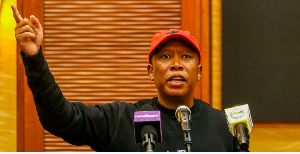
 South African Economic Freedom Fighters (EFF) leader Julius Malema
Firebrand South African opposition leader Julius Malema has asked Zimbabweans to seek employment in their own country. It is a pointer to a shifting political stance by a politician otherwise known for Pan-African rhetoric and a signal to mounting pressure on politicians in Africa’s largest economy to address an escalating illegal immigration crisis.
Outbreaks of xenophobia led by an extremist political group known as Operation Dudula (which means “force out” in isiZulu) have brought renewed attention to illegal immigrants in South Africa, most of whom are from Zimbabwe.
According to the results of South Africa’s 2022 census, Zimbabweans are by far the largest immigrant population, at over one million, or 35 per cent of foreigners, followed by Mozambicans (18.7 percent), BaSotho (10.2 percent), Malawians (8.9 percent), and Britons (2.8 percent).
Mr Malema, whose Economic Freedom Fighters (EFF) party has in the past gone against the grain in defending immigrants from Zimbabwe at a time of growing xenophobia, now says South Africans should be given priority when it comes to employment. He was reacting to a scandal in Limpopo, a province bordering Zimbabwe, where the mayor of the City of Polokwane, John Mpe, was accused of awarding tenders to foreign-owned companies. The companies included one owned by a Zimbabwean whose partner is a senior manager in the municipality.
“We don’t disagree that Zimbabweans should be given jobs, but they should be given jobs in their municipalities in Harare and other areas so we have opportunities to get jobs in our own municipalities,” he said. “When we say we want jobs where we pay for services, we are not saying we don’t want Zimbabweans. We are saying we should be given first preference before everyone else to get jobs.”
South Africa is battling a lack of jobs, with the latest statistics indicating that the unemployment rate rose for the second quarter in a row to 33.2 percent in April-June, up from 32.9 percent in January-March. The country’s coalition government, formed by the African National Congress (ANC) and the then main opposition Democratic Alliance after the 2024 election, has largely struggled to address joblessness.
This has seen frustration creeping in among citizens and a rise in popularity of organisations such as Operation Dudula, which has recently been hounding foreigners out of public hospitals.
Mr Malema’s weekend statements, however, contradicted his past stance on foreign nationals, especially Zimbabweans. In 2023, the former ANC youth leader encouraged South African employers to hire Zimbabweans while still giving South Africans priority.
“We want to emphasise to the owners of restaurants that no one should stop employing Zimbabweans and say the EFF said they don’t want them,” he said. “We want Zimbabweans to work in South Africa. It’s their home. They should make no apologies about hiring Zimbabweans or any other African brother or sister. In doing so, they must be considerate that there are locals, who must at all times be given preference.”
Zandile Dabula, the Operation Dudula president, recently said they were targeting Zimbabweans in their campaigns because the immigrants behaved as if they were entitled to be in South Africa.
“I don’t know why Zimbabweans think they are special,” Ms Dabula said. “Every time you talk of foreigners, they are the first ones to respond. Immediately, when you talk of illegal immigrants, the first response you will get, even on a social media platform, is a Zimbabwean. They feel so entitled that they are supposed to be here.”
Political parties that push for a hard-liner stance on immigration have been growing in popularity in South Africa in recent years, and even some ministers in the coalition government support groups like Operation Dudula.
Zimbabweans have been migrating to neighbouring South Africa for decades to seek economic opportunities, but the volume of people crossing the porous border began to increase steadily post-2000 when the country’s economic fortunes began taking a nosedive. Out of desperation, people risk their lives daily to cross the crocodile-infested Limpopo River, which divides the two countries.
South Africa regularly deports Zimbabweans who are caught violating immigration laws, but most of them quickly find their way back. In 2009, South Africa gave special permits to nearly 200,000 Zimbabwean immigrants that allowed them to work and live in the country as a way of addressing the problem of undocumented foreign nationals. Pretoria was forced to extend the validity of the permits last year after the holders took the government to court, challenging moves to end the dispensation. The lifespan of the permits has since been extended to the end of next year.