



Work First, Approval Later: The Hidden Cost of Unapproved Variations in Ghana’s Public Construction Projects
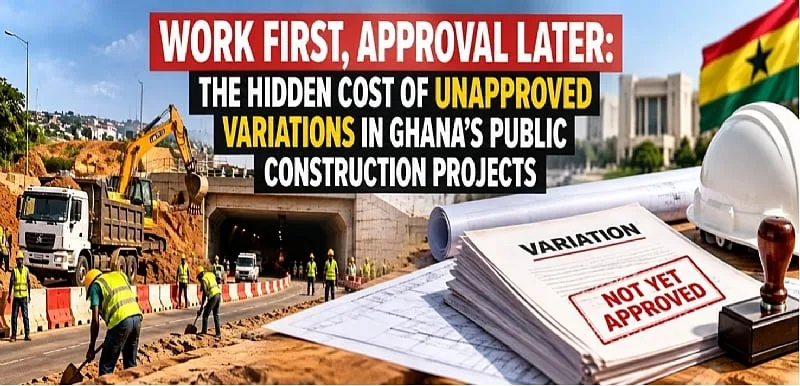
Changes to public construction contracts are often unavoidable. But Auditor-General findings on Ghana’s road sector show a more troubling pattern: work beginning before anyone with authority has approved it, with the paperwork catching up months later. A senior quantity surveyor explains where the line sits, and why it matters for every cedi spent on public infrastructure.
On the project, a contractor moved onto the approach roads to widen a junction, extend a carriageway and add a traffic gantry. The additional work, worth GH¢10.5 million, was a variation to the original contract: roughly 70 per cent on top of the GH¢14.8 million awarded for the tunnel itself.
There was one problem. Nobody with the authority to approve that spending had yet signed off. The Ministry gave its approval more than a month after the work started. The Central Tender Review Committee approved it two months after that. By the time the paperwork caught up with the machinery, the decision to commit an extra GH¢10.5 million of public money had effectively been made, not in a boardroom, but on the ground.
“The decision to commit an extra GH¢10.5 million of public money had effectively been made, not in a boardroom, but on the ground.”
This was not an isolated administrative slip. It is one of several findings recorded by the Auditor-General on Ghana’s infrastructure sector, and it captures a recurring governance problem: contract changes that alter the scope, cost or timeline of public works without following the sequence the law requires. That sequence is technical justification, independent valuation and approval, in that order, before work begins.
Public debate about cost overruns tends to fix on the final figure. The more useful question is procedural: at what point, and on whose authority, did the price change?
A variation is a formal change to the works, scope or price of a contract after it has been signed. It needs saying plainly: a variation is not, by itself, evidence of wrongdoing. Construction is one of the few industries where the product is designed and priced before it is fully understood. Ground conditions are confirmed only on excavation, utility routes only once surveyed, and designs often mature after the contract is signed.
Variations exist to handle this reality in an orderly way. Ghana’s standard conditions of contract, closely modelled on the internationally used FIDIC suite, give the Engineer or Contract Administrator authority to instruct changes, and give the Quantity Surveyor the tools to measure and value them fairly. Unforeseen site conditions, statutory or regulatory changes, necessary design development and instructions genuinely required to complete the project are all legitimate grounds. Treating every variation as suspicious would be as unhelpful as ignoring the pattern that follows.
“A variation is not, by itself, evidence of wrongdoing.”
The problem begins when a variation is instructed, priced or executed outside the approval sequence set by law and contract. Under the Public Procurement Act, 2003 (Act 663), as amended by the Public Procurement (Amendment) Act, 2016 (Act 914), variations above a procuring entity’s own approval threshold must be referred upward, ultimately to the Central Tender Review Committee, for approval before implementation. The Auditor-General cited Section 87(1) of the Act in this case.
The issue is not size. Large variations can be entirely legitimate where the works genuinely changed. The issue is timing: work instructed verbally, started on site, and regularised on paper only when it is complete or nearly so. This is retrospective approval, and it inverts the purpose of the process. Approval granted before work begins is a real decision: the authority weighs the justification, cost and alternatives, and can say no. Approval granted afterwards is a ratification of a fait accompli, because refusing it would mean unwinding completed construction, which in practice does not happen.
“Approval granted afterwards is a ratification of a fait accompli.”
This does not, by itself, establish fraud. It is a control weakness that removes oversight at the very moment it should operate. The Ministry, the Central Tender Review Committee and, ultimately, Parliament’s Public Accounts Committee are left reviewing history rather than exercising authority. The evidence suggests this is less often a single rogue decision than an institutional habit: a project on a fixed timetable, an Engineer under pressure to keep the contractor moving, and an approval process treated as a formality to tidy up rather than a gate to pass through.
How weak design becomes delayed infrastructure projects.
The Auditor-General’s findings trace a consistent chain. Incomplete feasibility work leads to preliminary rather than detailed designs. Those preliminary designs are used to estimate costs and secure funding. Detailed designs, produced only once construction is under way, reveal a different scope. That different scope becomes a variation. The unbudgeted variation strains project financing, and financing strain produces its own costs: interest on delayed payments (IDP), suspended works and requests for extension of time (EoT).
The audit put the root cause bluntly: the absence of feasibility data “was not helpful in interrogating the contractor’s design”, resulting in variations that affected scope, schedule and cost. The direct costs, such as additional quantities and revision of rates, are visible. The indirect costs are usually larger: extensions of time, prolongation costs (the contractor’s added overheads for staying on site longer), financing charges and the cost to the public of an infrastructure project left half-built while its budget is renegotiated. On the audited projects, payment delays running into hundreds of days triggered the contractor’s contractual right to suspend work, adding years to a project originally scheduled for 30 months.
The Auditor-General’s performance audit of selected infrastructure projects, submitted to Parliament by Auditor-General Daniel Yaw Domelevo on 28 November 2019, contains three findings that together illustrate the range from legitimate to problematic.
Spintex tunnel. The audit is direct: work on a GH¢10,504,982.66 variation began before either the Ministry or the Central Tender Review Committee had approved it, contrary to Section 87(1) of the Act. Both approvals followed retrospectively. This is the clearest example of the sequencing failure.
Lots 5 and 6. Here, the approval sequence was followed; variation orders went through the Ministry before or during implementation. But the underlying planning weakness, which made large variations almost inevitable, was not fixed. The asphalted length of the road was ultimately cut from 209.3 km to 168 km to hold the budget broadly constant. The lesson is about design readiness rather than approval timing.
O&G Enclave Road. A US$6.7 million variation, over 10 per cent of the contract value, arose from swampy ground discovered during construction. This is closer to the textbook case of a legitimate, site-driven variation, although this project, too, began without a feasibility study.
None of these findings, on its own, proves fraud or professional misconduct. The Auditor-General frames them as control weaknesses and compliance gaps, not criminal findings. What they show, in my reading, is a sector where the technical justification for a variation is often sound, but the sequencing (design before costing, approval before execution) often is not.
“The technical justification for a variation is often sound, but the sequencing often is not.”
Procurement does not end at contract award
Contract award is not the end of procurement; it is the point where procurement discipline must extend into contract administration. The scope that was competed for and awarded is the scope the public was told it was paying for. When variations move a contract significantly away from that scope, the procurement question returns: is this still a modification of the existing contract, or has it become, in substance, a new requirement that should have been competed separately?
The Act sets no fixed percentage for that line, and none should be invented. But the cumulative contract modification, meaning the total of all variations measured against the original contract sum, deserves close attention. A contract whose variations approach or exceed its original value deserves the scrutiny a fresh procurement would receive, not lighter treatment because the contractor is already on site. That scrutiny belongs before the money is spent, not after.
Two reforms would address most of what the evidence shows. The first is structural: give the Survey and Design divisions of the implementing organizations the budget and staff to complete genuine feasibility studies and detailed designs before tender, not during construction. Weak design was the root cause running through all three cases. The second is procedural and far cheaper: treat “work started before approval” as a named red flag that internal auditors and finance officers must check on every variation file.
Beyond these, seven control points assign each safeguard to the people best placed to apply it:
– Design readiness (Engineer/design consultant; Survey and Design Division): feasibility reports and detailed drawings before tender, to prevent variations caused by incomplete design.
– Scope verification (Procurement Unit; Entity Tender Committee): a scope comparison to catch a new procurement disguised as a modification.
– Technical justification (Engineer/Contract Administrator): every instruction written, dated, and technically justified before work starts, with no accommodation for contractors who move ahead without one.
– Independent valuation (Quantity Surveyor): independent measurement and valuation, rather than reliance on contractor-supplied figures, to guard against inflated rates or unverified quantities.
– Authority compliance (Procurement Unit; tender committees; Central Tender Review Committee): a threshold assessment so each variation reaches the correct approval level.
– Approval before execution (Ministry/Central Tender Review Committee; Contract Administrator): a date-stamped approval letter that can be checked against the site instruction date, ruling out verbal or retrospective approval.
– Cumulative cost monitoring (Quantity Surveyor; Finance; Internal Audit): a live variation register and cumulative cost forecasts reported to the client before approval thresholds are reached, so overruns are caught while they can still be acted on.
Three further checks would close the loop. Internal audit should routinely reconcile variation instructions against payment certificates. Finance departments, the last line of defence, should withhold payment where certification and approval requirements are not met, whatever the timetable pressure. And the Auditor-General and the Public Accounts Committee should track whether earlier recommendations on variation control have been implemented, rather than recording similar findings in the next audit cycle.
None of this requires a new law. FIDIC conditions and the World Bank’s procurement framework already treat change control as a governance function. The fix is enforcing the sequence Ghana’s existing law already requires.
“None of this requires a new law. The fix is enforcing the sequence Ghana’s existing law already requires.”
Every variation is a decision about public money
Public construction contracts will always change. Ground conditions differ from what boreholes suggested; designs mature; circumstances shift. The governance question is narrower and answerable: was the change technically justified, independently measured, properly authorised before it began, transparently documented, and still able to show that the public received value for its money?
Variation control, procurement compliance, quantity surveying and contract administration are not separate concerns. They are checkpoints on the same chain of custody over public money, and that chain is only as strong as its weakest link.
Between us, across more than two decades in district Engineering Works departments, cost engineering consultancy, regional contracts management and now the Ministry’s procurement directorate and Private consultancy services, we have valued more variations than we can count, most of them legitimate responses to conditions nobody could reasonably have foreseen. What concerns us is not the variations themselves. It is how often the paperwork trails the bulldozer. Getting the sequence right (justify, value, approve, then execute) costs nothing extra. Getting it wrong is what shows up, years later, in an Auditor-General’s report
Surv. Dr. Emmanuel Norgah Bukari is Chief Quantity Surveyor in the Procurement Directorate at Ghana's Ministry of Roads and Highways, and a Lecturer in Procurement and Supply Chain Management at KAAF University-Ghana. He specialises in and writes on public procurement governance, value for money in infrastructure, and construction contract administration in Ghana.
Surv. S. A. Razak Batong is a Quantity Surveyor and Director of Homeland Resources Ltd., Accra. He specialises in construction cost management, quantity surveying, and project administration, with professional interests in contract management, cost control, and value for money.
 WhatsApp




Comments (0)
No comments yet. Be the first to share your opinion!