



UniMAC inducts Ernest Ofori Sarpong as first Chancellor, secures GH¢10m government funding
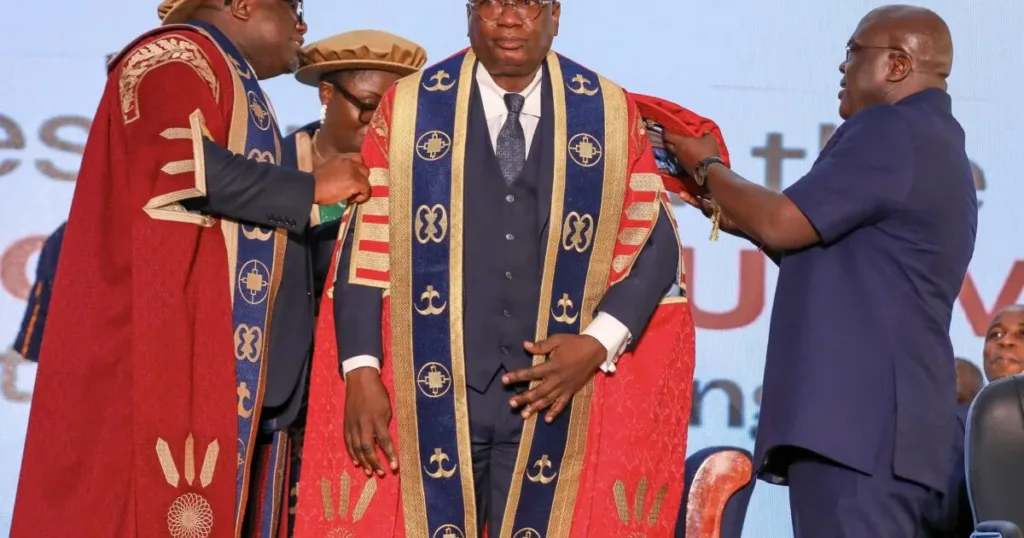
The University of Media, Arts and Communication (UniMAC) has inducted businessman Ernest Ofori Sarpong as its first Chancellor, with the government announcing GH¢10 million in seed funding to support the university’s development.
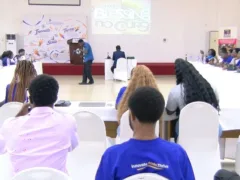
The investiture ceremony was held on Friday, 20 November 2026, at the university’s Ceremonial Grounds at its South Legon Campus in Accra. It brought together government officials, traditional authorities, diplomats, clergy, academics, students, alumni, business executives, family members and friends of the new Chancellor.
The government’s financial commitment and the appointment of a business leader to the university’s highest ceremonial office signal UniMAC’s ambition to strengthen partnerships between education, business and the creative industries.
At a time when the media and creative industries are being reshaped by technology, artificial intelligence and changing business models, the university is seeking to strengthen its institutional capacity while preparing graduates to become not only professionals seeking employment but also entrepreneurs capable of creating opportunities for others.
For a university established through the merger of three institutions with long histories in journalism, film and television, and language training, the appointment of a business leader with interests spanning several sectors represents an opportunity to build stronger connections between academic training and the demands of industry.
Speaking on behalf of the Minister of Education, Deputy Minister Dr Clement Abas Apaak announced that the government would provide GH¢10 million in seed funding to UniMAC. The funding is expected to support infrastructure development, modern teaching and learning facilities, digital technology, research and institutional capacity-building.
The announcement came against the background of a separate government commitment in the 2027 Budget to provide GH¢10 million to each of the country’s 10 public technical universities.
Dr Apaak said the government regarded education as a major investment in national development, particularly as Ghana pursues economic recovery, industrialisation, job creation and digital transformation under President John Dramani Mahama’s administration.
He noted that universities remained central to developing the human capital, intellectual capacity and skills required to strengthen the economy and improve the country’s global competitiveness.
He also challenged UniMAC to recognise the strategic importance of its disciplines in an era increasingly shaped by artificial intelligence, data, digital communication and the global creative economy.
The ceremony was attended by the Chief of Staff to the President, Dr Julius Debrah, while Dr Apaak represented the Minister of Education. Also present were the Chairman of the University’s Governing Council, Professor Wilberforce Sefakor Dzisah; the Vice-Chancellor, Professor Eric Opoku Mensah; members of the diplomatic corps; traditional leaders; representatives of the Presbyterian Church of Ghana; and members of the university community, including lecturers, staff and students.
The Russian Ambassador to Ghana, H.E. Mr Andrei Ordash, was among the diplomatic representatives at the gathering, which also attracted members of the business community, including associates from the Special Group of Companies, friends from the East Legon Executive Fitness Club and fellow old students of Presbyterian Boys’ Senior High School (PRESEC), where Ofori Sarpong was educated.
In explaining the choice of the new Chancellor, Professor Dzisah said the Governing Council had sought an individual whose experience, values, stature and influence could help bridge the worlds of academia, industry, enterprise and society.
Mr Ernest Ofori Sarpong, a Chartered Accountant with postgraduate education in finance and investment management, is the founder and Chief Executive Officer of the Special Group of Companies. His business interests span media, manufacturing, real estate, finance, construction and strategic investment. He is also known for his involvement in philanthropy, youth empowerment and community development.
Professor Dzisah said the Council believed his business experience and extensive networks could help strengthen the university’s institutional standing, expand its industry relationships and create opportunities for students and graduates.
He described UniMAC as “an old institution with a young identity and a bold ambition”, reflecting its history as three separate institutions now working towards a common future.
The Chairman said the success of the investiture would not ultimately be measured by the grandeur of the ceremony but by the institution the university builds after it. He therefore urged the university community to see the occasion as a collective responsibility to advance UniMAC’s mission.
That mission, as outlined by Vice-Chancellor Professor Eric Opoku Mensah, is already taking shape through a series of institutional reforms and development initiatives.
Established under the University of Media, Arts and Communication Act, 2020 (Act 1059), UniMAC brought together the Ghana Institute of Journalism, the National Film and Television Institute and the Ghana Institute of Languages. Each institution entered the merger with its own history, professional strengths and institutional culture, making the task of building one cohesive university both necessary and challenging.
Professor Opoku Mensah said management had been working to consolidate the three institutions into a competitive, internationally recognised specialised university. Among the measures taken are the strengthening of governance structures, the establishment of the university’s second Governing Council under Professor Dzisah and the appointment of Dr Obaapanin Oforiwaa Adu as substantive Registrar, effective 1 November 2026.
The university has also developed and launched its first Corporate Strategic Plan for 2026 to 2030, focusing on institutional consolidation, academic excellence, research and innovation, infrastructure development and stakeholder engagement. A Strategic Plan Implementation Portal has been developed to support digital monitoring and evaluation of the plan.
Academic programmes have also been diversified, with postgraduate offerings strengthened to include doctoral-level training in Media and Communication. Since the merger, more than 5,000 students have graduated from the university.
Professor Opoku Mensah further disclosed that UniMAC was about 75 per cent through the accreditation process for its Kumasi Campus to run all university programmes, a development expected to improve access for students in the northern part of the country.
However, he acknowledged that the university still faces significant challenges, particularly the need to renovate, upgrade or replace infrastructure inherited from the three former institutions. Harmonising administrative systems and integrating different institutional cultures also remain important tasks.
He therefore described the appointment of the first Chancellor as an opportunity to strengthen UniMAC’s visibility, expand its networks, attract strategic partnerships and mobilise resources to support its development.
For Mr Ernest Ofori Sarpong, the responsibility of becoming the university’s first Chancellor is not simply about occupying a ceremonial office. In his inaugural address, he described the appointment as a privilege that comes with the responsibility of helping define the standards and direction for those who will succeed him.
He outlined a five-pillar vision centred on infrastructure, investment in people, institutional branding, stronger links between education and business, and collective responsibility.
On infrastructure, he called for modern lecture theatres, film and television studios, digital media and language laboratories, research facilities, technology-enabled learning spaces and improved student accommodation. He argued that the quality of the university’s physical environment must reflect the level of excellence it seeks to achieve.
He also stressed that infrastructure alone would not deliver the transformation UniMAC needs. Lecturers, researchers, administrators, technical staff and students must be equipped with the knowledge and skills to respond to changes in the media and communication landscape.
With artificial intelligence and digital technologies rapidly changing how information is created, distributed and consumed, he said the university must prepare its graduates for emerging opportunities while preserving ethics, critical thinking and professional integrity.
A significant part of his address focused on the relationship between academic training and the business world. Drawing on his experience as an entrepreneur and Chartered Accountant, he argued that UniMAC must deliberately connect its programmes in journalism, public relations, strategic communication, film, translation, foreign languages, digital content and advertising to the opportunities within Ghana’s wider creative economy.
He wants graduates to leave the university with the capacity to establish viable businesses, employ others and contribute to economic development rather than depend solely on the availability of salaried jobs.
To achieve this, he called for stronger internship arrangements, industry-sponsored research, professional mentorship and practical support for viable businesses established by students and alumni. He also invited companies in the media, telecommunications, finance, technology and other sectors to regard UniMAC as a partner in developing talent and driving innovation.
His appeal extended to the university’s alumni, whom he urged not to distance themselves from the institution because their former schools had become part of a larger university. He said the histories of the Ghana Institute of Journalism, NAFTI and the Ghana Institute of Languages should be treated as a shared heritage that could strengthen, rather than divide, the new institution.
He also placed emphasis on building a respected institutional brand capable of attracting international recognition, partnerships and accreditation. In his view, UniMAC must not merely respond to developments in the media and creative industries but position itself to help shape their future.
The Chief of Staff to the President, Dr Julius Debrah, reinforced the need for a closer relationship between universities and enterprise, challenging the traditional approach to education that prepares graduates primarily to seek employment.
He said the appointment of a successful Ghanaian entrepreneur as Chancellor suggested that academia was increasingly recognising the value of working with business leaders to prepare young people for enterprise creation.
Using the example of Daniel Ek, the Swedish entrepreneur and co-founder of Spotify, Dr Debrah illustrated how identifying a problem in an industry and developing a business solution could produce a company with international reach.
He challenged Mr Ernest Ofori Sarpong to help UniMAC nurture filmmakers, musicians, writers and other creative professionals who could build sustainable businesses and take Ghanaian productions to international audiences.
He questioned why Ghanaian music and films had not achieved the same level of global exposure as productions from some other countries, and said the university had a role to play in developing the talent and business capacity needed to change that situation.
The cultural and religious elements of the ceremony gave the occasion a distinctly Ghanaian character. Following the academic procession and opening prayers, guests were treated to cultural performances, including a presentation by Abibigroma. The Chancellor’s robe was subsequently brought forward by the Ekyimkyim Arts Ensemble alongside a cultural tool in a display that connected the formality of the university’s academic traditions with Ghana’s artistic heritage.
The robe was dedicated by the Moderator of the General Assembly of the Presbyterian Church of Ghana, the Rt Rev. Dr Abraham Nana Opare Kwakye, before the formal induction proceedings. Hymns performed by The Jewels, including “To God Be the Glory”, “Zadok the Priest” and “Guide Me, O Thou Great Jehovah”, added to the solemnity of the occasion.
Mr Ernest Ofori Sarpong was robed by Dr Apaak, assisted by Professor Dzisah and Professor Opoku Mensah. He subsequently took the required oaths of office and was formally invested and enthroned as Chancellor, marking a historic first for the university.
The new Chancellor also acknowledged the people and institutions that had supported him throughout his journey. He expressed gratitude to God, the Governing Council, university management, the Presbyterian clergy, his fellow PRESEC old students, members of the East Legon Executive Fitness Club and sister clubs, associates from the Special Group of Companies, and the wider UniMAC community.
He reserved particular appreciation for his wife, daughters, siblings and extended family, describing them as his anchor away from the demands of public and business life.
As the ceremony drew to a close with the Hallelujah Chorus and a cheerful atmosphere, the university had formally entered a new chapter in its governance. The significance of the day, however, will ultimately depend on what follows the music, cultural performances and formalities of the investiture.
For UniMAC, the task is to turn its ambition into measurable institutional progress: better facilities, stronger research, relevant programmes, international partnerships and graduates equipped to thrive in a rapidly changing world.
For Mr Ernest Ofori Sarpong, the challenge is to use his experience and networks to help make those ambitions possible. For government and corporate Ghana, the university’s appeal is clear: the future of the country’s media and creative industries will depend not only on the talent Ghana produces but also on the institutions, investments and business opportunities created to support that talent.
 WhatsApp



Comments (0)
No comments yet. Be the first to share your opinion!