



Ghana on the altar of political convenience: The high cost of indiscipline
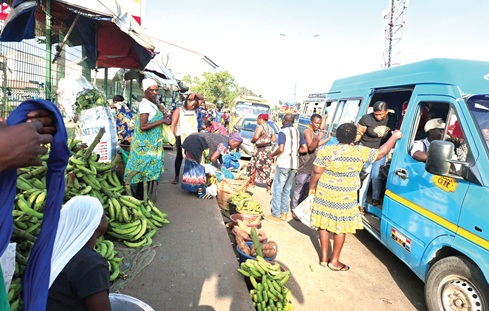
One of the greatest challenges confronting Ghana today is the growing culture of indiscipline and the apparent reluctance to confront it.
From our streets and markets to our residential areas and public spaces, the signs are unmistakable.
Rules are disregarded, public spaces are appropriated, and those who attempt to enforce regulations are sometimes met with resistance, political threats and emotional appeals.
What is even more worrying is the growing impression that political convenience has become more important than the national interest.
A recent one-week experience in Rwanda brought this concern into sharper focus for me. I was struck by the country's neatness, orderliness and apparent respect for public spaces.
I did not see streets taken over by traders, bus stops converted into markets or hawkers competing with motorists for space on principal roads.
It was a refreshing experience, but it also left me with an uncomfortable question: Why does Ghana, with all its human and natural resources, struggle to maintain basic order and discipline in our towns and cities?
Rwanda reminded me that an orderly society does not happen by accident. It requires responsible citizenship, effective institutions and above all, political leadership with the courage to enforce the rules, even when doing so may be unpopular.
Everywhere we turn in Ghana, we see evidence of growing indiscipline. Bus stops have been taken over by traders.
Pavements have become trading centres.
Hawkers occupy principal streets, markets spring up wherever there is an available space and buildings are erected without regard for approved plans, drainage systems or public safety.
Waterways are blocked, public spaces are encroached upon, and our cities are becoming increasingly difficult to manage.
Perhaps more disturbing than the indiscipline itself is the attitude with which some people defend it.
When authorities attempt to remove unauthorised structures or trading activities, two familiar arguments emerge.
The first is political: "We voted for this government. Let them come and remove us.
We will vote them out!" The second is emotional: "This is what we do to survive.
This is how we feed our children and take care of our families."
The second argument, in particular, tugs at the heart.
Nobody should be indifferent to the struggles of a mother or father trying to provide for their children.
Many people in the informal sector are genuinely struggling to make ends meet.
Their circumstances deserve compassion and practical intervention.
But we must also ask some difficult questions.
Does the need to survive give anyone the right to occupy a bus stop, block a pavement, trade on a busy road or build on a drainage channel?
What about the thousands of other citizens whose safety, convenience and livelihoods are affected by these activities?
Do their needs and rights not matter?
The survival of one person must not become the inconvenience, danger or suffering of thousands of others.
The government must provide properly organised and affordable trading spaces, give affected traders reasonable notice and treat them with dignity.
But legitimate compassion must not become an excuse for institutional failure.
We can protect livelihoods while enforcing the law.
Unfortunately, some politicians appear to have surrendered to these arguments.
Rather than enforcing the law, they choose political convenience.
Rather than protecting public spaces, they calculate the electoral consequences of doing so.
Rather than making difficult decisions in the national interest, they allow indiscipline to flourish for fear of losing votes.
This is how a nation sacrifices its future on the altar of political convenience.
Politicians must be reminded that the social contract between them and the electorate is not simply about winning elections and remaining in power.
When citizens vote, they entrust leaders with the responsibility of governing, protecting public resources, enforcing laws and creating an environment in which everyone can live with dignity.
The mandate of the people is not a licence to perpetuate oneself in power at the expense of the nation.
Leadership requires courage, including the courage to make unpopular decisions when the national interest demands it.
A pavement must be available to pedestrians.
A drainage channel must be protected from encroachment.
These are not political considerations; they are basic requirements of an orderly society.
We must also recognise that those who suffer most from this disorder are ordinary citizens.
The pedestrian forced onto a busy road because traders have occupied the pavement, the passenger who cannot access a bus stop, the motorist trapped in unnecessary traffic and the family whose home is flooded because someone has built on a waterway all have rights that deserve protection.
Where are our regional ministers and metropolitan, municipal and district chief executives and city mayors?
What are they doing about the growing disorder in the communities they administer?
I propose that regional ministers and MMDCEs be given clear and measurable Key Performance Indicators (KPIs), particularly in sanitation, spatial planning, protection of public spaces, control of unauthorised structures and enforcement of local regulations.
Their performance should be assessed quarterly, with reports made available to the public.
Officials who consistently fail to deliver should be dismissed.
We must not wait for a preventable flood, a major accident or a national embarrassment before holding them accountable.
An official who allows an unauthorised market to grow for months or years should not suddenly claim helplessness when the situation becomes difficult to control.
Public office must come with measurable responsibility.
The government should also establish a dedicated national hotline and digital reporting platform through which citizens can report illegal structures, unauthorised trading, encroachment on public spaces and other acts of indiscipline.
Every report should be tracked, referred to the appropriate assembly and followed up.
Citizens must be empowered to participate in restoring order rather than remain spectators while their communities deteriorate.
In this regard, the efforts of Ralph De Fellow Ghanaians and social media advocates such as the Bus Stop Boyz deserve commendation.
Their willingness to draw attention to acts of indiscipline and the misuse of public spaces demonstrates the important role citizens can play in promoting accountability. Such civic initiatives should be encouraged, provided they operate responsibly and within the law.
Ultimately, however, the responsibility rests with all of us.
We cannot demand discipline from politicians while refusing to practise it ourselves.
We cannot condemn illegal structures and then turn around to acquire land and build without the necessary permits.
We cannot complain about traffic congestion while contributing to the obstruction of roads and public spaces.
My experience in Rwanda has reinforced one important lesson: an orderly country does not happen by accident.
It requires leadership that is prepared to enforce the rules, institutions that take their responsibilities seriously and citizens who understand that public spaces belong to everyone.
Ghana needs a fundamental change in attitude.
Our political leaders must stop treating law enforcement as an electoral risk.
Our public officials must understand that their positions are not rewards for political loyalty but responsibilities to the nation.
And citizens must recognise that the right to vote does not include the right to break the law.
A government that restores order, even at the risk of losing some votes, should be commended for putting the country before its political fortunes.
The real question is not how many votes politicians might lose by enforcing the law.
It is how much more Ghana stands to lose if they continue to avoid doing so.
I returned from Rwanda with a simple but important conviction: Ghana can do better.
We have the people, the resources and the potential.
What we need is the political will to do what is right, even when it is inconvenient.
We must decide whether we want a country governed by laws or one governed by political threats and personal convenience.
We cannot continue to mortgage the future of our nation for the sake of the next election.
And the time to demonstrate that we mean it is now.
The writer is the Headmaster of St. Thomas Aquinas SHS, Cantonments
 WhatsApp



Comments (0)
No comments yet. Be the first to share your opinion!