

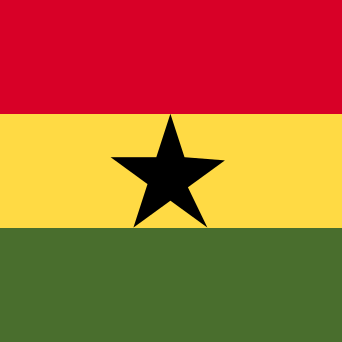

Ghana to Apply for BRICS as Partner Country, Not Full Member — Ablakwa Clarifies
Ghana’s Foreign Affairs Minister, Samuel Okudzeto Ablakwa, has provided further clarification on the country’s decision to seek membership in BRICS, revealing that Ghana intends to apply as a Partner Country rather than a full member. The clarification came during an exclusive interview on Key Points, a Saturday morning TV talk show on TV3, on 10th October 2026, following his initial announcement on the matter the previous week.
According to the Minister, Ghana already enjoys excellent relations with BRICS member countries and will be joining what he described as natural allies in a bloc that is arguably the largest trading bloc in the world today. He stressed that at the heart of the decision is the desire to put the national interest first, as enshrined in Article 40 of the 1992 Constitution of Ghana. This constitutional provision places the national interest above all other considerations in the conduct of foreign policy.
Ablakwa explained that BRICS brings together eleven major emerging markets and developing countries, including Brazil, China, Egypt, Ethiopia, India, Indonesia, Iran, Russia, Saudi Arabia, South Africa, and the United Arab Emirates. He noted that the bloc will serve as a useful platform for consultation and cooperation on contemporary issues of global and regional significance, as well as matters of global political and economic governance. For Ghana, this platform offers an opportunity to engage with some of the world’s fastest-growing economies on terms that reflect the country’s development priorities.
The Minister also moved to dispel fears that the decision could strain Ghana’s relations with its traditional partner countries that have ideological differences with BRICS members. He explained that, on the contrary, the decision affirms Ghana’s long-standing policy of non-alignment, which enabled President Kwame Nkrumah to navigate the treacherous terrain of the Cold War to secure support from the United States for the construction of the Akosombo Dam while simultaneously getting the then Soviet Union to launch Africa’s pioneering atomic energy programme, the Ghana Nuclear Reactor Project. This historical precedent, he argued, demonstrates that Ghana can maintain constructive relations with diverse global powers without compromising its sovereignty.
Ablakwa further disclosed that prior to the announcement, there had been engagement with European Union member states, and Ghana was clear in communicating the rationale for its decision. He emphasized that it was within Ghana’s right to diversify its strategic options for development and that the move did not mean the country sought to disengage from its traditional partners. The clarification is expected to reassure both domestic audiences and international partners about Ghana’s foreign policy direction as it seeks to expand its global engagement.
BRICS, originally formed as BRIC by Brazil, Russia, India, and China in 2006, was expanded to include South Africa in 2010. The bloc has since grown significantly, with Egypt, Ethiopia, Iran, Saudi Arabia, and the UAE becoming full members in January 2024, followed by Indonesia in January 2025. Several other countries, including Belarus, Bolivia, Kazakhstan, Cuba, Malaysia, Nigeria, Thailand, Uganda, Uzbekistan, and Vietnam, joined as Partner Countries in 2025. Ghana will join this group of partner countries if its bid succeeds.
Reported by News Hub Creator.
Read Original Report at news hub creator ↗ WhatsApp
Comments (0)
No comments yet. Be the first to share your opinion!