



Separating Spin from Substance: Why the GH¢55 Million EOCO Probe and Asset Freezes Against Miracles Aboagye Remain Very Much Alive
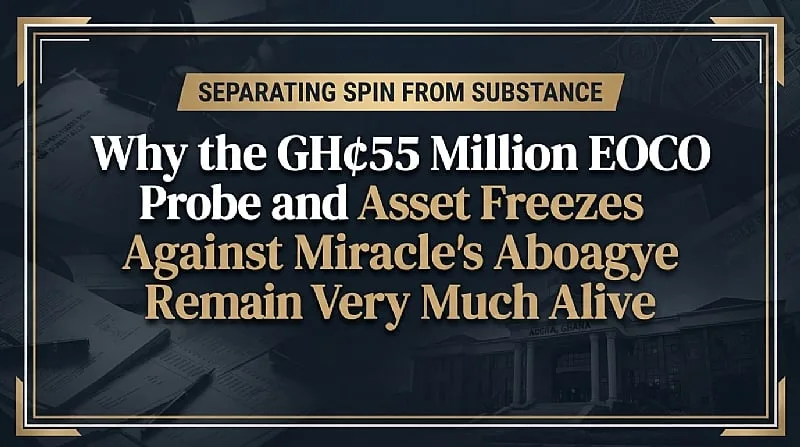
In Ghana’s polarized political discourse, public sympathy is often weaponized to blur the line between procedural fairness and substantive innocence. Following his recent appearance on TV3’s The Key Points, New Patriotic Party (NPP) Director of Communications, Dennis Miracles Aboagye, lamented the public stigma of being labeled the "GH¢55 million man," claiming that investigators at the Economic and Organised Crime Office (EOCO) have yet to confront him directly with that figure. While his remarks have sparked sympathy among partisans, a careful review of court records, official EOCO statements, and the Attorney-General’s recent directive tells a sobering story. Ghanaians must look past the emotional television soundbites: the GH¢55 million investigation has not been abandoned, his high-value assets remain under an active High Court freeze, and procedural reforms from the Attorney-General do not amount to a clean bill of health.
1. The Origin of the GH¢55 Million Investigation
The probe into Mr. Aboagye’s tenure as Executive Secretary of the Inter-Ministerial Coordinating Committee on Decentralisation (IMCCoD) was not born out of thin air or political conjecture.
– Forensic Audit Trigger: The investigation stemmed from a formal petition submitted by the current Executive Secretary of IMCCoD, requesting a criminal probe into a forensic audit covering August 1, 2022, to February 2, 2025.
– Scope of Allegations: EOCO confirmed in July 2026 that it is investigating suspected misappropriation, misapplication, diversion, and theft of public funds estimated at GH¢55 million, alongside procurement irregularities.
– Airport Interception and Bail: Mr. Aboagye was intercepted by the Ghana Immigration Service at Kotoka International Airport on July 12/13, 2026, pursuant to a prior Stop Order. He was subsequently granted a stringent GH¢50 million bail with three sureties (two to be justified)—a bail threshold reflecting the gravity of the financial sum under scrutiny.
– Co-Suspect Refunds: Notably, former IMCCoD accountant Gerald Appiah, who was arrested alongside Mr. Aboagye in connection with the secretariat's financial operations, voluntarily commenced refunding monies to the state—though EOCO explicitly noted that partial refunds neither conclude the investigation nor absolve any suspect of criminal liability.
2. The High Court Asset Freeze: What Is Actually Locked Down?
Far from being a mere media rumor, EOCO’s suspicions met the evidentiary threshold required to persuade a superior court to preserve assets pending trial. On August 3, 2026, the High Court in Accra confirmed an EOCO asset preservation order prohibiting the sale, transfer, mortgage, or withdrawal of specific properties and accounts:
– Five Active Bank Accounts: All financial transactions across five bank accounts linked to Mr. Aboagye remain blocked.
– Greater Accra Real Estate: A residential apartment complex in Adjiringanor and a two-bedroom residential property at Spintex.
– Eastern Region Holdings: A seven-bedroom residential house and approximately 15 acres of land situated in Larteh.
– Linked Corporate and Associate Assets: The court's preservation net also extends to assets associated with former accountant Gerald Appiah and Hillside Piggery and Meat Processing Limited.
3. Understanding the Attorney-General’s Directive
During his media appearance, Mr. Aboagye leaned heavily on a recent directive issued by Attorney-General and Minister of Justice Dr. Dominic Ayine (dated November 2, 2026) to argue against how he has been treated in the court of public opinion. However, conflating this directive with exoneration is misleading:
– Constitutional Compliance, Not Amnesty: Dr. Ayine’s directive instructs the Ghana Police Service, EOCO, the National Investigations Bureau (NIB), and the Narcotics Control Commission to strictly obey constitutional rules—specifically banning media parades of suspects, torture, and detention beyond the 48-hour constitutional limit.
– Strengthening Prosecutions: As legal analysts and the Attorney-General’s office have emphasized, the directive is designed to prevent technicalities and procedural abuses from collapsing valid state prosecutions in court.
– Quarterly Accountability: Agencies must now submit quarterly detention, exhibit, and warrant/court order registers to the Attorney-General for monitoring, with errant officers facing disciplinary action or prosecution.
– Irrelevance to Asset Freezes: Obtaining a High Court order to freeze suspected proceeds of crime is a lawful, court-supervised procedure under the EOCO Act—not an unlawful detention or media parade.
4. Recommendations and Suggestions for Institutional Accountability
To ensure that neither political theatrics nor investigative delays undermine public confidence in Ghana’s anti-corruption architecture, the following steps are essential:
– Expedited Charging by EOCO and the AG: Investigative bodies must conclude forensic tracing swiftly and either file formal charges in court or publicly clear suspects. Prolonged investigations without trial create a vacuum that suspects exploit to claim victimhood.
– Strict Enforcement of Asset Preservation: EOCO and the Financial Intelligence Centre (FIC) must maintain rigorous oversight over all frozen properties and corporate entities to prevent covert transfers or dissipation of state-linked assets while dockets are finalized.
– Transparent Public Briefings Within Legal Limits: While respecting the Attorney-General’s ban on parading suspects, anti-graft agencies should issue periodic, fact-based status updates on high-profile public fund probes so citizens are not left at the mercy of partisan spin.
– Civic Vigilance by Citizens and Media: Journalists and civil society organizations must consistently anchor political interviews in verified court orders and forensic audit timelines rather than allowing accused former officials to reframe active financial probes as mere reputational grievances.
Under Ghana’s 1992 Constitution, Dennis Miracles Aboagye—like every citizen—is presumed innocent until proven guilty by a court of competent jurisdiction. However, the presumption of innocence is a legal shield in a courtroom, not a license to rewrite public records on television. With five bank accounts, prime real estate in Greater Accra and the Eastern Region, and a GH¢50 million bail bond still binding him to an active EOCO probe into GH¢55 million of public funds, Ghanaians must remain alert. Procedural fairness from the Attorney-General is meant to ensure justice is properly served—not to sweep unanswered questions about public money under the rug.
For and on behalf of all Senior Citizens of the Republic of Ghana 🇬🇭
 WhatsApp





Comments (0)
No comments yet. Be the first to share your opinion!