



UMaT must lead Ghana’s fight against galamsey with research and technology – GTEC
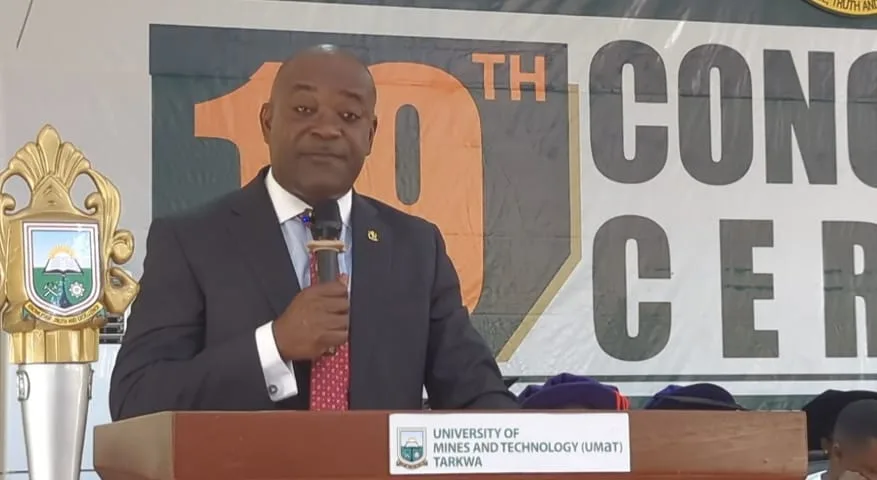
The Director-General of the Ghana Tertiary Education Commission (GTEC), Professor Ahmed Abdulai Jinapor, has challenged the University of Mines and Technology (UMaT) to use its research and technological expertise to develop practical solutions to illegal mining, popularly known as galamsey.
He said the university’s specialisation in mining, petroleum, technology and related disciplines placed it in a strategic position to help address the environmental and socio-economic challenges associated with illegal mining.
Speaking at UMaT’s 19th Congregation Ceremony in Tarkwa, Professor Abdulai said Ghana’s fight against galamsey required more than law enforcement, stressing the need for scientific knowledge, technological interventions and sustainable solutions.
“Our country is confronting a mining crisis. Illegal mining, popularly called galamsey, is destroying our forests, poisoning our rivers with mercury and silt, and degrading farmlands on which communities depend,” he stated.

He identified the Ankobra, Pra and Offin rivers as among the water bodies bearing the consequences of illegal mining, warning that the situation posed serious threats to public health, water supply, food security and the livelihoods of future generations.
“The menace threatens public health, water supply, food security, and the livelihoods of future generations. This is a fight that cannot be won by enforcement alone; it also needs knowledge, technology and solutions, and that is where UMaT must lead,” he emphasised.
Professor Abdulai urged the university to intensify research and develop cutting-edge practical interventions to support national efforts towards responsible and sustainable mining.
“Ghana needs cutting-edge practical research from UMaT,” he stressed.

The GTEC Director-General also called for greater specialisation among universities, urging tertiary institutions to build their academic and research programmes around their respective mandates and areas of strength.
He said GTEC was pursuing a vision of a differentiated tertiary education system in which institutions would develop distinct areas of expertise rather than attempting to offer everything to everyone.
“Every university must know its place in the national system. GTEC’s vision is a differentiated tertiary sector in which each institution builds on its mandates and strengths rather than trying to be everything to everyone,” he said.
Professor Abdulai noted that UMaT’s expertise in sustainable mining, petroleum and technology made its contribution particularly important as Ghana seeks to balance mineral resource exploitation with environmental protection and sustainable development.
The Vice-Chancellor of UMaT, Professor Bernard Kumi-Boateng, meanwhile, outlined the university’s ambition to become Africa’s leading centre for engineering, minerals and technology solutions.
He said the vision was to position UMaT as a premier institution that the continent could rely on for innovative engineering, mineral and technological solutions.
However, Professor Kumi-Boateng acknowledged that achieving this ambition would require significant investment in infrastructure, noting that the university continued to grapple with inadequate laboratories, overcrowded lecture halls and insufficient student accommodation.
He said the university would prioritise the modernisation of its laboratories and teaching facilities to ensure students received practical training consistent with industry standards.
The administration would also pursue the development of UMaT’s campuses at Essikado, Samahu and Kenyasi No. 2, alongside its community school at Bibiani.
Professor Kumi-Boateng said the university would implement its Strategic Plan to 2034, which seeks to expand enrolment to 30,000 students while maintaining academic quality.
He further identified stronger industry partnerships as critical to the university’s transformation, particularly in advancing research and developing practical solutions to national challenges.
At the 19th Congregation, a total of 3,338 students graduated from various academic programmes.
The graduands included 84 postgraduate students, comprising six Doctor of Philosophy recipients, 53 master’s degree recipients and 25 postgraduate diploma recipients.
A further 2,819 students received Bachelor of Science degrees in various engineering programmes, with 408, representing 14.47 per cent, obtaining First Class Honours.
The graduating class also comprised 121 diploma recipients, 27 professional diploma recipients and 287 certificate recipients.

Miss Anna Hannah Ansah, from the Department of Petroleum and Natural Gas Engineering, emerged as the overall best graduating student with a Cumulative Weighted Average (CWA) of 91.02.
She received the Gold Fields Ghana Award, which comes with a certificate, laptop, US$1,500 cash prize and two years of graduate training. She also won the Victoria Frempong Memorial Award for Best Graduating Female Student and the Ghana Institution of Engineering Award for the overall best engineering student.

Professor Kumi-Boateng noted that the last time a female student emerged as the university’s overall best graduating student was during its fifth congregation in 2013.

The university also introduced a new award for the best graduating brilliant but needy student, which was presented to Mrs Harriet Brown, who obtained an average of 84.47 per cent.
Meanwhile, Ms Bridget Bright Forson and Mr Emmanuel K. Biney were recognised as the Best Workers in the Senior Staff and Junior Staff categories, respectively. Both received citations and cash prizes of GH¢2,500 each.
The Vice-Chancellor also expressed confidence in the employability of UMaT graduates, disclosing that several companies had visited the university within his first three months in office to recruit graduating students.
He attributed their industry readiness to professional training, fieldwork and complementary skills in communication, entrepreneurship and computing.
 WhatsApp



Comments (0)
No comments yet. Be the first to share your opinion!