


Africa Did Not Wait For Banks. Africa Built Its Own
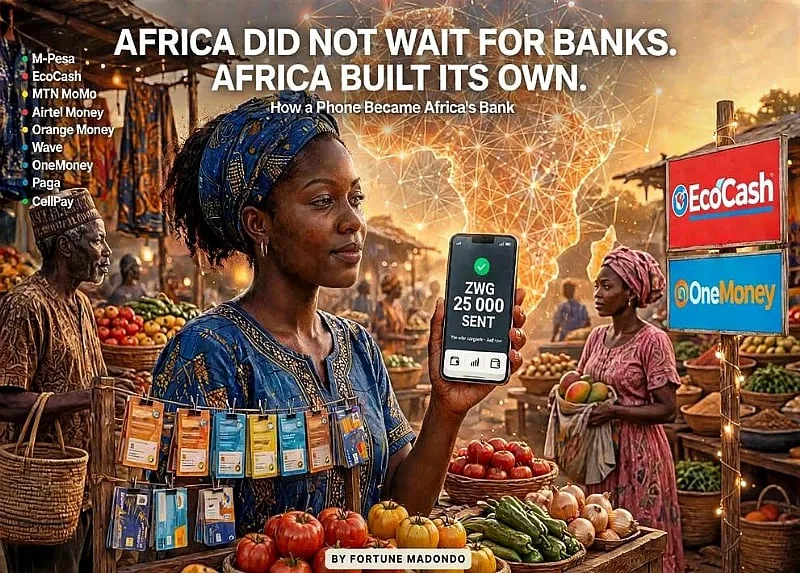
The People Turned Airtime Into Money First
Nearly half of all mobile money accounts in the world are in one place. Africa. Not London. Not New York. Not Silicon Valley. It is here, in our hands, in our kiosks, in our phones.
It did not start in a boardroom. It started because banking had not reached many Africans, particularly outside major cities. In Sub-Saharan Africa, the most common reason adults give for not having an account is not having enough money — 59% cite it. The next barriers are lack of necessary documentation, and distance to an agent, cited by 28% (Klapper et al., 2025). For a farmer, a market woman, or a young man with only an idea and a phone, the system was distant and costly.
So the people found another door. In Kenya, people began using prepaid phone minutes as money. Paying for goods with airtime. Trading minutes for cash (Jack & Suri, 2011). It was Africans who turned phones into wallets before any company made it official. That is the part the world forgets. No single company invented the habit. The people did. Companies later built systems around what people were already doing.
The idea of phone-based money was tried first in East Asia. The mobile money industry traces its commercial origins to 2001, with early services in the Philippines (GSMA, 2025). It remained relatively small there. It was in Africa that it became a system used at scale, part of everyday finance for millions.
Africa built it with a phone that could cost as little as fifteen dollars. With a kiosk on a dusty corner. With a PIN number memorised in a head that never went to university. Africa called it mobile money. The world called it a miracle. Africa called it a practical solution.An African solution to an African problem, (exclusion from the banking system).
There was no single African model. There were many. That is the point.
On the 6th of March 2007, Safaricom launched M-Pesa in Kenya (Jack & Suri, 2011). M for Mobile. Pesa for money in Swahili.
The idea had first been explored as a way to repay micro-loans by phone. During pilots in 2005 and 2006, users adapted it to send money to each other (Jack & Suri, 2011). A son in Nairobi to his mother in Kisumu. A sister to her brother in Mombasa.
For basic transfers at launch, no bank account, internet, or smartphone was required. No long form. A phone, a SIM card, and a PIN were enough. You gave cash to an agent, the agent loaded your wallet, you dialled a code, and family in the village received an SMS and collected cash from an agent near them.
Growth was unlike anything formal banking had seen in the region. Within eight months about one million Kenyans had joined, and within three years about ten million registered users (Jack & Suri, 2011). By 2016, about 96 percent of Kenyan households had used M-Pesa (Suri & Jack, 2016). One shop began to function like a banking access point, not as a licensed bank. One agent became a teller in practice. One SMS became a receipt.
Mary Is The System — And Esther Proves It
From Kenya the model spread, in forms fitted to each market. Tanzania and Uganda from 2008. Rwanda, the Democratic Republic of Congo and Mozambique from 2010. Zimbabwe with EcoCash, OneMoney and TeleCash in 2011. Ghana with strong growth of MTN MoMo from 2013. Senegal where Wave introduced a low-fee model around 1 percent from 2018 (GSMA, 2024).
Nigeria followed a different path. Under the pre-2018 framework, mobile network operators could only operate mobile money through bank partners. That changed only when the Central Bank of Nigeria issued Guidelines for Licensing and Regulation of Payment Service Banks in October 2018, allowing telcos, through subsidiaries, to apply directly to provide payment services (Central Bank of Nigeria, 2018).
Different names. Same idea. Reach people where they are.
That reach is built on agents. Globally, registered mobile money agents grew by 22 percent in 2023 to reach 18.6 million, while active agents grew by 14 percent to 8.3 million, driven by growth in Sub-Saharan Africa (GSMA, 2024).
Take Mary, a composite. She runs a small kiosk in Harare. She sells airtime and mobile money services. She opens early. She closes when the last customer leaves.
She describes trust as her main asset, because she is there every day. She also describes the challenges: security risks, network downtime, and customers directing frustration at agents when the system fails. She describes commissions as small relative to transaction volumes.
Mary is not a footnote. Mary is the system. Without millions of agents like her, from Kisumu to Kaduna to Dakar to Harare, the model does not reach the street.
Mary is a composite. Esther Muchemi is not.
On the morning M-Pesa launched on 6 March 2007, Muchemi was already at her shop on Koinange Street in Nairobi. Her company, Samchi Telecommunications, held till number 0001 — the first M-Pesa dealer in Kenya. She had tested the system for six months. Customers asked her the same questions Awa's customers still ask: How can money sit inside a phone? Is it safe? Will it really arrive?
"I was the first dealer to roll it out in all my shops. I didn't know where this thing was going. I didn't understand it. But I told my people: We're going," Muchemi said in an interview reported by Billionaires Africa (2025), reporting her earlier _Business Daily_ interview.
She did not have a theory of financial inclusion. She had a shop, a till, and a willingness to explain the same thing a hundred times a day. That is how a system is built. Not in a launch event. In a shop, on a street, by a person who stays.
The result is scale that is now continental. Sub-Saharan Africa accounts for nearly 50 percent of all mobile money accounts in the world and about two-thirds of global transaction value (GSMA, 2024). The region has about 156 live services, nearly half of all services globally (GSMA, 2024).
These are registered accounts, not all active users. Active use is lower and varies by market. That honesty matters. Even with dormancy, the shift is real.
In Kenya, access to formal financial services rose from about 26.7 percent in 2006 to over 75 percent by 2016 (Central Bank of Kenya, Kenya National Bureau of Statistics & FSD Kenya, 2016). Across Sub-Saharan Africa, account ownership rose from about 34 percent in 2014 to about 60 percent in 2024, and in 2024 about 40 percent of adults held a mobile money account, up from 27 percent in 2021 (Klapper et al., 2025).
For many people, exclusion had meant no formal record, no history, no way to show reliability. Inclusion means a transaction becomes a record. A farmer can show activity. A trader can build a record without becoming corporate.
That record changes lives in practical ways. Suri and Jack (2016) found that access to M-Pesa was associated with about 194,000 Kenyan households moving out of extreme poverty between 2008 and 2014, with notable effects for households headed by women. One reason is speed. Help that once took many days can now arrive much faster, helping families manage shocks without children leaving school or businesses losing stock.
For many women, the change has been about privacy and control.
In some households, money kept at home could be visible to all household members. With a phone and a PIN, many women gained more control over when to save, when to spend, and when to say no.
In Senegal in 2021, only about 6 percent of women saved using a traditional bank, while about four times more saved using mobile money (Klapper et al., 2025). In Kenya, Uganda and Zambia, the share of women saving with mobile money was more than double those saving with a bank (Klapper et al., 2025).
Take Awa, a composite. She sells fabric at a market in Dakar. She saves small amounts on her phone between customers. She does not need to carry cash home. She does not need to explain every coin. She can set aside money for school fees, for medicine, for stock. That small privacy is not a small thing. For some women, it was a new degree of control over money they manage.
She also describes the same pressures as other traders: network failures at busy times, fear of fraud, and fees that feel heavier on small amounts. Privacy has given her more control. It has not removed the risks.
Gaps remain. In Rwanda in 2020, about 51 percent of women owned mobile money accounts versus about 64 percent of men (Klapper et al., 2025). In Mali, the gender gap fell from about 20 percentage points in 2017 to about 5 points in 2021 (Klapper et al., 2025). Where services are affordable and private, adoption among women rises.
For youth, the phone is often a first account, a first way to be paid, and a first way to save.
Africa is the youngest continent, with a median age of 19 (United Nations DESA, 2024). Many young people had no formal salary, no collateral, and no credit history that formal banks traditionally required. What they had was a phone.p
A young designer in Kampala can receive payment for design work from a client in Nairobi. A young trader in Harare selling clothes on WhatsApp can receive payment through a merchant number. A young farmer in Kaduna can receive payment for produce and buy inputs on the same phone.
Agent networks have also created work as agents, merchants and distributors. Challenges remain: cost of smartphones, cost of data, access to electricity, irregular income, and risks from fraud and high-cost digital credit (GSMA, 2024; Klapper et al., 2025).
If inclusion is to deepen, three areas matter: appropriate age thresholds for account ownership, simple tiered identification for low-value accounts, and digital literacy in schools.
Mobile money also changed finance itself. Many transfers became lower cost and more instant. In Senegal, Wave entered with a 1 percent transfer model. Orange Money, the incumbent, dropped its rates to 0.8 percent as it raced to catch up to Wave (NextBillion, 2022). During COVID-19, Togo's Novissi cash transfer service reached 819,972 vulnerable Togolese through a mobile money wallet programme, transferring CFAF 13,308,224,040 as of November 2022 (IFC, 2023). In 2023, international remittances received via mobile money in Sub-Saharan Africa reached about 29 billion dollars (GSMA, 2024).
In some markets, transaction history is now used to inform credit scoring, allowing some traders without traditional collateral to access small loans (GSMA, 2024).
The future will not be decided by whether Africa uses mobile money. It already does. It will be decided by who owns the rails.
First, own the rails. Sending $200 to Sub-Saharan Africa cost 7.9 percent on average in Q4 2023, compared with a global average of 6.2 percent, well above the SDG target of 3 percent (World Bank, 2024). The Pan-African Payment and Settlement System can lower that cost, but only if African institutions set the rules transparently. PAPSS was developed by Afreximbank in partnership with the African Union and the AfCFTA Secretariat, and it collaborates with African central banks (SAIIA, 2024). That is African-led, but it is not automatically African-owned in the sense that matters: who sets fees, who holds settlement, who keeps the data, and who can audit it. Interoperability without accountable African ownership is just a faster way to pay rent — whether the rent is collected in London or in Cairo or in Accra.
Second, own the data. A farmer's transaction history is now her credit history. If that history belongs to a telco or a foreign fintech, she is a tenant in her own financial life. If it belongs to her, with portability and clear consent, she can take it from one provider to another and negotiate a better loan. Data portability is not a technical detail. It is the difference between inclusion and dependence.
Third, protect the agent. Mary is the system, but she is also the most exposed part of it. She carries cash, she absorbs fraud, she absorbs anger when the network fails, and she is paid last. Any reform that cuts fees without protecting agent commissions will cut the network itself. If Africa wants the system to last, it must pay the people who carry it.
Here is the trade-off no one wants to name: you cannot have lower fees for users _and_ higher pay for agents unless someone absorbs the cost. If providers absorb it, margins fall and investment slows. If governments absorb it, taxpayers pay. If no one absorbs it, agents leave and the network shrinks. My choice is clear: providers, who now earn scale from millions of transactions, should absorb it through volume, despite interoperability squeezing margins — and regulators should enforce a floor for agent commissions, just as they cap fees for users. Cheap for users cannot mean unpaid for agents.
That floor has a cost I accept. If it makes the smallest transfers unprofitable, some providers may stop serving them. A network that survives by starving its agents will not survive at all.
Africa did not wait solely for traditional branches to reach everyone. Africa built systems that reached people. Africa used a phone and made it serve as a bank for daily needs.
The next task is harder than the first. Anyone can use a phone. Not everyone owns the system behind it.
The Marys still open early in Harare. The Awas still save between customers in Dakar. Young designers in Kampala still get paid on their phones. And on Koinange Street, Esther Muchemi held till number 0001 — proof that this was never abstract. It was always a person, behind a counter, saying: We're going.
Whether it stays African — owned, governed, and priced in Africa — is the next story. And it is only the beginning.
Billionaires Africa. (2025). _Esther Muchemi: M-Pesa agent 0001 turned multimillionaire._ Reporting Muchemi's earlier _Business Daily_ interview. Samchi Telecommunications, till number 0001, Koinange Street, Nairobi. Quote: "I was the first dealer to roll it out in all my shops. I didn't know where this thing was going. I didn't understand it. But I told my people: We're going."
Central Bank of Kenya, Kenya National Bureau of Statistics & FSD Kenya. (2016). _FinAccess Household Survey 2016._ Nairobi: FSD Kenya.
Central Bank of Nigeria. (2018). _Guidelines for Licensing and Regulation of Payment Service Banks in Nigeria._ Abuja: Central Bank of Nigeria, 1 October 2018. Eligible promoters include telecommunications companies through subsidiaries.
GSMA. (2024). _State of the Industry Report on Mobile Money 2024._ London: GSM Association. Data for 2023: 1.75 billion registered accounts globally, 435 million monthly active accounts, 310 live services in 99 countries, 18.6 million registered agents, 8.3 million active agents, Sub Saharan Africa 156 live services.
GSMA. (2025). _State of the Industry Report on Mobile Money 2025._ London: GSM Association. Notes industry took 18 years from 2001 to reach 1 billion registered accounts.
IFC. (2023). _Country Private Sector Diagnostic: Creating Markets in Togo — Driving Economic Transformation with Private Sector-Focused Reforms._ Washington, DC: International Finance Corporation. p. 1: Novissi reached 819,972 vulnerable Togolese via mobile money wallet, CFAF 13,308,224,040 transferred as of November 2022.
Jack, W. & Suri, T. (2011). _Mobile Money: The Economics of M-PESA._ NBER Working Paper No. 16721. Cambridge, MA: National Bureau of Economic Research. https://www.nber.org/papers/w16721
Klapper, L., Singer, D., Starita, L. & Norris, A. (2025). _The Global Findex Database 2025: Connectivity and Financial Inclusion in the Digital Economy._ Washington, DC: World Bank. doi:10.1596/978-1-4648-2204-9. Survey fieldwork 2024, 145,000 adults in 141 economies. Barriers data: lack of money, lack of documentation, distance to agent.
NextBillion. (2022). _Analysis: Francophone Africa's First Unicorn Is Disrupting the Region's Mobile Money Market. But Can It Last?_ Ann Arbor: William Davidson Institute, University of Michigan. Reports Wave 1% model and Orange Money dropping rates to 0.8% in Senegal.
SAIIA. (2024). _PAPSS: What Is It Good For?_ Policy Briefing 300, October 2024. Johannesburg: South African Institute of International Affairs. PAPSS developed by Afreximbank in partnership with the African Union and AfCFTA Secretariat; analysis of governance, adoption, and collaboration with central banks.
Suri, T. & Jack, W. (2016). The long-run poverty and gender impacts of mobile money. _Science_, 354(6317), 1288-1292. doi:10.1126/science.aah4588. Author order as published.
United Nations DESA, Population Division. (2024). _World Population Prospects 2024._ New York: United Nations. Africa median age 19 in 2024.
World Bank. (2024). _Remittance Prices Worldwide, Issue 49, March 2024._ Washington, DC: World Bank. Average cost of sending $200 to Sub-Saharan Africa was 7.9% in Q4 2023, global average 6.2%.
Note on human stories: Mary in Harare, Awa in Dakar, and the youth examples are illustrative composites, not real named individuals. They are based on general conversations with market agents and traders. Names and identifying details are changed to protect privacy. Their experiences are described in paraphrased form, not as direct quotations about any specific company, service, or government programme. Esther Muchemi is a real, named, on-record person, quoted from published reporting, not a composite. No statements in this article are presented as allegations against any named company, regulator, or individual.
Editorial note: Registered mobile money accounts and registered agents include inactive accounts and agents. Active use is lower and varies by market. GSMA figures refer to 2023 data published in 2024, unless stated as 2024 data published in 2025.
 WhatsApp



Comments (0)
No comments yet. Be the first to share your opinion!