



Plastic-choked beaches: Coastal livelihoods under threat
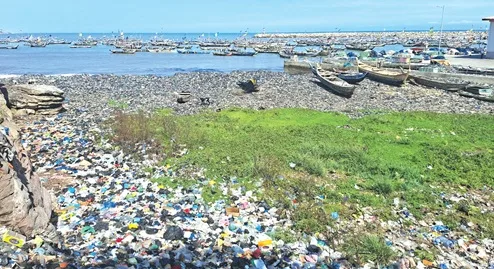
As one approaches the historic James Town Fishing Harbour, the first striking impression is not the salty Atlantic breeze but a jarring and suffocating sight.
The golden sand of the beach is virtually buried beneath a sprawling multi-coloured carpet of discarded polythene.
Towering drifts of crushed water sachets, bleached single-use grocery bags, tangled heaps of monofilament fishing nets, and sun-faded plastic bottles stretch along the seashore as far as the eye can see.
One is also greeted with piles of decomposing organic waste mingling with vast quantities of plastic, which release a pungent stench even under the scorching sun.
This is the stark reality of the James Town beachfront, once a vibrant cradle of marine life, now transformed into an open-air landfill where the ocean continually washes ashore the mounting waste generated by human consumption.
The James Town area, which served as an ancestral economic engine for its people, sustaining the livelihoods of hundreds of active artisanal canoes and supporting a direct workforce of fishermen, fish processors and traders, is stuttering to a halt.
When fishermen return from their early morning voyages, they often haul in catches in which plastics outnumber fish. Nets that once brimmed with cassava fish, herrings and mackerel are now dragged ashore clogged with heavy, waterlogged debris that damages expensive fishing gear and places strain on wooden boats.
On September 19, this year, Sammy Okine, a 37-year-old fisherman, and many others were seen in the James Town area busily mending their fishing nets, with frustration, dejection, and despair etched on their faces.
"We often have to repair our fishing nets two or three times a week because of the heavy plastic trapped in the water," he lamented.
Daniel Otoo, another fisherman at James Town, said they were experiencing diminishing returns in the fishing activities as they frequently returned from sea with barely enough fish to feed their families, let alone turn a profit.
The Nae Wulomo (Highest Chief Priest of the Ga State), Nuumo Kwaa Mensah III, said that beyond the heavy presence of plastics depleting fishery stocks in the area at an alarming rate, it was also robbing the people of their livelihoods.
“If you deploy 20 canoes, you cannot even get one tonne of fish; the plastic catch is even more than fish, and we must all be concerned about this development,” he stressed.
However, he said, fishermen could not blame the sea for the plastic catch because the sea was only returning what human beings had thrust into its belly.
“The plastics are from somewhere; the people of James Town do not manufacture plastics; they come from the markets and other places; so, it is a chain that must be looked at holistically,” he said.
The crisis facing the James Town fishermen is symptomatic of a broader national emergency along the country’s coastline.
According to the United Nations Environment Programme (UNEP), the world produces about 450 million tonnes of plastic waste annually, with poor management of the waste resulting in severe biodiversity loss, ecosystem degradation, and climate vulnerabilities across the world.
The UNEP warns that without immediate, aggressive global interventions, plastic waste flowing into aquatic and marine ecosystems could nearly triple by the year 2040.
Data from the Environmental Protection Authority (EPA) show that Ghana generates over one million tonnes of plastic waste annually, with less than 10 per cent collected and recycled.
The vast remainder spills directly into open drains, rivers, and ultimately the ocean, fuelling projections that by the year 2050, there could be more plastic waste by weight in the world's oceans than fish.
The President of the Ghana National Canoe Fishermen Council (GNCFC), Nana Joojo Solomon, said the activities of the over 140,000 artisanal fishermen across 320 coastal communities in the country contributed to plastic pollution.
"Anytime the fishermen are going out for fishing, they carry many bags of sachet and bottled water, but they dump the plastic waste into the ocean after drinking the water.
Imagine if 14,000 canoes carry 10 bags of sachet water for fishing and fail to bring the waste back. That is why the ocean is so angry with us," he said.
A study by the Council for Scientific and Industrial Research-Water Research Institute (CSIR-WRI) dubbed “Plastic on the Menu: Microplastics in Aquatic Foods and Beach Coastal Waste in Ghana” revealed that 80-93 per cent of the plastic found on the beaches is land-based in origin, arriving through drains, markets, and households.
The CSIR-WRI research, which was made public on August 13, 2026, revealed a high presence of microplastics in local fish, warning that consuming fish gills and guts had health risks.
A Senior Research Scientist at the CSIR-WRI, Dr Pennante Naa Ayikailey Bruce-Vanderpuije, told the Daily Graphic that the study found microplastic levels in fish sourced from some coastal communities in Accra, including James Town, to be dozens of times higher than internationally recommended safety limits.
The acceptable international guideline, set by the European Market Observatory for Fisheries and Aquaculture Products (EUMOFA), the European Food Safety Authority (EFSA), and the National Oceanic and Atmospheric Administration (NOAA), ranges from 112 to 3,078 particles a year.
Yet, the research established that Ghanaian children are estimated to be exposed to around 209 particles a year; consumers of farmed tilapia around 2,561 particles a year; and consumers of wild freshwater fish around 4,785 particles a year.
“Along the coast, the numbers climb far higher still: about 31,238 particles a year in James Town (Accra), 75,819 in Labadi, and 81,257 in Teshie; dozens of times above any international benchmark," portions of the study stated.
This is against the backdrop that fish remains a cornerstone of Ghana's nutrition, supplying up to 80 per cent of animal protein intake.
Dr Bruce-Vanderpuije described the situation as worrying because plastic pollution was depleting Ghana's fishing economy while microplastics were killing fingerlings – juvenile fish – and now account for up to 20 per cent of net catch volume in some areas, cutting directly into the incomes of fishers along the coast.
She described the increasing presence of microplastics in water bodies as alarming, warning that the particles posed serious risks to human health and the environment.
“These microplastics are very small in size (up to five millimetres), and they have surfaces that can absorb contaminants that are toxic in nature.
So, if you consume these microplastics in fish with the heavy contaminants, they tend to leach the microplastics into our bloodstream, milk, our system, urine, and sometimes even transfer them into our children,” she said.
The research scientist said there was ample evidence that microplastics exposure might suppress gut immune function, cause lung inflammation, trigger oxidative stress, disrupt hormones, damage the liver and kidneys, and contribute to bioaccumulation with an associated cancer risk, though none of those effects had yet been directly proven in a Ghana-specific study.
A specialist in environment and climate change, Dr Godfred K. Teye, explained that as vast quantities of plastic degrade under tropical ultraviolet radiation, they release potent greenhouse gases such as methane and ethylene.
Again, he said, microplastics floating on the ocean surface absorb heat and disrupt marine carbon sequestration cycles by interfering with zooplankton that drive the biological pump.
“This situation intensifies ocean warming and acidification that drive fish stocks further away from traditional coastal zones,” he added.
Also, as discarded plastics break down into harmful microplastics and leach toxic chemicals into the water, they destabilise not only the aquatic food web but also the coastal climate resilience of the region.
The evidence of health and climatic risks posed by plastic pollution underscores the need for urgent steps to restrict the influx of plastics into water bodies to prevent fish contamination.
Dr Bruce-Vanderpuije said there was the need for the EPA to finalise and implement the mandatory Extended Producer Responsibility framework that required plastic producers and importers to fund the collection and recycling of packaging they put on the market, as part of a broader circular economy roadmap for Ghana.
“That legislation is expected to reinforce a phased, government-led ban on polystyrene (styrofoam) food packaging, a major contributor to plastic along Ghana's coastline, taking effect gradually from January 2027,” she said.
Again, she recommended a policy restricting the worst single-use plastic items; a deposit-refund system under which consumers could pay a small deposit on packaging that is refunded when returned, to boost collection rates; investment in viable alternatives to plastic packaging; and a circular plastics fund jointly resourced by the EPA, district assemblies, and the Customs Division of the Ghana Revenue Authority.
She added that it was important to map pollution sources and intercept leaks at key chokepoints before they reached the water.
 WhatsApp




Comments (1)
지친 몸과 마음에 활력을 불어넣어 주는 프리미엄 홈케어, 검증된 관리사가 직접 찾아가는 <a href="https://massagebambam.com/" rel="nofollow ugc">출장마사지</a>로 최상의 휴식을 누려보시기 바랍니다.