


MK Party goes to SCA in fight against reinstating expelled senior members
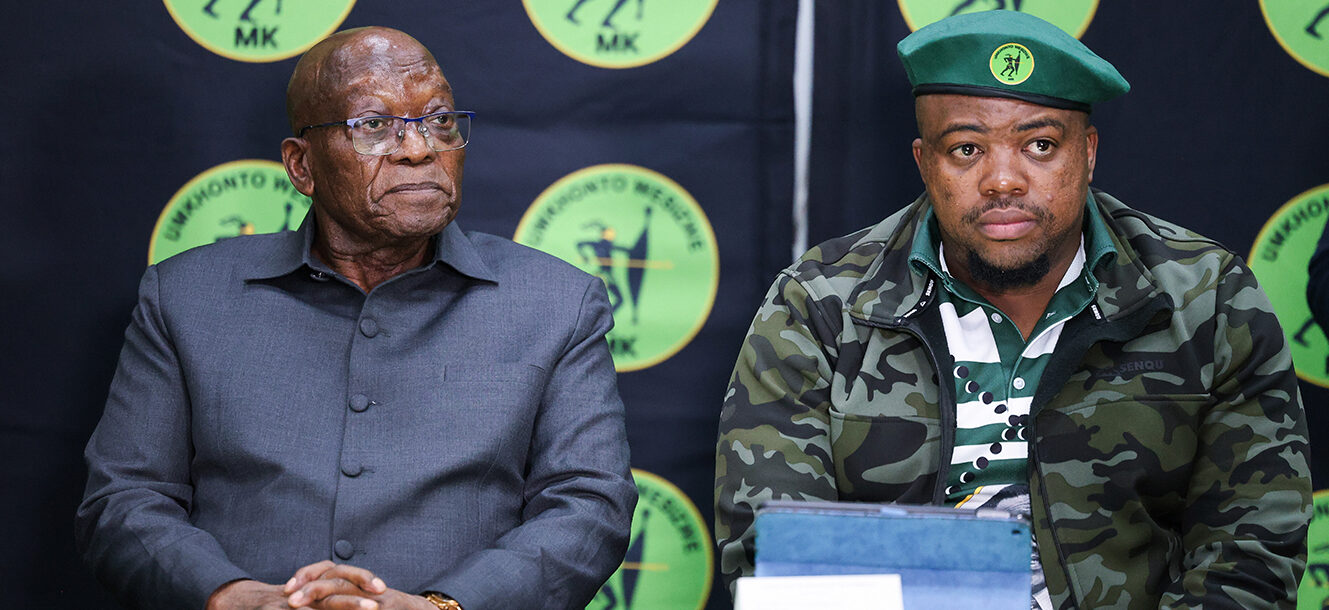
The battle over former president Jacob Zuma’s grip on the uMkhonto weSizwe Party (MKP) has exploded into a fresh legal war, with the party launching a bid to overturn a judgement that stripped the party’s leadership of its power to expel two MPs.
MKP’s leadership, which includes its president and the party’s secretary-general, Sibonelo Nomvalo, has applied for leave to appeal a Cape Town High Court judgement that set aside Zuma’s decision to terminate the membership of Pumlani Kubukeli and Khanyisile Litchfield-Tshabalala.
READ: MK Party expels Litchfield-Tshabalala, Pumlani Kubukeli ‘as per presidential decree’
The application, which seeks to take the fight to the Supreme Court of Appeal (SCA), effectively puts Zuma’s powers as MKP president under judicial scrutiny.
The party is warning that the judgement could have consequences far beyond the two politicians at the centre of the dispute.
At the heart of the legal battle is a fundamental political question, which asks if Zuma has the final say over who remains inside the MKP — or can the courts impose limits on powers contained in the party’s own constitution?
The appeal papers filed on Tuesday argue that the Cape Town High Court went too far by setting aside the presidential decree, despite finding that Zuma had the constitutional power to terminate the applicants’ membership.
The party insists Zuma acted within the powers granted to him by the MKP constitution.
The legal challenge strikes directly at the authority of the former president, who remains the central political figure in the MKP.
Kubukeli and Litchfield-Tshabalala argue that section 7(2)(h) of the MKP constitution gives the party president the express power to terminate membership through a presidential decree.
They say that the Cape Town High Court itself accepted that Zuma possessed this power and found that he acted in accordance with the party constitution. However, the court nevertheless set the decision aside after finding that the applicants had not been afforded an opportunity to be heard.
The Zuma party now argues that this effectively rewrote its constitution.
READ: Zuma’s unchecked expulsion power faces legal test
MKP’s lawyers say the constitution provides for disciplinary hearings in certain circumstances but that the presidential decree mechanism is a separate and summary power.
The appeal papers describe the decree power as the “ultimate power” of the organisation.
The party argues that a court cannot simply insert a hearing requirement into a power when the party’s constitution does not provide for one, with that argument placing Zuma’s leadership authority squarely at the centre of the appeal.
The party’s lawyers have launched a broader attack on what they regard as judicial interference in its internal political affairs, arguing that the relationship between MKP and its members is contractual and that the organisation’s constitution defines the rights and powers of both sides.
MKP says that if the applicants believed the presidential decree provision itself was unconstitutional, they should have challenged the validity of that provision, with the party citing through its appeal papers that Kubukeli and Litchfield-Tshabalala did not.
MKP says that the court effectively neutralised the provision by imposing a procedural safeguard that it does not contain.
READ: Expelled MK Party MPs challenge Zuma’s powers in the high court
The recent ruling that favoured Kubukeli and Litchfield-Tshabalala to remain as party members also stated that they should retain their parliamentary seats.
The ruling also brought to light that political parties must comply with procedural safeguards beyond those contained in their own constitutions, which could affect the way party leaders deal with internal rebellions, disciplinary disputes and membership battles across the political landscape.
Kubukeli and Litchfield-Tshabalala’s dispute has also raised the issue of parliamentary power, with MKP arguing that the two applicants did not simply get “removed from Parliament” by Zuma.
MKP says Kubukeli and Litchfield-Tshabalala’s loss of National Assembly membership followed automatically from the termination of their party membership under section 47(3)(c) of the Constitution.
The party therefore argues that the Cape Town High Court wrongly focused on the effect of the decision in Cape Town rather than where the actual decision was made.
READ: Zuma gets reined in as court reinstates expelled MK Party leaders
According to the appeal papers, the party took the termination decision in KwaZulu-Natal.
The respondents contend that the Western Cape High Court therefore had no proper jurisdiction over the MK Party leadership.
They accuse the court of using the consequences of the decision — including the parliamentary vacancies — to establish jurisdiction over a dispute whose cause of action arose elsewhere.
“It is common cause that the impugned decision was taken in KwaZulu-Natal by a party whose headquarters and principal officers are domiciled outside this division [Cape Town]. The cause of action being the contractual validity of the termination of membership, arose wholly outside this division and the founding affidavit pleaded no jurisdictional basis against the first to third Respondents. The learned judge recorded that the decree ‘was issued in the jurisdiction of the KwaZulu-Natal division’ and that the MKP ‘has offices in both KwaZulu- Natal and Gauteng’ and acknowledged that ‘if the applicants were not members of parliament with its seat in Cape Town, they would ordinarily have been facing the challenge of jurisdiction’, an acknowledgment that no ordinary ratio jurisdiction is existed,” reads MKP’s appeal papers.
The MKP has taken particular issue with the notion that Zuma personally removed the two applicants from parliament, as the party lawyers argue that their parliamentary status changed by operation of the Constitution after they lost their party membership.
MKP says Zuma exercised an internal party power, while the consequences for parliamentary membership flowed automatically from constitutional provisions.
On its appeal at SCA, MKP challenges the Cape Town High Court’s characterisation of the dispute as one affecting the composition and functioning of parliament.
However, MKP, Zuma, and Nomvalo say there was no evidence that parliament’s functioning had been impaired by the departure of Kubukeli and Litchfield-Tshabalala.
The party is now asking the appeal court to settle what it describes as a major question of law affecting political parties across South Africa, as MKP wants clarity on whether courts can impose the rules of natural justice on an express summary power contained in the constitution of a political organisation.
The appeal papers argue that the case is of national importance because political parties rely on their constitutions to regulate their internal affairs, with MKP warning that different high court divisions could reach conflicting conclusions on materially similar presidential decrees.
Save my name, email, and website in this browser for the next time I comment.
This site uses Akismet to reduce spam. Learn how your comment data is processed.
Reported by sundayworld.co.za.
Read Original Report at sundayworld.co.za ↗ WhatsApp
Comments (0)
No comments yet. Be the first to share your opinion!