
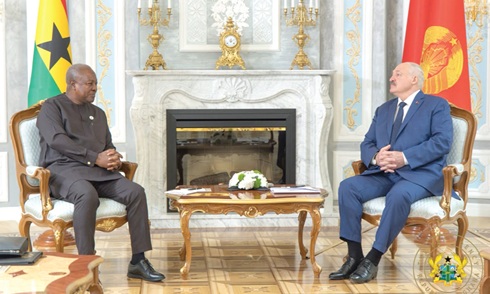
President John Dramani Mahama has secured a major procurement arrangement with Belarus for the supply of 1,840 pieces of agricultural equipment.
Addressing the first-ever Belarus-Ghana Business Forum in the capital, Minsk, yesterday, the President described the deal as a practical example of deepening economic ties between the two nations, and called on the private sectors of both countries to move beyond diplomatic cordiality and forge lasting commercial partnerships.
“We are gathered here not merely to exchange ideas but to create opportunities, to forge partnerships and to lay the foundations for a new chapter in Ghana-Belarus cooperation,” President Mahama told a gathering of business leaders, investors and policymakers.
The President, who is on a state visit to Belarus, said the two economies were “highly complementary”, with Belarus possessing strengths in agricultural mechanisation, industrial manufacturing, fertiliser production and pharmaceuticals, while Ghana offered political stability, natural resources and strategic access to African markets.
The President was accompanied by the Ministers of Foreign Affairs, Samuel Okudzeto Ablakwa; Food and Agriculture, Eric Opoku; the Special Aide to the President, Joyce Bawa Mogtari, the Deputy Chief of Staff, Operations, Stan Xoese Dogbe, the Deputy Presidential Spokesperson, Shamima Muslim, Presidential Staffer, Beatrice Annan, senior government officials and representatives of the private sector.
Economy on recovery path
President Mahama used the forum to showcase Ghana’s economic turnaround since his administration assumed office in January 2025.
He reiterated the country’s economic turnaround story, backing it with macroeconomic figures, including inflation dropping sharply from about 54.1 per cent in 2023 to 3.4 per cent in 2026 and strengthened international reserves position from $8.6 billion in 2024 to $13.9 billion in 2025.
“Investor confidence has returned,” President Mahama said, adding that Ghana’s Gross Domestic Product (GDP) had surpassed $100 billion, reaching $114 billion and making Ghana the eighth largest economy in Africa.
The cedi, he noted, appreciated by 46 per cent against major trading currencies in 2025, while the economy recorded growth above six per cent.
24-Hour Economy Initiative
The President outlined his administration’s flagship 24-Hour Economy and Accelerated Export Development Programme, which sought to maximise productivity, expand industrial output and position Ghana as a leading production and export hub in Africa.
“The programme is encouraging industries to operate around the clock while supporting investments in logistics, energy, transport, manufacturing and agro-processing,” he explained.
He identified agriculture as the greatest immediate opportunity for collaboration, and therefore, invited Belarusian investors to participate in commercial farming, irrigation development, greenhouse production, fertiliser manufacturing and agro-processing.
“Ghana’s fertile land, favourable climate and expanding market make it one of Africa’s most attractive agribusiness destinations,” he said.
Investment guarantees
President Mahama assured investors of Ghana’s political stability, transparent legal and regulatory systems, robust investor protection and guarantee of profit repatriation.
He reminded investors that establishing operations in Ghana would provide access not only to the domestic market of 34 million people, but also to the wider African market through the African Continental Free Trade Area, comprising 1.4 billion people.
The forum witnessed the signing of three memoranda of understanding (MoU). The first establishes a joint framework for economic cooperation, the second for cooperation in agricultural production and the third for collaboration between the chambers of commerce and trade of both countries.
The President disclosed that an agreement had also been reached for Belarusian manufacturers of mining equipment to visit Ghana as early as next week.
“The true measure of our relationship should not be the number of diplomatic exchanges that we conduct, it should be the number of businesses that we create, the jobs that we create, the technology that we transfer, and the prosperity we create for future generations,” President Mahama said.
He charged participants to leave Minsk with a determination to “transform our discussions into deals and partnerships and to transform those partnerships into projects”.

