


By Philip Tengzu, GNA
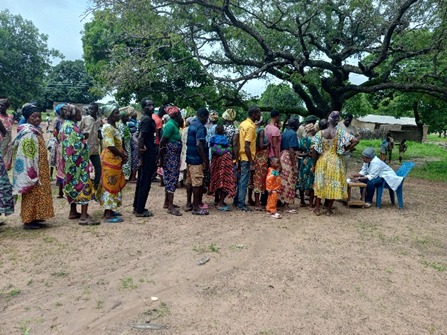
Wa, (UW/R), Dec. 28, GNA – The Blissful Sight for Kids (BS4Ks) project, a children-centred eye screening initiative, has ended the year 2025 with a free eye screening exercise for residents of Tumu in the Sissala East Municipality.
A total of 360 people, most of them children, were screened during the exercise, out of which 39 were found to have normal eyesight, while 301 presented various pathological conditions and were provided with medication.
Additionally, 16 people were diagnosed with refractive errors and given eyeglasses, while four others were found to have cataracts and glaucoma.
The BS4Ks project is an initiative of Bliss Eye Care, a private eye clinic in Wa, in partnership with Ghana Vision, a Swiss-based charity organisation, and is aimed at eradicating childhood blindness through free eye screening and early intervention.
Since its inception about a decade ago, the project has reached thousands of children in the Upper West Region and beyond, helping to address eye conditions that could hinder children’s access to quality education.
Some parents whose wards benefited from the screening exercise in Tumu at the weekend expressed gratitude to the benefactors, as access to specialised eye care services, particularly in rural communities, remained a major challenge.
Madam Niamatu Nuhu, whose daughter was screened and provided with eyeglasses, expressed joy and appreciation, and said the intervention would significantly improve her child’s vision and academic performance.
“It was her teacher who drew my attention to her eye problem. I also monitored her and realised that if she wanted to read from a book, she had to bring it closer to her eyes.
I took her to the hospital here in Tumu, but I was told they did not have the machines to detect the child’s problem,” she explained.
Madam Nuhu, however, said she was informed that a team of eye specialists would be coming to Tumu to conduct free eye screening, which she took advantage of.
Dr Zakarea Al-Hassan Balure, the Manager of Bliss Eye Care, expressed concern that some parents did not take the eye health of their children seriously and sometimes relegated it to the background even when children complained of eye problems.
“Children are always pushed to the background, and even when they complain of eye conditions, they are not taken seriously because people feel that eye diseases are more common among adults than children.
We think that once we address these conditions early, it gives the child a brighter future because he or she can learn better, see better in class, and comprehend what is happening around them”, he observed.
Dr Balure, an optometrist, encouraged parents and guardians to prioritise their children’s eye health, stressing that the eyes were irreplaceable and if damaged could negatively affect a child’s holistic development.
GNA
Edited by Caesar Abagali /Kenneth Odeng Adade