
By James Amoh Junior, GNA
Accra, Dec. 23, GNA – Traditional authorities, particularly chiefs and their judicial committees, remain central to the administration of justice in Ghana, Nii Kwabena Bonne V, Osu Alata Mantse, has said.
He said Chiefs hold significant responsibility in resolving disputes that would otherwise burden the formal courts.
The Osu Alata Mantse said traditional councils, properly constituted and functioning, had the mandate and capacity to adjudicate a wide range of customary and land-related disputes.
He stressed that many cases that ended up in higher courts were often referred back to chiefs after years of costly litigation.
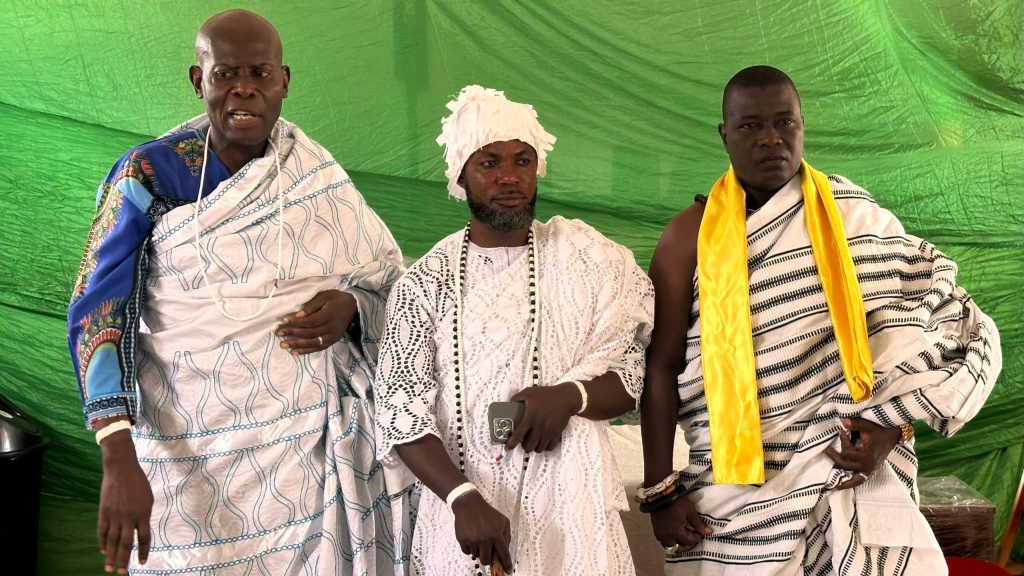
Nii Kwabena Bonne V was speaking in an interview with the GNA after the induction of Nii Nortey Otututse II and Nuumo Noi Osikan III into the Osu Traditional Council.
The two swore the Oath of Membership, Judicial Oath and Oath of Secrecy administered by Justice Bertha Aniagye.
The Osu Alata Mantse said the induction was part of efforts to strengthen the council’s capacity to sit on pending cases, following the loss of some members in recent years.

“As a traditional council, we have a lot of issues we are supposed to sit on and work on, issues that would otherwise go to the courts,” he said, noting that the law required a minimum number of members to constitute a panel for adjudication.
“With additional members, we can now sit in the required numbers and clear many of the pending cases,” he added.
Nii Kwabena Bonne emphasised that traditional councils were an integral part of Ghana’s modern justice system, pointing out that many chieftaincy and land disputes consumed years in the formal courts, drained litigants financially and emotionally, and were eventually referred back to customary authorities.
He said public education was needed to help citizens understand the mandate and jurisdiction of traditional councils, arguing that effective use of customary adjudication mechanisms could significantly decongest the courts.
The Osu Alata Mantse also highlighted the authority of gazetted chiefs, explaining that properly recognised traditional rulers could not be compelled by police to abandon their judicial duties, as their courts were legally mandated to handle specific customary matters.
Drawing comparisons, he cited the mediation roles played by eminent traditional rulers in resolving complex national disputes, saying chiefs were uniquely positioned to engage parties individually and broker consensus where formal legal processes struggled.
On land administration, he stressed that virtually all land in Ghana fell under one traditional area or another, making chiefs indispensable in land dispute resolution.
“Land issues cannot be handled effectively without reference to the traditional council,” he said, adding that criminal aspects of land disputes could go to court, but the customary ownership and authority aspects remained within the purview of chiefs.
Nii Kwabena Bonne V expressed concern that the credibility of chieftaincy had been undermined in some areas by multiple claimants to stools and skins, leading to public confusion and declining confidence in traditional authority.
He also blamed protracted land litigation in Accra partly on historical land acquisitions by the colonial administration and post-independence challenges in
restoring or properly managing such lands, urging caution among land buyers and calling for better coordination with traditional authorities.
The Osu Alata Mantse appealed to chiefs to act responsibly in land administration, warning that double sales and poor documentation were fuelling disputes and long-running court cases.
“Our forefathers were not greedy. Many lands were given freely by chiefs to families, not sold,” he said, urging contemporary chiefs to consider the welfare of future generations.
He called for renewed civic education on chieftaincy, customary law and land tenure systems, suggesting that clearer public understanding would reduce conflicts and restore confidence in traditional adjudication.
Advising the newly inducted members, Nii Kwabena Bonne V urged them to study customary law diligently and uphold fairness in their judicial roles.
“When cases come before the judicial committee, the aim should be a win-win outcome that restores harmony, not simply declaring winners and losers,” he said.
Such an approach, he noted, would encourage more people to submit disputes to traditional councils for resolution.
GNA
Edited by Christian Akorlie