
In a significant move toward modernizing its financial landscape, Ghana’s parliament has approved the Virtual Asset Service Providers (VASP) Bill, 2025, effectively legalizing and regulating cryptocurrency trading across the country.
Announced by Bank of Ghana Governor Dr. Johnson Asiama on December 19, 2025, during the central bank’s annual thanksgiving service in Accra, the new law establishes a comprehensive framework for licensing and supervising crypto platforms, bringing an already thriving informal market into the formal economy.
 “This means virtual asset trading is now legal – no one will be arrested for engaging in crypto – but we now have the framework to manage the risks involved,” Governor Asiama stated, emphasizing that the legislation prioritizes consumer protection, anti-money laundering (AML) measures, and financial stability while fostering innovation.
The bill addresses longstanding concerns over unregulated crypto activity, which has seen rapid growth in Ghana. Central bank estimates indicate that approximately 3 million Ghanaians – about 17% of the adult population – are already active in digital assets, driven by factors like remittances, hedging against inflation, and financial inclusion for the unbanked youth demographic.
Transaction volumes underscore the market’s scale: Crypto activity in Ghana reached roughly $3 billion in the year ending June 2024. While substantial, this pales in comparison to regional leader Nigeria, which recorded around $59 billion over a similar period (July 2023–June 2024, per earlier Chainalysis data), nearly twice the total for the entire Sub-Saharan Africa region in some metrics.
Ghana’s adoption, however, highlights its potential as a emerging hub, particularly for peer-to-peer and retail transactions.
The new regulatory framework empowers the Bank of Ghana to issue licenses to exchanges, wallet providers, and other VASPs, enforcing standards for cybersecurity, capital requirements, and compliance with global norms like the Financial Action Task Force (FATF) guidelines. It also aims to enhance transparency in transactions, reduce banking costs, improve customer experiences, and better serve small and medium-sized enterprises (SMEs) and traders.
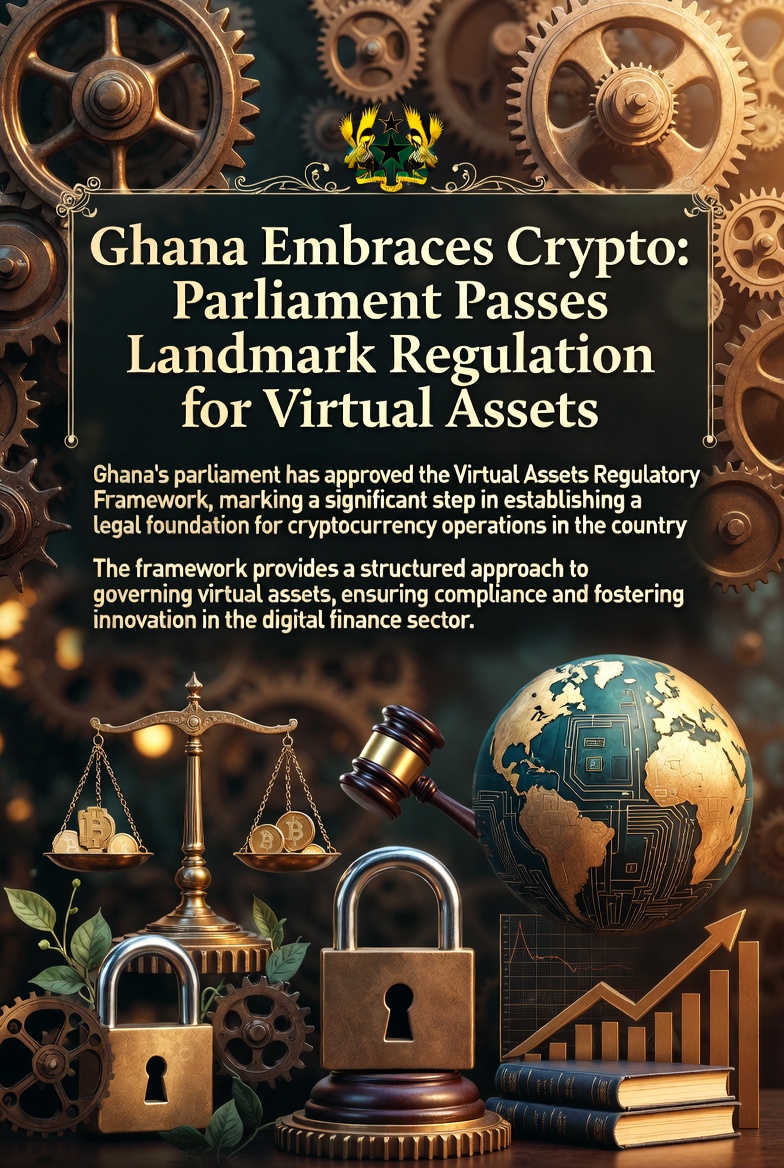 Governor Asiama noted that oversight will help mitigate risks such as fraud and volatility while supporting broader goals like financial inclusion and attracting responsible fintech investment. Cryptocurrencies remain not legal tender – the Ghanaian cedi retains that status – but trading and related services are now explicitly permitted under supervision.
This development aligns Ghana with a growing trend across Africa, where nations like Nigeria, Kenya, and South Africa are shifting from outright restrictions to structured regulation. Ghana’s approach – regulate rather than ban – could position it as a more attractive destination for crypto innovation, potentially boosting remittances (a key economic driver) and cross-border payments.
Challenges remain, including educating users on risks and ensuring effective enforcement. The central bank plans to establish a dedicated digital assets unit to monitor the sector closely.
As Africa continues to lead in grassroots crypto adoption – often driven by economic necessities like currency devaluation and limited banking access – Ghana’s proactive stance signals confidence in digital assets’ role in future growth. With the law now in place, the West African nation is poised to integrate crypto more seamlessly into its economy, balancing innovation with safeguards in an increasingly digital financial world.
 Also read:
Author: Slava Vasipenok
Founder and CEO of QUASA (quasa.io) – Daily insights on Web3, AI, Crypto, and Freelance. Stay updated on finance, technology trends, and creator tools – with sources and real value.
Innovative entrepreneur with over 20 years of experience in IT, fintech, and blockchain. Specializes in decentralized solutions for freelancing, helping to overcome the barriers of traditional finance, especially in developing regions.
This is not financial or investment advice. Always do your own research (DYOR).