
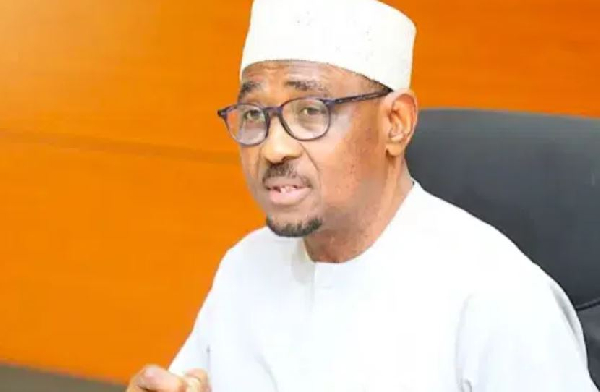

The oil and gas industry was, December 17, thrown into confusion as the chief executives of the Nigerian Upstream Petroleum Regulatory Commission, NUPRC, Engr. Gbenga Komolafe and his downstream counterpart at the Nigerian Midstream and Downstream Petroleum Regulatory Authority, NMDPRA, Engr. Farouk Ahmed resigned from their offices.
The two agencies, NUPRC and NMDPRA have the statutory responsibility of ensuring compliance with petroleum laws, regulations and guidelines in the upstream and downstream, respectively.
Engrs. Komolafe and Engr. Ahmed were appointed CEOs of NUPRC and NMDPRA in September 2021, by former President Muhammadu Buhari, following the enactment of the Petroleum Industry Act, PIA.
The two served in these positions and reported directly to President Bola Tinubu, who doubles as the Petroleum Minister until their resignations, yesterday.
The NMDPRA boss was recently dragged to the Independent Corrupt Practices and Other Related Offences Commission, ICPC, by industrialist Aliko Dangote.
Earlier on Sunday, Alhaji Dangote accused the NMDPRA leadership, headed by Ahmed, of economic sabotage, alleging that regulatory actions were undermining local refining capacity in Nigeria.
Dangote had claimed that the continued issuance of import licences for petroleum products is frustrating domestic refiners and entrenching dependence on imports.
Dangote further alleged that the NMDPRA was colluding with international traders and oil importers to the detriment of local operators, a charge the regulator has yet to publicly address.
He also raised personal allegations against the NMDPRA chief, claiming that Ahmed was living beyond his legitimate means.
Dangote alleged that four of Mr. Ahmed’s children attend secondary schools in Switzerland at costs running into several millions of dollars, arguing that such expenditure raises questions about potential conflicts of interest and the integrity of regulatory oversight in the downstream petroleum sector.
The controversy deepened on Tuesday when Mr. Dangote, through his lawyer, Ogwu Onoja, SAN, submitted a petition to the ICPC, calling for Ahmed’s arrest, investigation and prosecution.
But Ahmed on Wednesday, dismissed allegations.
He, however, explained that his children’s education overseas was funded mainly through scholarship, family support and savings over the years.
Ahmed in a statement, had said: “The allegation that I spent $5 million on my children’s Swiss secondary education is presented as evidence of corruption inconsistent with my official income. This requires factual correction.
“Three of my four children received substantial merit-based scholarships ranging from 40 per cent to 65 per cent of tuition costs, verifiable information are available to any authorised investigation. My late father, a Northern Nigerian businessman, who established education trust fund for his grandchildren before his 2018 passing, provided additional support consistent with our cultural traditions of collective family investment in education.
“When scholarships, family contributions, and my savings accumulated over three decades are properly accounted for, my personal financial obligation was entirely consistent with someone of my professional standing and length of service. My annual compensation as NMDPRA CEO, approximately N48 million including all allowances, is publicly available in our audited reports.
“Combined with legitimate savings from decades of federal employment, cooperative investments available to all civil servants, and family resources, funding my children’s education required neither corruption nor living beyond my means. I have submitted detailed asset declarations to the Code of Conduct Bureau every year since entering public service.
“Recent allegations regarding the financing of my children’s education have necessitated this response—not because I fear scrutiny of my finances, which I welcome, but because the timing and nature of these claims demand context that only three decades of public service can provide.
“Since 1991, I have dedicated my professional life to Nigeria’s petroleum sector, rising through merit and competence from a junior engineer in the Department of Petroleum Resources to my current position as Chief Executive of the NMDPRA.”
Earlier, Ahmed, yesterday evening paid a visit to the Presidential Villa, Abuja, and proceeded straight to the president’s office.
Ahmed who arrived the Presidential Villa about 5:30p.m., left the President’s office after less than 25 minutes.
At press time, there was no information whether he met with the president and if at all they met, the agenda of the meeting was not made public.
Already, President Bola Tinubu has asked the Senate to approve the nominations of two new chief executives for NMDPRA and the NUPRC.
The requests followed the resignation of Ahmed of the NMDPRA and Komolafe of the NUPRC.
To fill these positions, President Tinubu has written to the Senate, requesting expedited confirmation of Oritsemeyiwa Eyesan as CEO of NUPRC and Engr. Saidu Mohammed as CEO of NMDPRA.
Special Adviser to the President, Information and Strategy, Mr. Bayo Onanuga, who disclosed this in a statement yesterday, said: “The two nominees are seasoned professionals in the oil and gas industry.
Eyesan, a graduate of Economics from the University of Benin, spent nearly 33 years with the NNPC and its subsidiaries. She retired as Executive Vice President, Upstream (2023–2024), and previously served as Group General Manager, Corporate Planning and Strategy at NNPC from 2019 to 2023.
“Engr. Mohammed, born in 1957 in Gombe, graduated from Ahmadu Bello University in 1981 with a Bachelor’s in Chemical Engineering. He was announced today as an independent non-executive director at Seplat Energy.
“His prior roles include Managing Director of Kaduna Refining and Petrochemical Company and Nigerian Gas Company, as well as chair of the boards of West African Gas Pipeline Company, Nigeria LNG subsidiaries, and NNPC Retail.
“He also served as Group Executive Director/Chief Operating Officer, Gas & Power Directorate, where he provided strategic leadership for major gas projects and policy frameworks, including the Gas Master Plan, Gas Network Code, and contributions to the PIA.
“Engr. Mohammed played a pivotal role in delivering key projects such as the Escravos–Lagos Pipeline Expansion, the Ajaokuta–Kaduna–Kano (AKK) Gas Pipeline, and Nigeria LNG Train.”
The resignation may have ended the conflict between the Chief Executive officer of the NMDPRA, Engr. Ahmed Farouk and President and Africa’s richest man, Aliko Dangote, over issuance of import licenses to importers to import petroleum products into Nigeria.
However, in his memo, yesterday, The Dangote Refinery-NMDPRA Dispute: Beyond Commercial Disagreement to Questions of Economic Sovereignty – Senior Partner, OAL Energy and Natural Resource Practice Group, Dr. Olisa Agbakoba, said: “Nigeria now has a $20 billion refinery, one of the world’s largest, yet we continue importing petroleum products. A private investor has built the refining capacity our nation desperately needs, but faces systematic undermining from the very regulatory authority whose mandate is to support such investments.
“When government policy actively frustrates transformative local investment, we must question whether our economic strategy serves national interest or perpetuates dependency. The issues here, local refining, poverty alleviation, employment, industrial development, go far beyond commercial dispute. They touch the fundamental question of how Nigeria governs its most valuable resource.
“This situation exemplifies the conflict between two fundamentally different approaches to petroleum governance. Nigeria currently operates under “Contract Oil”: a system where petroleum is treated merely as a commodity for extraction and export, with value addition and job creation systematically externalised to foreign entities. We export raw crude only to import refined products at premium prices, perpetuating dependency rather than fostering development.
“Saudi Arabia demonstrates the alternative, “Development Oil,” using petroleum resources for comprehensive national transformation. The kingdom does not permit any operation that undermines its local capacity. This has delivered over 500 vessels in its maritime fleet, comprehensive downstream capacity including world-class refineries, and absolute control over the petroleum value chain. Nigeria operates with no such vessels despite being Africa’s largest oil producer.
“This is not merely about one refinery or one company, it is about whether Nigeria will continue the failed contract oil approach that has produced seven decades of resource curse, or embrace development oil principles that align hydrocarbon management with constitutional obligations and national development imperatives. This is a defining moment between sovereignty and dependency, between development and extractive stagnation, between constitutional compliance and commercial expediency.
“We urge all stakeholders to recognise the profound implications of this dispute and work toward a resolution that serves Nigeria’s constitutional obligations, development imperatives, and long-term national interest.”
Similarly, Wumi Iledare, Professor Emeritus of Petroleum Economics, said priotising indigenous refining will not result in monopolising the downstream market.
He said: “It can only be oligopolistic, not monopolistic. Monopolistic is a distinct market structure with low barriers to entry and is inherently anti-competitive. That is not the case here. I am certain Dangote is not seeking to be a monopolist. Monopoly is not even good for business sustainability.”