
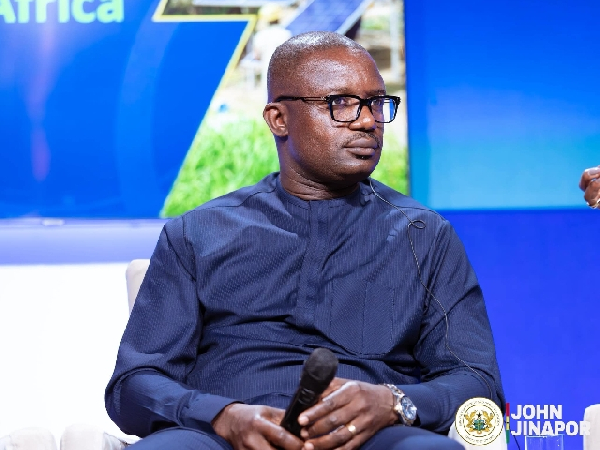

Minister for Energy and Green Transition, John Abdulai Jinapor, has urged West African governments to accelerate efforts toward a fully interconnected regional power system, arguing that the future of the sub-region’s energy security depends on deeper cooperation, harmonised regulation, and coordinated investment.
Expressing these thoughts at the 2025 West Africa Energy Cooperation Summit in Accra, Jinapor stated that the region can no longer afford fragmented approaches that isolate national utilities and increase system-wide costs.
Addressing colleagues, regulators, and private-sector operators, he said West Africa must “move with urgency towards a fully interconnected, interoperable, and inclusive energy system,” warning that years of working in isolation had weakened resilience and restricted economic growth.
He stated that integration remained the most viable route to delivering reliable, affordable power to households and industry.
“For too long, our energy systems have operated in isolation, undermining our collective resilience. Today, we must move with urgency towards a fully interconnected, interoperable, and inclusive energy system,” he said.
The minister’s appeal comes as Ghana positions itself as a central hub for power distribution within the Economic Community of West African States (ECOWAS). He argued that by aggregating the Gross Domestic Products (GDP) of member states, the region could negotiate more favourable financing terms for infrastructure than any single nation could achieve alone.
The economic logic presented by Mr. Jinapor rests on the complementary nature of regional demand cycles. He noted that peak demand periods in Ghana often coincide with off-peak periods in Nigeria due to differing industrial and festive calendars, creating a natural arbitrage opportunity. “In times when we need more, and they have less, we can take that from them,” he explained.
The minister highlighted a landmark achievement in November 2025, when the West African Power Pool (WAPP) successfully conducted a four-hour synchronisation trial linking the Ghana–Togo–Benin network with Nigeria at the Sakete substation in Benin. The trial represented the first time the entire regional grid had operated as a single system, marking what he described as “a significant leap towards our regional power market.”
According to him, the exercise demonstrated both the technical feasibility and economic potential of deeper interconnection. Data from the trial are now being analysed to inform a permanent synchronisation strategy, which officials say will pave the way for real-time power trading, shared grid services, and more efficient utilisation of generation assets across West Africa.
Jinapor said the achievement “reminds us of what is possible when countries commit to integration,” adding that a fully unified grid is no longer aspirational but “within reach if governments sustain political will and regulatory discipline.”
The Ghanaian minister placed this cooperation within a broader continental context, noting that energy will play a decisive role in the success of the African Continental Free Trade Area (AfCFTA) and the African Single Electricity Market (AfSEM).
He argued that cross-border manufacturing, logistics, and digital innovation cannot expand without dependable and competitively priced power.
“AfCFTA and AfSEM must go hand-in-hand,” he said, calling for standardised grid codes, coordinated investment planning, and bankable regional power purchase agreements to support industrial clusters and enable scale.
During a Ministers Roundtable—moderated by Kweku Awotwi, Co-Founder & Director, Cenpower Generation, under the theme: ‘Maximising the Power of Regional Collaboration to Scale up Energy Development’— Jinapor outlined Ghana’s domestic reforms, positioning the country as a stable and commercially reliable partner for regional integration.
He pointed to recent improvements in liquidity, including a sharp increase in payments to independent power producers and greater reliance on natural gas to stabilise generation. The government’s renewed commitment to competitive procurement and its plan to add over 1,200MW of solar capacity, he said, would reinforce Ghana’s ability to serve as a dependable node within the emerging regional market.
Mr. Jinapor was candid about the costs of reliable energy, defending recent tariff adjustments and aggressive revenue collection measures.
He revealed that payments through the cash waterfall mechanism—the system used to distribute revenue to value-chain stakeholders—have surged from GH₵6 billion to over GH₵15 billion this year. Consequently, Independent Power Producers (IPPs) are now receiving full payment for their invoices, a marked improvement from the 35 to 40 per cent recovery rates of previous years.
“There are no shortcuts. If you pretend to subsidise, you can’t pay it… If you want a reliable supply of power, you have to be honest, you have to be firm, and you must do what is right,” Mr. Jinapor warned.
Regional counterparts expressed complementary priorities while acknowledging that the viability of this regional market relies heavily on Nigeria, the region’s largest economy and gas producer.
Nigeria’s Minister of Power, Adebayo Adelabu, confirmed that Africa’s most populous nation is undergoing a significant infrastructure overhaul to meet these regional aspirations.
Adelabu reported that Nigeria’s installed generation capacity has risen to over 14 gigawatts (GW) in the last two years, with transmission capacity currently at 8,500 megawatts (MW). Under the Presidential Power Initiative, often referred to as the Siemens Project, Nigeria targets a transmission capacity of 15,000 MW by 2028.
“If Nigeria can be fixed, the entire West Africa will be fixed,” Mr. Adelabu told the summit. He added that the country had reduced grid collapses from nearly a dozen annually to a single minor disturbance this year, signalling the stability required for reliable cross-border trade.
The benefits of integration were corroborated by smaller markets in the bloc. The Gambia’s Minister of Petroleum, Energy & Mines, Nani Juwara, noted that interconnection with Senegal and Guinea had transformed energy access in his country, shifting communities from 14 hours of power daily to 24-hour availability.
“It used to be power cuts on a daily basis before we were interconnected with Senegal. In some parts of the country, they only enjoyed power for less than 14 hours a day. But when we got interconnected with Senegal on the eastern part, we are now able to provide 24-hour electricity supply to those communities for the first time.”
Similarly, Liberia reported stability improvements following the completion of the CLSG transmission line connecting Côte d’Ivoire, Liberia, Sierra Leone, and Guinea.
“Increasingly, we are seeing the benefits of cooperation across the region, and we are working towards seeing it deepened,” Deputy Minister of Mines & Energy of Liberia, Charles Umehal, said.
The ministers all agreed that while infrastructure is being built, the regulatory and market frameworks must now catch up to allow for efficient, real-time energy trading.