
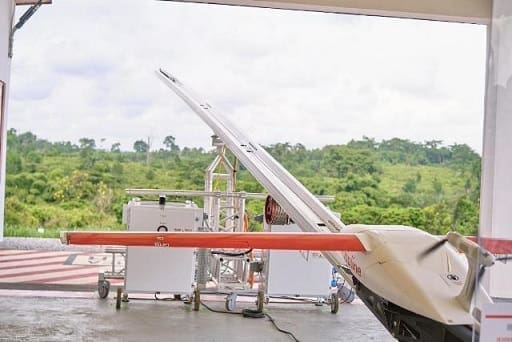


Health Minister Kwabena Mintah Akandoh publicly addressed mounting concerns about Ghana’s financial commitments to Zipline, revealing that only 16 percent of drone deliveries align with the contract’s original emergency and hard to reach mandate.
Speaking at the Government Accountability Series on Monday, December 1, 2025, Akandoh disclosed that hard to reach areas constitute merely 12 percent of Zipline’s activities while emergency services account for just 4 percent of all flights. The figures raise questions about the government’s monthly expenditure exceeding $500,000 under a take or pay contract signed in 2018 and implemented in 2019.
The Minister revealed Ghana pays $88,000 monthly per center regardless of delivery volume. With six operational centers nationwide, monthly costs total more than half a million dollars for services extending beyond the original emergency focused mandate. The contract structure requires payment even when deliveries are not made.
Akandoh detailed items being transported by the advanced aerial platform, arguing standard couriers could handle logistics far more cheaply. Transported items include condoms, blood donor cards, mosquito nets, food and nutrition supplies, adhesive tapes, syringes and needles, educational materials including textbooks, exercise books, and school uniforms.
The delivery of school uniforms, textbooks, and donor cards by a service contracted for medical emergencies underscores inefficiency given high operational costs associated with drone technology. The Minister stated these facts raise legitimate concerns about value for money.
The Ministry confirmed meeting with Zipline on more than three occasions and remains committed to ongoing discussions following presidential directive that all public spending must deliver clear value. Akandoh emphasized the government is renegotiating terms and assured the public would be kept informed of outcomes.
The financial debate has led to tangible consequences. Three Zipline centers at Sefwi Wiawso in Western North Region, Krachi in Volta Region, and Anum in Eastern Region have commenced partial suspension due to delayed payments. The reported outstanding debt totals GH¢175 million, with centers closing beginning November 25, 2025.
New Patriotic Party (NPP) Member of Parliament for Effiduase Asokore Dr Nana Ayew Afriye, Ranking Member of the Parliamentary Health Committee, informed Parliament during 2026 budget debate that the debt had crippled centers’ ability to continue supplying blood products and essential medicines to remote communities.
Despite payment disputes, proponents strongly assert the drone service has delivered tremendous public health benefits, particularly rapid delivery of blood and essential drugs crucial in locations where poor roads impede ground transport. Zipline currently operates distribution centers strategically covering vast geographical areas to ensure critical supplies reach approximately 2,000 health facilities.
The partnership launched in Ghana in 2019 utilizes autonomous drones to deliver medical supplies including blood products, vaccines, and emergency medicines to remote health facilities. Ghana was among the first African countries to fully integrate this sophisticated technology into national healthcare logistics chains.
Zipline marked a milestone of 1.6 million drone deliveries in Ghana, strengthening health logistics capabilities. A study found Zipline and Ghana Health Service reduced maternal mortality in Ashanti Region by 56.4 percent, demonstrating significant impact in specific contexts.
Majority Leader Mahama Ayariga has been vocal critic, describing the entire drone delivery scheme as mismanagement of public funds that has utterly failed to provide value for money. The government faces pressure to either re engineer the Zipline contract to strictly enforce its mandate or terminate the agreement entirely.
When pressed on whether the government would cancel the contract, Akandoh maintained careful deliberation stance, noting engagement process remains active. Whether or not to cancel Zipline, we have not gotten to that point yet, he stated, emphasizing ultimate decisions will balance undeniable efficiency in emergency and remote settings against financial sustainability.
Earlier in 2025, health sector stakeholders warned shutdowns could seriously endanger vital medical supply chains relied upon by remote communities dependent on drone logistics. The Ministry stressed despite public scrutiny and parliamentary pressure, termination decision has not been reached.
Akandoh used the platform to highlight positive reforms across the health sector backed by billions in investment. Following structural reforms, National Health Insurance Scheme (NHIS) coverage increased from 18 million to approximately 20 million people in under a year, indicating public trust in revitalized services.
After government uncapped NHIS funding, payments to service providers resumed promptly, effectively restoring provider confidence. The government announced 120 percent NHIS tariff increase for healthcare providers starting 2026 to combat unrealistic rates that had strained the system.
Looking ahead to 2026, Akandoh announced free primary healthcare introduction backed by GH¢1.5 billion intervention fund. The initiative will focus on preventive, promotive, and early detection services under NHIS coverage. To combat rising non communicable diseases including cancer, hypertension, and diabetes, Ghana Medical Trust Fund popularly known as Mahama Cares has been activated with GH¢2.3 billion and has begun supporting patient care.
Addressing workforce concerns, the Minister stated 13,500 nurses have been placed on government payroll this year while 700 medical doctors are being deployed across the country, especially to underserved districts. Government has cleared arrears, paying GH¢500 million in nursing training allowances with additional GH¢231 million scheduled for release in early December.
The controversy has drawn attention to broader questions about public private partnerships in healthcare delivery. Some public health experts and political figures argue costs could be better invested in strengthening traditional logistics infrastructure like cold chain vehicles and improved road networks.
The Minister’s presentation offered dual picture: a sector undergoing massive, well funded reforms in coverage and staffing yet simultaneously struggling under heavy, non negotiable financial weight of legacy contracts like the Zipline drone service arrangement.
During ministerial vetting in January 2025, Akandoh expressed concerns over previous government’s claim it would not take money from coffers to pay for services provided by Zipline Technology. He described it as fantastic policy but indicated plans for further inquiry into contract regarding service provisions.
The partnership has faced criticism primarily concerning long term costs. The take or pay structure binds government to continuous payments regardless of utilization levels, creating ongoing financial obligations during periods of reduced demand or operational adjustments.
Zipline operates multiple distribution centers including facilities in Western North, Volta, Eastern, Ashanti, and other regions. The company sought expansion to serve both public and private sectors, announcing plans to establish a seventh center before the current financial disputes emerged.
The government review examined both operational and financial aspects of the agreement as part of commitment to prudent public spending. Officials emphasized review aims to ensure taxpayer money achieves maximum health outcomes rather than funding services that could be delivered through less expensive alternatives.
The contractual viability scrutiny comes as Ghana implements broader fiscal consolidation measures following completion of domestic debt restructuring program. The government seeks to optimize spending across all sectors while maintaining essential service delivery to citizens.
Zipline’s entry into Ghana represented pioneering use of drone technology for medical supply delivery in Africa. The platform garnered international recognition and served as model for similar initiatives across the continent. However, implementation challenges and cost effectiveness questions have tempered initial enthusiasm.
What began as revolutionary logistics solution has evolved into complex debate balancing technological innovation, public health needs, fiscal responsibility, and contract enforcement. The outcome of ongoing negotiations will significantly impact Ghana’s future medical supply logistics and set precedents for technology driven health interventions.
The Minister’s revelations have sparked national conversation about appropriate uses of advanced technology in resource constrained settings. While emergency medical supply delivery via drones offers undeniable advantages in specific scenarios, questions persist about whether current deployment maximizes value relative to substantial ongoing costs.
As negotiations continue, stakeholders await clarity on whether revised terms can align Zipline operations more closely with original emergency mandate while reducing financial burden, or whether fundamental contract restructuring or termination becomes necessary to achieve fiscal sustainability and value for money.