
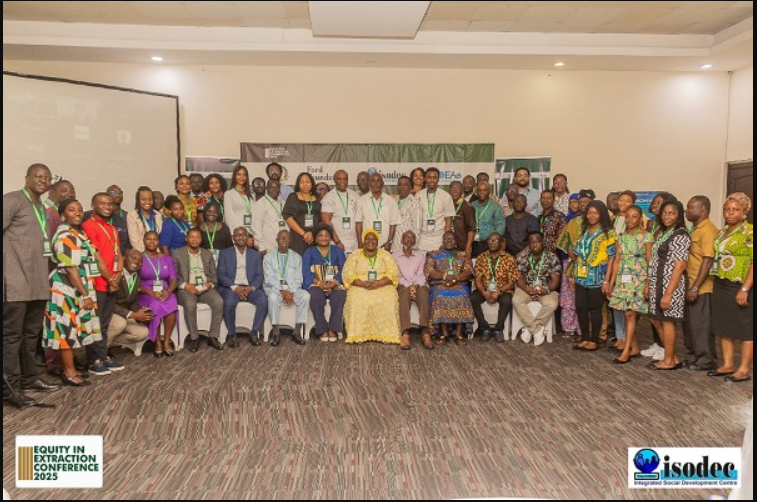

West African states must leverage the rising global demand for critical minerals to drive the sub-region’s development, the Integrated Social Development Centre (ISODEC) has urged.
According to the civil society organisation, the increasing demand for minerals such as cobalt, lithium, manganese, nickel and rare earth elements, key inputs for low-carbon technologies, presented a significant opportunity for industrialisation across West Africa.
ISODEC made the call in a communiqué issued at the end of the High-Level West Africa Conference on Equity in Extraction: Addressing Inequalities in Natural Resource Governance, Critical Minerals and Climate Change, held in Accra.
The three-day conference, convened in partnership with IDEAs and the National Development Planning Commission, with support from the Ford Foundation, brought together academics, policymakers, labour representatives, civil society actors and traditional authorities to deliberate on how Africa’s mineral wealth can be harnessed more equitably and sustainably.
Participants observed that the soaring global demand for critical minerals offers both opportunities and risks for West African countries.
While the minerals are central to the global shift towards renewable energy, longstanding governance gaps, weak environmental protections and inequitable revenue distribution continue to undermine the region’s ability to benefit from its vast resources.
Climate change, they warned, further heightens vulnerabilities and complicates the governance of extractive industries.
Reaffirming the sovereign rights of states to manage their natural resources, the conference delegates adopted a set of principles to guide national and regional action.
Those include promoting equity and intergenerational fairness, ensuring transparency and accountability, embedding rights-based governance that respects Free, Prior and Informed Consent (FPIC), and safeguarding environmental integrity.
The communiqué also underscored the importance of regional cooperation to curb illicit financial flows, harmonise legal frameworks and maximise collective benefits.
Among a raft of recommendations was the urgent need for West African governments to develop or update national mineral strategies that integrate climate resilience, set clear targets for value addition, and establish equitable fiscal regimes.
The delegates emphasised that mineral extraction must support industrial development, technology transfer and skills enhancement rather than perpetuate dependency on raw mineral exports.
On artisanal and small-scale mining (ASM), the conference called for inclusive formalisation processes that provide miners with technical support, safety standards, market access and gender-responsive assistance.
Participants noted the need for robust grievance mechanisms, enforceable community benefit agreements, and a defined share of mineral revenues dedicated to local development funds focusing on education, health, livelihoods and climate adaptation.
To strengthen accountability, the communiqué urged ECOWAS and the African Union to accelerate efforts toward a regional traceability mechanism for critical minerals. Member States were encouraged to publish contracts, revenues and environmental monitoring data as part of strengthened transparency measures.
The conference also recommended the establishment of a West Africa Steering Committee on Equitable Mineral Governance to coordinate implementation, monitor progress and prepare annual reports. Delegates further called for regional centres of excellence to support technical training, environmental monitoring, geological data management and contract negotiation.
ISODEC and its partners stressed that the governance of critical minerals would significantly shape West Africa’s economic transformation and its role in the global energy transition.
They urged the African Union, ECOWAS, Member States, development partners and private sector actors to act swiftly and collaboratively to ensure that the region’s mineral wealth delivers sustainable, inclusive and climate-resilient development for present and future generations.
BY KINGSLEY ASARE