
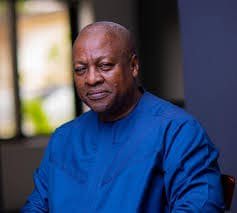

John Dramani Mahama is reportedly facing increasing pressure from within his party, the National Democratic Congress (NDC), to launch a formal investigation into the operations of the Office of the Special Prosecutor (OSP). According to sources, influential party figures are dissatisfied with what they see as the Office’s under-performance and possible mismanagement, and are urging the President to act potentially by dismissing the current Special Prosecutor and installing someone perceived as more competent.
A citizen‐submitted petition has already been delivered to the President, alleging that the OSP has engaged in extravagant spending and mis-use of public funds, thereby warranting external scrutiny. Critics say that the very institution tasked with fighting corruption must itself be accountable.
Against this backdrop, the critical question emerges: can President Mahama legitimately investigate and perhaps remove a Special Prosecutor who is both a close personal friend and was responsible for exonerating him in the Airbus scandal in 2024?
Historical Background of the OSP
The Office of the Special Prosecutor was established under the Office of the Special Prosecutor Act, 2017 (Act 959 of 2017), which was passed by Parliament and came into effect in early 2018.
The object of the Act is to investigate and prosecute specific cases of corruption and corruption-related offences involving public officers, politically exposed persons and private sector actors; to recover the proceeds of corruption; and to take steps to prevent corruption.
The OSP formally began operations in 2018.
Its mandate includes investigation, prosecution, asset recovery/management, and prevention of corruption.
Because of the OSP’s independent status and unique powers (including police‐type investigation powers and prosecutorial authority under the Attorney-General’s oversight), it was designed to fill gaps in Ghana’s anti-corruption framework.
According to the OSP’s own documents, by 2023 the Office was handling over 70 active investigations and had recovered proceeds exceeding one million Ghana cedis (GHS).
The Act also provides a mechanism for removal of the Special Prosecutor: if a petition is received, the President must refer it to the Chief Justice, who then sets up a committee to assess whether there is a prima facie case; this committee then makes recommendations to the President. But even before the president proceeds a new Chief Justice has not been vetted by Parliament after the Existing Chief Justice was forcibly removed by the president
The Petition & Political Dynamics
On 28 October 2025 the Coalition for Integrity in Governance‑Ghana (COFIIG) officially petitioned President Mahama to remove the current Special Prosecutor, Kissi Agyebeng, arguing that the Office lacked transparency, accountability and value for money.
The petition referenced alleged misuse of resources and demanded investigation into OSP’s expenditure and operations. (The publicly available summarised note of the petition does not list all details, so further specifics may be contained in the document submitted to the Presidency.)
The political nuance is significant: Agyebeng is viewed as an ally of the current Attorney-General, Dr Dominic Ayine. The fact that he had previously exonerated Mahama in the Airbus scandal (by declaring him “Government Official One” but clearing him of criminal liability) adds complexity to any proposed investigation by the President.
Internal dynamics within the NDC suggest some senior members feel the OSP has not performed to expectations and assert that replacing its leadership would enhance credibility and efficacy
Key Legal & Constitutional Considerations
Under Act 959, the Special Prosecutor may only be removed for stated misbehaviour, incompetence, incapacity, willful violation of the oath of office, or conduct prejudicial to the economy or security of the State. The removal process demands adherence to the statutory procedure (petition → Chief Justice → committee → recommendation → President).
While the President has the formal power to act on the committee’s recommendation, he cannot unilaterally sack the Special Prosecutor outside of that process without raising serious constitutional and institutional-integrity concerns.
The fact that the Office handles politically exposed persons and high-level public officers heightens the need for transparency, fairness, and procedural propriety.
Implications & Strategic Options for President Mahama
If Mahama proceeds to investigate the OSP, the process must be entirely in line with Act 959—where any removal must be preceded by the prescribed petition/committee pathway—to avoid accusations of political interference.
Given the close personal and political links between Mahama, Ayine and Agyebeng, there is a heightened risk of perceptions of conflict of interest, bias, or even retribution. Public trust could be significantly impacted either way.
Alternatively, Mahama might opt for a forensic audit or independent inquiry into OSP expenditures rather than immediate removal of the Special Prosecutor. This could signal accountability without appearing to override the independence of the institution.
The internal pressure within the NDC suggests that Mahama must balance loyalty and political alliances with the party’s demand for reform and performance. How he navigates this will speak to his leadership on governance, accountability and internal party discipline.
The petition lodged against the OSP adds real momentum to calls for scrutiny. Historically, the OSP was created as a cornerstone in Ghana’s anti-corruption architecture and endowed with strong legal protections to preserve its independence.