


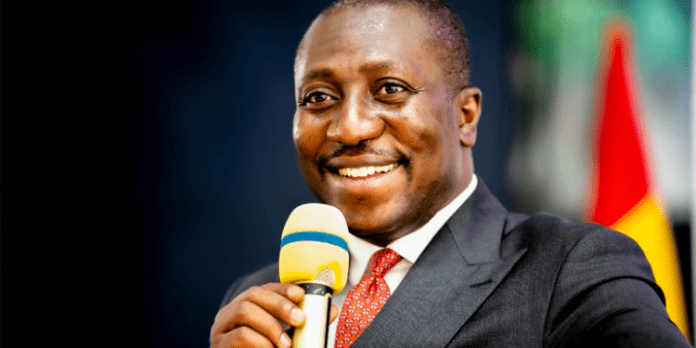
Parliamentary Minority Leader Alexander Afenyo-Markin has condemned what he termed the destructive “I do you, you do me” culture in Ghanaian politics, urging leaders to abandon personal vendettas in favor of policy-focused governance that addresses citizens’ needs.
Speaking at the Young Commons Forum (YCF) Summit held at the University of Education, Winneba (UEW) Central Campus on Friday, September 19, 2025, Afenyo-Markin criticized the persistent pattern where incoming governments prioritize persecuting political opponents over implementing campaign promises.
The Effutu Member of Parliament (MP) described the cycle as counterproductive to national development, explaining that politicians often believe targeting opponents will enhance their popularity rather than focusing on manifesto implementation. “Unfortunately, that mindset has kept Ghana’s progress far behind,” he told the student gathering.
Afenyo-Markin delivered his keynote address under the theme “Empowering Next Generation For Leadership and Nation-Building,” emphasizing that Ghana’s future depends on youth energy and resolve rather than politicians alone. The lawmaker has been actively championing youth empowerment initiatives through various forums across educational institutions.
The criticism reflects broader concerns about political governance patterns where successive administrations reportedly focus on investigating predecessors rather than advancing development agendas. This approach has drawn criticism from civil society organizations and political analysts who argue it impedes institutional continuity and policy implementation.
During his address, Afenyo-Markin challenged students to position themselves as solutions to national challenges rather than passive observers. He warned that continuing current practices would leave future generations with “a Ghana of regrets” unless leaders embrace integrity and genuine commitment to development.
The Minority Leader advocated for politics to serve as a development vehicle rather than a score-settling mechanism. He called for next-generation leaders to prioritize policy innovation and national interest over partisan rivalries that have characterized Ghana’s political landscape.
Afenyo-Markin cited international examples of youth-driven transformation, highlighting South Korea’s transition from poverty to prosperity through technological empowerment. Singapore’s rise to global economic prominence through education and innovation investment also featured in his examples of successful youth mobilization.
African success stories included Ethiopia’s progress in aviation and renewable energy sectors, alongside Kenya’s leadership in mobile money and fintech through innovations like M-Pesa. These examples demonstrated how youth creativity combined with opportunity and support can drive nation-building efforts.
The Young Commons Forum represents part of Afenyo-Markin’s broader youth engagement strategy across Ghanaian universities. Recent events have included sessions at University of Professional Studies, Accra (UPSA) focusing on transparency, social media responsibility, and corruption resistance.
Political observers note that Afenyo-Markin’s youth-focused messaging aims to differentiate opposition approaches from traditional partisan politics. His emphasis on technological innovation and global competitiveness aligns with contemporary discussions about Ghana’s development trajectory.
The Minority Leader’s critique of political persecution cycles resonates with ongoing debates about governance accountability and institutional effectiveness. His call for policy-focused leadership reflects growing public dissatisfaction with political approaches that prioritize conflict over progress.
Educational institutions have become key venues for political engagement with emerging voters, with leaders across party lines recognizing youth influence on democratic outcomes. University forums provide platforms for discussing governance issues beyond traditional partisan frameworks.
Afenyo-Markin’s message emphasizes collective responsibility for democratic progress, positioning youth as active participants in shaping national direction rather than passive beneficiaries of political decisions made by older generations.
The summit continues broader discussions about leadership development and civic participation among university students who will influence Ghana’s political future through their professional contributions and electoral participation in coming years.